

Zigbee vs. Z-Wave Dubai: Choosing the Best Smart Home Protocol in 2026

The most expensive smart home hardware on the market will still fail if it's fighting a losing battle against Dubai's concrete architecture. While many users prioritize brand names, the real victory in home automation is won at the frequency level. You've likely experienced the annoyance of a smart bulb that refuses to respond or a security sensor that drops offline in a crowded high-rise. This isn't usually a hardware flaw. It's often a protocol mismatch.
Understanding the nuances of zigbee vs z-wave dubai is the key to building a lag-free, reliable system that overcomes Wi-Fi congestion and reinforced masonry. You deserve a "set-it-and-forget-it" automation system that provides both emotional reassurance and functional excellence. This guide provides the technical clarity needed to choose a future-proof setup that integrates with Matter and maintains stable climate control to lower your energy bills. We will break down TDRA-compliant frequencies, the impact of Zigbee 4.0, and why Z-Wave's 868.4 MHz signal remains a strategic choice for penetrating the thick walls of UAE villas.
Key Takeaways
- Understand why Z-Wave's 868.4 MHz frequency offers superior signal penetration through Dubai’s reinforced concrete walls compared to higher-frequency alternatives.
- Learn how to eliminate system lag in high-density areas like Dubai Marina by offloading smart devices from crowded 2.4 GHz Wi-Fi bands.
- Compare the technical specifications of zigbee vs z-wave dubai to determine which protocol best supports high-node lighting systems versus high-security door locks.
- Discover how new Matter and Thread standards integrate with your existing hardware to ensure a future-proof automation investment.
- Identify why a professional hybrid integration using a multi-protocol smart hub gateway provides the most reliable foundation for a stable, long-term system.
Understanding Smart Home Protocols in the Dubai Context
Smart home success depends on the underlying communication language. Zigbee and Z-Wave are the two primary low-power mesh networking standards designed to replace unstable Wi-Fi connections. In the specific context of zigbee vs z-wave dubai, relying solely on a standard router often leads to severe network congestion. Dubai high-rises are saturated with 2.4 GHz and 5 GHz Wi-Fi signals from every neighboring apartment. This overcrowding causes interference, leading to delayed responses or failed commands for your smart lighting or climate control.
A dedicated smart hub gateway serves as the central brain of this operation. It manages these specialized protocols, offloading traffic from your home internet. Because Zigbee and Z-Wave use very little energy, they significantly extend the battery life of motion sensors and water leak detectors. These devices remain in a low-power "sleep" state until needed, waking up instantly to transmit data with millisecond precision.
The Concept of Mesh Networking
Unlike traditional Wi-Fi where every device connects to a central router, mesh networks allow devices to communicate with each other. Every mains-powered device, such as a smart plug or a curtain motor, acts as a signal repeater. This creates multiple paths for data to travel. If one device is blocked by a heavy piece of furniture, the signal simply reroutes through another node. In the zigbee vs z-wave dubai debate, this means your network actually becomes more resilient as you add more hardware. While Zigbee uses a "mesh" approach that allows many paths, Z-Wave utilizes a structured routing table to ensure the most efficient path is always prioritized.
TDRA Regulations and UAE Frequencies
Precision in frequency selection is mandatory for operational stability. The Telecommunications and Digital Government Regulatory Authority (TDRA) governs all wireless emissions in the UAE. For Z-Wave to operate legally and without interference, it must use the 868.42 MHz frequency. Importing hardware from North America, which typically uses 908.42 MHz, can lead to connectivity failures or regulatory issues. Rocatech ensures all integrated hardware meets these local standards, providing a stable environment where your automation works exactly as intended. Using the correct frequency avoids conflict with mobile networks and emergency services, reinforcing the long-term value of a professionally commissioned system.
Zigbee vs. Z-Wave: Technical Comparison for 2026
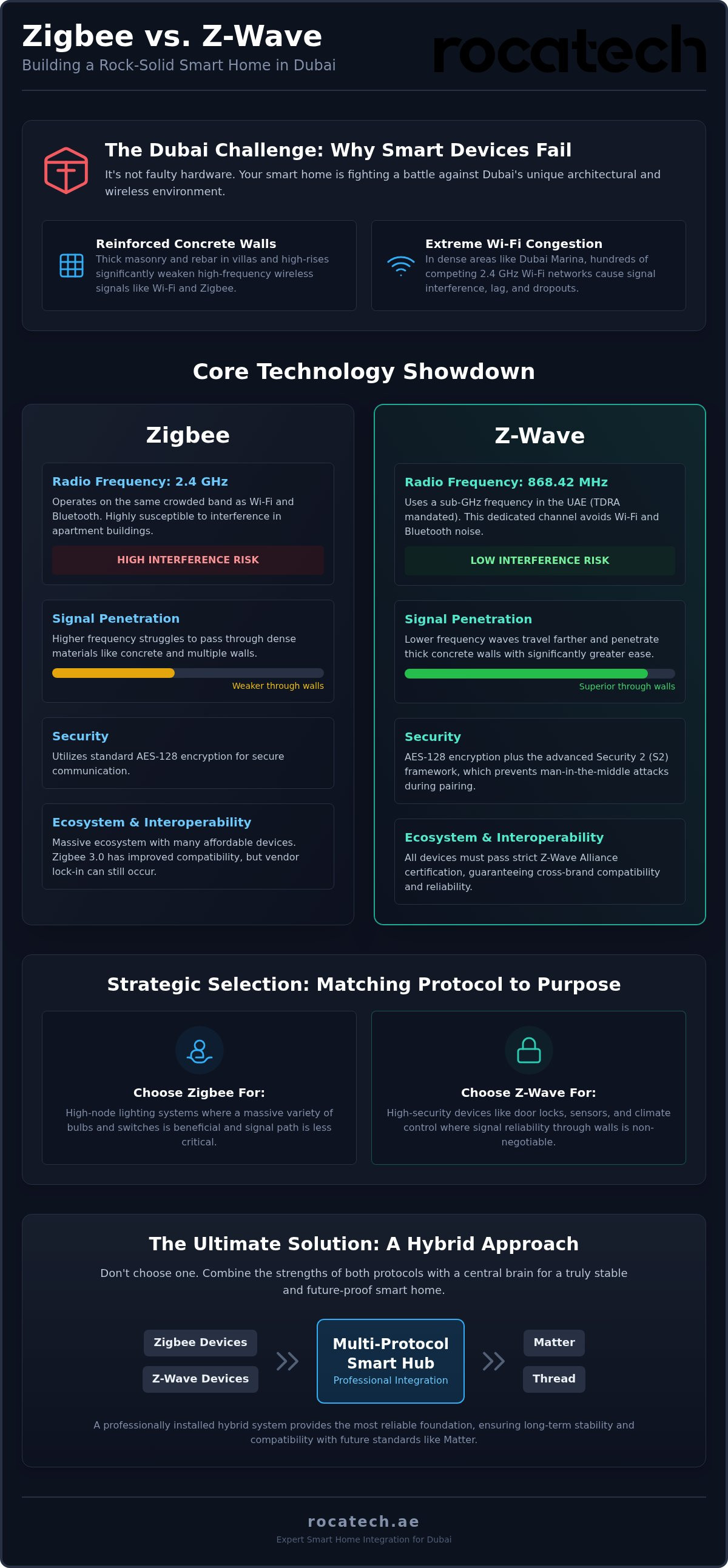
Technical specifications are the foundation of any reliable automation system. In the context of zigbee vs z-wave dubai, the most significant differentiator is the radio frequency. Zigbee operates on the 2.4 GHz band. This is a globally standardized frequency, which allows for a massive ecosystem of affordable devices. However, this band is shared with Wi-Fi and Bluetooth, increasing the risk of signal collisions in dense residential areas like Downtown Dubai. Conversely, Z-Wave utilizes the 868.42 MHz frequency in the UAE, as mandated by TDRA regulations. This sub-GHz frequency experiences significantly less interference and offers superior range for residential applications.
Security remains a non-negotiable priority for high-stakes environments. Both protocols utilize robust AES-128 banking-grade encryption to protect your data. Z-Wave goes a step further with its Security 2 (S2) framework, which requires a unique QR code or PIN for device pairing. This prevents "man-in-the-middle" attacks during the initial setup process. While Zigbee is often cited for slightly lower latency due to its faster data transfer rates, the difference is negligible for most home users. Reliability is the true metric of performance, and both protocols offer the speed required for a responsive smart home.
Interoperability and Certification
Every Z-Wave device must undergo rigorous testing by the Z-Wave Alliance to ensure cross-brand compatibility. This certification ensures that a Z-Wave sensor from one manufacturer will communicate perfectly with a hub from another. Zigbee 3.0 has made significant strides in reducing the "vendor lock-in" seen in earlier versions, but professional integration remains essential to ensure complex lighting scenes and climate triggers operate without a hitch. For those seeking maximum stability, consulting a professional smart home partner ensures that each device is correctly commissioned within the network.
The 2026 Outlook: Matter and Thread
The smart home landscape in 2026 is defined by the Matter standard. Zigbee is naturally evolving toward the Thread protocol, which uses the same 2.4 GHz radio but offers better efficiency and IP-based connectivity. Z-Wave maintains its relevance through the 800 series and Z-Wave Long Range (ZWLR), which supports up to 4,000 nodes on a single network. While Z-Wave doesn't run Matter natively, high-quality smart hub gateways act as bridges, allowing Z-Wave hardware to participate in Matter ecosystems. Investing in hardware with upgradeable firmware is vital to ensure your system adapts as these standards mature over the next decade.
Performance in Dubai Homes: Concrete, Glass, and Interference
Dubai's architectural standards present a unique challenge for wireless communication. Most residential properties utilize reinforced concrete and thick masonry, which act as significant barriers to radio signals. In the comparison of zigbee vs z-wave dubai, physics plays a decisive role in system reliability. Z-Wave’s 868.4 MHz signal utilizes longer wavelengths that wrap around obstacles and penetrate solid mass more effectively than higher frequencies. Conversely, Zigbee operates on the 2.4 GHz band, which is more susceptible to absorption by concrete and reflection by the high-performance E-glass common in luxury developments.
The "Faraday Cage" effect is a common phenomenon in Dubai high-rises. The combination of dense steel rebar within walls and metallic coatings on windows can trap signals or block them entirely. While Wi-Fi and Zigbee struggle to maintain a stable link through these materials, Z-Wave’s lower frequency often finds a path. This technical distinction is why a sensor in a far bedroom might respond instantly on one protocol while failing on another.
Overcoming Signal Blockage in Villas
Large villas in areas like Jumeirah or Emirates Hills often feature floor plans exceeding 5,000 square feet. Mapping potential "dead zones" is the first step in a professional installation. To maintain a robust mesh, we strategically place mains-powered devices, such as smart plugs or smart curtain motors, to act as repeaters. These nodes bridge the gap between the smart hub gateway and distant sensors. For perimeter security, Z-Wave Long Range (ZWLR) provides a distinct advantage, offering the ability to reach gate locks and outdoor motion sensors without requiring additional repeaters in the middle of a garden.
High-Rise Living and RF Congestion
Living in dense urban blocks like Dubai Marina or Downtown Dubai introduces the challenge of radio frequency (RF) congestion. The 2.4 GHz spectrum is often over-saturated because it’s shared by hundreds of neighboring Wi-Fi routers, Bluetooth devices, and microwave ovens. This "noise" can lead to significant latency in smart lighting control. By utilizing Z-Wave for critical commands, you move your automation traffic to a Sub-GHz "clear lane." This strategic separation ensures that your zigbee vs z-wave dubai choice results in a system that remains responsive even during peak internet usage hours in your building.
Strategic Selection: Matching Protocols to Use Cases
Assigning a protocol based on the specific function of a device is the hallmark of a professionally designed automation system. In the context of zigbee vs z-wave dubai, a blanket approach often leads to performance bottlenecks. We categorize devices by their frequency of use, data requirements, and criticality to home security. This ensures that high-traffic lighting systems don't interfere with essential life-safety sensors.
Lighting systems often require dozens of individual nodes throughout a property. Zigbee is the industry standard for these high-density applications due to its ability to support hundreds of devices on a single mesh. For critical access points, Z-Wave’s sub-GHz frequency provides the low-latency response needed for smart door locks and alarm triggers. Similarly, ensuring smart thermostats maintain a constant link is vital for managing Dubai’s extreme summer temperatures. A protocol drop here can lead to significant energy waste and thermal discomfort.
High-Node Count Systems (Lighting & Plugs)
Managing 50+ smart switches requires a mesh that doesn't buckle under high traffic. Zigbee’s faster data transmission rates make it ideal for simultaneous commands, such as "All Lights Off" scenes. This protocol is also deeply embedded in the ecosystems of Apple HomeKit and Amazon Alexa, simplifying the user experience. Because Zigbee modules are generally more compact and cost-effective, they are the preferred choice for large-scale lighting projects where volume and aesthetics are equally important. This allows for comprehensive control without the premium price tag often associated with proprietary systems.
Critical Security Infrastructure
Z-Wave’s structured routing ensures that a motion sensor or door contact signal reaches the hub without competing for airtime with a neighbor’s Wi-Fi. This protocol is specifically optimized for battery-powered devices, allowing sensors to last years even in high-heat areas like balcony entries. Its resistance to RF jamming makes it the preferred choice for high-stakes security environments where operational failure is not an option. By isolating security traffic on the 868.42 MHz band, you ensure that your security system remains functional even if your 2.4 GHz network is under heavy load. Consulting with an expert at Rocatech ensures these technical choices translate into real-world reliability for your specific property layout.
The Rocatech Advantage: Expert Hybrid Integration
Navigating the technical landscape of zigbee vs z-wave dubai requires more than just reading a spec sheet. A hybrid approach represents the gold standard for automation in the UAE. This strategy doesn't force a binary choice between protocols. Instead, it utilizes Zigbee’s efficiency for high-node lighting and Z-Wave’s penetration for critical security and climate infrastructure. This dual-protocol architecture provides the emotional reassurance that comes with a system that simply works, every time. It allows for a sophisticated interplay between devices that might otherwise remain siloed in a less engineered environment.
The value of a professional smart home installation lies in the invisible work of network commissioning. We act as a consultative partner, moving beyond retail transactions to build long-term value for our clients. Our engineers understand the mechanics of the operational floor. We ensure your system is grounded in practical, real-world application rather than theoretical performance. This results in a set-it-and-forget-it reliability that protects your investment and provides significant peace of mind for property owners.
Precision Configuration and Setup
Precision configuration involves tuning the mesh for maximum range and stability. We don't just place devices; we optimize the routing tables to eliminate dead zones caused by Dubai's unique architecture. Beyond hardware placement, we focus on security hardening and TDRA-compliant frequency management to meet local regulatory requirements. This ensures your system remains resilient against external threats and interference. We harmonize complex integrations, such as smart curtain motors and precision cooling, into a single interface. This creates a steady, predictable rhythm in your daily home operations.
Future-Proofing Your Dubai Property
Future-proofing is a strategic necessity in 2026. We prioritize smart hub gateways that support Matter, Thread, Zigbee, and Z-Wave simultaneously. This ensures your property is ready for the next decade of innovation without requiring a total system overhaul. Scalability is built into every design, allowing you to add sensors or controllers as your automation needs grow. We view our client relationships as holistic involvements in your long-term success. If you're ready to secure your property's technological future with a dependable ally, contact Rocatech Dubai for a detailed technical consultation.
Securing Your Smart Home’s Operational Future
The decision regarding zigbee vs z-wave dubai ultimately comes down to a strategic frequency plan tailored to your property's specific architecture. You shouldn't have to compromise on reliability because of the reinforced masonry walls in your villa or the intense RF congestion in a high-rise district. By adopting a hybrid architecture, you leverage the massive scale of Zigbee for lighting while utilizing the superior signal penetration of Z-Wave for critical security and climate infrastructure. This balanced approach ensures every sensor remains responsive regardless of environmental interference.
Rocatech provides the precision needed to manage these invisible protocol battles. Our specialists focus on TDRA-compliant installations and masonry-penetrating mesh networks that offer 24/7 technical reliability for high-stakes home security. We move beyond simple retail to act as your long-term consultative partner, ensuring your system is future-proof and Matter-ready. If you're ready to transition to a seamless, "set-it-and-forget-it" automation system, we invite you to Book a Professional Smart Home Consultation in Dubai. Your home's technology should be a source of emotional reassurance and functional excellence for years to come.
Frequently Asked Questions
Does Zigbee or Z-Wave work better through Dubai concrete walls?
Z-Wave generally performs better through Dubai's reinforced concrete walls. Its 868.4 MHz frequency utilizes longer wavelengths that wrap around structural obstacles and penetrate solid masonry more effectively than higher-frequency signals. While Zigbee’s 2.4 GHz signal often reflects off these surfaces, Z-Wave maintains a stable link. This makes it the preferred protocol for large villas where signal propagation through multiple rooms is a critical requirement for consistent system reliability.
Are Z-Wave devices from the US compatible with UAE hubs?
Z-Wave devices manufactured for the US market are not compatible with UAE hubs. The United States utilizes the 908.42 MHz frequency, while the UAE operates on the 868.4 MHz band as mandated by TDRA regulations. Attempting to pair a US-frequency device with a local hub will result in complete connectivity failure. For a stable zigbee vs z-wave dubai setup, you must ensure all hardware is region-specific to maintain regulatory compliance and operational harmony.
What is the frequency of Z-Wave in the UAE?
The approved frequency for Z-Wave operation in the United Arab Emirates is 868.42 MHz. This specific sub-GHz band is regulated by the Telecommunications and Digital Government Regulatory Authority (TDRA) to prevent interference with other wireless services. Using the correct frequency is essential for maintaining a lag-free network. It ensures that your smart home system doesn't conflict with local mobile networks or emergency communication channels, providing a stable foundation for your automation.
Do I need a smart hub if I use Zigbee or Z-Wave?
Yes, a dedicated smart hub gateway is essential for any professional Zigbee or Z-Wave installation. Unlike Wi-Fi devices that connect directly to your router, these protocols require a central controller to manage the mesh network and bridge communications to the internet. A high-quality hub handles the complex routing logic and ensures that your sensors and controllers respond instantly, even if your primary internet connection experiences a temporary outage.
How many devices can I have on a Zigbee mesh network?
A single Zigbee mesh network can theoretically support over 65,000 devices. However, practical installations in residential environments usually peak between 100 and 250 devices per smart hub gateway to maintain optimal response times. The actual capacity depends on the number of mains-powered repeaters in your home. Adding more smart plugs or switches strengthens the mesh, allowing for a higher density of battery-powered sensors without compromising the system's overall stability.
Will Matter replace Zigbee and Z-Wave in 2026?
Matter will not replace Zigbee and Z-Wave in 2026; instead, it acts as a unifying layer. While new devices may use Thread, millions of existing Zigbee and Z-Wave products remain in operation. Most modern hubs now include bridging capabilities that allow these older protocols to participate in a Matter ecosystem. This evolution ensures your current hardware investment remains relevant while benefiting from the improved interoperability and simplified setup that the Matter standard provides.
Can Zigbee and Z-Wave devices work together in the same home?
Zigbee and Z-Wave devices can work together seamlessly if you utilize a multi-protocol smart hub gateway. These advanced controllers are equipped with both radios, allowing you to manage a hybrid system through a single user interface. This is often the gold standard for a zigbee vs z-wave dubai strategy. It lets you choose the best protocol for each specific use case, such as Zigbee for lighting and Z-Wave for security sensors.
Why is my Zigbee lighting lagging in my Dubai Marina apartment?
Lag in dense areas like Dubai Marina is usually caused by radio frequency congestion on the 2.4 GHz band. Because Zigbee shares this frequency with hundreds of neighboring Wi-Fi routers and Bluetooth devices, signal collisions are frequent. This "noise" forces devices to retransmit data, leading to noticeable delays. Moving critical commands to a sub-GHz protocol or strategically adding Zigbee repeaters can help bypass this interference and restore the precision of your lighting control.