

Motion Sensors for Smart Lighting in Dubai: 2026 Guide

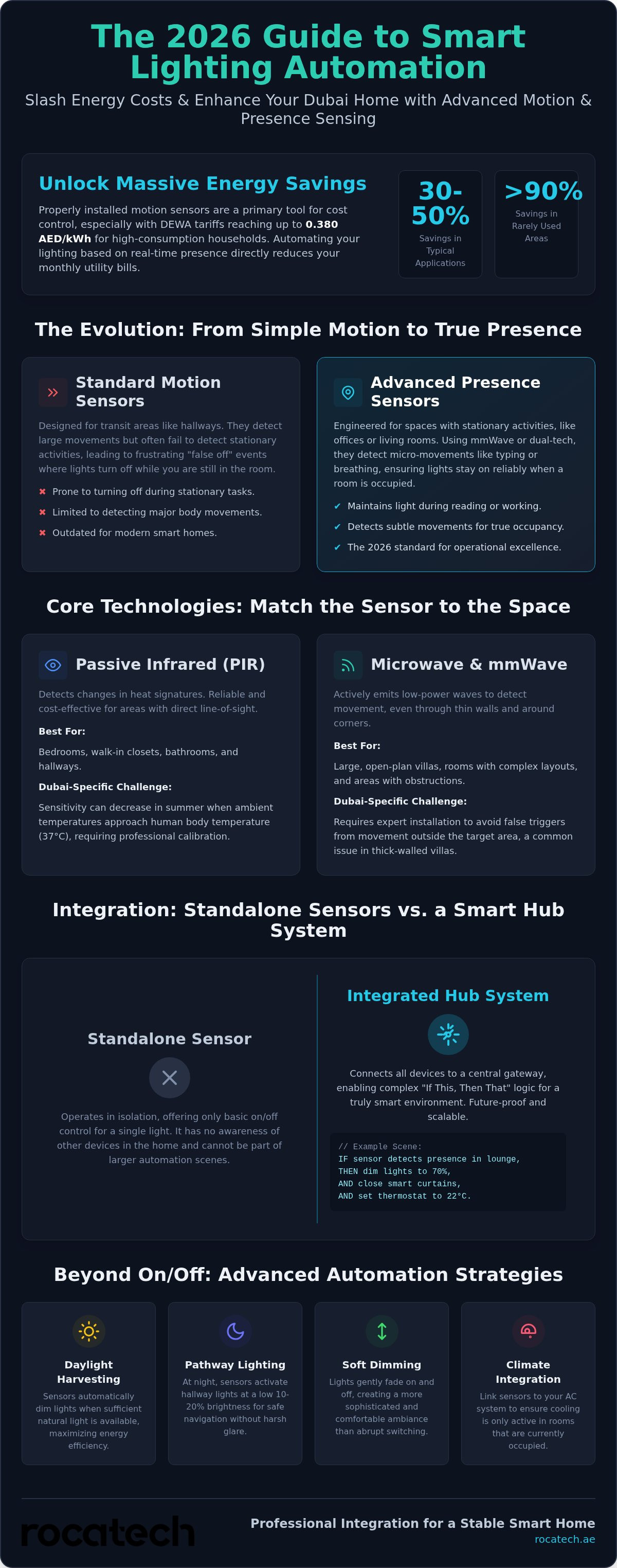
Did you know that properly installed motion sensors can lead to energy savings of 30% to 50% in typical applications, and sometimes exceed 90% in rarely used areas? For residents facing tiered DEWA tariffs that can reach 0.380 AED/kWh for high consumption, every minute a light stays on in an empty room is a direct hit to the monthly budget. Selecting the right motion sensor for smart lighting dubai requires more than just picking a device off a shelf; it's a strategic decision that demands an understanding of how hardware interacts with the unique environmental demands of the UAE.
We understand the frustration of inconsistent sensor performance in high-heat environments and the technical confusion surrounding Zigbee, Wi-Fi, and Z-Wave protocols. This 2026 guide will show you how to slash energy costs and automate your home using the latest mmWave presence detection and professional integration strategies. We will examine the transition from traditional PIR technology to advanced presence sensing, ensuring your smart lighting system provides both operational excellence and the psychological reassurance of a truly automated environment.
Key Takeaways
- Understand the technical shift from standard PIR to advanced presence sensing to eliminate false triggers and ensure lights remain active when rooms are occupied.
- Learn how a professionally configured motion sensor for smart lighting dubai can significantly reduce energy consumption and lower high DEWA utility costs.
- Discover strategic placement techniques designed for the thick-walled architecture of Dubai villas to ensure seamless coverage without signal interference.
- Explore advanced automation strategies like daylight harvesting and soft-dimming scenes that move beyond simple on-off switching for a more sophisticated environment.
- Recognize the importance of professional integration to achieve long-term system stability and ensure all wireless devices meet mandatory local regulatory standards.
The Evolution of Motion Sensors for Smart Lighting in Dubai
The modern motion sensor for smart lighting dubai has transitioned from a simple peripheral into the primary intelligence of the automated home. While early systems relied on basic infrared triggers for security, current technology serves as the brain that coordinates your entire living environment. Residents across Dubai are rapidly abandoning manual switches in favor of occupancy-based systems that anticipate their needs. This shift isn't just about convenience; it's a response to the 2026 energy landscape. With DEWA tariffs reaching 0.380 AED/kWh for high-consumption households, the ability to automate lighting based on real-time presence is a vital tool for cost control. These systems provide a seamless blend of operational efficiency and the psychological comfort of a home that reacts to your presence.
Motion vs. Occupancy: What is the Difference?
Understanding the distinction between simple motion and occupancy sensor technology is critical for maintaining system stability. Standard motion sensors are designed for transit areas like hallways or staircases where brief, high-level movement is expected. However, occupancy sensors are engineered for stationary activities, such as reading in a lounge or working in a home office. These advanced units detect subtle movements like breathing or typing, preventing the lights from turning off while you're still in the room. In the UAE, hardware durability is also a factor. Premium sensors often feature vacuum-sealed housings to protect sensitive internal electronics from fine Dubai dust, ensuring long-term reliability that open-air designs cannot match.
Why Smart Integration Beats Standalone Sensors
A standalone sensor operates in isolation, but a professionally integrated system connects every device to a smart hub gateway. This centralized control allows for complex "If This Then That" (IFTTT) logic. For instance, a sensor trigger can simultaneously dim the lights, close the smart curtains, and adjust the thermostat to a pre-set comfort level. This level of system harmony is what defines a modern Dubai smart home. By investing in a hub-based architecture, you future-proof your property for 2026 and beyond. It allows for seamless firmware updates and the addition of new devices without needing to reconfigure the entire network, maintaining a stable and scalable technical environment that grows with your needs.
Core Technologies: PIR, Microwave, and Ultrasonic Sensors
Selecting the correct motion sensor for smart lighting dubai depends on matching the specific detection technology to your home's physical environment. In high-stakes technical environments like Dubai villas, where architectural materials range from thick concrete to expansive glass, a one-size-fits-all approach leads to system failure. Engineers typically categorize sensors into three primary types: Passive Infrared (PIR), Microwave, and Ultrasonic. Each technology interacts differently with the ambient conditions of the UAE, particularly regarding temperature fluctuations and room density. Implementing these systems correctly is a proven strategy to reduce energy use and costs by ensuring lights only operate during periods of verified occupancy.
PIR Sensors: Reliability for Living Areas
Passive Infrared (PIR) technology remains the global standard for residential applications. These devices operate by detecting changes in heat signatures, specifically the infrared radiation emitted by human bodies. They're exceptionally effective for "line-of-sight" detection in bedrooms, walk-in closets, and bathrooms. However, PIR sensors face unique challenges during Dubai summers. When ambient room temperatures rise close to 37 degrees Celsius, the contrast between a human heat signature and the environment narrows, which can degrade sensitivity. To maintain reliability, professional calibration is necessary to adjust the threshold for these seasonal shifts. PIR is most stable in smaller, enclosed spaces where movement is predictable and unobstructed.
Microwave and Ultrasonic: Advanced Detection
For larger, open-plan villas or spaces with complex layouts, more active detection methods are required. Microwave sensors emit low-power electromagnetic waves and measure the reflection off moving objects. Because these waves can penetrate thin walls and glass, they're ideal for expansive living areas but require precise tuning to avoid "ghost" triggers from outside traffic or neighboring rooms. Ultrasonic sensors, conversely, use high-frequency sound waves. They're superior for partitioned offices or restrooms because the sound waves bounce around corners, detecting motion even when a direct line of sight isn't available. A common technical hurdle in Dubai is the high-velocity airflow from powerful AC units, which can inadvertently trigger sensitive ultrasonic or microwave units. Balancing this sensitivity is critical for operational harmony.
To achieve the highest level of precision, dual-technology sensors combine PIR with either microwave or ultrasonic detection. These units require both technologies to be triggered simultaneously before activating the lights. This redundancy can reduce false alarm rates by up to 85 percent, providing the emotional reassurance that your system is both responsive and accurate. If you're looking for a stable, long-term solution for your property, our team at Rocatech offers a consultative approach to professional setup that ensures your hardware is perfectly calibrated for your specific floor plan.
Strategic Placement for Dubai Villas and Apartments
Strategic positioning is the final step in ensuring system stability. Even the most advanced motion sensor for smart lighting dubai will underperform if it's placed in a "blind spot" or improperly calibrated for the room's dimensions. In large Dubai villas, mapping the detection zone involves more than just covering the floor area; it requires a three-dimensional understanding of how occupants move through the space. For example, mounting a sensor at the standard height of 2.1 to 2.4 meters provides the widest field of view while remaining high enough to avoid most pet-related triggers. When designing hallway automation, we recommend an "Entry-Exit" strategy. This involves placing sensors at both ends of the corridor to trigger a light path before the occupant enters the dark zone, ensuring a seamless transition between rooms.
Outdoor placement demands additional technical consideration. UAE environments are characterized by extreme heat and high humidity, which can degrade standard consumer-grade plastics. It's vital to use weather-rated sensors that are specifically tested for these high-ambient-temperature conditions. Proper angling is essential here to prevent the sensor from "looking" at the street. This focus avoids false triggers from passing vehicles or pedestrians, focusing instead on the immediate perimeter of the property. Precision here isn't just about convenience; it's about maintaining the integrity of your security and automation layers.
Navigating Obstacles in Dubai Villa Layouts
Dubai's architectural reliance on thick concrete and steel reinforcement creates significant challenges for wireless signal propagation. While a sensor might detect motion perfectly, its ability to communicate with the smart lighting control system can be hampered by these materials. We often use multiple sensors to navigate L-shaped corridors or large rooms with structural pillars. By overlapping detection zones, we eliminate dead spots and create a consistent "light path" that follows the user. This approach moves beyond the simple "one sensor per room" model, providing a more robust and reliable infrastructure for high-end residential properties.
Avoiding Common False Trigger Pitfalls
System reliability is often undermined by environmental factors unique to the region. PIR sensors are particularly sensitive to rapid temperature changes, making them prone to false triggers if they're too close to high-velocity AC vents. The moving air can create a thermal signature that fools the device. Similarly, floor-to-ceiling windows can introduce sunlight glare that momentarily blinds infrared sensors. We calibrate these systems with pet-immune settings that ignore movement below a certain mass or height threshold. This ensures your pets can roam freely without activating the entire smart lighting network, maintaining both energy efficiency and operational peace of mind.
Maximizing Efficiency and DEWA Savings in 2026
Integrating a motion sensor for smart lighting dubai is no longer just about turning lights off when you leave a room. It's about total environment harmony. In 2026, the focus has shifted to maximizing efficiency through daylight harvesting and intelligent dimming protocols. These systems don't just react to movement; they analyze ambient light levels in real time. If a room is flooded with natural light from large villa windows, the system keeps the artificial lighting off or at a specific dimming percentage. This nuanced approach contributes directly to the Dubai Green Building Regulations, which mandate energy-efficient controls for all new residential developments to support the city's smart city initiatives.
Daylight Harvesting in the Land of Sun
Dubai's climate provides an abundance of natural light that many homeowners fail to utilize effectively. Smart sensors equipped with integrated lux meters can determine exactly how much artificial light is needed at any given moment. As the sun sets, the system can trigger a gradual fade-in of warm lighting scenes rather than a harsh, sudden switch. For a truly automated environment, we often recommend linking these sensors to automated curtains in Dubai. This integration ensures that your home manages both thermal gain and lighting levels simultaneously, protecting your interiors from UV damage while reducing the electrical load on your AC system.
Advanced Energy Analytics
Operational excellence is driven by data. Modern smart hubs allow you to track detailed occupancy patterns across your entire property. You can identify which rooms are consistently left with lights on or where sensors need recalibration to prevent energy waste. This level of insight is crucial for managing DEWA costs effectively. With residential tariffs reaching up to 0.380 AED/kWh for high-consumption tiers, precision automation is a financial necessity. By analyzing these patterns, you can lower your carbon footprint and ensure your villa operates at peak efficiency without sacrificing the luxury of a well-lit home.
The financial ROI of a professionally installed network is clear. Properly calibrated systems lead to energy savings of 30% to 50%. In areas like garages or guest rooms, these savings can exceed 90% because the lights only activate when strictly necessary. When you consider the 0.060 AED/kWh fuel surcharge and 5% VAT on top of standard DEWA rates, the cumulative savings are substantial. This isn't just about hardware; it's about the precision of the installation. If you're ready to optimize your home's performance, our team provides a professional consultation for smart lighting integration to ensure your system delivers maximum long-term value.
Professional Integration: Why Rocatech is the Leading Choice
Achieving a truly automated home requires moving beyond simple hardware acquisition toward precision engineering. While retail solutions offer a quick entry point, they often lack the technical stability required for high-stakes residential environments. A professionally configured motion sensor for smart lighting dubai ensures that every component operates with zero latency and high reliability. Our approach at Rocatech focuses on the entire lifecycle of your system, from initial site analysis in Oud Metha to long-term operational support. Expert calibration eliminates the common pitfalls of DIY setups, such as "zombie" lights that won't turn off or sensors that fail to communicate through thick villa walls. By prioritizing technical excellence, we provide the emotional reassurance that your home's intelligence is both dependable and invisible.
Security is a primary pillar of our integration strategy. When a motion sensor detects movement in a restricted zone, it doesn't just activate a light; it can simultaneously trigger your home security cameras to begin recording and alert your mobile device. This level of system harmony transforms a simple lighting tool into a comprehensive safety asset. We ensure that all wireless devices meet mandatory TDRA type-approval standards, maintaining compliance with local regulations while delivering a sophisticated security perimeter for your property.
Seamless Ecosystem Integration
The true value of a motion sensor for smart lighting dubai is realized when it communicates with other environmental controls. We specialize in syncing these sensors with smart thermostats in Dubai to create a holistic automation layer. For example, a "Welcome Home" scene can be programmed to activate your favorite lighting path, lower the AC to a precise comfort level, and open the smart curtains the moment you step through the door. This centralized control is managed through a single, intuitive interface, removing the complexity of navigating multiple apps and ensuring a unified user experience.
Custom Consultations for High-End Properties
Luxury villas in developments by Emaar, Nakheel, and Damac require a bespoke touch that respects the architectural integrity and interior design of the property. Our team conducts detailed assessments to ensure that hardware placement is both effective and aesthetically discreet. We understand the unique layouts of Dubai’s premier communities and design systems that work with, rather than against, your home’s structural elements. Precision installation ensures that sensors are hidden from view while maintaining a perfect field of detection. To explore how we can elevate your living environment, book a smart home consultation in Dubai to begin your journey toward a more intelligent, efficient home.
Elevating Your Home’s Intelligence and Efficiency
Mastering the implementation of a motion sensor for smart lighting dubai is a strategic investment in both comfort and operational control. By selecting the right detection technology and ensuring precise placement within your villa’s architectural layout, you move beyond simple automation toward a truly responsive environment. We've examined how professional configuration eliminates the technical friction of false triggers and ensures your system remains fully compliant with mandatory UAE regulations. This level of technical precision provides the emotional reassurance that your home's intelligence is both dependable and discreet.
The transition to a sophisticated smart home shouldn't be a source of technical stress. Our Oud Metha-based team provides expert integration services for major Dubai property developments, maintaining a specialized focus on energy-efficient home automation. We offer comprehensive support throughout the entire lifecycle of your operations, ensuring your systems remain stable and efficient as technology evolves. Request a Professional Smart Home Consultation in Dubai today to begin building a more precise and reliable living environment. We look forward to partnering with you to achieve total system harmony and long-term value for your property.
Frequently Asked Questions
Can motion sensors for smart lighting work through walls in Dubai villas?
Microwave sensors are the only technology capable of detecting movement through materials like thin walls or glass. However, the thick concrete and steel reinforcement common in Dubai villas often impede signals for standard wireless devices. For these environments, we recommend a distributed network of sensors rather than relying on penetration. PIR sensors require a direct line of sight and won't function through any solid structural barriers.
How do I prevent my pets from triggering the smart lights at night?
You can prevent pet triggers by using sensors with built-in pet-immunity features that ignore movement below a specific height or mass threshold. We typically recommend mounting your motion sensor for smart lighting dubai at a height of 2.1 to 2.4 meters. This positioning allows the sensor to monitor human activity effectively while creating a "blind zone" near the floor where smaller animals can move without activating the lighting network.
Will AC airflow in my Dubai apartment cause false triggers for my sensors?
High-velocity airflow from powerful AC units can indeed cause false triggers, particularly for PIR and ultrasonic sensors. PIR sensors detect rapid changes in heat signatures, and a sudden blast of cold air can momentarily confuse the device. Similarly, ultrasonic waves can be disrupted by moving air. Professional calibration is necessary to adjust the sensitivity thresholds, ensuring your system remains stable despite the heavy cooling requirements of a Dubai apartment.
Do I need a smart hub to use motion sensors with my lights?
While some standalone sensors connect directly to bulbs via Bluetooth or Wi-Fi, a dedicated smart hub or gateway is essential for complex automation. A hub allows you to create sophisticated logic, such as closing curtains or adjusting thermostats when a room is unoccupied. This centralized architecture ensures all your devices work in harmony, providing a more reliable and scalable technical foundation for your home's long-term automation needs.
What is the battery life of wireless smart motion sensors in the UAE?
Most modern wireless motion sensors provide a battery life of approximately one to two years under normal operating conditions. In the UAE, extreme indoor temperature fluctuations can occasionally impact battery performance. Utilizing low-energy protocols like Zigbee or Z-Wave significantly extends operational life compared to standard Wi-Fi. Our technical team monitors these levels during routine maintenance to ensure your system provides uninterrupted service and emotional reassurance of a functional home.
Can motion sensors help improve my home security in Dubai?
Integrating a motion sensor for smart lighting dubai significantly enhances your property's security perimeter. When a sensor is triggered in an unexpected zone, it can activate a high-intensity lighting scene while simultaneously alerting your home security camera to begin recording. This coordinated response acts as a powerful deterrent. By linking these devices through a central hub, you create a robust security layer that provides real-time protection for your family.
Are there sensors that can distinguish between a human and a vacuum robot?
Advanced mmWave presence sensors and dual-technology units are specifically designed to distinguish between human movement and smaller objects like vacuum robots. These devices utilize sophisticated algorithms to filter out low-profile or non-human patterns. By configuring the detection zone to ignore movement within 15 to 20 centimeters of the floor, you ensure your automated cleaning schedule doesn't inadvertently trigger the entire lighting system throughout your villa or apartment.
How much can I realistically save on my DEWA bill with motion sensors?
Properly calibrated sensors typically reduce lighting-related energy consumption by 30% to 50%. In rarely used areas like garages or storage rooms, these savings can exceed 90%. Given that DEWA's tiered residential tariffs can reach 0.380 AED/kWh for high-consumption households, the financial impact is substantial. When combined with a 5% VAT and the current fuel surcharge, the cumulative reduction in your monthly utility costs provides significant long-term value and operational efficiency.