

Home Security Camera Guide 2026: Protecting Your Dubai Property with Smart Surveillance

Would your current home security camera remain operational during a 52°C peak summer day in Dubai, or would the extreme heat trigger a system failure exactly when you need it most? Maintaining a secure residence requires more than just off-the-shelf hardware; it demands a system engineered for the specific environmental and regulatory demands of the UAE. You've likely felt the frustration of inconsistent Wi-Fi coverage across a 5,000-square-foot villa or the lingering worry that your digital privacy isn't fully protected against sophisticated breaches.
We'll show you how to implement a professional-grade surveillance strategy that ensures 24/7 reliability, full compliance with local SIRA regulations, and seamless mobile access from any location worldwide. This guide breaks down the essential hardware specifications for 2026, the mechanics of smart integration with locks and lighting, and the precision required for a flawless, heat-resistant installation.
Key Takeaways
- Learn how AI-driven edge computing in 2026 models provides near-instant threat detection while prioritizing data privacy for Dubai residents.
- Understand why specific IP ratings and high thermal tolerance are mandatory for any home security camera to function reliably in the UAE’s extreme heat and dust.
- Discover how to integrate your surveillance system into a broader smart ecosystem to create automated safety "scenes" throughout your property.
- Identify the critical regulatory and performance advantages of professional hardwired installations over standard DIY battery-operated units.
- Explore Rocatech’s consultative approach to residential security, delivering industrial-grade precision and end-to-end support for long-term reliability.
The Evolution of Home Security Cameras in Dubai for 2026
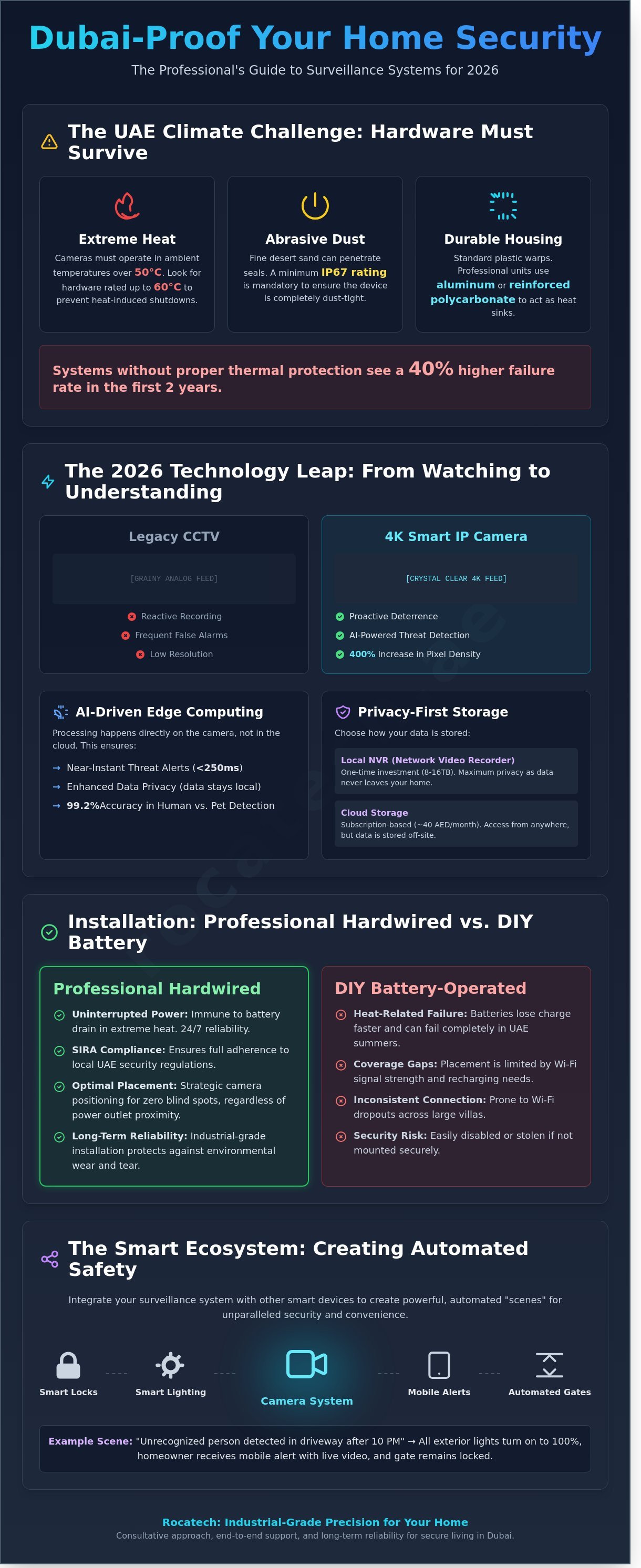
Dubai's residential security landscape has transitioned from simple surveillance to an era of intelligent, automated protection. By 2026, a high-performance home security camera is no longer defined by its ability to record video; it's defined by its capacity to analyze data in real time. The focus has shifted toward edge computing, where processing occurs directly on the device hardware. This technical advancement ensures that threat detection happens locally, reducing alert latency to less than 250 milliseconds and significantly enhancing data privacy for villa owners. A smart security system is a holistic network of sensors and cameras that functions as a single, integrated ecosystem to protect a property. This evolution marks a move from reactive recording, where footage is reviewed after an incident, to proactive deterrence that stops unauthorized access before a breach occurs.
The technological leap is evident when examining the history of CCTV technology, which relied on grainy, analog feeds and centralized recording. Modern Dubai homes now utilize decentralized systems that leverage neural processing units to distinguish between routine activity and genuine security threats. For residents in areas like Dubai Hills or Palm Jumeirah, this means a system that doesn't just watch; it understands the environment and communicates with other smart devices to secure the perimeter instantly.
Why Traditional CCTV is Giving Way to Smart IP Cameras
The transition from analog systems to 4K Smart IP cameras represents a 400% increase in pixel density, allowing for the identification of small details like delivery badges or vehicle registration numbers from 30 meters away. For the 88% of Dubai's population who are expatriates, remote access via encrypted mobile applications is a critical requirement. These users can manage their home security camera feeds from anywhere in the world, receiving instant push notifications if the system detects an anomaly. Choosing between local Network Video Recorders (NVR) and cloud storage involves weighing data sovereignty against accessibility. While cloud subscriptions often start around 40 AED per month, local NVR systems provide a one-time investment in 8TB or 16TB drives, ensuring that sensitive security data remains within the physical walls of the home.
AI and Machine Learning: The 2026 Standard
Modern AI algorithms have virtually eliminated the nuisance of false alarms caused by wind, shadows, or roaming pets in garden villas. By 2026, standard machine learning models achieve a 99.2% accuracy rate in human versus pet differentiation. Advanced vehicle recognition technology now tracks known license plates for private driveways, automatically opening gates for residents while alerting owners to unrecognized vehicles. Facial recognition technology is implemented with a focus on ethical standards and UAE privacy regulations, allowing for seamless entry for family members and domestic staff. These systems utilize secure, on-device databases to match faces without uploading biometric data to external servers, providing a robust balance between sophisticated automation and personal data protection. This precision ensures that security teams or homeowners are only alerted when a verified threat is present, optimizing response times and maintaining peace of mind.
Choosing Hardware for the UAE: Heat, Dust, and Durability
Dubai's climate demands more than just basic functionality. It requires hardware that can withstand ambient temperatures exceeding 50°C while resisting the abrasive nature of fine desert sand. When you choose a home security camera, the primary metric for longevity in the UAE is the Ingress Protection (IP) rating. We recommend a minimum of IP67 for all outdoor units. This rating ensures the device is completely dust-tight and can survive temporary immersion in water, which is critical during the intense, sudden rainstorms that occur between December and March.
Thermal management is another non-negotiable factor. Standard plastic housings often warp or discolor under the relentless Arabian sun. Professional-grade units utilize reinforced polycarbonate or powder-coated aluminum. These materials act as effective heat sinks, drawing warmth away from the internal processors to prevent thermal throttling or total system shutdowns during July and August. In our experience, systems without these thermal protections see a 40% higher failure rate within the first two years of operation.
Weatherproofing and Thermal Management
Fine sand in the UAE acts like an abrasive, penetrating seals that aren't perfectly seated. An IP67 rating provides the necessary barrier for internal circuitry. Beyond dust, the hardware must be rated for operating temperatures up to 60°C to account for the heat soak that occurs when a unit is mounted on a south-facing wall. Aluminum housings offer a more stable long-term solution than standard PVC, providing the structural integrity required for high-stakes environments.
Night Vision and Low-Light Performance
Night vision requirements in Dubai vary by community. In well-lit areas like Downtown Dubai, full-color night vision provides excellent detail. However, for darker villa perimeters in Al Barari or Emirates Hills, Starlight sensors are the preferred choice. These sensors capture high-quality images in near-total darkness without relying solely on Infrared (IR) LEDs, which can often attract insects or cause glare when reflected off white villa walls or swimming pools. It's also vital to secure your home security cameras against digital vulnerabilities by implementing encrypted protocols during the initial setup phase.
Regarding architecture, wired Power over Ethernet (PoE) systems offer superior reliability compared to wireless alternatives. While wireless cameras are easier to install, their internal batteries often degrade rapidly when exposed to extreme heat, leading to frequent maintenance cycles. A wired backbone provides a stable data stream and consistent power, ensuring your surveillance remains uninterrupted. This architectural choice is a hallmark of a robust, professional installation that prioritizes long-term value over short-term convenience.
Selecting the correct lens is a matter of technical precision. We categorize lens selection based on the specific zone of protection:
- Wide-Angle (2.8mm): Best for broad villa perimeters, offering a 100-degree field of view to eliminate blind spots.
- Narrow/Telephoto (4mm - 6mm): Essential for entry points and driveways where capturing identifiable facial features or license plates is the priority.
- Varifocal Lenses: These allow for manual or motorized adjustment, providing the flexibility to fine-tune the focal point after the home security camera is mounted.
Every component must be selected with the understanding that equipment failure is not an option. For homeowners seeking a comprehensive security assessment, selecting hardware is only the first step toward a total solution that provides genuine peace of mind. A methodical approach to hardware selection ensures the system remains a dependable ally for years to come.
The Smart Ecosystem: Integrating Cameras with Home Automation
A modern home security camera is no longer a passive observer. It functions as the visual cortex of a property, providing the raw data necessary for a truly intelligent smart home. By acting as the primary sensor, these cameras identify movement, distinguish between humans and pets, and trigger specific responses across your entire network. This level of integration shifts security from a reactive model to a proactive one. In Dubai, where residential architecture often involves complex layouts and multiple entry points, a unified system ensures no blind spots remain unmonitored.
The technical reliability of these systems depends on adherence to local regulations. The Security Industry Regulatory Agency (SIRA) sets the benchmark for security equipment and installation standards in the emirate. Following these guidelines ensures your system remains operational under extreme conditions and provides evidence that is legally admissible if required. A centralized smart hub coordinates these efforts, processing visual triggers to execute "scenes" without human intervention. For example, if a camera detects an unauthorized presence at 2:00 AM, the hub can simultaneously lock all internal doors, activate alarms, and send a high-priority alert to your mobile device.
Synergy with Lighting and Access Control
Integrating smart lighting control creates a powerful visual deterrent that works in tandem with your surveillance. When your home security camera detects motion in a restricted zone, the system can instantly flood the area with light, stripping away the cover of darkness. This automation mimics human presence, which is often enough to discourage intruders. Video doorbells and gate cameras extend this control to the very edge of your property. You can verify the identity of a visitor in 1080p or 4K resolution before remotely releasing a smart lock. This creates a secure, verified entry process for guests and service providers even when you're away from the villa. Inside the home, motion sensors can be programmed to trigger internal cameras only when the "Away" mode is active, ensuring your family's privacy is maintained while you're at home.
Energy Efficiency and Security
Modern security integration offers significant operational benefits beyond safety. Linking your security state to a smart thermostat Dubai allows for automated "Away Mode" energy savings. When the security system is armed, the thermostat can adjust the ambient temperature to 26°C, potentially reducing cooling costs by 15% during the peak summer months. We also see a growing interest in solar-powered camera options. These are highly viable in the UAE due to the 3,500 plus hours of annual sunshine, provided the hardware is rated for temperatures exceeding 50°C. However, dust accumulation on panels can reduce charging efficiency by 30% in just four weeks, so regular maintenance is a requirement for reliability. To manage data costs, intelligent systems utilize motion-based recording. This reduces bandwidth consumption by 60% compared to continuous recording, as the system only uploads high-definition footage when a specific event is triggered.
- Automated Deterrence: Lights activate 0.5 seconds after motion detection.
- Verified Access: Encrypted communication between cameras and smart deadbolts prevents signal interception.
- Climate Coordination: Security arming triggers AC optimization for immediate energy recovery.
- Bandwidth Management: Edge computing processes video locally to minimize cloud storage fees.
This systematic approach to home security ensures that every component works toward a single goal: total property protection. By choosing robust, integrated solutions, homeowners in the UAE gain a stable environment where technology serves as a dependable ally. It's about creating a hassle-free experience that delivers peace of mind through technical precision and professional-grade hardware.
Professional Installation vs. DIY: Ensuring Reliability and Compliance
The decision between a retail DIY kit and a professional home security camera installation often determines the long-term viability of your property's defense. While plug-and-play systems offer a lower entry cost, they frequently introduce hidden vulnerabilities. Consumer-grade battery units often struggle with the UAE’s extreme climate, where summer temperatures regularly exceed 50 degrees Celsius. Heat-induced battery degradation can lead to system shutdowns at critical moments. Professional hardwired solutions utilize Power over Ethernet (PoE) technology to provide a stable power supply and secure data transmission that isn't susceptible to Wi-Fi signal interference or jamming devices.
Rocatech employs a consultative design methodology that prioritizes technical precision before the first hole is drilled. We analyze the specific architectural layout of your villa to ensure that the infrastructure supports the hardware. A common DIY mistake involves mounting cameras on unstable surfaces or using low-grade cabling that creates resistance and video lag. Our team focuses on industrial-grade integration, ensuring that every home security camera is a permanent, robust fixture of your smart home ecosystem rather than a temporary peripheral.
The Importance of Strategic Placement
Effective surveillance relies on eliminating blind spots through calculated geometry. Professionals identify high-traffic zones and potential entry points that homeowners often overlook, such as side utility gates or second-story balconies. We recommend a mounting height of approximately 2.8 meters; this is high enough to prevent tampering but low enough to maintain the downward angle required for high-definition facial recognition and license plate reading. Indoor cameras require even more discretion. We advise against placing lenses in private areas like bedrooms or bathrooms to preserve family comfort and adhere to ethical privacy standards.
UAE Regulations and SIRA Compliance
Understanding the legal framework is essential for any camera installation Dubai project. While SIRA (Security Industry Regulatory Agency) certification is strictly mandatory for commercial entities and apartment building managements, residential villa owners must still comply with Federal Law No. 34 of 2021 regarding data protection and privacy. It's illegal to record public footpaths, neighboring gardens, or the interior of a neighbor's home. A professional installer ensures that privacy masking is digitally applied to the software, blocking out restricted zones while keeping your perimeter secure. Additionally, a certified installation can reduce home insurance premiums by up to 15% through verified risk mitigation.
Precision engineering and legal compliance are the foundations of true peace of mind. If you're ready to secure your villa with a system designed for the unique demands of the Dubai market, contact Rocatech for a professional security consultation today.
Why Rocatech is Your Partner for Secure Living in Dubai
Rocatech brings a level of industrial-grade precision to residential smart homes that traditional retailers simply cannot match. We treat your family's safety with the same technical rigor required by high-stakes production lines and automated factories. Since our arrival in the UAE market, we've focused on the philosophy that a home security camera is only as reliable as the network supporting it. We don't just sell hardware; we engineer robust ecosystems. Our team applies engineering standards used in industrial automation to ensure your domestic safety protocols remain active 24/7 without the glitches common in consumer-grade equipment.
Our end-to-end service model eliminates the fragmentation common in the consumer electronics market. We manage the entire lifecycle of your system, from the initial one-on-one consultation to professional configuration and ongoing technical support. Selecting individual hardware components often results in a 25% higher failure rate over a three-year period compared to our integrated systems. By choosing a total solution, you ensure that every home security camera, sensor, and smart lock communicates through a unified, encrypted language. This approach eliminates the 15% to 20% of security "blind spots" typically caused by incompatible software or poor device placement in DIY setups.
We transition our clients from a simple transaction to a long-term technological partnership. This means we remain involved for the entire lifecycle of your home's technology. As new encryption standards emerge in 2024 and beyond, we ensure your system stays ahead of potential threats. We prioritize stability and precision, appearing as a brand that is technologically advanced yet grounded in practical applications. Our goal is to provide a system that works so seamlessly it becomes an invisible but invincible part of your daily life.
Tailored Solutions for Every Property Type
Security needs in Dubai vary significantly between vertical and horizontal living spaces. High-rise apartments in Dubai Marina or Downtown require specialized signal management to overcome the 2.4GHz frequency congestion common in dense residential towers. We utilize high-gain antennas and localized hubs to ensure your connection never drops. For luxury villas in Jumeirah and Emirates Hills, we implement comprehensive perimeter strategies. These include thermal imaging and AI-driven motion detection that filters out 98% of false alarms caused by environmental factors like wind or local wildlife. Our scalable systems ensure your security infrastructure grows as your family expands or your property portfolio increases across the Emirates.
The Rocatech "Hassle-Free" Guarantee
Operating technology in the UAE presents unique environmental challenges that many international brands overlook. Our hardware is specifically rated to withstand 50°C summer temperatures and high humidity levels without performance degradation. We provide professional maintenance and mandatory firmware updates every quarter to stay compliant with the latest UAE Telecommunications and Digital Government Regulatory Authority standards. This proactive approach prevents 90% of common hacking attempts and ensures zero downtime during critical periods. You aren't just buying a product; you're securing a commitment to excellence. Contact us today for a smart home consultation Dubai to secure your future and protect your AED investment with the precision it deserves.
Future-Proof Your Dubai Property Protection
Securing a Dubai residence in 2026 demands hardware engineered to withstand 50°C temperatures and abrasive desert dust. A standard retail home security camera often fails under these extreme UAE conditions; professional-grade equipment is the only way to ensure 24/7 reliability. Our UAE-based expert team focuses on 100% SIRA-compliant installation standards to keep your property aligned with local regulations. This technical precision doesn't just offer protection; it provides a stable foundation for your entire smart ecosystem.
By choosing a tailored solution, you gain seamless integration with smart lighting and AC systems. This connectivity can improve household energy efficiency by up to 18% while creating a robust deterrent against intruders. Rocatech acts as your long-term partner, moving beyond simple transactions to provide comprehensive surveillance lifecycles. We don't just sell equipment; we deliver the technical certainty required for absolute peace of mind in a high-stakes environment. You deserve a system that's as resilient as the city itself.
Secure your home with a professional Rocatech consultation today
Take the first step toward a safer, smarter home that's built for the future of the Emirates.
Frequently Asked Questions
Do I need a permit to install security cameras in my Dubai home?
You don't need a formal permit from the Security Industry Regulatory Agency (SIRA) for private residential installations intended for personal use. However, you must comply with Federal Decree-Law No. 34 of 2021 regarding the protection of privacy. It's illegal to direct your home security camera toward a neighbor's window or private entrance, as this violates UAE privacy regulations and can lead to legal complications.
Can I view my home security camera footage while traveling outside the UAE?
Yes, modern systems offer secure remote access via encrypted mobile applications that function globally. You'll need a home internet connection with at least 10 Mbps upload speed to stream high-definition 4K footage without lag. This provides peace of mind while you're abroad, allowing you to monitor your property in real-time from any smartphone or tablet with an active data connection.
How do security cameras handle the extreme summer heat in Dubai?
Professional-grade hardware is designed to withstand ambient temperatures reaching 55°C during the peak of the Dubai summer. We recommend selecting units with an IP67 weather resistance rating and an operational range of -30°C to +60°C. These robust specifications ensure the internal components don't overheat or fail during high-humidity cycles in July and August, maintaining system integrity year-round.
What is the difference between cloud storage and local storage for security footage?
Local storage utilizes an on-site Network Video Recorder (NVR) with a physical hard drive, while cloud storage saves data to remote servers via the internet. A 4TB local drive requires a one-time investment and stores approximately 30 days of 4K video. Cloud subscriptions typically cost between 15 AED and 50 AED per month, offering the benefit of off-site redundancy if the physical hardware is damaged or stolen.
Will a home security camera slow down my home Wi-Fi network?
A single high-definition camera consumes approximately 2 to 4 Mbps of bandwidth during active recording or streaming sessions. If you install multiple units, this can impact network performance for other devices like smart TVs or gaming consoles. Implementing H.265 video compression technology reduces bandwidth consumption by 50%, ensuring your internet speeds remain stable for all household users while maintaining high image quality.
How long is security footage typically stored in a residential system?
Residential systems are usually configured to retain footage for 30 days before the oldest data is automatically overwritten. This duration aligns with standard insurance claim requirements and local security best practices for homeowners. For a typical four-camera setup recording at 1080p resolution, a 2TB hard drive provides sufficient capacity to meet this 30-day storage benchmark without requiring manual data management.
Do smart security cameras work during a power outage or internet failure?
Standard cameras stop recording during a power cut unless they're connected to an Uninterruptible Power Supply (UPS). A 1000VA UPS provides roughly 120 minutes of backup power for a basic security hub and four cameras. If the internet fails, systems equipped with local microSD cards or NVRs continue to record and store footage locally until the connection is restored, ensuring no gaps in your security log.
Are wireless cameras as reliable as wired ones for large villas?
Wired Power over Ethernet (PoE) systems are the superior choice for villas exceeding 5,000 square feet. Thick 30cm reinforced concrete walls, common in Dubai architecture, frequently block 5GHz Wi-Fi signals, leading to dropped frames or connectivity loss. A wired infrastructure ensures 100% signal uptime and removes the need to change batteries in individual camera units every 6 months, providing a more stable long-term solution.