

How to Convince Your Partner to Get a Smart Home: A Strategic Guide for 2026

What if your home's technology wasn't a collection of high-tech gadgets, but a silent partner that reduced your monthly overhead while remaining completely invisible? Many homeowners find it difficult to convince partner to get smart home systems because of valid concerns about reliability, aesthetics, and technical complexity. You've likely heard the argument that smart tech is just an expensive hobby that will eventually break or leave your walls covered in bulky equipment. We understand that in a high-stakes domestic environment, operational failure isn't an option; you need a system that offers psychological reassurance rather than constant tinkering.
This strategic guide will help you transform that resistance into enthusiasm by focusing on professional system harmony and real world UAE benefits. You'll learn how to present automation as a sophisticated tool for long term value, such as mitigating the June 2026 DEWA electricity fuel surcharge of AED 0.060 per kWh. We'll outline a roadmap to achieving a harmonious home environment where smart thermostats and lighting controls work reliably, ensuring your space remains both beautiful and highly efficient for every member of the household.
Key Takeaways
- Learn how to shift the conversation from "gadgets" to integrated lifestyle enhancements to effectively convince partner to get smart home systems.
- Discover how precision cooling via smart thermostats provides significant operational savings by optimizing energy use in response to UAE utility rates.
- Explore the psychological benefit of proactive protection, using water leak sensors and smart door locks to prevent villa damage and enhance family security.
- Understand why professional installation and a unified smart hub gateway are essential for maintaining system stability and avoiding the instability of DIY setups.
Understanding the Resistance: Why Partners Say No to Smart Tech
Resistance to home technology is rarely about the devices themselves. Instead, it's often rooted in a desire to protect the sanctuary of the home from unnecessary complexity. To successfully convince partner to get smart home upgrades, you must bridge the gap between "tech for tech's sake" and genuine lifestyle enhancement. Many partners fear that a smart home will become a demanding hobby that requires constant troubleshooting, or worse, that it will introduce digital clutter into their daily lives. They don't want another app to manage; they want a home that functions more efficiently without their intervention.
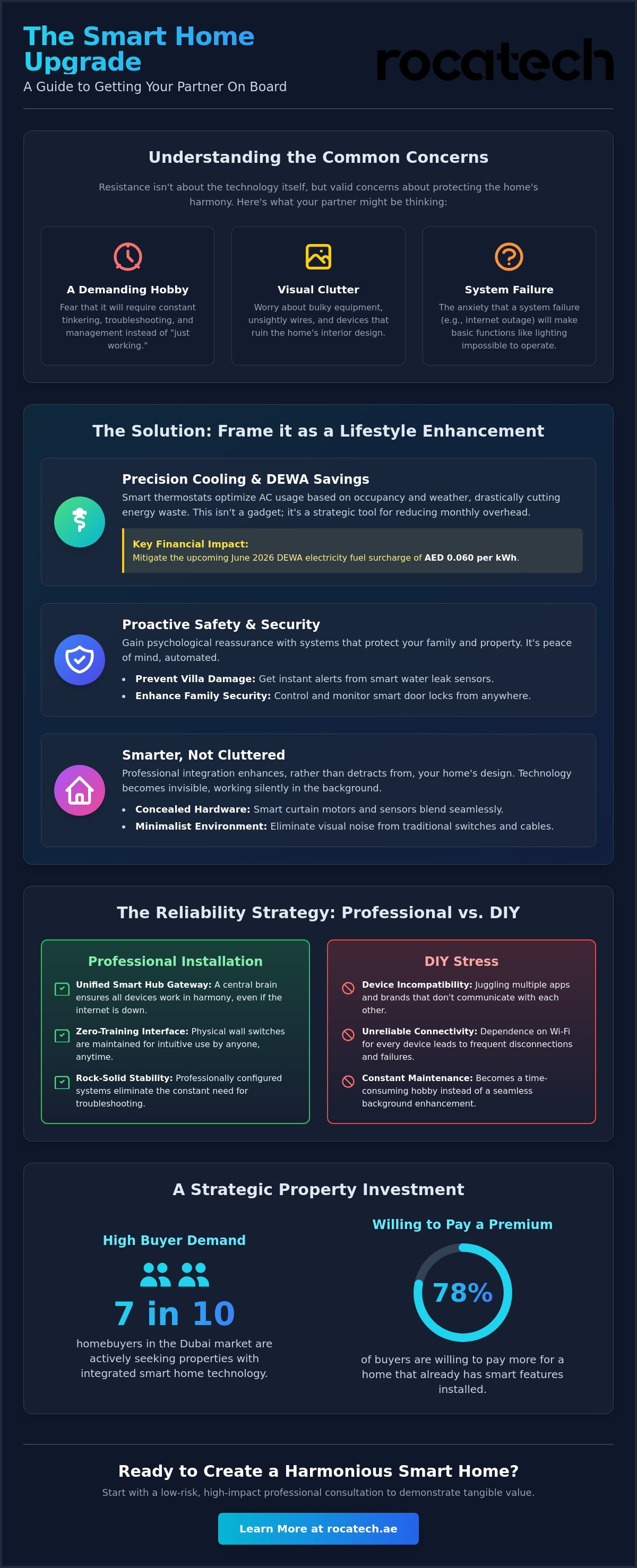
A professional approach shifts the narrative from gadgets to operational stability. Modern home automation systems are designed to provide psychological reassurance by performing repetitive tasks reliably. In the Dubai real estate market, these systems are no longer just luxury add-ons; they are strategic property investments. Data shows that 7 in 10 homebuyers are actively seeking smart homes, and 78% are willing to pay a premium for integrated technology. Framing the conversation around long-term villa value and reduced operational costs helps align the project with your family's broader financial goals.
The Complexity Trap
The fastest way to lose a partner's support is by over-automating basic functions. If a guest or a child cannot operate a light switch without a tutorial, the system has failed. High-performance systems prioritize "zero-training" interfaces. This means maintaining physical wall switches while using a unified smart hub gateway to manage the heavy lifting in the background. Stability is the goal. When you convince partner to get smart home features, promise them a system that "just works" even if the internet goes down, ensuring that the home remains functional for everyone at all times.
The Aesthetic Argument
Fear of unsightly wires and bulky equipment is a significant barrier for those who value interior design. Professional integration solves this by hiding the "brain" of the house within existing cabinetry or dedicated tech closets. You aren't proposing a science lab; you're proposing a minimalist, catalog-worthy environment. Smart curtain motors are concealed within recessed tracks, and motion sensors are small enough to blend into the ceiling. By focusing on design-led technology, you demonstrate that smart features can actually enhance the aesthetic of your home by removing the visual noise of traditional hardware and tangled cables.
The Functional Pitch: Precision Cooling and DEWA Savings
In the UAE, air conditioning is not a luxury; it is a critical operational requirement that accounts for the majority of a villa's energy consumption. If you want to convince partner to get smart home systems, start with the financial logic of precision cooling. Most homes waste significant energy by cooling unoccupied rooms or maintaining unnecessarily low temperatures during peak heat hours. Transitioning to a model of "thermal comfort" ensures the environment is always pleasant without the inefficiency of manual adjustments. This approach reframes the technology as a necessary utility upgrade rather than an elective hobby.
The financial argument is particularly compelling when you look at the ROI of automated systems in high-consumption environments. Energy efficiency and cost reduction are consistently cited among the top benefits of smart home technology by researchers at Harvard. By presenting a data-driven case, you move the conversation away from "gadgets" and toward a strategy for long-term household stability and wealth preservation.
Mastering the Dubai Climate
Extreme heat and high humidity levels in Dubai require a more sophisticated approach than a standard on-off schedule. A smart thermostat dubai uses advanced algorithms to manage cooling based on real-time occupancy and external weather conditions. These systems learn your family's daily routines, ensuring the master bedroom is cooled before bedtime while preventing the living area from being chilled while everyone is at work. This precision reduces the constant cycling of your HVAC units, which effectively lowers maintenance costs and extends the lifespan of your equipment.
Quantifying the Savings
Hard data helps remove the emotional friction from the decision-making process. As of June 2026, the DEWA electricity fuel surcharge stands at AED 0.060/kWh, which is applied on top of standard slab tariffs. In a large villa, even a 15% reduction in AC runtime results in significant monthly savings. You can further optimize these results by using smart plugs to identify and eliminate "vampire" power drains from electronics that remain on standby. When you present the system as a self-paying investment, it becomes much easier to secure partner agreement for a comprehensive installation. This logical, business-centric perspective positions home automation as a responsible choice for any modern household.
Safety and Security: Peace of Mind for the Whole Family
Traditional security discussions often center on cameras and alarms, yet true peace of mind comes from proactive protection. When you attempt to convince partner to get smart home technology, shift the focus from "surveillance" to "prevention." A high-performance system doesn't just watch your home; it actively mitigates risks that could lead to catastrophic property damage. This transition from reactive monitoring to proactive defense offers a level of psychological reassurance that traditional hardware cannot match. It's about creating a stable environment where operational failure is managed before it escalates.
Integrated systems provide a comprehensive service model that addresses both safety and smart home energy efficiency. By framing these features as essential household infrastructure, you position the investment as a strategic move for family welfare. This is especially relevant for frequent travelers who need to know their primary residence remains secure and functional regardless of their physical location.
Proactive Disaster Prevention
Dubai villas are particularly susceptible to water damage from aging AC drainage lines or irrigation failures. Installing water leak sensors in high-risk areas like laundry rooms and behind kitchen appliances provides an invisible safety net. These sensors can trigger an automatic water shut-off, preventing thousands of dirhams in repair costs while you're at work or abroad. Coupled with integrated smoke and CO2 detectors, your home gains a 24/7 monitoring capability that protects against environmental hazards without requiring your constant attention.
Seamless Access Control
Managing a household in the UAE often involves coordinating with maintenance crews, cleaners, or delivery services. Smart door locks eliminate the stress of lost keys or the security risk of leaving spares under a mat. You can provide temporary, time-stamped access codes to staff remotely, ensuring they can complete their work while you maintain full control over entry points. Video doorbells complement this by allowing you to verify who is at the gate before they even ring. For many, the ability to manage these operational details from a single interface is the most compelling reason to convince partner to get smart home capabilities, as it removes daily friction and enhances family privacy.
The Reliability Strategy: Professional Installation vs. DIY Stress
A primary reason homeowners struggle to convince partner to get smart home upgrades is the fear of technical instability. DIY "gadget clusters", where disparate devices from different brands are forced to communicate over congested home Wi-Fi, often lead to system lag and frequent reboots. When the lights don't turn on or the AC fails to respond, it creates domestic friction. In a high-stakes domestic environment, operational failure is not an option. Transitioning from a collection of consumer toys to a unified smart hub gateway ensures that every component works in harmony. This professional approach provides the psychological reassurance that the system is as stable as the home's plumbing or electrical wiring.
Industry data reflects this growing preference for stability; professional installation services accounted for 70.54% of the global market revenue in 2025. This preference exists because a professionally commissioned system offers a single point of failure management. You aren't just buying hardware; you're securing a supportive partnership that prioritizes long-term value over immediate transactions. This reliability is the most effective tool you have to convince partner to get smart home features that actually improve daily life.
Eliminating the 'Tech Headache'
Professional grade hardware differs significantly from consumer grade alternatives in both durability and communication protocols. While DIY kits often rely on crowded 2.4GHz Wi-Fi bands, professional systems utilize dedicated automation frequencies to prevent interference. A comprehensive smart home installation dubai ensures a "no-wire" aesthetic where all control modules are hidden from view. This setup guarantees system harmony across different ecosystems, allowing Apple, Google, and Amazon devices to communicate through a centralized, stable architecture that requires zero "tinkering" from the end user.
Long-Term Support and Maintenance
The value of a professional system extends far beyond the initial setup. Unlike DIY projects that leave you hunting through YouTube tutorials when a device goes offline, a professional installation comes with a comprehensive service model and a clear warranty. This future-proofs your investment, ensuring the system can grow as your family's needs change. Rocatech's commitment to precision and excellence means your automation is treated as critical infrastructure. We provide the technical expertise needed to maintain a seamless environment, allowing you to enjoy the benefits of a smart home without the burden of managing it. Contact our expert team to discover how a unified system can bring operational stability to your villa.
Taking the First Step: A Collaborative Consultation
Securing agreement on a technical project often requires a strategic, phased approach. Rather than overhauling the entire villa at once, you can convince partner to get smart home systems by demonstrating value in a single, high-traffic area. This method reduces the perceived risk and allows both residents to evaluate the operational benefits without feeling overwhelmed by a whole-house transition. By focusing on the entire lifecycle of the home's operations, you shift the focus from a one-time expense to a long-term enhancement of your living environment.
A collaborative consultation provides the ideal forum for addressing specific concerns. It moves the conversation beyond abstract ideas and into practical, real-world applications. When a seasoned expert joins the discussion, they act as a neutral party capable of bridging the gap between technical ambition and practical domestic requirements. This professional guidance ensures the system design reflects the priorities of everyone in the household, fostering a sense of shared ownership rather than a unilateral decision.
Start with One High-Impact Room
The living room often serves as the best proof of concept. Implementing smart lighting control in this space allows you to showcase the immediate convenience of automated scenes for dining, movies, or hosting guests. It's an invisible upgrade that doesn't require structural changes but provides an immediate aesthetic and functional lift. Once your partner experiences the ease of managing the environment through a single, reliable interface, the resistance to broader automation typically dissolves. You aren't just telling them it's better; you're letting them live the improvement firsthand.
The Rocatech Partnership Approach
We view every installation as a long-term commitment to your home's success. Our consultative process moves away from aggressive sales tactics toward a supportive partnership model. During a site visit, we prioritize listening to both partners' needs to ensure the final solution provides psychological reassurance for everyone. Our approach focuses on several key areas:
- Identifying Pain Points: We address specific domestic frustrations like uneven cooling or security anxieties.
- Intuitive Control: We design interfaces that are easy to use for every family member and guest.
- System Longevity: We ensure your investment is future-proofed against changing technology standards.
Experience the precision of integrated living by booking a personalized consultation. We invite you to explore a demo of a system that balances technical excellence with domestic harmony, ensuring your home remains a sanctuary of reliability and comfort. By choosing a professional path, you ensure that the transition to a connected home is a shared success story for your entire family.
Achieving Long-Term Domestic Harmony
Since 2021, Rocatech has specialized in Dubai-specific climate control and security, providing the local expertise needed for high-stakes domestic environments. Our professional installation and integration fees include full support to ensure your system performs flawlessly from day one. Book a Professional Smart Home Consultation with Rocatech Dubai to design a solution that provides psychological reassurance for every member of your family. Taking this collaborative step ensures your villa remains efficient, secure, and sophisticated for years to come.
Frequently Asked Questions
What is the #1 reason partners are against smart home technology?
The primary barrier is the fear of unnecessary complexity and technical failure. Many homeowners find it difficult to convince partner to get smart home systems because of the "learning curve" associated with basic daily tasks. Partners often worry that simple actions, like turning on a light or adjusting the AC, will become dependent on a smartphone app that might lag or fail, disrupting the domestic sanctuary.
How can a smart home actually save money in Dubai?
Savings are primarily driven by precision cooling and intelligent energy management. By automating AC based on occupancy and real-time weather data, you reduce waste in high-consumption villas. This is particularly effective for mitigating the June 2026 DEWA electricity fuel surcharge of AED 0.060/kWh. Smart plugs also help by identifying "vampire" power drains from electronics left on standby mode.
Does a smart home mean I have to use my phone for everything?
Professional systems prioritize "zero-training" interfaces that don't require a phone for daily operations. High-performance setups maintain physical wall switches and utilize voice commands or motion sensors for seamless control. The goal is a home that functions autonomously, ensuring that guests, children, and partners can operate every feature without ever touching a mobile device.
What happens to the smart home if we lose internet connection?
Core functions remain operational through local processing via a smart hub gateway. While remote access might be temporarily unavailable, critical systems like lighting controls, smart thermostats, and door locks continue to function over local frequencies. This design ensures that your home's operational stability is never compromised by a service provider's external outage.
Is professional smart home installation worth the extra cost?
Professional installation is essential for long-term reliability and aesthetic precision. Unlike DIY setups that often lead to "gadget clusters" and system instability, professional integration provides a unified architecture with a single point of support. It ensures a "no-wire" finish and includes a comprehensive service model that future-proofs your investment as your family's needs evolve.
Can smart home devices be integrated into an older Dubai villa?
Retrofit solutions allow for sophisticated automation without the need for structural electrical wiring or major renovations. Modern smart thermostats, curtain motors, and lighting controls are designed to fit into existing infrastructure. This allows owners of older properties to enjoy the same levels of efficiency and security found in the newest luxury developments across the city.
Which smart home feature has the highest 'Partner Approval Factor'?
Smart lighting control and automated climate control typically receive the highest approval because they provide immediate, tangible comfort. The ability to set "scenes" for different times of day or ensure the bedroom is perfectly chilled before sleep offers instant psychological reassurance. These features demonstrate the lifestyle value of the tech far more effectively than niche gadgets or complex sensors.
Are smart home systems secure from hacking in 2026?
Modern systems utilize advanced encryption standards and local control protocols to minimize external vulnerabilities. In 2026, the industry has shifted toward localized data storage, meaning your domestic habits aren't constantly uploaded to the cloud. When you convince partner to get smart home technology from a professional provider, you're securing a system built on international security standards designed for high-stakes environments.