

Troubleshooting Common Smart Home Problems in Dubai: The 2026 Stability Guide

Your luxury villa's reinforced concrete walls and the 50°C summer heat are more than just architectural features; they are the primary disruptors of your digital ecosystem. It's frustrating when a smart thermostat loses its connection just as the midday sun peaks or a video doorbell goes offline because of signal interference in a high-density Marina high-rise. You've likely invested in these technologies to gain peace of mind, yet technical instability often creates more stress than it solves.
This guide provides a systematic approach to resolving common smart home problems dubai residents face, ensuring your system remains stable even during the most demanding environmental shifts. We'll explore how to shield your hardware from heat-related damage, bypass signal-blocking concrete, and unify conflicting brand ecosystems using the 2026 Matter protocol. You'll learn why devices go offline in Dubai's unique vertical environments and how to leverage the latest standards for a resilient home. By following this technical roadmap, you can restore system harmony and ensure your smart lighting and climate controls deliver the reliability you expect.
Key Takeaways
- Implement a tiered diagnostic hierarchy to isolate network failures from hardware glitches before performing invasive factory resets.
- Identify how to mitigate common smart home problems dubai residents experience, such as signal blockage from reinforced concrete and RF interference in high-density areas.
- Master specific troubleshooting techniques for smart thermostats and lighting controls to ensure reliable operation during extreme peak-summer heat.
- Transition from cloud-based logic to local execution and Matter protocols to eliminate latency and maintain harmony in multi-brand automation setups.
- Recognize the technical indicators that signal when professional integration is necessary to maintain the long-term stability and value of your home ecosystem.
The Smart Home Troubleshooting Hierarchy: A Tiered Diagnostic Approach
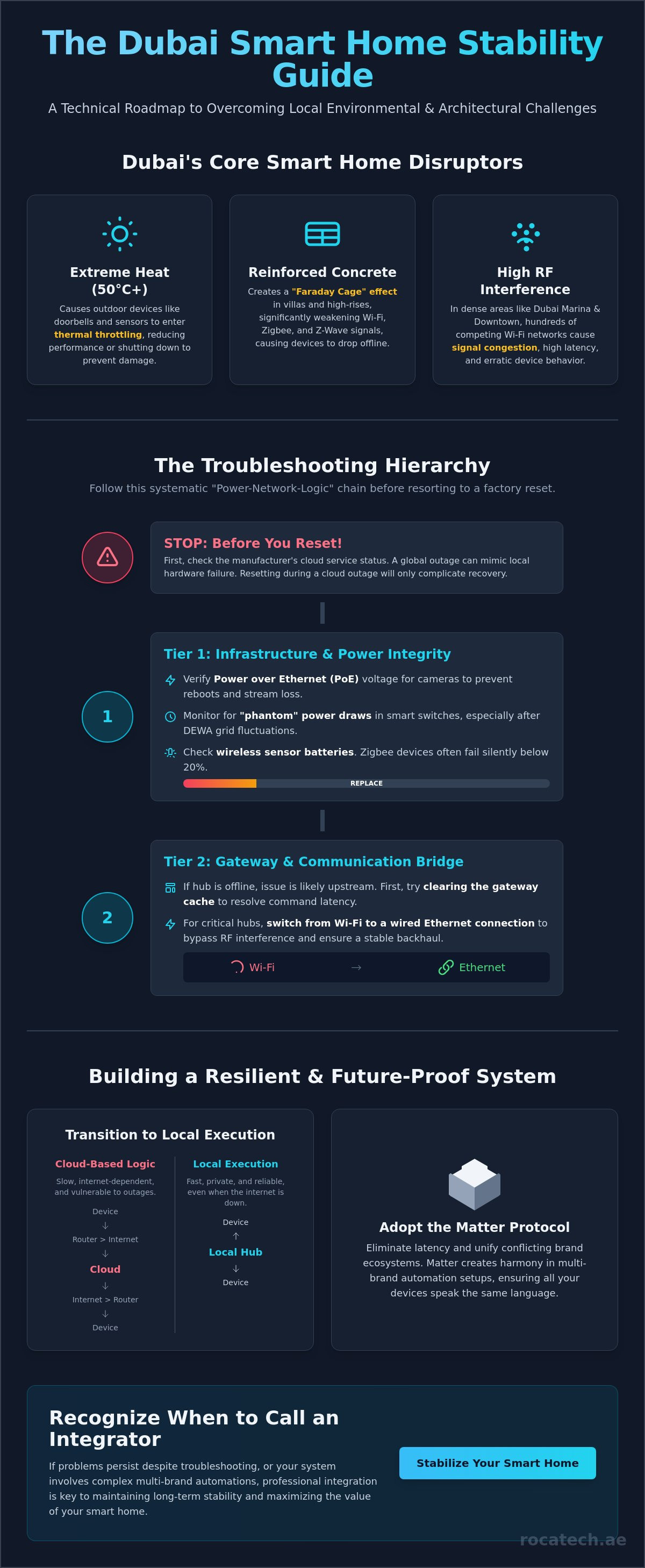
A structured diagnostic hierarchy is essential for maintaining a high-performance home automation system. Most users instinctively reach for a factory reset when a device fails, but this is often the least efficient troubleshooting method. Resets erase critical configurations and often ignore the actual root cause of the failure. Instead, professionals use a three-tier process to isolate failures systematically. This approach addresses the common smart home problems dubai residents encounter, such as environmental interference or power fluctuations, before any permanent software changes are made.
Identifying and fixing common smart home problems dubai users experience requires a methodical mindset. It's vital to verify the "Power-Network-Logic" chain in 2026 systems. If the power is unstable, the network won't connect. If the network is down, the automation logic cannot execute. Before diving into local hardware, you should identify whether you're facing a global or local outage. Checking the cloud service status for major brands is a standard first step. Major outages can mimic local hardware failure, and resetting your devices during a cloud downtime only complicates the eventual recovery. If the cloud is operational, the issue likely resides within one of the following two tiers.
Tier 1: Infrastructure and Power Integrity
Stability begins at the electrical source. In the UAE, high-end security cameras often rely on Power over Ethernet (PoE), where even a slight drop in voltage can cause intermittent reboots or loss of high-definition streams. You should also monitor for "phantom" power draws in smart switches. These often occur after DEWA grid fluctuations or during peak summer demand when the electrical load on the property is at its highest. For wireless components, battery health is a critical metric. Zigbee sensors typically fail when battery levels drop below 20%. They may appear "online" in your app but fail to trigger automations. Replacing batteries at this threshold prevents silent system failures and keeps your security perimeter intact.
Tier 2: The Gateway and Communication Bridge
The gateway serves as the central nervous system of your integrated home. If your smart hub gateway shows an offline status, the issue is likely upstream. Before attempting a hard reset, try clearing the gateway cache. This simple step often resolves command latency in multi-device environments where data packets become congested. For critical automation bridges, we recommend switching from Wi-Fi backhaul to a physical Ethernet connection. This eliminates the RF interference common in high-density Dubai neighborhoods like Downtown or Dubai Marina, providing a dedicated, interference-free path for your automation signals.
Dubai Environmental Factors: Heat, Concrete, and Signal Density
Dubai's architectural landscape and extreme climate create a unique set of technical hurdles for any automated system. The heavy use of reinforced concrete and steel in local villas and high-rises often results in a "Faraday Cage" effect. This physical barrier significantly attenuates Zigbee, Z-Wave, and Wi-Fi signals, leading to the common smart home problems dubai homeowners face, such as sensors that unexpectedly drop offline or commands that fail to reach their destination. In high-density districts like Downtown Dubai or JBR, this issue is compounded by intense radio frequency (RF) interference. With hundreds of competing Wi-Fi networks in close proximity, signal congestion can cause high latency and erratic device behavior.
Environmental stressors also impact physical hardware longevity. When outdoor temperatures exceed 50°C, smart doorbells and sensors can suffer from thermal throttling. This is a protective state where the device reduces performance or shuts down entirely to prevent internal damage. Along the coast, humidity and salt-air corrosion present additional risks, potentially degrading the sensitive electronics in smart locks and entry systems. Addressing these common smart home problems dubai requires a proactive approach to both network design and hardware selection. If you're experiencing persistent connectivity drops, you may need to stabilize your smart home infrastructure with professional-grade components designed for the Middle Eastern climate.
Optimising Network Stability for Dubai Villas
Large villas require a sophisticated network topology to overcome structural interference. We recommend segmenting your network by configuring 2.4GHz bands for long-range, low-bandwidth smart sensors while reserving 5GHz bands for high-traffic devices. Strategic placement of Mesh nodes is essential. They must be positioned to bypass signal-blocking elevator shafts and concrete cores. Implementing Static IPs for critical infrastructure, such as thermostats and hubs, ensures that devices don't lose their logic path during routine router reboots or DHCP lease renewals.
Climate-Proofing Your Automation Hardware
Maintaining hardware in Dubai requires specific seasonal routines. Fine desert dust can accumulate on an outdoor home security camera lens after a storm, triggering false motion alerts or degrading night vision clarity. Inside the home, smart curtain motors installed behind floor-to-ceiling glass must manage significant heat dissipation to avoid motor fatigue. While ensuring physical durability, managing cybersecurity and privacy risks is equally vital for any device exposed to the public internet. Always verify that your outdoor sensors carry an appropriate Ingress Protection (IP) rating to withstand both the summer humidity and the occasional heavy rain of the winter months.
Resolving Component Glitches: AC Thermostats and Lighting
Maintaining indoor climate stability is the highest priority for any property owner in the UAE. When a smart thermostat Dubai installation becomes non-responsive during the peak of July, it isn't just a minor inconvenience; it's a critical system failure. These common smart home problems dubai residents face often stem from a misalignment between modern consumer hardware and regional HVAC infrastructure. Similarly, a smart lighting control system that exhibits flickering or "ghosting" usually points to underlying electrical interference or wiring incompatibilities rather than a faulty bulb.
Addressing "Device Unreachable" errors in smart plugs or curtain motors requires looking beyond the device itself. For instance, automated blinds that fail to close fully against the harsh afternoon sun often need a limit-switch recalibration. This drift is frequently caused by the thermal expansion of the internal hardware during extreme heat cycles. As the industry moves toward the Matter smart home standard, many of these communication glitches are becoming easier to diagnose through improved local interoperability. However, the physical nuances of a Dubai installation still require a precise, technical approach to ensure long-term reliability.
HVAC and Chiller Integration Troubleshooting
Older apartments in Dubai often lack the dedicated C-wire (common wire) required to provide constant power to modern smart thermostats. Without this, the thermostat may attempt to "power steal" from the HVAC control circuit, leading to intermittent shutdowns when the cooling demand is highest. In large open-plan villas, syncing remote sensors is vital to eliminate "hot spots" where the AC continues to run unnecessarily because the main unit is placed in a cool hallway. We also frequently diagnose communication lag between smart units and building chiller systems. This often requires a specific gateway configuration to ensure the cooling request is acknowledged by the building's central plant without delay.
Lighting Control and Dimmer Instability
Many legacy properties in Dubai were wired without a neutral wire at the switch box. Installing smart dimmers in these environments often causes LED flickering unless a bypass capacitor is integrated to provide a minimum load. Sudden DEWA power surges or scheduled grid maintenance can also desync smart switches from their central hub. In these scenarios, a simple power cycle is rarely sufficient. You may need to perform a targeted firmware update to resolve LED flickering issues within custom lighting scenes, ensuring the driver's dimming curve matches the software's intended output for a stable, high-end aesthetic.
Automation Logic and 2026 Protocol Interoperability
Automation logic is the invisible layer that transforms a collection of independent devices into a cohesive ecosystem. Solving common smart home problems dubai homeowners face often requires moving beyond simple device connectivity to analyzing the underlying logic layer. In 2026, the industry has shifted away from "If-This-Then-That" (IFTTT) cloud-based logic due to inherent latency and reliability issues. When your home relies on remote servers, a minor internet hiccup can prevent your smart curtains from closing during a sandstorm. Local execution, powered by the Matter protocol, ensures that your devices communicate directly with each other, providing the stability required for high-stakes environments like climate control and security.
Interoperability challenges frequently arise in multi-brand setups where different protocols compete for bandwidth. You might encounter "Race Conditions," where two conflicting automations trigger simultaneously. For example, a motion sensor might be programmed to turn on the lights, while a separate energy-saving routine attempts to dim them. This creates a loop of indecision that can cause system-wide lag. Identifying Zigbee mesh "dead zones" is another technical priority. Because Zigbee relies on repeating nodes, if a single smart plug is disconnected in a large villa, the entire path to a distant sensor can collapse. If your automation logic remains inconsistent, you should consult with a professional integrator to audit your protocol architecture and eliminate these logic conflicts.
Diagnosing Failed Scenes and Routines
When a "Sunset" scene triggers at 3 PM, the issue is rarely the device itself. It's usually a matter of sensor thresholds or incorrect geo-location data. Dust accumulation on outdoor light sensors can trick the system into thinking it's evening, while cloud-dependent integrations like Apple Home or Google Home may fail if regional servers experience downtime. We recommend isolating any non-certified or legacy devices that don't support modern encryption. These older units often inject "noise" into the network, causing significant lag across your entire suite of routines and scenes.
Protocol-Specific Fixes: Zigbee, Z-Wave, and Thread
Maintaining a healthy mesh network requires a technical understanding of protocol behavior. Rebuilding a Zigbee mesh isn't instantaneous; it requires a "wait and see" approach as the network takes 24 to 48 hours to self-heal and find the most efficient routing paths. In 2026, managing Thread Border Router handoffs is essential for homes with multiple gateways. If two different brand hubs attempt to lead the Thread network, devices may become unresponsive during the handoff. You must also account for RF interference from non-smart electronics, such as older microwave ovens or unshielded baby monitors, which can disrupt the 2.4GHz frequency used by many automation standards.
Strategic Maintenance: When to Call a Professional Integrator
While individual device resets can solve temporary glitches, persistent instability often signals a deeper architectural flaw. Many common smart home problems dubai homeowners encounter are linked to the initial configuration rather than hardware defects. A professional smart home installation Dubai ensures that your network topology and protocol layers are optimized from day one. This proactive approach eliminates the reactive cycle of troubleshooting and provides the structural stability needed for high-stakes systems like biometric locks and precision climate control. When a system is professionally integrated, the likelihood of a catastrophic failure during peak environmental stress is significantly reduced.
Strategic maintenance also involves future-proofing your property for the next generation of automation. As Dubai moves toward AI-powered utility management, such as the DEWA AI Virtual Engineer launching in June 2026, your home systems must be capable of integrating with advanced diagnostic standards. Upgrading legacy components to modern standards allows for predictive failure alerts. In this environment, the system identifies a potential fault before it impacts your daily routine, shifting the focus from repair to prevention. This transition requires a technical partner who understands both the mechanics of the hardware and the strategic requirements of the broader smart city infrastructure.
Signs Your System Requires a Professional Audit
Identifying when to move beyond DIY fixes is crucial for maintaining property value and operational security. You should consider a professional audit if you experience any of the following common smart home problems dubai residents face in older or poorly integrated setups:
- Persistent system-wide lag where commands for lighting or curtain motors exceed a two-second response time.
- Frequent "Device Offline" notifications that occur despite a stable, high-speed internet connection from your provider.
- Evidence of physical thermal damage, such as discoloration or warping, on wiring, smart switches, or central controllers.
- Inconsistent automation triggers that suggest a conflict in the underlying logic or protocol interference.
The Rocatech Advantage: Precision Maintenance
Precision is the cornerstone of a reliable automated environment. For Rocatech Dubai clients, we provide a comprehensive service model that extends far beyond the initial setup. Our approach includes remote monitoring and proactive patch management to ensure your software remains secure and compatible with the latest Matter and Thread standards. We utilize specialized tools to perform on-site signal strength mapping, which allows us to eliminate the dead zones common in large villas with reinforced concrete walls.
Our technicians specialize in custom logic repair for complex, multi-brand ecosystems. If your smart lighting, thermostats, and security cameras are failing to communicate, we audit the communication bridges to restore harmony. This level of technical oversight provides emotional reassurance, knowing that your home’s critical operations are managed by seasoned experts. By establishing a consultative partnership, we ensure your automation remains a high-value asset that adapts to your lifestyle and the evolving technological landscape of the UAE.
Securing Long-Term Stability for Your Dubai Smart Home
Achieving a reliable automated environment requires more than just premium hardware; it demands a strategic understanding of how Dubai's architecture and climate interact with digital signals. By applying a tiered diagnostic hierarchy and prioritizing local execution protocols, you can eliminate the most common smart home problems dubai residents face. Maintaining system harmony is an ongoing process that involves proactive maintenance and the technical oversight needed to map signal interference and audit complex automation logic.
Our expert technicians, based in Oud Metha, Dubai, are specialists in high-stakes automation environments. We provide comprehensive lifecycle support, moving from precision installation to long-term maintenance and predictive system optimization. Schedule a Professional Smart Home System Audit with Rocatech to ensure your property remains a stable and high-performing asset. Your home's technology should provide psychological reassurance, not technical frustration. With the right diagnostic approach and professional partnership, you can enjoy a seamless, resilient living environment that stands up to the unique demands of the UAE.
Frequently Asked Questions
Why is my smart home hub showing as offline when my internet is working?
Offline status often indicates a local network congestion issue or an IP address conflict rather than a total internet failure. In high-density Dubai districts, intense RF interference can disrupt the hub’s connection to the router. Assigning a static IP to your gateway through your router settings helps maintain a persistent path and prevents the device from dropping during DHCP lease renewals.
How do I fix a smart light that keeps turning on by itself?
This behavior usually stems from a "ghost" automation or an overly sensitive motion sensor trigger. Check your app’s activity log to identify if a software routine or a specific sensor is initiating the command. In some cases, power fluctuations in the local grid can cause smart switches to default to an "on" state after a brief voltage drop.
Can high temperatures in Dubai damage my outdoor smart security cameras?
Extreme summer heat exceeding 50°C can cause thermal throttling or permanent image sensor degradation in consumer-grade hardware. It's essential to install your home security camera in shaded areas or utilize specialized sun shields. Professional-grade units with high Ingress Protection (IP) ratings are better equipped to dissipate heat and survive the UAE’s harsh environmental stressors.
What should I do if my smart thermostat is not cooling my home correctly?
First, verify the power stability of the C-wire and ensure the thermostat is correctly communicating with the building’s central chiller system. If the cooling fails during peak midday heat, the unit might be entering a thermal safety mode. You should also check for "hot spots" in your villa that might require additional remote sensors for accurate temperature balancing.
How do I reset my smart home system without losing all my automation settings?
Avoid a factory reset of the main gateway, as this erases all custom logic and device pairings. Instead, perform a soft power cycle by disconnecting the hub from its power source for thirty seconds. Most modern systems store your automation data in the cloud, allowing the system to resync your settings automatically once the hardware reboots and reconnects.
Why are my smart home scenes taking so long to respond?
Latency is one of the most common smart home problems dubai residents face in large properties. This delay is typically caused by cloud-dependent logic that must send data to overseas servers before executing a command. Transitioning to local execution via Matter or Thread protocols allows your devices to communicate directly, significantly reducing the response time for complex scenes.
Is it necessary to update firmware for all my smart devices regularly?
Regular firmware updates are vital for maintaining cybersecurity and ensuring interoperability between different brands. These updates often contain patches for common smart home problems dubai users encounter, such as connectivity bugs or energy management glitches. Always ensure your network is stable before starting an update to prevent hardware failures during the data transfer process.
How can I improve the Zigbee or Z-Wave signal strength in a large villa?
The most effective way to boost signal strength is to install mains-powered repeaters, such as smart plugs or smart lighting switches, throughout the property. Since reinforced concrete walls act as signal barriers, these repeaters create a mesh network that routes data around obstacles. In very large villas, using multiple gateways connected via a wired Ethernet backhaul provides the most reliable coverage.