

Smart Home Network Requirements Dubai: The 2026 Professional Guide

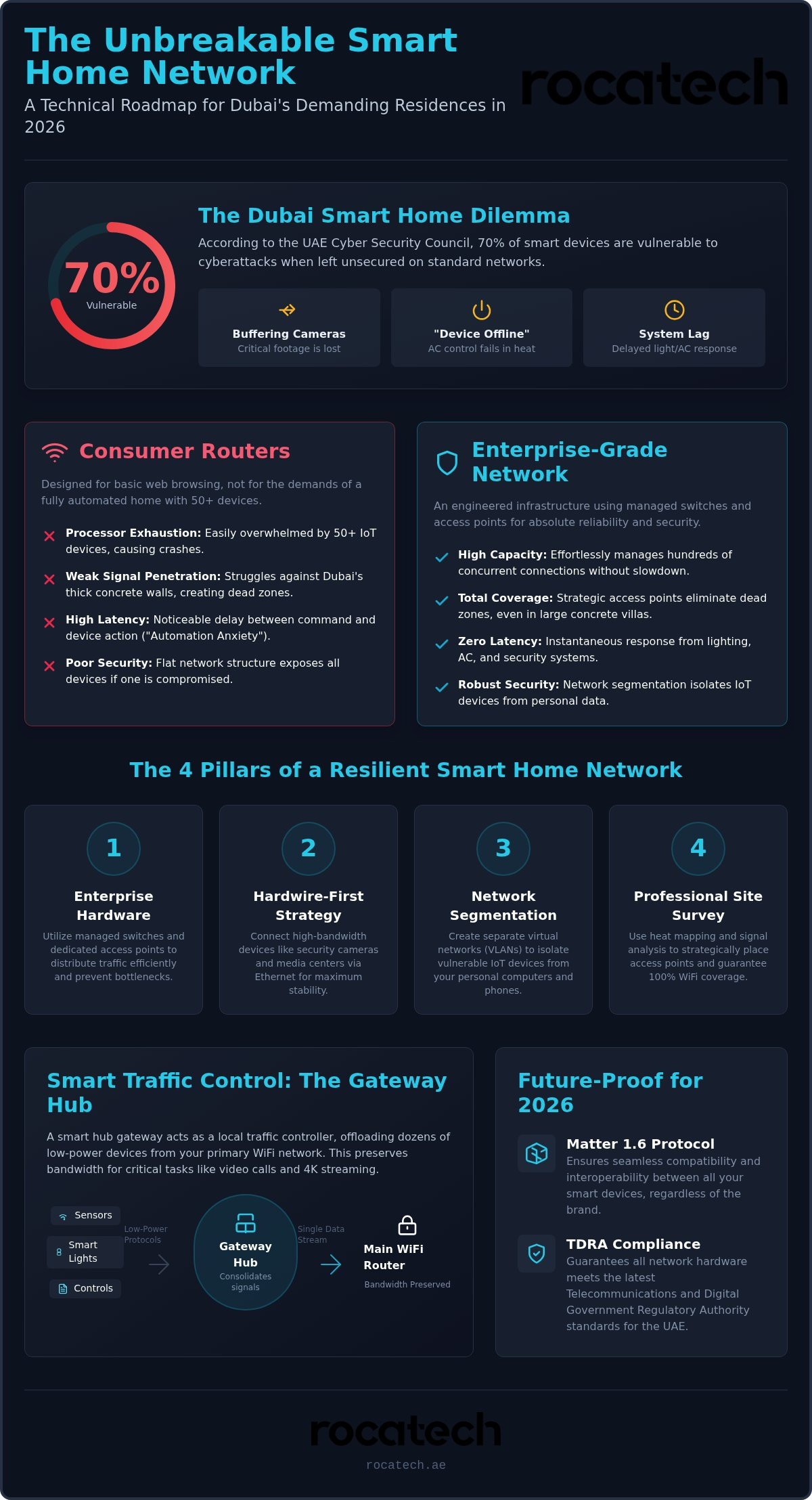
According to the UAE Cyber Security Council, 70% of smart devices in the UAE are vulnerable to cyberattacks when left unsecured. It's a sobering reality for homeowners who prioritize privacy. You've likely experienced the frustration of a security camera feed buffering or a "device offline" error just as you're trying to adjust the AC. These issues often stem from standard consumer routers struggling against the thick concrete walls of Dubai villas. Understanding the specific smart home network requirements dubai has in 2026 is no longer optional; it's the foundation of a functional, secure residence.
We understand that you expect your technology to work with absolute precision and reliability. This professional guide provides the technical roadmap you need to build a robust infrastructure that supports zero-latency control and future-proof security. We'll explore the transition to enterprise-grade networking, the latest TDRA labeling regulations, and how to implement the Matter 1.6 protocol to ensure your home remains a sanctuary of seamless automation.
Key Takeaways
- Transition from consumer-grade setups to enterprise-level hardware to ensure smart lighting and climate controls remain responsive during peak load.
- Master the specific smart home network requirements dubai demands, including Matter 1.6 protocol compatibility and TDRA-compliant hardware standards for 2026.
- Implement a hardwire-first strategy for high-bandwidth devices like home security cameras to eliminate buffering and ensure mandatory footage retention.
- Protect your digital ecosystem through network segmentation, isolating smart devices from personal data to mitigate the high vulnerability risks reported in the region.
- Understand how professional site surveys and heat mapping eliminate WiFi dead zones in large concrete villas, ensuring total coverage and system harmony.
The Foundation of Automation: Why Network Stability Matters in Dubai
Smart home networking is the invisible backbone that connects every sensor, switch, and controller in your residence. While many view it as a simple WiFi extension, professional home automation systems require a dedicated, engineered infrastructure designed specifically for device-to-device communication. In a city where outdoor temperatures regularly exceed 40°C, the stability of this network is a matter of physical comfort. A high-performance smart thermostat Dubai installation, for instance, is only as effective as its connection to the local gateway. When the network falters, the ability to manage cooling remotely disappears, leading to what we call "Automation Anxiety." This psychological stress occurs when a homeowner loses confidence in their system's ability to maintain a livable environment during the peak of summer.
Consumer-grade "plug-and-play" routers are generally designed to handle a few laptops and smartphones. They quickly become overwhelmed when tasked with managing 50 or more concurrent IoT connections. Professional integrated networks, by contrast, use managed switches and dedicated access points to distribute traffic efficiently. This distinction is vital for maintaining long-term value and system harmony. By treating the network as a core utility rather than an afterthought, you ensure that every component, from curtain motors to door locks, operates with the reliability of a hardwired system.
The "Dubai Factor": Heat, Concrete, and Interference
Dubai's unique architecture presents significant challenges for wireless signals. Most villas are constructed with thick reinforced concrete and masonry, which effectively act as Faraday cages, blocking or severely degrading WiFi signals between rooms. In high-density residential areas like Dubai Marina or JLT, signal congestion from hundreds of neighboring routers creates massive interference. Meeting the smart home network requirements dubai homeowners need in 2026 involves more than just adding range extenders. It requires a strategic approach to overcome these structural barriers, ensuring that critical systems like AC control remain operational regardless of external conditions.
Reliability as a Premium Standard
While internet providers often market "speed" as the primary metric, professional automation prioritizes uptime and minimal latency. Network latency is the specific delay between a user triggering a command and the smart lighting or hardware executing that action. In a precision-engineered home, this response must be instantaneous. Rocatech moves beyond the limitations of consumer hardware by implementing enterprise-level stability. We focus on creating a resilient digital environment where operational failure is mitigated through superior hardware and intelligent design. This commitment to precision ensures that your smart home remains a supportive, rather than a frustrating, presence in your daily life.
Technical Requirements: Bandwidth, Protocols, and 2026 Standards
Standard ISP routers provided by local service providers are typically optimized for general web browsing and media consumption. They are not engineered to manage the complex orchestration required by 50 or more concurrent IoT connections. When a network is flooded with requests from sensors, switches, and appliances, these basic units often experience processor exhaustion. This leads to dropped connections and system instability. Meeting the smart home network requirements dubai residences demand in 2026 requires a tiered approach to bandwidth management. We categorize devices into three distinct traffic groups: low-bandwidth sensors, medium-frequency controls like smart lighting, and high-bandwidth 4K video feeds.
A critical component in managing this traffic is the smart hub gateway. By acting as a local traffic controller, the gateway offloads communication from the primary WiFi network. Instead of 30 individual light bulbs competing for WiFi bandwidth, they communicate via low-power protocols directly to the hub. The hub then sends a single, consolidated signal to your router. This architecture preserves your WiFi capacity for high-priority tasks like video conferencing and streaming. If you are unsure if your current hardware can support your planned automation, consulting with a professional integrator can help identify potential bottlenecks before they impact your daily routine.
Understanding Device Density and Traffic
Calculating your device count requires precision. Every motion sensor, water leak detector, and smart plug consumes a network address and contributes to signal overhead. While 2.4GHz remains the standard for range, it is highly congested in Dubai's urban centers. Modern villas now utilize WiFi 6E and WiFi 7 standards, leveraging the 6GHz band to provide interference-free channels for high-performance hardware. Security cameras are particularly demanding; they require dedicated upload bandwidth to maintain 1080p or 4K streams without stuttering. Without sufficient upload capacity, your security system may fail to record critical events during network spikes.
Modern Protocols Beyond WiFi
Low-power mesh networks like Zigbee and Z-Wave have long been the industry standard for sensors due to their reliability. However, 2026 marks the widespread adoption of the Thread protocol, specifically version 1.4. Thread is a self-healing mesh network that eliminates single points of failure, ensuring your devices remain connected even if one node goes offline. The Matter 1.6 protocol, published in June 2026, works over Thread to simplify multi-brand integration, allowing hardware from different manufacturers to communicate natively without complex workarounds. This unified language ensures that your smart home remains interoperable and future-proof as new technologies emerge.
Infrastructure Design: Structured Cabling and Mesh WiFi in Dubai
Dubai villas are architectural marvels built with dense reinforced concrete and heavy rebar. While these materials offer excellent thermal insulation against the desert heat, they are inherently hostile to wireless signals. Relying solely on a single router is a recipe for system failure. To meet the smart home network requirements dubai residents demand, a transition from wireless-only setups to a hybrid wired backbone is essential. We implement a "Hardwire First" rule for all critical hardware. This is particularly vital for your home security camera system. A wired connection ensures that high-definition 4K video streams remain stable and secure, bypassing the interference issues common in high-density areas like Palm Jumeirah or Downtown Dubai.
Designing a resilient villa network requires a methodical approach. Follow this 5-step checklist to establish a professional backbone:
- Professional RF Survey: Conduct a site survey to identify "dead zones" caused by structural concrete.
- Centralized Rack Location: Designate a climate-controlled area for your network switch and smart hubs.
- Vertical Data Risers: Install dedicated cabling paths between floors to prevent signal degradation.
- PoE Integration: Utilize Power over Ethernet switches to provide both data and power to sensors and cameras.
- Outdoor Extension: Deploy weather-resistant access points to cover pool areas and landscaped gardens.
Structured Cabling: The Wired Advantage
In 2026, Cat6a and Cat7 cabling have become the gold standard for high-end Dubai residences. These cables support 10Gbps speeds, providing the necessary overhead for future technological shifts. We recommend installing dedicated data points behind every smart TV and security console. This strategy offloads heavy traffic from the WiFi bands, leaving the airwaves clear for mobile devices and low-power sensors. By utilizing PoE technology, we simplify the installation of hardware like motion sensors and touch panels, as they no longer require a separate electrical outlet near the device.
Advanced Mesh Systems for Villas
For large properties in communities like Emirates Hills, a standard mesh system is often insufficient. Professional-grade Tri-band Mesh systems or wired Wireless Access Points (WAPs) are required to ensure seamless roaming. This allows you to move from the kitchen to the master suite without your connection dropping or switching. These systems handle the "handoff" between nodes with surgical precision. This ensures that your smart lighting and AC controls respond instantly, regardless of your location in the home. Strategic WAP placement, determined by heat mapping, eliminates the frustration of signal drops in multi-story villas.
Security and Segmentation: Protecting the Dubai Smart Ecosystem
Security in a connected residence is a multi-layered discipline that extends far beyond simple passwords. As you integrate more devices, the surface area for potential cyber threats expands. A single compromised smart plug shouldn't provide a gateway to your private financial data or personal documents. This is why advanced segmentation is a core pillar of the smart home network requirements dubai homeowners must prioritize. By isolating your automation hardware from your primary computing devices, you create a digital containment zone that protects your most sensitive information.
Implementing a dedicated guest network is a practical necessity in the Dubai residential landscape. Given the frequent presence of maintenance staff, service providers, and visitors, providing access to your primary network backbone is a significant security risk. A professionally configured guest network allows visitors to access the internet without ever seeing your smart locks, security cameras, or internal servers. This separation ensures that your home remains functional and hospitable without compromising the integrity of your smart home installation Dubai project.
VLANs and IoT Isolation
A Virtual Local Area Network (VLAN) is a logical partition within your physical network that isolates traffic into distinct groups. It acts as a digital wall, ensuring that devices on one "segment" cannot communicate with those on another unless explicitly permitted. For a business-minded homeowner, this means your smart lighting and AC sensors live on a different plane than your work laptop. If a low-security sensor is targeted by a malicious script, the VLAN prevents that threat from migrating to your private server. Rocatech configures robust firewalls to manage this inter-VLAN traffic, allowing for seamless control while maintaining strict security boundaries.
VPNs and Secure Remote Access
For residents who travel frequently, the ability to monitor their Dubai property from abroad is essential. While many basic setups rely on "port forwarding" to allow remote access, this method leaves your network vulnerable to automated scans and brute-force attacks. We advocate for the use of secure cloud gateways or encrypted VPNs (Virtual Private Networks). These technologies create a secure tunnel between your mobile device and your home network, ensuring your data remains private even on public airport WiFi. Rocatech is dedicated to data integrity; we ensure that your remote access is as secure as your physical doorstep. To protect your property with enterprise-grade encryption, you can secure your smart home network through our professional consultation service.
The Rocatech Approach: Precision Networking for Total Control
Rocatech operates at the intersection of mechanical precision and digital intelligence. We understand that a high-end villa is more than a collection of smart devices; it's a complex ecosystem that requires a stable backbone to function correctly. Our role is to bridge the technical gap between your property's electrical infrastructure and the sophisticated automation hardware you rely on for comfort and security. By aligning our designs with the specific smart home network requirements dubai residences demand, we ensure that every command is executed with surgical accuracy.
Our engagement begins with a rigorous consultation process. We don't rely on guesswork. We conduct detailed site surveys and use heat mapping technology to visualize how signals move through your home's unique structural layout. This is particularly important for properties within Emaar, Nakheel, or Damac developments, where specific building materials and community standards influence network performance. Professional calibration serves as the final step, where we optimize your system's frequency bands to ensure maximum uptime and zero interference from neighboring networks.
Consultative Partnership vs. Retail Sales
We prioritize a consultative approach over simple hardware transactions. Before recommending a single router or access point, we conduct a thorough lifestyle analysis to understand how you interact with your home. This ensures that the resulting network isn't just fast, but is specifically tailored to support your daily routines. Rocatech Dubai focuses on building long-term value through ongoing support and system maintenance. We view our clients as partners, providing the technical stability needed to protect your investment and ensure your home remains a sanctuary of reliability.
Next Steps for Your Smart Home
Preparing for a professional network audit is the first move toward a more resilient home. We recommend gathering your property floor plans and a list of all currently connected devices before our visit. This documentation allows us to design a more accurate heat map and identify potential bottlenecks in your current setup. If you're ready to transition from a consumer-grade experience to an enterprise-level infrastructure, the time to act is now. Secure your home's digital foundation today by scheduling a comprehensive survey with our engineering team to ensure your system remains responsive, secure, and fully optimized for the standards of 2026.
Future-Proofing Your Residence with Precision Networking
Establishing a resilient home network is no longer a luxury; it's a critical utility. You've seen how enterprise-grade hardware, protocol standards like Matter 1.6, and strategic structured cabling differentiate a high-performance villa from a standard residence. By prioritizing network segmentation and hardwired backbones for security cameras, you protect your data while ensuring instantaneous system response times. These steps ensure your automation remains a seamless part of your lifestyle rather than a source of technical frustration.
Mastering the smart home network requirements dubai architecture demands provides long-term value and operational peace of mind. Rocatech serves as your dedicated ally in this technical journey. Our Dubai-based technical experts focus on comprehensive system integration and high-stakes reliability to ensure your hardware never fails the network. Book a Professional Smart Home Network Consultation with Rocatech today to finalize your infrastructure design. Your home deserves a foundation that's as intelligent and stable as the technology it supports.
Frequently Asked Questions
Do I need a separate internet connection for my smart home in Dubai?
You don't need a second physical internet subscription to run a connected home. However, you should logically separate your automation traffic from your personal browsing using a Virtual Local Area Network (VLAN). A single high-speed fiber connection from a major local ISP is sufficient, provided you use professional networking hardware to manage the smart home network requirements dubai residences demand for stability.
Will my smart home work if the internet goes down?
Essential functions will continue to work if your system is designed with a local smart hub or gateway. Commands for lighting, climate control, and sensors are processed locally within your property rather than relying on a cloud server. While you'll lose the ability to control your home via your phone from an external location, your physical switches and automated schedules will remain fully operational.
What is the minimum internet speed required for a smart home with cameras?
Upload speed is the most critical factor for surveillance. For a standard 1080p home security camera, you should allocate at least 4 Mbps of upload bandwidth per device. If you've upgraded to 4K surveillance, this requirement increases to approximately 25 Mbps per stream to ensure you don't experience dropped frames or pixelation during recording.
Can I use my standard ISP router for home automation?
The standard routers provided by local telecommunications companies are rarely sufficient for high-density smart homes. These units are designed for general web traffic and often struggle to manage the 50 or more concurrent connections required by a fully automated villa. Professional-grade routers and managed switches are necessary to prevent the processor exhaustion that causes devices to go offline.
How do I stop my smart devices from slowing down my Netflix streaming?
Network segmentation and Quality of Service (QoS) settings are the most effective solutions. By placing high-bandwidth devices like cameras on a separate VLAN and prioritizing streaming traffic, you ensure your entertainment isn't interrupted by background IoT data. Offloading low-power sensors to Zigbee or Thread mesh networks also keeps your primary WiFi channels clear for 4K video.
Is it better to use WiFi or Zigbee for my smart light switches?
Zigbee is the superior choice for lighting and sensors because it operates on a dedicated mesh network that doesn't compete for WiFi bandwidth. WiFi switches are prone to interference in dense residential areas like Dubai Marina. Zigbee devices are also more energy-efficient and provide a self-healing network architecture, ensuring that if one switch fails, the others remain connected.
How much does it cost to professionally wire a villa for smart technology?
Costs vary significantly based on the square footage and the structural materials of the property. Factors such as the number of Cat6a data points and the complexity of routing cables through reinforced concrete walls influence the final investment. We recommend a professional site survey to provide a precise technical assessment and a detailed design tailored to your specific architectural needs.
What are the main security risks of a smart home network?
The primary risks involve unauthorized access through unsecured IoT devices and the potential for "lateral movement" across a non-segmented network. If a single smart plug is compromised, an attacker could potentially access your private computers if they're on the same network. Implementing robust firewalls and isolating your automation ecosystem are the most effective ways to mitigate these vulnerabilities.