

15 Motion Sensor Automation Ideas for Your Dubai Home in 2026

Why is your air conditioning still running at full capacity in an empty room simply because a manual switch wasn't toggled? Many Dubai residents face the daily frustration of high energy bills and "dumb" sensors that turn off while they're still in the room. You need a system that offers reliability and technical precision rather than occasional convenience. This guide delivers 15 advanced motion sensor automation ideas dubai residents can use to transform their villas or apartments into truly intelligent environments. We'll show you how to move beyond simple triggers to create a home that enhances your security, comfort, and energy efficiency. You'll get a preview of how to integrate motion technology with your smart thermostats and lighting controls to ensure your property operates with total excellence throughout 2026.
Key Takeaways
- Understand how transitioning from PIR to mmWave technology ensures your home detects presence with precision, eliminating the frustration of sensors that fail while you are still in the room.
- Discover innovative motion sensor automation ideas dubai residents can use to create custom lighting scenes, such as the "Midnight Path" for safe, glare-free navigation at night.
- Learn to integrate smart thermostats and curtain motors with occupancy data to automatically regulate climate and block solar heat gain when rooms are empty.
- Strengthen villa security with active deterrence automations that link sensors to cameras and floodlights for immediate notification of perimeter activity.
- Gain insight into why professional placement is critical in Dubai's extreme climate to ensure thermal interference does not compromise the reliability of your automation system.
The Essential Role of Motion Sensors in a Dubai Smart Home
A reliable motion detector serves as the primary trigger for any sophisticated automation sequence. In a technically advanced residence, these devices act as the neural endings of the property, providing the raw data required for "hands-free" logic. Without precise sensing, a home isn't truly smart; it's merely remote-controlled. By 2026, the standard for residential automation in the UAE has shifted from simple reactive triggers to proactive environment management. This evolution ensures that your home anticipates your needs rather than waiting for a manual command.
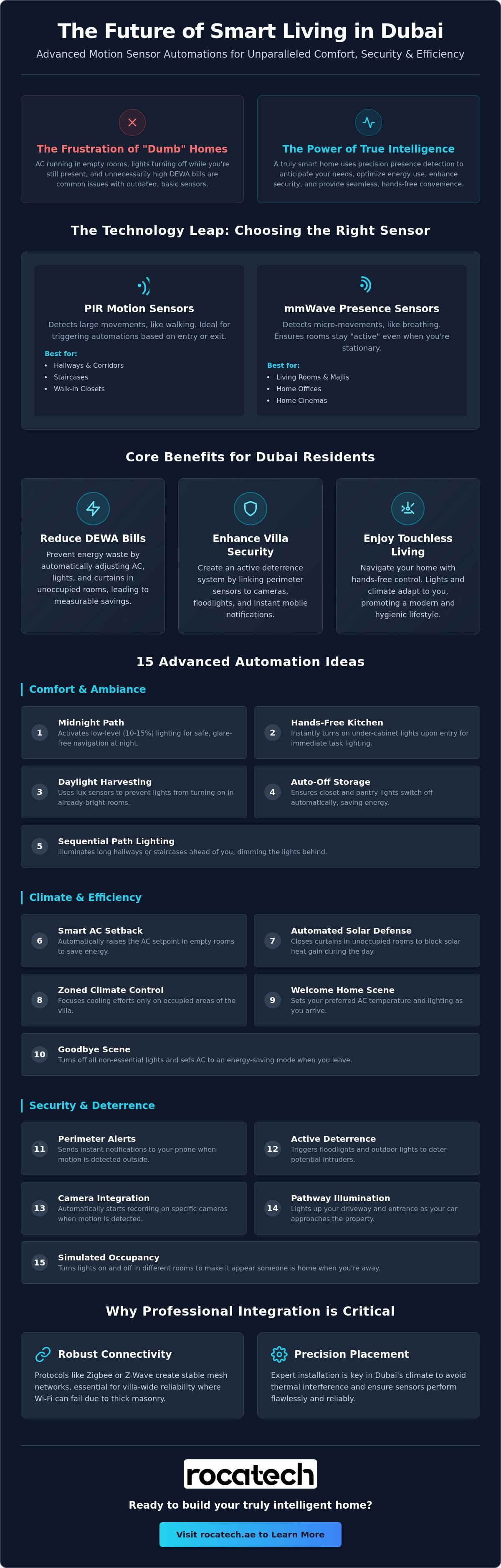
The technological landscape in 2026 has seen a significant transition from traditional Passive Infrared (PIR) sensors to mmWave presence detection. While PIR technology remains effective for transit areas, mmWave sensors utilize high-frequency radio waves to detect micro-movements, such as the rise and fall of a chest during breathing. This precision eliminates the common frustration of lights turning off while you're still in the room. When implementing motion sensor automation ideas dubai homeowners must consider this distinction to ensure operational reliability in every living space.
System stability is paramount, especially in large villas where thick masonry can obstruct signals. For this reason, professional integrations favor Zigbee or Z-Wave protocols over standard Wi-Fi. These mesh networks provide the robust connectivity required for villa-wide stability, ensuring that a sensor in the far wing of a property communicates instantly with the central gateway. This architectural approach to connectivity guarantees that your automation sequences execute without latency or failure.
Motion vs. Presence: Choosing the Right Sensor
Selecting the correct hardware depends entirely on the room's function. PIR sensors are the superior choice for high-traffic transit areas like hallways, staircases, and walk-in closets where movement is constant and brief. In contrast, presence (mmWave) sensors are essential for "dwell" zones such as home offices, living rooms, and cinemas. These sensors maintain the active state even when occupants are stationary. For outdoor applications, hardware must be specifically weather-rated to withstand Dubai's intense UV exposure and fine desert dust, preventing hardware degradation over time.
The Core Benefits for UAE Residents
The primary advantage for Dubai residents is a measurable reduction in DEWA electricity consumption. By using active occupancy data to set back air conditioning temperatures in empty rooms, homeowners can avoid the waste associated with cooling unoccupied spaces. Security is another critical pillar, particularly for expansive villas in prestigious areas like Jumeirah or Emirates Hills. Integrated sensors provide a layer of active deterrence that traditional alarms cannot match. Finally, the touchless convenience afforded by these systems supports a modern, hygienic lifestyle in high-traffic family homes, allowing for seamless movement without the need to touch physical switches.
Smart Lighting Automations for Comfort and Ambiance
Lighting is no longer merely a functional requirement; it's a vital component of environmental design. In a high-end residence, the transition from darkness to light must be fluid and intentional. One of the most effective motion sensor automation ideas dubai homeowners can adopt is the "Midnight Path" scene. This configuration utilizes low-level dimming to guide occupants through hallways or to the bathroom during late hours. By capping brightness at 10% or 15%, the system provides enough visibility for safety without the blinding glare that disrupts sleep cycles.
In the kitchen, motion sensors provide critical hands-free convenience. Under-cabinet lighting can be programmed to activate the moment you enter with groceries, providing immediate task lighting without searching for a switch. Efficiency is further enhanced through lux-integrated sensors. These devices measure the current light levels in a room, ensuring that artificial lights only trigger if the space is actually dark. This prevents energy waste during the bright Dubai daytime. Furthermore, placing sensors in closets and pantries eliminates the "forgotten light" problem, ensuring these storage areas remain dark when unoccupied.
Advanced Hallway and Staircase Logic
Large villas require a more sophisticated approach than simple on-off triggers. Sequential lighting allows LEDs to follow your movement down a long corridor or staircase, illuminating the path directly ahead while dimming the lights behind you. Integrating these sensors with smart lighting control enables time-of-day dimming. This logic ensures the system delivers 100% brightness during active daytime hours but automatically switches to a soft, amber-toned glow during the night to maintain a tranquil atmosphere. If you value technical precision, exploring professional automation solutions ensures these sequences execute with absolute reliability.
Living Room and Entertainment Scenes
Entertainment spaces demand complex logic to avoid intrusive lighting. A "Movie Mode" exception is essential; it instructs the system to ignore motion triggers if the home cinema system or television is active. For residents in Emaar or Nakheel apartments, occupancy-based "Welcome Home" scenes can trigger ambient accent lighting for art or architectural features the moment the door opens. This level of environmental harmony is supported by academic research on smart home security and automation, which demonstrates that integrated systems significantly improve the living experience by reducing manual overhead. These motion sensor automation ideas dubai residents use most frequently prove that when technology is applied with precision, it becomes invisible.
Motion-Driven Climate Control and Energy Efficiency
In the extreme climate of the UAE, cooling accounts for a substantial portion of residential energy expenditure. Integrating occupancy data with your climate systems is one of the most impactful motion sensor automation ideas dubai homeowners can implement to reduce costs. The "Empty Room" setback is a primary example of this efficiency. By programming your system to raise the thermostat temperature by two or three degrees when no motion is detected for 30 minutes, you prevent the unnecessary cooling of unoccupied spaces. This logic ensures that comfort is prioritized only where it's actually required.
Curtain integration adds another layer of thermal protection. When sensors indicate a guest room or secondary living area is vacant, the system can automatically signal smart curtain motors to close. This simple action blocks direct sunlight, significantly reducing solar heat gain and easing the load on your AC units. These coordinated movements prevent "vampire" energy waste, where systems work at peak capacity to cool rooms that nobody is using. It's a methodical approach that directly optimizes your DEWA utility bills through technical precision. Even bathroom humidity can be managed more effectively by triggering exhaust fans only when the room is occupied, ensuring ventilation runs exactly when needed.
Maximising Your Smart Thermostat
To achieve true environmental harmony, link your external motion sensors to a smart thermostat Dubai system designed for precision cooling. This setup allows for multi-room temperature balancing based on real-time occupancy. If the system detects that the family is gathered in the dining room, it can prioritize airflow to that zone while scaling back in the bedrooms. For villas with balconies, you can create a safety logic that deactivates the AC if a door remains open for more than two minutes while motion is detected nearby, preventing the system from trying to cool the outdoors.
Smart Plug and Appliance Automations
Motion data can also govern your smaller appliances via smart plugs. You can program hot water dispensers or coffee machines to power down when the house remains empty for an extended period. This strategy is also effective for home theatre systems, which often consume significant standby power during work hours. Safety is a critical benefit here as well. You can configure a rule to cut power to high-heat appliances, such as hair straighteners or irons, if the sensor detects no movement in the dressing area for 10 minutes. This provides psychological reassurance and operational safety for every resident, ensuring that high-stakes technical failures are avoided through automated oversight.
Enhanced Villa Security and Outdoor Automations
Security in Dubai's gated communities requires a proactive approach that traditional alarms often fail to provide. By implementing advanced motion sensor automation ideas dubai residents can create an "Active Deterrence" environment that identifies threats before they reach the main structure. For instance, detecting movement near the villa gate at night can immediately trigger high-intensity floodlights while sending a critical notification to your smartphone. This immediate response often discourages unauthorized entry by removing the cover of darkness. Similarly, garage and driveway lighting can be programmed to illuminate the moment your vehicle enters the villa perimeter, ensuring a safe and well-lit arrival.
Pool area safety is a high-priority concern for families. You can configure sensors to send an immediate alert to parents' phones if motion is detected near the water after hours, providing an essential layer of protection for children. Integrating these triggers with your home security camera system ensures that recording only occurs during specific "events." This methodical approach saves storage space and makes it significantly easier to review critical footage rather than sifting through hours of static video. To ensure your villa is protected by the most reliable technology, consult with a specialist at Rocatech to design a custom security ecosystem.
Intelligent Perimeter Monitoring
Technical precision is required to differentiate between pets and humans to avoid the annoyance of false "intruder" alerts. Modern dual-technology sensors use AI-driven algorithms to analyze heat signatures and movement patterns, ensuring that a stray cat doesn't trigger a full security response. These sensors can also facilitate "soft" alerts. For example, a specific light in the kitchen could flash when a delivery arrives at the gate, providing a non-intrusive notification. Additionally, outdoor motion can be used to prep your smart hub gateway for your arrival, ensuring that internal climates and lighting scenes are activated the moment you step through the door.
Internal Security Alerts
The "Away Mode" logic is a cornerstone of villa protection. If your system is armed and motion is detected in unauthorized zones, the automation can trigger a full alarm, including sirens and the activation of every internal light to maximize visibility. For high-value properties in Palm Jumeirah, safe room monitoring provides an additional layer of psychological and operational reassurance. You can also restrict motion-triggered events based on occupant type; for example, you might only allow motion-triggered lights in specific service zones for visitors or staff, keeping private wings of the villa entirely dark and secure unless you are present. These motion sensor automation ideas dubai homeowners value most provide a level of control that is both sophisticated and grounded in practical application.
Professional Implementation: Why Precision Integration Matters
While the wide range of motion sensor automation ideas dubai residents can explore is extensive, the success of these systems depends entirely on the precision of their implementation. DIY installations often result in "dead zones" where sensors fail to trigger or "false positives" where lights activate without cause. These technical failures undermine the reliability of a smart home, transforming a supposed convenience into a source of daily frustration. Precision is not optional when dealing with high-stakes environments where operational failure is unacceptable.
Professional placement is particularly critical during the 50°C Dubai summer. Extreme heat significantly affects the performance of Passive Infrared (PIR) sensors, which rely on detecting changes in heat signatures. A sensor positioned too close to a high-output AC vent or a window receiving direct solar radiation will experience thermal interference. This leads to erratic behavior or total system blindness. Expert installers understand these environmental variables and calibrate the hardware to maintain stability regardless of external temperatures.
Centralized control ensures that your sensors, smart thermostats, and curtain motors operate as a single, harmonious unit. This integration allows for the complex logic sequences required for true energy efficiency and security. By moving away from standalone gadgets toward a consultative partnership approach, you ensure that your investment provides long-term value and operational excellence.
Designing Your Sensor Network
Building a robust network requires a methodical approach to hardware selection and placement. For a standard 5-bedroom villa, the optimal number of sensors typically exceeds fifteen units to ensure total coverage without overlap. Our engineers evaluate the specific requirements of each zone to determine the best connectivity model:
- Hardwired Sensors: These are prioritized for high-traffic transit areas and new-build projects to ensure maximum reliability without the need for battery maintenance.
- Battery-Powered Sensors: These offer flexibility for retrofitting existing properties or placement in architectural niches where cabling is impractical.
- Protocol Standardization: We utilize Matter and Thread protocols to ensure your system remains compatible with new hardware releases through 2026 and beyond.
Start Your Automation Journey with Rocatech
Our smart home installation Dubai service is designed to deliver system harmony through rigorous technical standards. We begin every project with an on-site survey to identify the exact placement for mmWave presence sensors, accounting for furniture layout and room usage patterns. This level of detail ensures that your automation system provides the emotional reassurance of a home that simply works. To begin designing your bespoke ecosystem, book a consultation with Rocatech Dubai and secure a partnership grounded in technical excellence.
Elevate Your Living Environment Through Precision Automation
Transforming your residence into a high-performance smart home requires more than just hardware; it demands a strategic approach to system integration. By implementing the motion sensor automation ideas dubai homeowners value most, you move beyond simple triggers to achieve a state of environmental harmony. You've seen how mmWave presence detection eliminates the flaws of older technology, while occupancy-based climate control directly addresses the demands of the UAE’s extreme summer heat. These systems provide the technical reliability and psychological reassurance that your property is operating with total excellence at all times.
Achieving this level of sophistication requires a partner with deep expertise in Dubai's unique villa architecture. Rocatech offers professional integration with DEWA-saving AC controls and employs certified installers for Zigbee and Z-Wave systems to ensure villa-wide stability. Our consultative approach prioritizes long-term value and operational precision to ensure your home remains technologically advanced for years to come. Design your custom motion automation with Rocatech Dubai to secure a home that anticipates your needs and protects your interests. It's time to experience the future of integrated living today.
Frequently Asked Questions
What is the best location for a motion sensor in a Dubai villa?
The optimal location for a motion sensor is typically in a corner at a height of 2.1 to 2.4 meters. This placement provides a 90-degree field of view across the entire room, ensuring maximum coverage. In Dubai villas, it is critical to keep sensors away from direct AC airflow and windows receiving intense sunlight. Rapid thermal changes can cause false triggers in standard infrared hardware, so precision in placement is essential for system stability.
Do motion sensors work through glass balcony doors?
Standard Passive Infrared (PIR) sensors do not work through glass because they detect infrared radiation, which glass panels effectively block. However, mmWave presence sensors utilize high-frequency radio waves that can sometimes penetrate thin materials. For reliable balcony security, we recommend placing weather-rated sensors on the exterior side of the door. This ensures the system detects perimeter activity without the interference or signal degradation caused by heavy glazing.
How can I stop my pets from triggering my smart home motion sensors?
You can prevent pet-related false alarms by using pet-immune sensors or adjusting the installation height. Pet-immune hardware is designed to ignore heat signatures below a certain weight threshold, typically 20 to 40 kilograms. Another effective strategy is to invert the sensor or mask the lower portion of the lens. This creates a "pet alley" where movement near the floor remains undetected while the system still monitors for human presence at chest height.
Can motion sensors really help lower my DEWA bill in the summer?
Yes, motion sensors are highly effective at reducing DEWA consumption by automating climate set-backs. By linking occupancy data to your smart thermostat, the system can raise temperatures in unoccupied rooms by several degrees automatically. This prevents the "vampire" energy waste common in large Dubai villas during the peak summer months. It's a methodical approach that ensures cooling systems only run at full capacity when a room is actually in use.
What is the difference between a motion sensor and a presence sensor?
The primary difference lies in the sensitivity and technology used for detection. A standard motion sensor requires significant movement, such as walking, to trigger an event. A presence sensor utilizes mmWave technology to detect micro-movements like breathing. This precision is essential for the motion sensor automation ideas dubai residents use in living rooms or offices. It ensures lights and AC remain active even when occupants are sitting still for long periods.
Do I need a smart hub to use motion sensors in my home?
While some standalone Wi-Fi sensors exist, a dedicated smart hub or gateway is essential for complex, reliable automations. Hubs utilizing Zigbee or Z-Wave protocols provide a stable mesh network that connects sensors to other devices like lights and AC units. This centralized architecture ensures that your automation logic executes locally. It maintains system harmony even if your external internet connection fluctuates, providing the technical reliability required in high-stakes home environments.
How long do the batteries last in wireless smart motion sensors?
Most high-quality wireless motion sensors offer a battery life of one to two years under normal operating conditions. Factors such as the frequency of movement in the area and the specific communication protocol used will influence this duration. To ensure operational excellence, we recommend professional systems that provide low-battery notifications through your central hub. This proactive monitoring prevents unexpected gaps in your home's automation coverage and ensures long-term reliability.
Are smart motion sensors affected by the high humidity in Dubai?
Standard indoor sensors are generally unaffected by humidity within a climate-controlled environment. For outdoor areas, balconies, or bathrooms, it's vital to use hardware with a high Ingress Protection (IP) rating, such as IP65 or higher. These devices are sealed against moisture and fine dust particles. Using weather-rated hardware ensures the long-term durability and technical precision required for the unique environmental conditions found throughout the UAE.