

Smart Home Privacy Concerns in the UAE: A 2026 Security & Privacy Guide

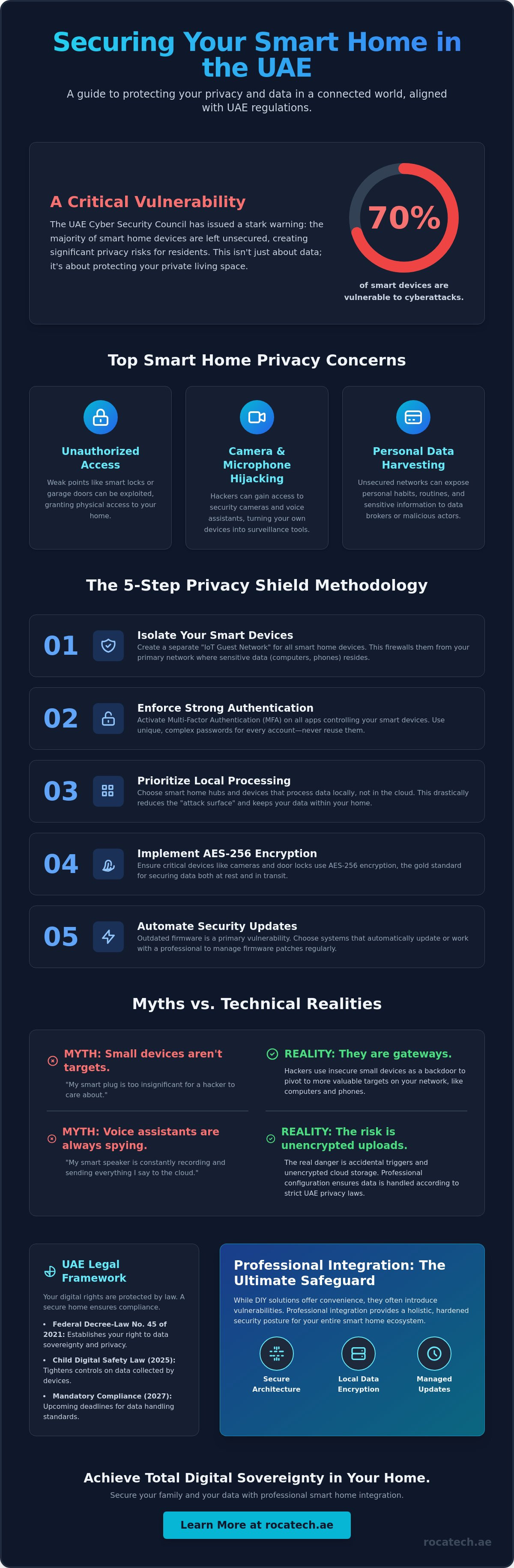
The UAE Cyber Security Council recently warned that 70% of smart home devices are vulnerable to cyberattacks when left unsecured. This statistic is a wake-up call for residents who integrated technology for comfort but now face growing smart home privacy concerns uae authorities highlighted throughout early 2026. You want the convenience of a smart door lock or a video doorbell, but you don't want the risk of unauthorized access to your private living spaces. It's understandable to feel uneasy about voice assistants recording conversations or the complexity of securing a home network against sophisticated digital fraud.
This guide ensures you can enjoy a connected home in Dubai with total confidence that your family's privacy is ironclad. You'll discover how to implement professional security standards that align with the UAE Federal Data Protection Law and the 2025 Child Digital Safety Law. We'll outline a methodical approach to securing your network, from local data encryption to meeting the mandatory 2027 compliance deadlines. This strategy ensures your smart hub, motion sensors, and cameras work for you without compromising your digital sovereignty or operational stability.
Key Takeaways
- Gain an expert understanding of how the UAE Federal Decree-Law No. 45 of 2021 establishes your rights to data sovereignty and personal privacy.
- Identify the primary smart home privacy concerns uae homeowners encounter when balancing the convenience of connected hubs with the need for robust network security.
- Master the "5-Step Privacy Shield" methodology to secure your IoT guest network and enforce multi-factor authentication across all platforms.
- Explore the technical advantages of AES-256 encryption for critical hardware such as smart door locks, video doorbells, and security cameras.
- Learn why professional integration serves as the ultimate safeguard against the common security vulnerabilities found in "off-the-shelf" DIY installations.
The Current State of Smart Home Privacy in the UAE (2026)
In 2026, the UAE has solidified its position as a global leader in urban automation. From the high-rises of Downtown Dubai to the sprawling villas of Emirates Hills, the "Smart City" initiative has turned private residences into sophisticated data hubs. While this shift brings immense convenience, it also amplifies smart home privacy concerns uae homeowners must address. Every connected device, whether it's a smart thermostat or a simple motion sensor, represents a potential entry point for unauthorized access if it isn't managed with technical precision. A secure home provides a psychological benefit that goes beyond physical safety; it offers the emotional reassurance that your private life remains truly private.
True privacy in a connected environment isn't about avoiding technology. It's about establishing local sovereignty over your data. There's a fundamental difference between functional data collection, which allows your smart lighting control to respond to your presence, and data exploitation, where personal habits are harvested for external profit. Understanding Smart Home Technology Explained helps clarify that while platform fragmentation remains a challenge, professional integration can bridge these gaps with secure, local encryption. By 2026, the reality is clear: more devices mean more entry points, making a structured security strategy essential for every household.
Why Dubai Residents are Prioritising Digital Security
Residents in integrated communities like JVC and Emirates Hills are shifting their focus from novelty gadgets to secure infrastructure. This change is driven by a series of warnings from the UAE Cyber Security Council throughout early 2026. These reports revealed that 70% of IoT devices remain vulnerable to cyberattacks due to poor configuration or outdated firmware. Security is no longer a luxury feature in Dubai's real estate market; it's a foundational requirement. Moving from digital anxiety to technical confidence requires a shift toward systems that prioritize local storage and encrypted gateways over vulnerable, cloud-only models.
Common Privacy Myths vs. Technical Realities
- Myth: "My smart plug or water leak sensor is too insignificant for a hacker to target."
- Reality: Small, unbranded sensors often lack robust security protocols, allowing them to serve as "lateral movement" gateways. Once a hacker accesses a weak device, they can navigate your entire home network to reach sensitive data on your computers or smartphones.
- Myth: "Voice assistants are constantly recording and transmitting every private conversation."
- Reality: While 2026 regulations like the Child Digital Safety Law have tightened controls, the real risk lies in accidental triggers and unencrypted cloud uploads. Professional configuration ensures these systems only activate under specific, user-defined conditions and that audio data is handled according to strict UAE privacy standards.
Top Smart Home Privacy Concerns for UAE Homeowners
Homeowners in Dubai often prioritize aesthetic integration, yet technical vulnerabilities in certain hardware categories create significant smart home privacy concerns uae residents must mitigate. The primary risk factor often stems from "off-the-shelf" unbranded devices. These products lack the rigorous security certifications found in professional ecosystems. When a manufacturer's cloud server is compromised, every device connected to that server becomes a potential liability. This is particularly critical for hardware that controls physical access, such as a smart door lock, or captures sensitive visuals, like a home security camera.
A major differentiator in 2026 is the architectural choice between cloud-dependent and local-first automation. Cloud-based systems transmit your data to external servers for processing, which increases the "attack surface" available to hackers. Local hubs, by contrast, process data within the confines of your home network. This technical distinction is vital for maintaining compliance with evolving Data protection laws in the UAE, which emphasize the rights of individuals to control their personal information. Choosing local processing reduces the risk of data exploitation significantly.
Security Cameras and the "Indoor Spying" Risk
Unauthorized access to live video feeds remains the most significant fear for families in the region. Cheap, unbranded cameras often ship with hardcoded "backdoor" passwords that are easily exploited by botnets. To ensure your property remains private, look for cameras equipped with physical privacy shutters and clear LED activity indicators. These hardware-level features provide a visual guarantee that the lens is inactive. For a deeper look at protecting your premises, consult our Home Security Camera Guide 2026.
Smart Hubs and Data Aggregation
The smart hub or gateway acts as the brain of your home, but it's also a central point for data aggregation. These devices track behavioral patterns, such as when you activate your smart lighting control or adjust your smart thermostat. If a hub uses third-party app integrations without strict sandboxing, your daily routines could be shared with data brokers without your explicit consent. Selecting a hub that prioritizes local processing ensures that your behavioral data stays on-site. If you're ready to upgrade to a more secure architecture, exploring a professionally configured smart hub solution can provide the necessary stability and peace of mind.
UAE Data Protection Laws: Your Rights as a Consumer
The legal landscape in the Emirates has evolved to provide residents with robust control over their digital footprints. Federal Decree-Law No. 45 of 2021, known as the Protection of Personal Data (PDPL), serves as the primary legislative shield for homeowners. This law is particularly relevant when addressing smart home privacy concerns uae residents face as they integrate more sensors into their daily lives. By 2026, the executive regulations for the PDPL have activated strict enforcement timelines, meaning manufacturers and service providers must now demonstrate exactly how they protect your information.
One of the most powerful aspects of the PDPL is the "Right to be Forgotten." This allows you to request the permanent deletion of your data from a provider's database once you stop using a specific smart plug or gateway. Additionally, the law ensures data portability, giving you the right to move your information between different service ecosystems without technical barriers. When you partner with a local UAE-based integrator, you gain the advantage of legal accountability. Unlike overseas vendors, local companies operate under the direct jurisdiction of the UAE Data Office, ensuring that any breach notification occurs within the mandatory 72-hour window required by law.
Identifying PDPL-Compliant Smart Devices
Before purchasing a new smart thermostat or video doorbell, it's essential to verify the manufacturer's privacy policy. A compliant policy must clearly state where your data is stored and who has access to it. Data residency is a critical factor; storing information on local UAE servers often provides higher security than sending it to overseas data centers with varying protection standards. Ask your provider if their smart lighting control systems allow for local data storage or if they rely exclusively on international cloud clusters. A transparent provider will offer clear documentation on their encryption standards and data handling protocols.
The Role of the TDRA in Smart Home Security
The Telecommunications and Digital Government Regulatory Authority (TDRA) plays a pivotal role in maintaining the integrity of the Emirates' IoT landscape. Through its IoT Regulatory Framework, the TDRA ensures that every certified device undergoes testing for security vulnerabilities before it reaches the consumer. This centralized monitoring prevents the influx of substandard hardware that often leads to privacy breaches. Ensuring your smart home installation dubai adheres to these local safety codes is the most effective way to protect your family. These regulations work in tandem with the 2025 Child Digital Safety Law to enforce strict parental controls and age verification for any device used by minors in your household.
The 5-Step Privacy Shield: How to Secure Your Dubai Home
Securing a modern residence requires more than just a strong password. To effectively mitigate smart home privacy concerns uae, homeowners must adopt a layered defense strategy. This methodical approach ensures that even if one component is targeted, the rest of the ecosystem remains isolated and secure. Moving from basic settings to a professional security posture provides the technical stability needed for a truly connected life.
- Step 1: Implement Network Segmentation. Your primary Wi-Fi should be reserved for computers and smartphones. Create a dedicated "IoT Guest Network" for devices like smart plugs and sensors. This prevents lateral movement, ensuring a compromised sensor cannot access your personal banking data.
- Step 2: Enforce Multi-Factor Authentication (MFA). Every automation account, from your video doorbell to your lighting app, must require a second verification step. MFA is the most effective barrier against unauthorized account takeovers.
- Step 3: Disable Unused Features. Audit your hardware for "feature creep." Turn off built-in microphones on smart TVs and disable remote access for devices that only need to function while you are physically present in the home.
- Step 4: Conduct Regular Firmware Audits. Manufacturers frequently release patches to counter 2026-specific exploits. Check your management apps monthly to ensure all hardware is running the latest, most secure version.
- Step 5: Prioritise Local Storage. Whenever possible, use a Network Video Recorder (NVR) for your home security camera instead of cloud subscriptions. Keeping your footage on physical hardware within your villa eliminates the risk of cloud-based data leaks.
Advanced Network Hardening for Villas
Standard ISP-provided routers are often the weakest link in your privacy chain. These devices frequently lack the sophisticated hardware firewalls and encrypted DNS capabilities needed to block sophisticated trackers effectively. Utilizing a professional smart hub gateway allows you to centralize your security management. This architecture shields your internal traffic from external observation and provides a stable foundation for advanced encryption protocols.
Physical Privacy Measures
Digital security should always be complemented by physical safeguards. A smart curtain motor can be programmed to close automatically at dusk, preventing external visual surveillance of your living spaces. Similarly, smart lighting control can utilize "Mockupancy" settings to simulate your presence while you're away, deterring physical intruders without exposing your real-time habits to the cloud. In your camera software, configure "Privacy Zones" to mask neighbors’ windows or gardens, ensuring your surveillance remains respectful of community standards and UAE privacy expectations. If you want a system designed with these professional standards from the start, you can secure your home automation today with our expert integration services.
Why Professional Integration is the Ultimate Privacy Safeguard
While DIY kits offer a low barrier to entry, they often lure homeowners into a "DIY Trap" where security is sacrificed for ease of use. Self-installed systems frequently rely on default cloud configurations that are easily bypassed by modern exploits. Professional integration addresses smart home privacy concerns uae residents face by implementing AES-256 encryption across all device communications. This standard ensures that data traveling between your smart door lock and your gateway remains unreadable to outside parties. Security isn't a one-time setup; it's a continuous lifecycle that requires expert oversight to maintain its integrity.
Rocatech’s commitment to "Privacy by Design" means that security is baked into the initial architecture of every project. We prioritize local-first processing, ensuring that sensitive data from your motion sensors and water leak sensors never leaves your local network unless explicitly required. This approach provides a level of operational stability and data sovereignty that off-the-shelf products simply cannot match. By choosing a professional path, you move away from vulnerable, generic setups toward a customized environment where every entry point is strictly controlled.
Precision Setup vs. Generic Installation
Our engineers conduct a comprehensive audit of your local network environment to identify and eliminate potential vulnerabilities before they can be exploited. We implement customized user permissions, ensuring that only verified family members have access to critical systems like your video doorbell or home security camera. This level of granularity prevents the "all-or-nothing" access models common in basic apps. Partnering with Rocatech Dubai provides you with a long-term ally dedicated to the precision and excellence of your home's digital infrastructure.
Future-Proofing Your Privacy for 2027 and Beyond
The digital landscape is shifting rapidly, and by 2027, homeowners will face even more sophisticated AI-driven hacking attempts. Proactive monitoring is essential to stay ahead of these threats. We specialize in identifying and upgrading legacy devices that no longer receive security patches, removing these "weak links" from your ecosystem. This forward-thinking strategy ensures your home remains a fortress as UAE privacy standards continue to tighten. Rocatech balances the convenience of luxury automation with the uncompromising stability of military-grade privacy standards to protect your Dubai property.
Securing Your Digital Future in the Emirates
Establishing a secure smart home in Dubai requires a shift from simple convenience to a structured, network-first approach. We've explored how network segmentation and strict multi-factor authentication form the primary defense against the smart home privacy concerns uae residents face today. By 2026, maintaining compliance with the PDPL and the Child Digital Safety Law is essential for anyone seeking absolute data sovereignty within their private residence. Technical reliability provides the emotional reassurance that your family's daily routines remain confidential and protected from external observation.
As UAE-based expert installers, we specialize in high-security villa automation and PDPL-compliant system designs. Our engineers prioritize local-first processing to ensure your data stays within your property, effectively future-proofing your privacy for 2027 and beyond. Secure your home with a professional Rocatech consultation today to experience the peace of mind that comes with precision-engineered automation. Your connected home should be a sanctuary; with the right technical partner, it will be.
Frequently Asked Questions
Do smart home devices in the UAE record my conversations?
Voice assistants and smart hubs are designed to record only after detecting a specific "wake word." However, accidental triggers can happen. To mitigate this, use the hardware mute buttons on your devices when privacy is paramount. The 2025 Child Digital Safety Law also mandates stricter parental controls for these devices, ensuring that children's voices are handled with enhanced protection standards across all UAE households.
How can I tell if my smart camera has been hacked?
You can identify a compromised home security camera by observing unexpected lens movements or the LED status light blinking when the system isn't in use. Check your management app for unfamiliar login locations or IP addresses. If you notice your smart lighting control acting erratically without user input, it might indicate a broader network breach. Immediate action includes resetting the device and changing your gateway credentials.
Is it safer to use Apple HomeKit, Google Home, or Amazon Alexa in Dubai?
Security levels vary based on how each platform handles data residency and encryption. Apple HomeKit is often preferred for privacy because it emphasizes local processing over cloud storage. Regardless of the platform, the most stable and secure approach for a Dubai residence involves professional integration. A localized system ensures your data stays within the UAE, aligning with the high standards of the Federal Data Protection Law.
Does the UAE Personal Data Protection Law apply to smart home manufacturers?
Every manufacturer or service provider processing the personal data of UAE residents must comply with Federal Decree-Law No. 45 of 2021. This law grants you specific rights, including the right to access and erase your data. Companies selling smart thermostats or video doorbells in the Emirates are legally obligated to protect your information and must notify the UAE Data Office within 72 hours of any breach.
Can I use a smart home without an internet connection for better privacy?
You can operate a fully functional smart home without an active internet connection by using local-only protocols like Zigbee or Z-Wave. This setup ensures that your smart curtain motors and motion sensors communicate only with a local hub. By keeping data off the cloud, you effectively eliminate the primary smart home privacy concerns uae homeowners face regarding external server vulnerabilities and unauthorized remote data harvesting.
What is network segmentation and why does my villa need it?
Network segmentation involves creating a dedicated, isolated Wi-Fi sub-network specifically for your IoT hardware. Your villa needs this because it prevents a compromised smart plug from accessing your private laptops or smartphones. By keeping your automation traffic separate from your personal data traffic, you create a digital firewall that significantly reduces the risk of a total home network takeover.
Are smart door locks in Dubai vulnerable to digital picking?
High-quality smart door locks are remarkably resistant to digital picking when they utilize professional-grade encryption like AES-256. Most security failures occur in cheap, unbranded locks that use weak communication protocols. Choosing certified hardware from a reputable integrator ensures your physical entry points remain as secure as your digital ones. Regular password rotations and enabling multi-factor authentication provide the necessary layers of technical reliability.
How often should I update the firmware on my smart devices?
You should audit and update your device firmware at least once every 30 days. Manufacturers release these patches to fix security holes that hackers exploit. Since the UAE Cyber Security Council warned that 70% of IoT devices are vulnerable if left unmanaged, staying current with software versions is a critical maintenance task. Setting your smart hub to notify you of available updates ensures your system stays resilient.