

Smart Home for High Humidity Climate: The 2026 Dubai Guide

Why does your villa still feel heavy and damp even when the AC is running at full capacity? In the intense humidity of a Dubai summer, traditional cooling often fails to address the underlying moisture that leads to mold growth and sticky indoor air. You've likely noticed your DEWA bills climbing into the higher slab rates, reaching as much as AED 0.380 per kWh for consumption over 6,000 kWh, without achieving the crisp comfort you expect.
It's frustrating to manage a home that feels like it's working against you. This guide provides the technical roadmap to mastering a smart home for high humidity climate management. You'll learn how to integrate professional-grade sensors and automated systems to maintain a healthy, mold-free environment without constant manual intervention. We will examine the specific hardware, from smart thermostats to precision curtain motors, that stabilizes your indoor atmosphere and optimizes energy efficiency for the unique UAE market in 2026.
Key Takeaways
- Understand how coastal humidity levels in Dubai trigger condensation and mold, and how automated monitoring provides a permanent solution.
- Learn why high-precision hygrometers are the essential foundation of a smart home for high humidity climate management in the UAE.
- Reduce monthly energy consumption by utilizing smart thermostats that automate AC fan speeds and dedicated dehumidification modes.
- Discover how integrated smart curtain motors minimize thermal load, preventing your HVAC system from struggling against intense solar heat.
- Recognize the importance of professional installation to ensure sensor accuracy and long-term system stability in demanding technical environments.
Understanding the Impact of High Humidity on Dubai Homes
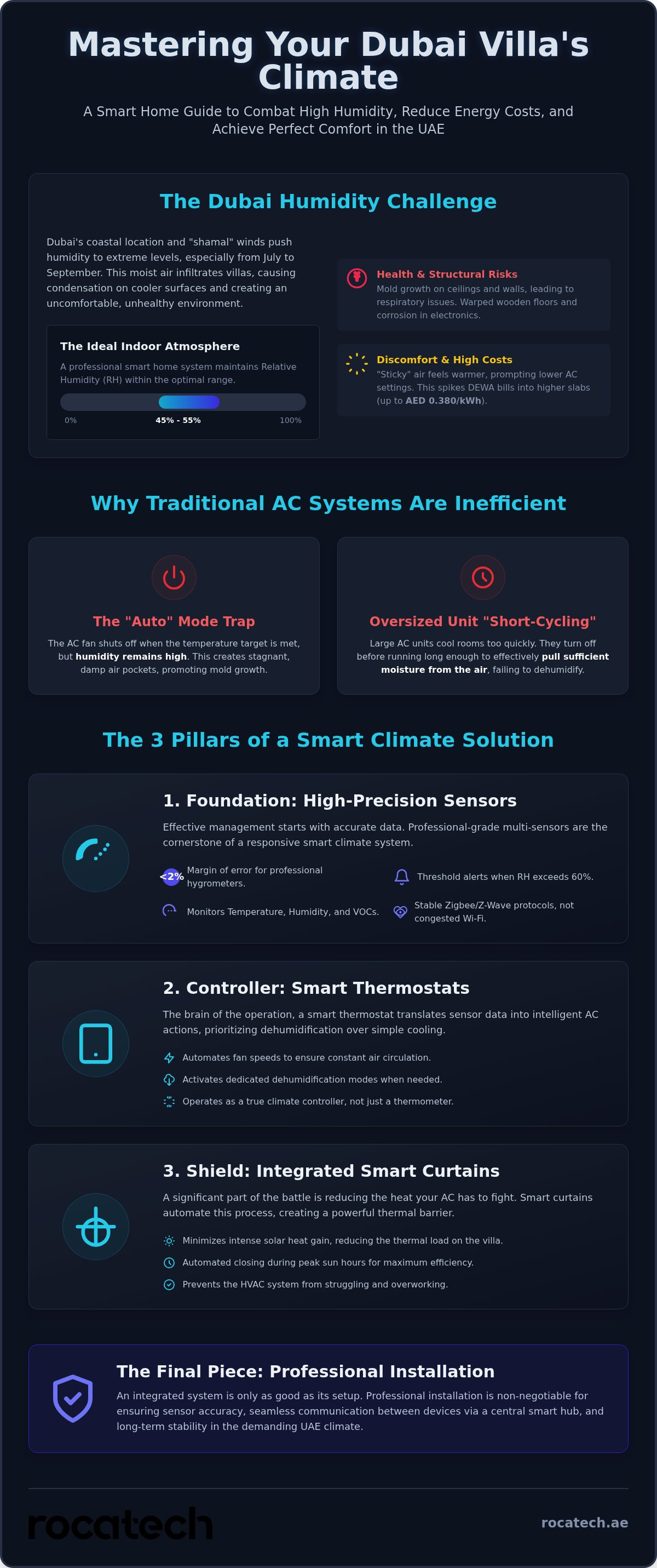
Dubai's geography creates a unique atmospheric challenge for homeowners. Being a coastal city, the "shamal" winds carry significant moisture from the Arabian Gulf, pushing outdoor humidity levels well beyond comfortable thresholds during the peak months of July through September. When this warm, moist air meets the cooler surfaces of a villa, condensation occurs. This isn't just a matter of comfort; it's a technical failure of the building envelope. A professional smart home for high humidity climate approach treats the house as a single, integrated ecosystem where sensors and cooling units communicate to prevent saturation. Implementing sophisticated home automation systems allows for the constant monitoring of Relative Humidity (RH), ensuring it stays within the ideal 45% to 55% range.
The Health and Structural Risks of Excess Moisture
High indoor humidity is the primary catalyst for mold proliferation. It often appears as dark spotting on gypsum ceilings or behind wallpaper in poorly ventilated corners. For residents, this leads to chronic respiratory irritation and heightened allergy symptoms. Beyond health, the structural toll is significant. Luxury wooden flooring can warp, and high-end electronics often fail prematurely due to internal corrosion caused by damp air. There's also the "sticky" factor to consider. High humidity prevents sweat from evaporating, making a room at 24°C feel significantly warmer. This perceived heat often drives residents to lower their AC setpoints, which inadvertently spikes DEWA consumption and increases monthly utility costs.
Why Traditional AC Settings Fail in the UAE Summer
Most residents rely on the standard "Auto" mode on their thermostats, but this is a common trap. In "Auto" mode, the AC fan frequently shuts off once the temperature target is reached, even if the humidity remains dangerously high. This creates stagnant, damp air pockets throughout the home. Many Dubai villas are also equipped with oversized AC units. These systems cool the air so rapidly that they "short-cycle," turning off before they've had enough runtime to effectively pull moisture from the air. Without the precision of a smart thermostat dubai integration, your cooling system operates as a simple thermometer-based switch rather than a comprehensive climate controller. Professional automation ensures that dehumidification remains a priority, regardless of the current temperature reading.
Essential Smart Sensors for Real-Time Humidity Monitoring
Effective humidity management starts with high-fidelity data. In a smart home for high humidity climate, the hygrometer is your most critical diagnostic tool. Unlike basic thermometers found in retail stores, professional-grade hygrometers provide real-time relative humidity (RH) readings with a margin of error of less than 2%. This precision is vital because even a 5% discrepancy can be the difference between a dry room and one where mold spores begin to colonize. Research on the Impact of Humidity on Indoor Air Quality in Dubai highlights that consistent monitoring is necessary to mitigate health risks in coastal environments where atmospheric moisture is persistent.
While Wi-Fi sensors are common, they often drain batteries quickly and congest your home network. For a reliable residential setup, Zigbee or Z-Wave protocols are technically superior. These technologies create a low-power mesh network that remains stable even if your main router fluctuates. Monitoring should extend beyond the primary living area. Bathrooms and kitchens are obvious moisture sources, but walk-in closets are often overlooked. Without airflow, these confined spaces become breeding grounds for mold on leather goods and fabrics. By setting threshold alerts, your system can notify your smartphone the moment RH levels exceed 60%, allowing for immediate manual or automated intervention.
Choosing High-Precision Multi-Sensors for the UAE
When selecting hardware, prioritize multi-sensors that track temperature, humidity, and Volatile Organic Compounds (VOCs). High humidity often traps pollutants, so monitoring air purity alongside moisture provides a holistic view of your home's health. In the UAE's heat, battery durability is a concern; look for industrial-grade components designed for long-term operational stability. These devices require a centralized smart hub gateway to translate sensor data into actionable commands for your AC system, ensuring every room stays within safe parameters.
Strategic Placement for Accurate Data Collection
Sensor placement is as important as the hardware itself. You should avoid "dead zones" behind heavy furniture or locations directly in the path of AC vents, as these provide false readings that don't reflect the room's true state. Pay close attention to large glass facades common in Dubai villas; the temperature differential near the glass can cause localized humidity spikes and condensation. For the most accurate results, sensors should be mounted at chest height, approximately 1.5 meters from the floor, to capture the air quality in the breathing zone. If you're unsure about the optimal layout for your specific floor plan, professional sensor mapping ensures your automation system receives the highest quality data possible.
Optimizing AC and Ventilation with Smart Automation
Conventional cooling is often insufficient in the UAE. To maintain a smart home for high humidity climate, your AC must act as a dedicated dehumidifier. Most standard thermostats only monitor temperature, but a smart thermostat dubai allows you to prioritize Relative Humidity (RH) levels as a primary trigger. When sensors detect moisture exceeding 60%, the system can automatically switch the AC to "Dry Mode" or modulate the fan speed. Lowering the fan speed increases the time air spends in contact with the cold evaporator coils. This maximizes moisture extraction. This technical adjustment prevents the common trap where the compressor shuts off too early, leaving the air feeling heavy and damp.
Integrating exhaust fans into the smart ecosystem is another vital step. By using smart switches or plugs, bathroom and kitchen fans can activate automatically based on localized humidity spikes. This ensures that steam from showers or cooking is evacuated at the source before it migrates to other rooms. Coordinating these smaller components with your central HVAC system creates a comprehensive moisture barrier that protects your home's interior and lowers the risk of mold in hidden cavities.
Precision Cooling and Dehumidification Modes
Coordinating multiple AC units is essential for large villas. Moisture travels quickly from high-humidity zones to cooler areas, creating condensation on vents and walls. Smart automation manages these zones as a unified system. Features like "Follow Me" use motion sensors to prioritize cooling only in occupied spaces. This reduces the total load on the compressor and helps keep electricity consumption within the lower DEWA slab rates, such as the AED 0.230/kWh bracket for residential users. It prevents the system from pushing you into the more expensive AED 0.380/kWh tier through inefficient, constant cooling.
Automated Ventilation Cycles for Fresh Air Exchange
Fresh air is necessary for indoor health, but uncontrolled ventilation in Dubai is a liability. Implementing Smart Ventilation for Humidity Control involves using automated dampers that only open when outdoor conditions are favorable. While many believe early morning air is always better, the relative humidity in Dubai often peaks before sunrise. Smart systems analyze both indoor and outdoor data to time air exchange only when the absolute moisture content is manageable. This strategy significantly reduces the latent heat load on your AC. It prevents the compressor from working overtime to strip moisture from newly introduced air, ensuring long-term hardware durability and consistent comfort.
Reducing Thermal Load with Integrated Smart Curtains
Dubai's sun is a primary driver of indoor humidity issues. When solar radiation penetrates large glass windows, it creates a greenhouse effect that rapidly raises the internal temperature. This thermal load forces your AC system to work at maximum capacity. However, high-speed cooling often bypasses the dehumidification cycle, leaving rooms cold but damp. Integrating smart curtain motors into your smart home for high humidity climate strategy allows you to manage this heat gain proactively. By automating your window treatments, you maintain a more stable "thermal envelope," which is the physical barrier that keeps treated air in and extreme external conditions out.
Shading automation works best when synchronized with other systems. For instance, combining motorized curtains with smart lighting control ensures your home remains bright even when the curtains close to block the afternoon sun. Instead of relying on manual adjustments, the system tracks the sun's position across the Dubai sky, closing east-facing curtains in the morning and west-facing ones in the afternoon. This precision reduces the latent heat that the AC must overcome, directly impacting your moisture management capabilities.
Blocking Solar Heat to Improve AC Efficiency
The impact of infrared and UV radiation on a villa's cooling demand is substantial. Unprotected glass can increase the cooling load by as much as 30% during peak summer hours. By reducing this demand, you keep your electricity consumption within more favorable DEWA brackets. For example, maintaining usage below 6,000 kWh per month keeps your rate at AED 0.320/kWh, avoiding the top-tier AED 0.380/kWh surcharge. Automated shading ensures the compressor runs in longer, more efficient cycles that are optimized for stripping water vapor from the air rather than just dropping the temperature in a short burst.
Creating Humidity-Responsive Automation Scenes
You can program advanced "Summer Shield" scenes that respond to real-time environmental data. If outdoor humidity spikes or light sensors detect intense glare, the curtains close automatically to fortify the home's defenses. This prevents the indoor temperature from rising to a point where the air's moisture-holding capacity increases, which is a major factor in preventing that "sticky" indoor feeling. If you're ready to fortify your villa against the summer heat, consider professional smart curtain motor integration to see how precision shading can transform your indoor environment.
Professional Installation: Why Integration Matters for UAE Climates
Building a robust smart home for high humidity climate management requires more than just high-end hardware. It demands a deep understanding of how coastal salinity and extreme heat impact electronic longevity. In areas like Dubai Marina or the Palm Jumeirah, the salt-heavy air can corrode exposed sensors and external components much faster than in inland regions. Professional smart home installation dubai ensures that your devices are shielded and positioned to withstand these specific environmental stressors while maintaining peak operational accuracy.
DIY attempts often stumble when facing the complexity of local HVAC systems. Most Dubai villas utilize ducted systems or high-capacity split units that require specialized bridging adapters to communicate with smart thermostats. A simple wiring error can lead to system short-cycling, which is a primary cause of humidity spikes. Expert calibration is necessary to ensure that your sensors aren't just reading the air; they must provide the precise data needed to trigger dehumidification cycles at the exact moment they're required. Without this technical precision, even the most expensive gadgets will fail to deliver the moisture control your home needs.
The Rocatech Approach to Climate Precision
Our methodology begins with a comprehensive property audit. We identify humidity hotspots, such as north-facing walls or poorly sealed balcony doors, that standard setups might miss. By selecting professional-grade hardware designed specifically for Gulf conditions, we create a unified ecosystem. This includes the seamless integration of your smart thermostats, curtain motors, and lighting controls into a single, stable interface. This holistic approach ensures that every component works in harmony to reinforce your home's thermal envelope, preventing the atmospheric saturation that leads to mold growth.
Long-Term Reliability and System Maintenance
Maintaining a healthy indoor environment is an ongoing process. As technology evolves toward 2026 standards, regular firmware updates become critical to keep sensor algorithms accurate. rocatech dubai provides the technical stability needed for high-stakes home environments where system failure could lead to costly mold remediation. We help homeowners transition from reactive cooling to proactive moisture management. This shift not only protects your property's structural integrity but also provides the psychological reassurance that your living space is being monitored by a seasoned ally. Operational failure is not an option when your health and luxury finishes are at stake.
Secure Your Indoor Environment with Precision Automation
Managing Dubai's extreme coastal moisture requires a shift from simple cooling to technical climate orchestration. By integrating high-precision hygrometers with smart thermostats and automated curtain motors, you create a home that actively defends against mold and structural damage. This approach doesn't just improve comfort; it optimizes your energy footprint, helping you stay within lower DEWA tariff brackets even during the peak summer months. Precision sensors ensure that your AC works to dehumidify the air rather than just lowering the temperature in inefficient bursts.
Implementing a smart home for high humidity climate management is a high-stakes investment that demands professional expertise. Rocatech specializes in localized solutions that address the specific architectural and environmental challenges of the UAE. Trusted by residents across Emaar and Nakheel properties, we provide full lifecycle support from the initial technical consultation to professional installation. Book a professional smart home consultation with Rocatech today to ensure your villa remains a healthy, energy-efficient sanctuary throughout 2026 and beyond. We look forward to helping you achieve total indoor climate control and long-term peace of mind.
Frequently Asked Questions
What is the ideal indoor humidity level for a home in Dubai?
The ideal relative humidity for a Dubai home is between 45% and 55%. Maintaining this range prevents the proliferation of mold and dust mites while ensuring respiratory comfort for residents. If levels consistently exceed 60%, the risk of structural damage to luxury finishes and wooden flooring increases significantly. A professional smart home for high humidity climate setup uses automated triggers to keep your environment within these safe parameters.
Can a smart thermostat really lower my DEWA bill in the summer?
A smart thermostat can significantly reduce your monthly DEWA expenses by optimizing cooling cycles. By avoiding unnecessary over-cooling and utilizing precision sensors, you can keep your consumption within the lower slab rates, such as the AED 0.230/kWh bracket. This prevents your bill from escalating into the AED 0.380/kWh tier, which applies once usage exceeds 6,000 kWh. Intelligent scheduling ensures you only pay for the cooling you actually need.
Do I need a separate dehumidifier if I have a smart AC system?
Most Dubai homes don't require standalone dehumidifiers if the central AC system is properly automated. Smart thermostats can activate "Dry Mode" and modulate fan speeds to prioritize moisture extraction over simple temperature drops. This technical integration allows your existing HVAC hardware to function as a powerful dehumidifier. It's a more efficient solution than running multiple portable appliances that increase your total energy load and heat output.
How do smart curtains help with indoor humidity?
Smart curtains manage the greenhouse effect caused by intense solar radiation through large glass facades. By blocking infrared heat, they reduce the thermal load on your AC system. When the AC doesn't have to fight extreme heat spikes, it can run in longer, steadier cycles. These extended runtimes are much more effective at removing water vapor from the air than the short, aggressive bursts typical of unshaded rooms.
Are smart sensors reliable in the extreme heat of the UAE?
Industrial-grade smart sensors are specifically designed to maintain accuracy in high-temperature and high-salinity environments like the UAE coast. Unlike basic consumer models, professional hardware uses durable components that won't drift or fail due to heat exposure. For the best reliability, we recommend Zigbee or Z-Wave sensors. These protocols provide a stable mesh network that remains operational even if your home's primary Wi-Fi connection fluctuates during peak usage.
Is it better to have a DIY smart home or professional installation in Dubai?
Professional installation is highly recommended due to the technical complexity of Dubai's ducted and split AC systems. DIY setups often lack the bridging adapters and precise calibration needed to prevent AC short-cycling, which is a leading cause of humidity spikes. A professional integrator ensures that your sensors, thermostats, and curtain motors work as a unified system. This provides the long-term reliability required in high-stakes technical environments.
What happens to my smart home system during a dust storm?
Your smart home system can be programmed to respond proactively to dust storms and high-wind events. When sensors detect a drop in air quality or a spike in external pressure, the system can automatically close smart curtains and shut ventilation dampers. This creates a sealed environment that prevents fine dust and humid air from entering your living spaces. It protects your indoor air quality and reduces the post-storm cleaning burden.
Can I monitor my home's humidity while I am traveling away from the UAE?
You can monitor and manage your home's climate from anywhere in the world via a secure mobile application. By using a centralized smart hub gateway, you receive real-time alerts if humidity levels cross your defined thresholds while you're traveling. You can also activate an "Away Mode" that maintains a safe baseline humidity level. This protects your property from mold growth while keeping energy consumption at an absolute minimum.