

Nest Thermostat in Dubai: The Ultimate 2026 Integration & Efficiency Guide

Did you know that air conditioning typically accounts for 70% of a Dubai household's annual DEWA bill? You likely feel the financial impact every summer when temperatures exceed 45 degrees Celsius, yet certain rooms remain uncomfortably warm while others are freezing. Integrating a nest thermostat into your HVAC system is no longer just a luxury upgrade; it's a technical necessity for precision climate management in the UAE's demanding environment.
We understand that the complexity of US versus UAE hardware specifications often leads to hesitation, especially when a DIY mistake could damage an expensive cooling unit. This guide provides a comprehensive roadmap to mastering your home's climate through professional integration. You'll discover how to achieve consistent cooling, reduce energy consumption, and enjoy the peace of mind that comes with a robust, expertly configured smart home interface. We will outline the specific technical steps required to transform your AC into a high-efficiency system designed for 2026 standards and beyond.
Key Takeaways
- Understand the critical technical distinctions between international hardware and UAE standards to prevent equipment failure and ensure system longevity.
- Learn how to optimize your nest thermostat settings to significantly reduce DEWA cooling costs during Dubai’s extreme 50°C summer months.
- Discover the necessity of industrial-grade step-down transformers and power kits for bridging the 220V vs 24V divide in local HVAC systems.
- Compare the technical specifications and aesthetic finishes of the Gen 3, Nest E, and 2026 Gen 4 models to find the perfect fit for your interior design.
- Identify why professional integration and technical traceability provide the ultimate peace of mind for high-performance climate control in the UAE.
Understanding Nest Thermostat Compatibility in the UAE Market
The Nest Thermostat functions as a learning, Wi-Fi-enabled controller designed to manage residential and commercial HVAC systems with industrial-grade precision. It's no longer just a luxury gadget. In Dubai, where cooling systems operate nearly 3,500 hours per year, this device serves as a critical interface for energy optimization. Integrating this technology into a smart home installation Dubai strategy allows for a transition from reactive cooling to predictive climate management.
Hardware selection is the first technical hurdle for UAE residents. There's a vital distinction between US-spec and UAE-compatible hardware versions. US models are built for 24V systems common in North America. However, many Dubai properties utilize 220-240V systems or specific digital protocols that require a Nest Heat Link or a third-party 24V transformer and relay. Using the wrong hardware version can lead to motherboard failure or inefficient compressor cycling. Professional integration ensures the hardware matches the local electrical standards and the specific requirements of the cooling unit.
Local property developers like Emaar, Damac, and Nakheel often utilize centralized chilled water systems or complex Fan Coil Units (FCUs). These systems frequently use proprietary backplates or multi-speed fan configurations that aren't natively compatible with a standard nest thermostat out of the box. Specialized adapters or professional rewiring are often necessary to maintain control over fan speeds and valve actuators, ensuring the system remains robust and responsive during peak summer temperatures.
Property-Specific AC Configurations in Dubai
Dubai's real estate landscape features two primary cooling architectures. High-rise apartments typically use Chilled Water systems, while standalone villas in areas like Arabian Ranches often rely on DX (Direct Expansion) units. Identifying the thermostat backplate is essential. Older villas may have simple four-wire setups, while newer smart-ready homes feature complex digital interfaces. The "C-wire" (Common wire) requirement is the most frequent obstacle, as it provides the continuous power needed for Wi-Fi connectivity. Approximately 85% of retrofit projects in older Dubai districts require a new C-wire pull or a power-add-on kit to ensure system stability.
The Evolution of Nest Hardware for 2026
The latest Gen 4 and Learning Thermostat models have evolved to meet the demands of 2026 smart environments. These units now feature enhanced Matter protocol support, which is vital for future-proofing UAE homes against platform fragmentation. This allows the thermostat to communicate seamlessly with other industrial-grade sensors and automation hubs. The Nest Learning Thermostat provides 2026 homeowners with an autonomous energy-management system that predicts cooling requirements based on external humidity and occupancy patterns. This level of integration transforms the HVAC system from a utility into a managed asset that prioritizes both comfort and operational longevity.
Maximizing Energy Efficiency and DEWA Savings in 50°C Heat
Managing cooling costs in Dubai isn't just about comfort; it's a critical financial strategy. During peak summer months, air conditioning can account for up to 70% of a residential DEWA bill. The nest thermostat addresses this high-load environment by moving beyond simple timers. It utilizes machine learning to analyze your home's thermal profile, understanding exactly how long it takes to cool down when the outside temperature hits 50°C. This predictive cooling prevents the HVAC system from overworking, which stabilizes energy consumption and reduces the risk of mid-summer mechanical failure.
The Airwave feature provides a technical solution to compressor fatigue. In traditional setups, the compressor and fan run simultaneously until the target temperature is reached. Nest's algorithm shuts off the compressor a few minutes early while keeping the fan running to distribute the remaining cold air trapped in the coils. This small adjustment significantly lowers electricity draw without sacrificing indoor climate quality. For residents in glass-heavy penthouses in Dubai Marina or Downtown, Sunblock technology is equally vital. It uses built-in light sensors to detect when direct sunlight is hitting the unit, preventing the thermostat from misreading the room temperature and triggering unnecessary, expensive cooling cycles.
The ROI of Smart Cooling in the UAE
Local energy audits indicate that ENERGY STAR certified smart thermostats can reduce cooling costs by approximately 15% in the UAE climate. For a large villa, this translates to savings of several hundred AED every month during the high-summer season. Beyond direct DEWA savings, precise temperature maintenance extends the operational lifespan of your HVAC equipment. By preventing the rapid "short-cycling" of compressors, the system experiences less mechanical wear. Remote access also eliminates "accidental cooling," allowing you to shut down systems from your office if they were left running in an empty home.
Advanced Features for the Dubai Lifestyle
Modern integration allows the thermostat to function as part of a wider ecosystem. Connecting your HVAC to smart lighting control enables holistic "Away" modes that close motorized blinds and dim lights simultaneously to keep heat gain at a minimum. Other essential features include:
- Humidity Sensing: Monitors internal moisture levels to prevent mold growth during Dubai’s humid August nights.
- Geofencing: Uses your phone’s location to begin cooling the home exactly 15 minutes before you arrive from work.
- Holiday Optimization: Provides peace of mind by allowing you to monitor your home's vitals from anywhere in the world during the summer travel season.
Implementing these systems requires a high level of technical precision to ensure compatibility with local wiring standards. For homeowners seeking a stable, long-term solution, consulting with an automation specialist ensures your cooling infrastructure is robust enough to handle the most demanding desert conditions.
Technical Integration: Bridging the 220V vs. 24V Divide
The industrial reality of UAE electrical standards presents a significant hurdle for smart home adoption. Most residential HVAC systems in Dubai operate on a 220V to 240V high-voltage circuit. The nest thermostat is engineered for 24V low-voltage North American standards. Connecting these systems directly will result in immediate hardware failure; it often destroys the unit internal circuitry within seconds. This voltage gap requires a structured technical approach to ensure the device operates safely within the local infrastructure.
Integration requires a dedicated step-down transformer and a specialized power kit. These components act as a bridge between the mains power and the thermostat logic board. Beyond simple power delivery, we must address the 3-speed fan challenge common in Dubai fan coil units (FCU). While a standard nest thermostat is designed for single-speed systems, maintaining your AC's variable airflow is vital for comfort and humidity control. We utilize advanced relay modules to translate the thermostat digital signals into physical commands for low, medium, and high fan speeds.
Professional Installation vs. DIY Risks
Attempting a DIY setup in a high-end Dubai villa carries substantial financial risks. A single wiring error can short-circuit the control board of a central AC unit, leading to emergency repairs that often exceed AED 3,000. Certified technicians prioritize a rigorous commissioning phase. This involves testing fan relay speeds and validating the cooling call sequence to prevent "short cycling," which is a leading cause of compressor failure in the UAE heat. Precision during this stage ensures the system delivers the reliability expected in a professional environment.
Integration with Building Management Systems (BMS)
Modern Dubai apartments frequently utilize centralized cooling networks from providers like Empower or Emicool. To unify these systems, we configure a smart hub gateway to synchronize the thermostat with external sensors and district cooling valves. In a standard Dubai AC circuit, the 24V transformer serves as the critical isolation point that converts high-voltage mains into a safe, regulated signal for the thermostat's processor. Professional calibration is the final step; it ensures the device reflects the actual room temperature rather than the heat trapped within the wall cavity, providing the precision required for true energy efficiency.
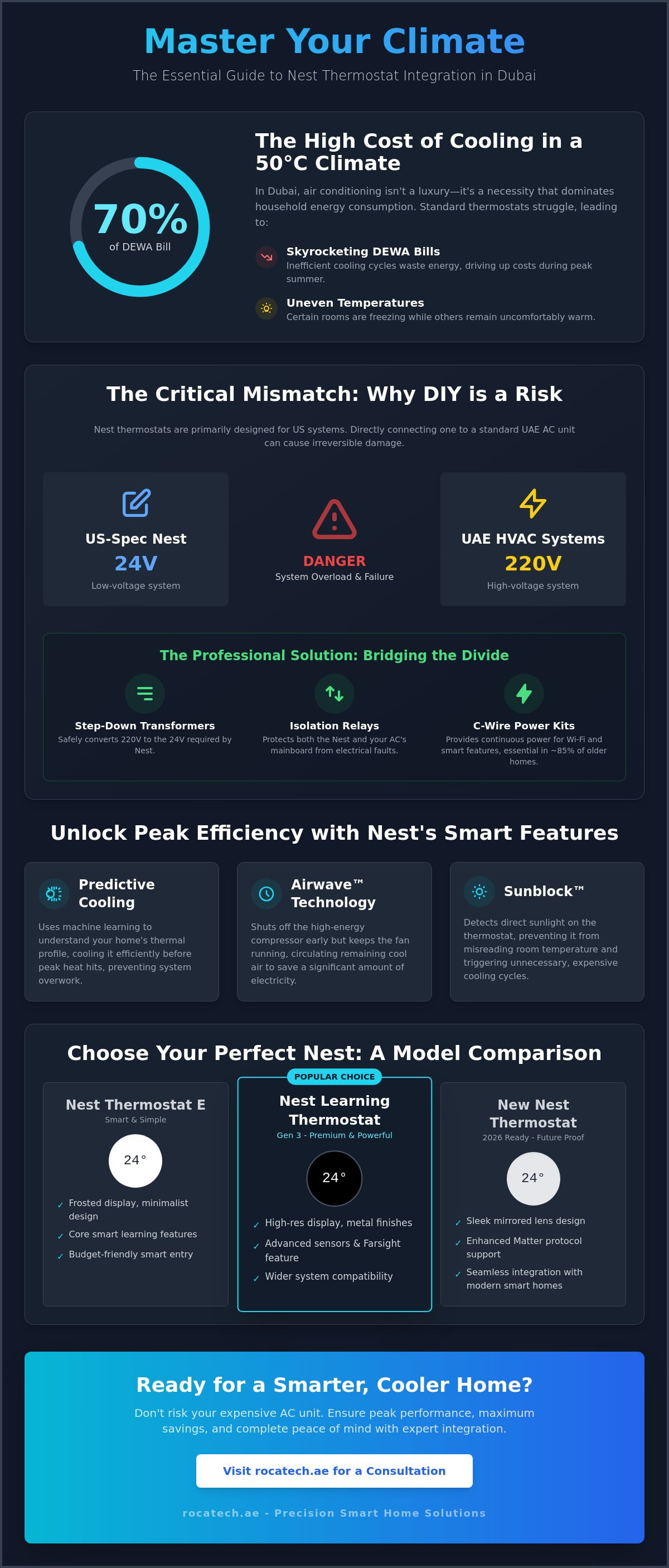
Comparing Nest Models: Which is Best for Your UAE Home?
Selecting the right nest thermostat involves balancing aesthetic preferences with the technical requirements of your HVAC system. In the Dubai market, where air conditioning accounts for nearly 70% of household energy consumption, this choice directly impacts your operational costs. Rocatech views this selection not as a simple purchase, but as a strategic investment in home automation infrastructure. Whether you live in a high-rise apartment or a sprawling villa, the hardware must match the architectural demands of your space.
The Nest Learning Thermostat Gen 3 & 4
These flagship models represent the pinnacle of climate control technology. The 2026 Gen 4 release features ultra-high-resolution displays and premium metal finishes like polished steel, brass, and copper. These materials complement the high-end interior designs found in luxury Dubai villas. The primary advantage is the advanced learning algorithm. It studies your habits for seven days and automates temperature shifts without manual input. For large, multi-story residences in areas like Emirates Hills, these models support up to six remote room sensors. This ensures balanced cooling across every floor, preventing the common issue of "hot spots" in complex floor plans.
- Strengths: Dynamic Farsight display, stainless steel construction, and predictive cooling.
- Best for: Large villas and owners seeking a total "hands-off" solution.
- Integration: Seamlessly connects with multi-stage HVAC and district cooling systems.
The Nest Thermostat E and Entry Models
The Nest E offers a minimalist, frosted glass aesthetic that blends into neutral walls. It's a robust solution for modern apartments or rental properties in areas like Jumeirah Village Circle. While it lacks the high-polish finish of the flagship, it provides reliable energy management through a simplified interface. It's important to verify compatibility before installation. These entry-level models may face limitations when integrated into complex chilled water systems common in older Dubai towers. They're designed for residents who prefer a "set it and forget it" manual schedule over autonomous learning.
- Strengths: Cost-effective, unobtrusive design, and easy app-based scheduling.
- Best for: Apartments and residents who prioritize functional simplicity.
- Limitations: Fewer terminal connections for advanced HVAC accessories.
While premium models require a higher initial outlay, the long-term ROI is measurable. Data from local energy audits indicates that a correctly configured nest thermostat can reduce cooling expenses by 15% to 20% annually. For a villa in Arabian Ranches, this translates to thousands of Dirhams (AED) in savings over a five-year residency. You aren't just buying a device; you're securing a more efficient lifecycle for your entire HVAC system. This precision ensures that your equipment doesn't work harder than necessary during the 45°C summer peaks.
Ensure your home remains a sanctuary of precision and comfort by choosing the right hardware with Rocatech's expert integration services.
The Rocatech Advantage: Precision Smart Home Solutions
Rocatech operates as your authoritative partner for advanced smart thermostat integration. We don't just supply devices; we engineer environments. Our methodology applies industrial-grade installation standards to residential properties, ensuring every nest thermostat deployment meets rigorous technical benchmarks. This commitment to technical traceability means every wire, connection, and software setting is documented and optimized for the high-demand climate of the UAE.
Our "Total Solution" approach eliminates the guesswork often associated with consumer-grade smart home setups. We begin with a comprehensive AC audit to verify system compatibility and electrical load capacity. Following the physical installation, our team handles the complex software configuration required to sync your cooling with local environmental variables. This systematic process ensures your system provides the reliability and peace of mind necessary for high-stakes property management. Reliability is our baseline, not an optional feature.
Custom Consultations for Dubai Residents
Dubai's residential architecture varies from high-rise apartments in Marina to expansive villas in Arabian Ranches. Each requires a tailored assessment of the HVAC system's current state. Rocatech experts analyze your electrical capacity to prevent circuit overloads during peak summer months. We provide expert advice on device placement, ensuring sensors aren't skewed by direct sunlight or kitchen heat. Our ongoing support packages maintain your system at peak efficiency, preventing the cooling loss often caused by poorly calibrated units.
Beyond the Thermostat: Integrated Living
A smart home reaches its full potential when components work in unison. You can expand your ecosystem by integrating home security cameras that communicate with your cooling system. For example, your home can automatically enter "Eco Mode" when your security system arms, dropping the cooling load immediately when the property is vacant. This unified ecosystem responds to Dubai's environmental changes without manual intervention. It's a robust solution for the modern resident who values precision over trial and error.
Partner with Rocatech for your Nest Thermostat installation in Dubai and secure a future-proof home today.
Future-Proof Your Home Climate Strategy
Optimizing your cooling system for the 50°C UAE summer demands more than just a hardware upgrade. It requires a precise technical bridge between the standard 220V power supply and the low-voltage requirements of modern smart devices. It's a process that secures measurable reductions in DEWA consumption while maintaining a stable indoor environment. Choosing the right model ensures your HVAC system operates at peak performance throughout the year's most demanding months.
Rocatech has served as a trusted partner in industrial and residential automation since 2021. Our certified experts specialize in the complex HVAC conversions necessary to make a nest thermostat function seamlessly within the local infrastructure. We provide a comprehensive 1-year installation warranty to ensure your long-term peace of mind and system reliability. Our methodical approach eliminates the technical risks associated with DIY attempts in high-stakes environments.
Take the first step toward a more efficient, automated lifestyle today. Schedule a Professional Nest Installation Consultation with Rocatech and experience the benefits of precision-engineered climate control.
Frequently Asked Questions
Does the Nest Thermostat work with 220V AC systems in Dubai?
The Nest Thermostat is a low-voltage device designed for 24V systems and requires a step-down transformer to operate with Dubai's standard 220V AC units. Most residential buildings in the UAE utilize high-voltage Fan Coil Units (FCUs) that will damage the device without proper voltage conversion. Technical integration involves installing a 220V to 24V relay kit to ensure system stability and equipment longevity.
Can Nest control a 3-speed fan common in UAE apartments?
Standard Nest models don't natively support the 3-speed fan control found in many UAE apartments. To maintain multi-speed functionality, you must install a dedicated fan speed control module or relay board during the integration process. Without this hardware, the system typically defaults to a single high-speed setting, which might impact acoustic comfort and localized airflow precision.
How much can I realistically save on my DEWA bill with a Nest?
Users can realistically reduce cooling costs by 10% to 15% according to data from DEWA's Smarter Living initiative. By leveraging the learning algorithms of the nest thermostat, the system optimizes cooling cycles based on your actual occupancy patterns. This precision prevents unnecessary energy expenditure during peak tariff hours, directly lowering monthly utility overheads during high-consumption months like August.
Is professional installation required for Nest in the UAE?
Professional installation is essential in the UAE because most local HVAC systems use 220V wiring rather than the 24V standard found in North America. Attempting a DIY setup often results in shorted control boards or compromised compressor cycles. A certified technician ensures the correct wiring of common wires and relay modules, providing a robust foundation for long-term operational reliability.
Will Nest work if my Wi-Fi goes down in Dubai?
Your AC system will continue to function based on the last programmed schedule or manual temperature adjustments if your Wi-Fi connection fails. The device retains its internal memory and local control capabilities, ensuring your living environment remains stable. You'll lose remote access via the Google Home app and real-time weather adjustments until the internet service is restored to your residence.
Can I control multiple Nest thermostats in different rooms from one app?
You can manage up to 20 thermostats per home through a single Google Home account. This centralized control allows for precise thermal management across different zones, such as master bedrooms and living areas. It's a scalable solution for larger villas in areas like Dubai Hills, where maintaining distinct climate profiles in multiple rooms is necessary for total home efficiency.
Does the Nest Thermostat support the local humidity levels in Dubai?
The thermostat includes built-in humidity sensors designed to monitor the high moisture levels common in coastal Dubai. While it doesn't control a standalone dehumidifier in most UAE residential setups, it uses Cool to Dry technology to run the AC specifically for moisture removal. This feature helps prevent mold growth when indoor humidity exceeds 60%, maintaining a healthy indoor air quality.
Is the Nest Learning Thermostat compatible with Emaar property AC units?
The nest thermostat is compatible with Emaar property AC units provided a 24V interface relay is utilized. Most Emaar developments use district cooling or individual FCUs that operate on high-voltage circuits. Integration requires a tailored wiring approach to bridge the gap between the smart interface and the industrial-grade cooling hardware found in towers across Downtown Dubai or Dubai Marina.