

How to Reduce Your DEWA Bill with Smart Home Automation in 2026

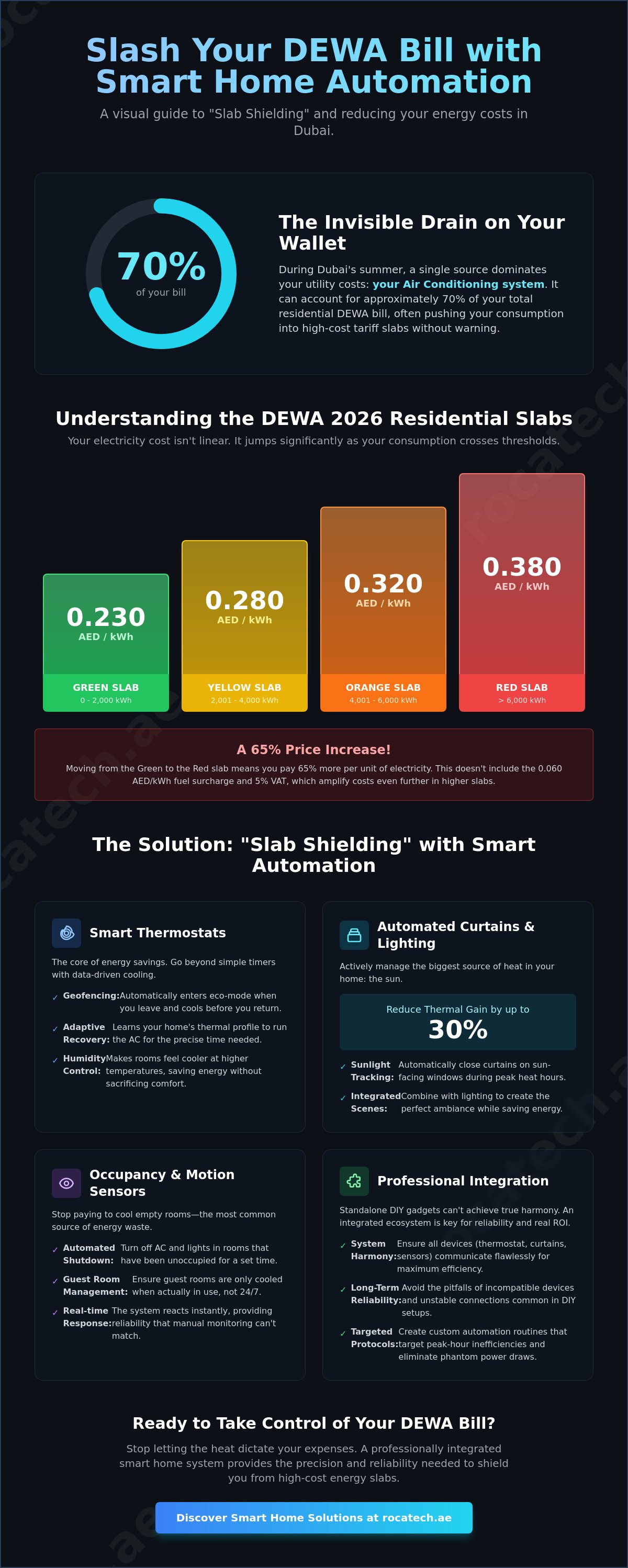
Approximately 70% of your residential DEWA bill during the Dubai summer is generated by a single source: your air conditioning system. For many residents, the transition from the 0.230 AED/kWh green slab to the 0.380 AED/kWh red slab happens without warning, often driven by cooling systems that run at full capacity in empty rooms. It's a common frustration to feel that your monthly utility costs are dictated by the heat rather than your actual needs.
This article demonstrates how you can effectively reduce dewa bill with smart home automation by adopting a strategy of precision "Slab Shielding." By leveraging integrated devices like smart thermostats and motion sensors, you can program your home to respond dynamically to DEWA's 2026 tariff structures and peak-hour windows. We'll examine how the technical harmony of smart curtain motors and lighting controls creates a stable, energy-efficient environment that secures long-term value for your household operations.
Key Takeaways
- Identify the specific 2026 DEWA residential slab thresholds to prevent your consumption from escalating into high-cost "Red" pricing tiers.
- Optimize HVAC performance by utilizing smart thermostats that adapt cooling cycles to occupancy and real-time environmental data.
- Reduce thermal gain by up to 30% through the automated synchronization of smart curtain motors and precision lighting systems.
- Discover how to effectively reduce dewa bill with smart home protocols that target peak-hour inefficiencies and eliminate phantom power draws.
- Understand the long-term reliability and system harmony provided by a professionally integrated automation ecosystem compared to standalone DIY gadgets.
Understanding DEWA Slab Tariffs and the Cost of Inefficiency
The 2026 DEWA residential tariff structure is designed to reward conservation through a progressive pricing model. For expatriates and UAE nationals, electricity costs are categorized into four distinct slabs. The Green slab covers the first 2,000 kWh at 0.230 AED per kWh. Once consumption enters the Yellow slab (2,001 to 4,000 kWh), the rate increases to 0.280 AED. The Orange slab reaches 0.320 AED for usage up to 6,000 kWh. Anything beyond this enters the Red slab at 0.380 AED per kWh.
When you cross these thresholds, the financial impact is immediate. Moving from the lowest to the highest tier represents a 65% increase in the base cost per unit of energy. This is where "Slab Shielding" becomes a critical strategy for homeowners. By using technical precision to reduce dewa bill with smart home protocols, residents can actively prevent their usage from crossing into these premium pricing brackets. It's a method of energy management that prioritizes staying within the most economical tiers through automated system constraints.
The Non-Linear Nature of Dubai Energy Costs
Dubai's utility billing is not a simple linear calculation. Total monthly costs include a 0.060 AED/kWh fuel surcharge and a 5% VAT. Because these additions are calculated on top of the base slab rate, every kilowatt saved in a higher slab yields disproportionate savings. Reducing your usage by just 10% when you're in the Red slab can reduce your total bill by significantly more than 10% due to the removal of high-tier costs and their associated taxes. During the "danger zone" months between June and September, villa owners often see bills double as AC demand pushes them through multiple slabs in a single cycle. Precision automation ensures these spikes are managed before they impact the bottom line.
Why Manual Monitoring Fails in the UAE Climate
The intensity of the Dubai climate makes manual energy management nearly impossible. Humans are prone to forgetfulness. We often leave AC units running in unoccupied guest rooms or ignore "phantom loads" from home entertainment systems. Modern home automation systems provide the technical oversight necessary to manage these variables without constant human input. While manual monitoring requires frequent attention to the DEWA app, a smart hub provides a stable, automated environment that reacts to consumption spikes in real time. Relying on human behavior to reduce dewa bill with smart home strategies often fails during the peak summer heat. Automation offers the reliability that manual efforts simply cannot match.
Maximizing AC Efficiency with Precision Smart Thermostats
Air conditioning represents the largest operational expense for Dubai residents, typically accounting for over 70% of a home's total DEWA bill. Standard AC controllers operate on a binary logic, cycling the compressor based on a simple, often inaccurate temperature threshold. In contrast, a smart learning thermostat utilizes advanced algorithms to understand your home's thermal profile. This technical shift is the most effective way to reduce dewa bill with smart home technology, as it replaces guesswork with data-driven cooling.
One of the primary benefits is geofencing. This feature uses your smartphone's location to automatically adjust setpoints when the property is vacant. Instead of cooling an empty villa, the system enters an eco-mode, returning to your preferred comfort level just before you arrive. Research on the impacts of smart home technologies indicates that these automated adjustments provide significant energy management benefits compared to manual scheduling. Precision cooling ensures you maintain comfort without over-taxing the compressor during the hottest hours of the day.
Smart Thermostat Features That Drive DEWA Savings
Adaptive recovery is a standout feature in modern systems. It learns how long your specific HVAC unit takes to reach a target temperature, preventing the compressor from running longer than necessary. Additionally, integrated sensors monitor humidity levels. Lowering humidity can make a room feel cooler at a higher temperature, allowing you to raise the setpoint by one or two degrees without sacrificing comfort. Whether your property uses a District Cooling (Chiller) system or a standard DX unit, professional integration ensures the thermostat communicates perfectly with the HVAC hardware. For a deeper technical breakdown, you can explore our Smart Thermostat Dubai: The Complete 2026 Guide to Precision Cooling.
Optimizing Setpoints for the Dubai Summer
Finding the "Comfort vs. Cost" balance is essential for long-term ROI. While many suggest a static 24°C, smart scheduling allows for dynamic adjustments that reflect your actual lifestyle. An "Away Mode" prevents the "heat soak" effect, where walls and furniture absorb heat during the day, forcing the AC to work twice as hard in the evening. By maintaining a slightly higher but controlled temperature while you're out, you protect the building's thermal envelope. This stability reduces peak-load demand on the grid and protects your equipment from premature wear. If you're looking to stabilize your utility costs, a professionally installed smart thermostat offers the most reliable path to operational efficiency.
The Thermal Multiplier: Automated Curtains and Lighting
While the thermostat manages the cooling response, the property's thermal envelope determines the intensity of the workload. Solar gain through expansive glass surfaces in Dubai villas can force HVAC systems to work 30% harder to maintain a stable interior temperature. This thermal load is a primary reason why many attempts to reduce dewa bill with smart home technology fail when they focus solely on the AC unit. By integrating smart curtain motors, you address the source of heat entry, creating a more resilient and energy-efficient environment.
Technical harmony is achieved when shading and lighting systems work in tandem with the cooling infrastructure. This coordination prevents the "Greenhouse Effect" where heat trapped behind glass creates a localized microclimate that forces the AC to run continuously. Implementing these integrated systems provides a psychological benefit as well. A naturally cool home feels more stable and comfortable, reducing the urge to manually override thermostats to lower settings during peak heat hours.
Automated Shading as a Passive Cooling Strategy
Traditional curtains rely on manual operation, which often results in windows remaining exposed during the most intense solar windows. Smart curtain motors utilize solar tracking to close based on the sun's exact position. This passive cooling strategy blocks radiant heat before it penetrates the living space. In large villas with floor-to-ceiling windows, this automated intervention is essential for maintaining the building's thermal integrity and protecting the compressor from excessive wear. It's a precise method of managing the "Slab Shielding" strategy mentioned previously by keeping the total energy demand low.
Efficient Lighting and Motion Sensors
Lighting control represents another critical layer of operational efficiency. Beyond simply switching to LED, Smart Lighting Control for Your Home in Dubai ensures that energy is never wasted in empty rooms. Motion sensors are highly effective in transitional spaces like hallways, closets, and bathrooms where lights are frequently left on by mistake. These sensors provide a reliable, automated check against human error. Additionally, dimming protocols can extend the life of your fixtures while reducing the heat emission that old bulbs often contribute to the room's temperature. Utilizing these tools is a sophisticated way to reduce dewa bill with smart home automation by eliminating unnecessary wattage across the entire property.
Coordinating these elements through "Energy Scenes" allows for a single command to optimize the home. A "Summer Peak" scene can be programmed to close all south-facing curtains and dim non-essential lighting to 30% during the hottest parts of the day. This strategic alignment ensures your home remains in the most economical DEWA slab without sacrificing the quality of your living environment.
Strategic Automation Protocols for Peak and Off-Peak Hours
The efficacy of any automation system rests on its ability to synchronize with the external environment. In Dubai, this means aligning residential operations with DEWA’s peak load periods, which typically fall between 12:00 PM and 6:00 PM. Implementing strategic protocols during these hours is a sophisticated way to reduce dewa bill with smart home technology. By shifting high-energy tasks to off-peak windows, you minimize the risk of crossing into the Orange or Red slab tariffs during the hottest parts of the day.
One of the most effective techniques is "Pre-Cooling." This involves lowering the home's temperature during the early morning when the outdoor air is cooler and the HVAC system operates with higher efficiency. By cooling the thermal mass of the building, including the walls, floors, and furniture, before 10:00 AM, the property can maintain a comfortable environment during peak hours with minimal compressor intervention. Additionally, utilizing smart plugs can eliminate "phantom power" from home entertainment systems and standby electronics. These devices often consume energy even when turned off, contributing to a slow but steady climb through the slab thresholds. This proactive approach is the most reliable way to reduce dewa bill with smart home configurations.
How to Program Your Home for Summer Savings
- Step 1: Set the morning pre-cool at 21°C before 10:00 AM to prepare the building’s thermal envelope.
- Step 2: Program smart curtain motors to activate a "Solar Block" protocol for all south-facing windows at 12:00 PM.
- Step 3: Schedule heavy appliance use, such as dishwashers and washing machines, to begin after 8:00 PM when grid demand is lower.
- Step 4: Utilize "Sleep Mode" on your thermostat to gradually increase the temperature by 2°C overnight, reflecting the natural reduction in metabolic rate and external heat.
The Role of the Smart Hub in Energy Orchestration
A centralized smart hub gateway is the operational brain of an efficient property. Unlike standalone Wi-Fi devices that operate in silos, a hub ensures all components, from motion sensors to pool pumps, communicate through a unified protocol. This stability is vital for high-stakes energy management. A hub provides the data visualization necessary to see exactly where your DEWA dirhams are going, allowing for iterative improvements to your automation logic. For those seeking technical excellence, our Smart Hub Gateway: The Ultimate Guide for Your Dubai Home in 2026 offers an in-depth look at these systems. To begin optimizing your property's performance, explore our range of integrated smart home solutions today.
Professional Integration: Why Rocatech is the Key to Real ROI
Achieving a measurable return on investment requires more than purchasing standalone gadgets from a retail shelf. While off-the-shelf devices offer basic functionality, they often lack the technical harmony required for complex energy management. A professionally integrated ecosystem ensures that your strategy to reduce dewa bill with smart home technology remains stable and effective over the long term. This reliability is the difference between a system that occasionally saves money and one that consistently shields your household from the highest DEWA tariffs. Operational failure in an automation system leads to more than just inconvenience. It leads to immediate financial loss through missed cooling cycles and high-tier energy consumption.
Rocatech’s consultative approach moves away from aggressive sales tactics toward a supportive partnership model. We focus on the entire lifecycle of your home's operations, ensuring that every sensor and gateway contributes to a unified goal of efficiency. Technical reliability provides significant emotional reassurance for homeowners, knowing that their "Slab Shielding" protocols will execute perfectly every day without manual intervention. This professional oversight transforms a collection of devices into a sophisticated asset that protects your bottom line.
Precision Engineering for High-Stakes Environments
Operational stability is the foundation of true energy efficiency. We understand the specific architectural nuances of Dubai’s premier communities, including developments by Emaar, Nakheel, and Damac. Each property has a unique thermal signature based on its orientation and construction materials. A consultative approach allows us to map your automation protocols to your specific floor plan and lifestyle. This level of customization ensures that your "Energy Scenes" are not just generic presets but are engineered for maximum performance. To understand how we align technology with regional standards, read more at Rocatech Dubai: Your Partner in Precision Smart Home Automation.
Your Next Steps to a Lower DEWA Bill
Professional installation also adds tangible value to your property. In a market that increasingly prioritizes sustainability, a fully integrated smart home is a significant asset that appeals to high-value buyers and tenants. The lifecycle of a Rocatech installation begins with a comprehensive energy assessment where we identify specific inefficiencies in your current HVAC, lighting, and shading systems. We then implement a customized hardware suite and optimize the software logic to ensure peak performance. Reclaiming control over your utility costs is a strategic necessity in 2026. By moving away from manual adjustments and toward a precision-engineered environment, you ensure your home operates with the same efficiency as a high-performance commercial facility. It is time to reduce dewa bill with smart home solutions that prioritize durability, novelty, and long-term value. Book your personalized consultation today to begin the transition toward a more stable and cost-effective home environment.
Securing Your Home’s Operational Efficiency for 2026
Managing residential energy costs in Dubai has evolved from a matter of habit to a requirement for technical precision. By implementing "Slab Shielding" through integrated automation, you move beyond basic conservation and enter the realm of strategic energy management. The coordination of smart thermostats with automated shading ensures your home remains in the most economical DEWA pricing tiers even during the peak summer months. It is the most reliable way to reduce dewa bill with smart home technology while maintaining a stable, high-performance living environment. This technical harmony protects your equipment from excessive wear and provides significant emotional reassurance for your family.
Rocatech provides the expertise necessary to navigate these complex utility structures. Our Dubai-based technical experts specialize in the seamless integration of HVAC and lighting systems, utilizing proven 2026 energy-saving protocols to deliver measurable results. Operational stability is no longer a luxury; it's a fundamental component of modern property management. To secure the long-term value of your villa or apartment, Book a Professional Energy Assessment with Rocatech today. Take the first step toward a more predictable and efficient future for your home.
Frequently Asked Questions
Can a smart home really reduce my DEWA bill by 30%?
Achieving a 30% reduction is possible through the strategic coordination of cooling and shading systems. By preventing your consumption from crossing the 2,000 kWh threshold into the 0.280 AED/kWh Yellow slab, you gain a significant technical advantage. The most impactful savings occur when automation protocols eliminate human error, such as cooling empty rooms or leaving lights on during peak hours.
Which smart device has the fastest ROI for Dubai homes?
The smart thermostat offers the fastest return on investment because HVAC systems account for approximately 70% of residential energy use in the UAE. By optimizing the compressor's workload and utilizing geofencing to reduce cooling when the home is vacant, homeowners can see a shift in their utility costs within the first billing cycle. This device is the foundational tool to reduce dewa bill with smart home technology.
Do I need to replace my existing AC units to use a smart thermostat?
You don't need to replace your existing AC hardware to implement smart controls. Most modern smart thermostats are designed to integrate with standard DX and split systems through existing wiring or infrared interfaces. Professional integration ensures that the new controller communicates accurately with your HVAC unit, maintaining operational stability without the need for structural electrical modifications or expensive equipment upgrades.
How does the DEWA slab tariff affect my monthly bill?
DEWA utilizes a progressive slab tariff where the cost per unit of electricity increases as your consumption rises. In 2026, rates jump from 0.230 AED/kWh in the Green slab to 0.380 AED/kWh in the Red slab for usage exceeding 6,000 kWh. Automation helps you stay in lower-cost brackets by capping unnecessary usage, ensuring you never pay premium rates for inefficient cooling or phantom power loads.
Is professional smart home installation worth it for apartments?
Professional installation is highly beneficial for apartments to ensure system harmony and technical reliability. While DIY gadgets are available, a professionally integrated ecosystem provides a more stable connection between devices like smart lighting and curtain motors. This setup ensures your energy-saving scenes execute without failure, maximizing the long-term value and operational efficiency of even smaller living spaces.
Does a smart home work with District Cooling (Chiller) systems?
Smart home systems are fully compatible with District Cooling or Chiller systems. Specific smart thermostats are engineered to manage the fan coil units common in Dubai’s high-rise buildings. These controllers manage the actuator valves and fan speeds with greater precision than standard dials, allowing apartment residents to reduce dewa bill with smart home automation effectively.
What is the best temperature to set my AC for DEWA savings?
Setting your AC to 24°C is the recommended baseline for a balance between comfort and efficiency. However, a smart system allows for dynamic setpoints, such as increasing the temperature to 26°C when the room is unoccupied or gradually raising it overnight. This precision prevents the compressor from running at full capacity during peak heat, protecting your equipment and lowering consumption.
Can I monitor my DEWA consumption in real-time with smart home tech?
You can monitor your consumption in real-time by utilizing a smart hub gateway paired with energy-monitoring smart plugs and sensors. These tools provide a granular view of which appliances are driving your costs. Data visualization allows you to identify consumption spikes immediately, enabling you to adjust your automation protocols to remain within the most economical DEWA slab tariffs.