

CCTV in Dubai: The 2026 Guide to Smart Surveillance Systems

Can your current security system withstand a 52°C Dubai summer while maintaining 100% SIRA compliance? You've likely felt the frustration of grainy night-vision footage or the constant worry that your hardware might fail under the relentless UAE sun. It's a valid concern for property owners who require reliable protection without the technical headache of navigating complex IP versus analog configurations. At Rocatech, we understand that a security system is only as strong as its weakest component during a high-stakes moment.
This 2026 guide demonstrates how advanced cctv technology now integrates seamlessly with smart home ecosystems to provide high-definition remote monitoring and absolute legal certainty. You'll discover how to transition from basic recording to a proactive, intelligent defense strategy that secures your assets and provides genuine peace of mind. We will break down the essential components of a robust surveillance strategy, covering everything from heat-resistant hardware specifications to the latest SIRA-approved cloud storage solutions for UAE properties.
Key Takeaways
- Learn why 4K resolution and advanced IP technology have become the new baseline for high-precision facial recognition and reliable property monitoring.
- Understand the essential SIRA compliance requirements and legal frameworks governing surveillance installations across Dubai’s residential and commercial sectors.
- Compare cutting-edge infrared and full-color low-light technologies to ensure your security infrastructure remains robust in the unique environmental conditions of the UAE.
- Discover how to tailor a professional cctv strategy that addresses the specific security challenges of luxury villas, high-rise apartments, or commercial retail assets.
- Explore the seamless integration of surveillance with smart home ecosystems to achieve a comprehensive, automated security solution that provides total peace of mind.
Understanding Modern CCTV: More Than Just Video Surveillance
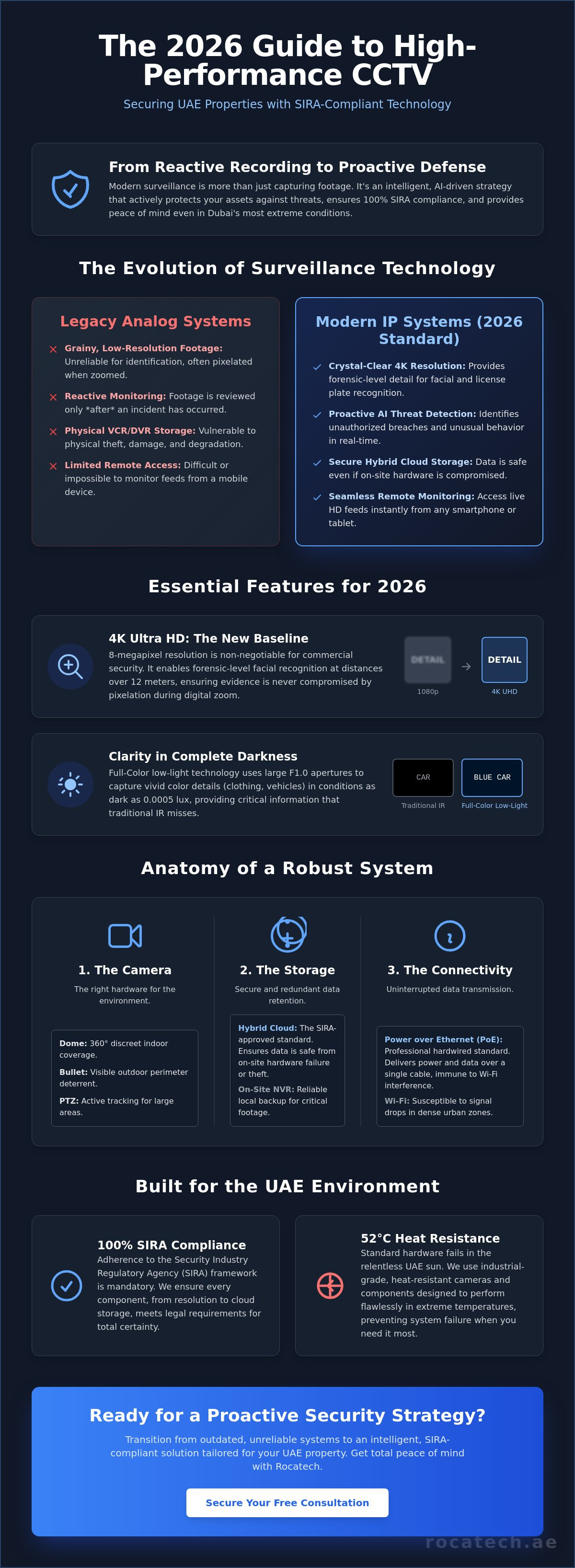
A Closed-circuit television (CCTV) system is defined by its private nature; unlike broadcast television, the signal is transmitted to a limited set of monitors for specific security purposes. In Dubai's 2026 landscape, this technology has transitioned from a simple recording tool into a sophisticated data asset. Modern cctv systems now utilize high-definition IP (Internet Protocol) cameras that offer superior clarity compared to the grainy analog systems of the past. This shift allows for a transition from reactive recording, where footage is only reviewed after a theft or incident, to proactive AI-driven threat detection. These smart systems can identify unauthorized perimeter breaches or unusual behavioral patterns in real time, providing a level of precision that manual monitoring cannot match.
For property owners in the United Arab Emirates, a robust surveillance strategy is the cornerstone of operational stability. It's about more than just deterring intruders. It's about creating a transparent environment where every movement is accounted for, ensuring total traceability across industrial or residential sites. This sense of control provides the ultimate peace of mind for business leaders who require their facilities to run without interruption.
The Evolution of Surveillance Technology
The transition from low-resolution VCR tapes to 4K cloud storage represents a massive leap in technical reliability. Modern camera hardware now incorporates edge computing, which allows the device to process data locally before sending it to the server. This reduces network latency and ensures that critical alerts are triggered instantly. Property managers can now access live feeds through smartphone apps, allowing for remote oversight from any location. This connectivity ensures that you're never disconnected from your assets, regardless of where you are in the world.
Key Components of a Robust CCTV System
Building a dependable cctv network requires a strategic selection of hardware and infrastructure. Each component must be tailored to the specific environment it protects. Consider these essential elements:
- The Camera: Choice depends on the application. Dome cameras offer discreet 360-degree coverage for interiors. Bullet cameras serve as a visible deterrent for outdoor perimeters. PTZ (Pan-Tilt-Zoom) units allow operators to actively track movement across large areas.
- The Storage: While traditional Network Video Recorders (NVR) provide reliable on-site storage, many Dubai firms now adopt hybrid cloud solutions. This ensures that data remains secure even if the physical hardware is compromised.
- The Connectivity: Stable Power over Ethernet (PoE) is the professional standard. It beats standard Wi-Fi by providing a dedicated, hardwired connection that isn't susceptible to the signal interference common in dense urban zones.
By focusing on these technical specifications, Rocatech ensures that every installation is a long-term investment in safety. We move away from generic setups toward tailored integrations that respect the unique requirements of the local market. This methodical approach guarantees that your surveillance system remains a functional, high-performance tool for years to come.
Essential Features for High-Performance Security Cameras in 2026
By 2026, 4K resolution has moved from a premium option to the industrial baseline for Dubai's commercial sectors. This 8-megapixel standard provides the granular detail needed for forensic-level facial recognition, allowing security teams to identify individuals at distances exceeding 12 meters. Systems that fail to meet this resolution often struggle with pixelation during digital zoom, which can compromise evidence during legal proceedings. Adhering to these high-definition standards is a core component of maintaining SIRA compliance for businesses operating within the emirate.
Night vision technology has also evolved beyond traditional Infrared (IR). While IR remains effective for covert monitoring, Full-Color low-light technology uses F1.0 large apertures to deliver vivid color imagery in environments as dark as 0.0005 lux. This distinction is vital for identifying the color of a vehicle or a suspect's clothing, which are details often lost in grainy black-and-white feeds. Integrated two-way audio serves as a proactive deterrent; security personnel can issue immediate verbal commands through the camera's built-in speaker. This capability often stops a breach before it escalates into a physical confrontation.
AI-Powered Analytics and Smart Detection
Line Crossing Detection acts as a virtual perimeter, triggering an alert only when a person or vehicle crosses a pre-defined digital boundary on the screen. This precision helps security teams focus on genuine threats rather than routine movement. Facial recognition software now assists in identifying unauthorized personnel by cross-referencing live feeds against a database of known staff and visitors with 99.2% accuracy. Modern AI algorithms effectively filter out environmental noise, such as moving tree branches or small animals. This reduces notification fatigue by approximately 85% compared to legacy motion sensors, ensuring that every alert sent to your smartphone requires actual attention.
Storage and Data Management
Managing high-resolution cctv footage requires efficient codecs to prevent network congestion. H.265+ compression technology reduces bandwidth and storage requirements by up to 80% without degrading image quality. For critical infrastructure, we recommend a hybrid storage model that combines on-site NVRs with encrypted off-site cloud backups to ensure data redundancy. Cybersecurity remains a top priority for 2026 systems; they utilize AES-256 encryption and multi-factor authentication to prevent unauthorized remote access to your feed. If you're looking to upgrade your existing infrastructure, our team can provide a tailored consultation to ensure your hardware meets these modern benchmarks.
CCTV Standards in the UAE: SIRA Compliance and Environment
Regulatory compliance in Dubai is a foundational requirement for operational stability and public safety. The legal framework governing surveillance is rigorous, ensuring that every cctv installation contributes to a unified security mesh. Business owners must view these regulations not as hurdles, but as benchmarks for technical excellence. Adhering to these standards protects the organization from legal liabilities while ensuring that the captured data is forensic-grade and admissible if needed.
Navigating Dubai Security Regulations
The Security Industry Regulatory Agency (SIRA) serves as the primary governing body for security standards in Dubai. Under Law No. 12 of 2016, specific commercial sectors must install mandatory surveillance systems. This includes 100% of hotels, financial institutions, jewelry stores, and large-scale warehouses. These entities are required to connect their systems to the SIRA Video Guard portal for real-time monitoring and system health checks.
Compliance involves more than just mounting hardware. You must ensure your system meets specific technical parameters:
- Retention Periods: Most commercial licenses require a minimum of 31 days of recorded footage stored on secure servers.
- Certified Partners: Only SIRA-certified integrators can legally install and maintain these systems. They provide the necessary completion certificates required for trade license renewals.
- Privacy Boundaries: UAE privacy laws are strict. Cameras must not overlook private residential spaces, balconies, or staff changing areas. Residential installations should focus strictly on the owner's perimeter to avoid infringing on neighbor privacy.
Hardware Built for the Middle East Climate
Dubai's environmental conditions are among the most challenging in the world for electronic components. Standard hardware often fails when exposed to the 50°C peak temperatures and 90% humidity levels typical of the UAE summer. Precision engineering is required to maintain system uptime in these high-stakes environments. Thermal management is the first line of defense. High-end cameras utilize advanced heat sinks and specialized housing materials to dissipate heat away from the image sensor, preventing the "thermal noise" that degrades video quality.
Ingress protection is equally vital. A rating of IP67 or IP68 is mandatory for any outdoor cctv component. These ratings ensure the internal circuitry remains sealed against fine desert dust and pressurized moisture. For properties located along the Dubai coastline, such as the Palm Jumeirah or Jebel Ali Port, salt-mist corrosion is a significant risk factor. In these zones, we specify cameras with 316L stainless steel housings or specialized anti-corrosion coatings. This level of hardware durability ensures that your security infrastructure remains a stable, long-term asset rather than a recurring maintenance burden.
Selecting the Right Surveillance Strategy for Your Property
Effective surveillance requires a tailored approach that aligns with the physical architecture of your property. A 10,000-square-foot villa in Emirates Hills demands a different strategy than a high-rise office in Business Bay. Residential installations prioritize discreet aesthetics; cameras must blend into the architectural design while providing 360-degree coverage of perimeters and entry points. Commercial environments, however, focus on high-traffic zones and asset protection. Retailers often utilize wide-angle lenses to monitor showroom floors, while warehouses require long-range thermal capabilities for perimeter fence lines.
Residential vs. Commercial Needs
Luxury homes in Dubai require systems that offer security without feeling intrusive. In-ceiling dome cameras provide a low-profile solution for interiors, while ruggedized bullet cameras handle the harsh exterior heat. For businesses, the focus shifts to operational efficiency. Centralized monitoring is a critical asset for multi-location enterprises across the UAE. It allows a single security team to manage feeds from Dubai, Abu Dhabi, and Sharjah through a unified interface. This integration increases office productivity by reducing the need for localized security staff at every branch. A professional cctv system acts as a force multiplier for your existing security personnel.
Wired vs. Wireless: The Reliability Debate
Wired systems are the industry benchmark for industrial-grade reliability. They utilize Power over Ethernet (PoE) to deliver both data and electricity through a single cable, which eliminates the risk of signal interference in dense urban environments. Wireless cameras are suitable for temporary sites or light-use residential areas where structural constraints prevent cabling. However, for 24/7 mission-critical monitoring, the stability of a wired backbone is unmatched. You can learn more about specific hardware configurations in our Home Security Camera Guide 2026.
Integrating cctv with other security layers, such as PIR motion sensors and door contacts, transforms a passive recording tool into an active defense system. If a sensor is tripped after hours, the system can immediately alert the control room and bring the relevant camera feed to the main screen. This proactive stance is the hallmark of a professional installation. While DIY kits might seem cost-effective initially, they often lack the robust encryption and SIRA compliance required for UAE businesses. A consultative approach ensures your system is scalable, secure, and built for long-term performance. It's about moving away from basic hardware and toward a comprehensive security partnership.
Contact Rocatech today to schedule a professional security audit for your property.
Professional CCTV Integration with Rocatech
Rocatech doesn't just sell hardware; we deliver engineered security solutions tailored for the high-stakes environments of Dubai. Our methodology begins with a meticulous site survey. We don't rely on guesswork. We analyze architectural blueprints and physical layouts to eliminate blind spots that standard off-the-shelf kits often miss. This precision ensures your cctv system functions as a robust, permanent shield for your property rather than a temporary fix.
The Rocatech Installation Experience
Our methodology follows a logical path from initial consultation to final commissioning. We prioritize Smart Home Installation Dubai standards to ensure every camera integrates seamlessly with your existing digital infrastructure. Every system undergoes rigorous stress testing before we consider the job finished. This "Peace of Mind" guarantee means your surveillance is active, stable, and reliable from the moment of handover. We provide ongoing technical support to address the unique environmental challenges of the UAE, such as extreme heat and humidity, which can degrade inferior hardware. Our local expertise ensures your system remains operational year-round.
Unified Smart Security
A standalone camera is merely a passive observer. Rocatech transforms it into an active participant in your home's wider ecosystem. By connecting your security hardware through a Smart Hub Gateway, your cctv setup triggers intelligent, automated responses. For instance, if a video doorbell detects an individual after midnight, the system can instantly activate exterior floodlights and double-check all smart locks.
If unauthorized motion is detected in a restricted zone, your smart curtains can close automatically to shield your interior from view. This "Total Solution" strategy creates a secure environment where safety and automation work in perfect harmony. We focus on long-term value, moving away from aggressive sales toward a consultative partnership. We understand the specific regulatory requirements in Dubai, ensuring your installation meets all SIRA-aligned expectations. Our team provides the technical precision required for both residential villas and industrial facilities across the Emirates. Contact Rocatech for a professional security consultation to begin your transition to a smarter, safer lifestyle.
Future-Proof Your Property with Advanced Surveillance
Dubai's security landscape in 2026 demands more than basic recording. Adhering to SIRA regulations remains a legal necessity for property owners, ensuring every system meets the rigorous standards set by the Security Industry Regulatory Agency. Modern cctv systems now prioritize intelligent analytics and full interoperability with smart home ecosystems. Selecting a system isn't just about the hardware; it's about building a robust infrastructure that functions without failure.
Rocatech provides a comprehensive approach to property protection. Our team delivers SIRA-compliant integration expertise to ensure your facility meets all local legal requirements. Every installation is performed by certified technicians who focus on technical precision and long-term system health. We specialize in creating seamless connections between your security hardware and leading smart home brands, providing a unified control interface for your entire premises. This consultative partnership moves beyond simple equipment sales to offer a total solution that protects your investment.
Secure your property with Rocatech’s expert CCTV solutions and enjoy the confidence that comes with professional-grade security. Your peace of mind starts with a system built for the high-stakes environment of the UAE.
Frequently Asked Questions
Is CCTV mandatory for homes in Dubai?
CCTV isn't mandatory for private residential villas in Dubai, though it's highly recommended for asset protection. However, Law No. 12 of 2016 requires all commercial buildings, hotels, and residential apartment complexes to install approved surveillance systems. Owners of these properties must ensure their systems meet specific technical standards to maintain compliance with local safety regulations and licensing requirements.
How long does a CCTV system record for?
A standard CCTV system typically records for 31 days to meet the minimum retention requirements set by Dubai authorities for the commercial sector. The actual duration depends on your hard drive capacity and the number of cameras in operation. High-definition systems using H.265 compression can store more footage on smaller drives, ensuring your data remains accessible during critical investigations.
Can I view my CCTV cameras on my phone while outside the UAE?
You can view your camera feed from anywhere in the world as long as you've a stable internet connection. Modern systems use secure mobile applications that connect to your recorder via encrypted cloud protocols. This remote access provides peace of mind for homeowners and business managers who travel frequently, allowing for real-time monitoring and instant mobile alerts if motion is detected.
What is the difference between an NVR and a DVR?
The primary difference lies in how they process video data. An NVR works with IP cameras that encode video data before sending it to the recorder, while a DVR processes raw data from analog cameras via coaxial cables. NVR systems generally provide superior image quality and more advanced features, making them the preferred choice for modern industrial and residential installations in Dubai.
How much does professional CCTV installation cost in Dubai?
Professional installation for a basic 4-camera CCTV setup in Dubai usually ranges from 1,500 AED to 3,000 AED. This price covers the labor for cabling, mounting, and system configuration. More complex industrial integrations or larger villa projects will naturally command higher fees based on the technical requirements and the total number of hardware units involved in the surveillance network.
Do CCTV cameras work during a power outage?
Surveillance cameras won't operate during a power outage unless you've installed an Uninterruptible Power Supply (UPS). A dedicated UPS ensures your security remains active by providing backup power for 60 to 180 minutes. For critical industrial environments, we recommend integrating robust power backups to prevent gaps in your security coverage and protect your hardware from potential voltage spikes when power returns.
Is it legal to record audio on my security cameras in the UAE?
Recording audio is strictly regulated under UAE privacy laws and is generally illegal in most public and private settings without explicit consent. Federal Law No. 3 of 1987 protects individual privacy, and unauthorized audio surveillance can result in heavy fines or legal action. It's best to focus on high-quality video capture to ensure your security measures remain fully compliant with local legislation.
What is SIRA and do I need their approval for my villa?
SIRA stands for the Security Industry Regulatory Agency, the body responsible for overseeing security standards in Dubai. You don't need SIRA approval for a private villa installation. However, all commercial entities and multi-tenant buildings must use SIRA-certified equipment and licensed installers to obtain their annual trade license renewals and ensure total regulatory compliance with Dubai's safety framework.
1 comment
Great guide on smart surveillance systems and the future of CCTV technology in Dubai. Advanced monitoring features improve security and efficiency. HD CCTV DVR installation Dubai Dubai ensures high-quality recording and dependable surveillance.