

Best Smart Hub for Dubai Home 2026: The Precision Integration Guide

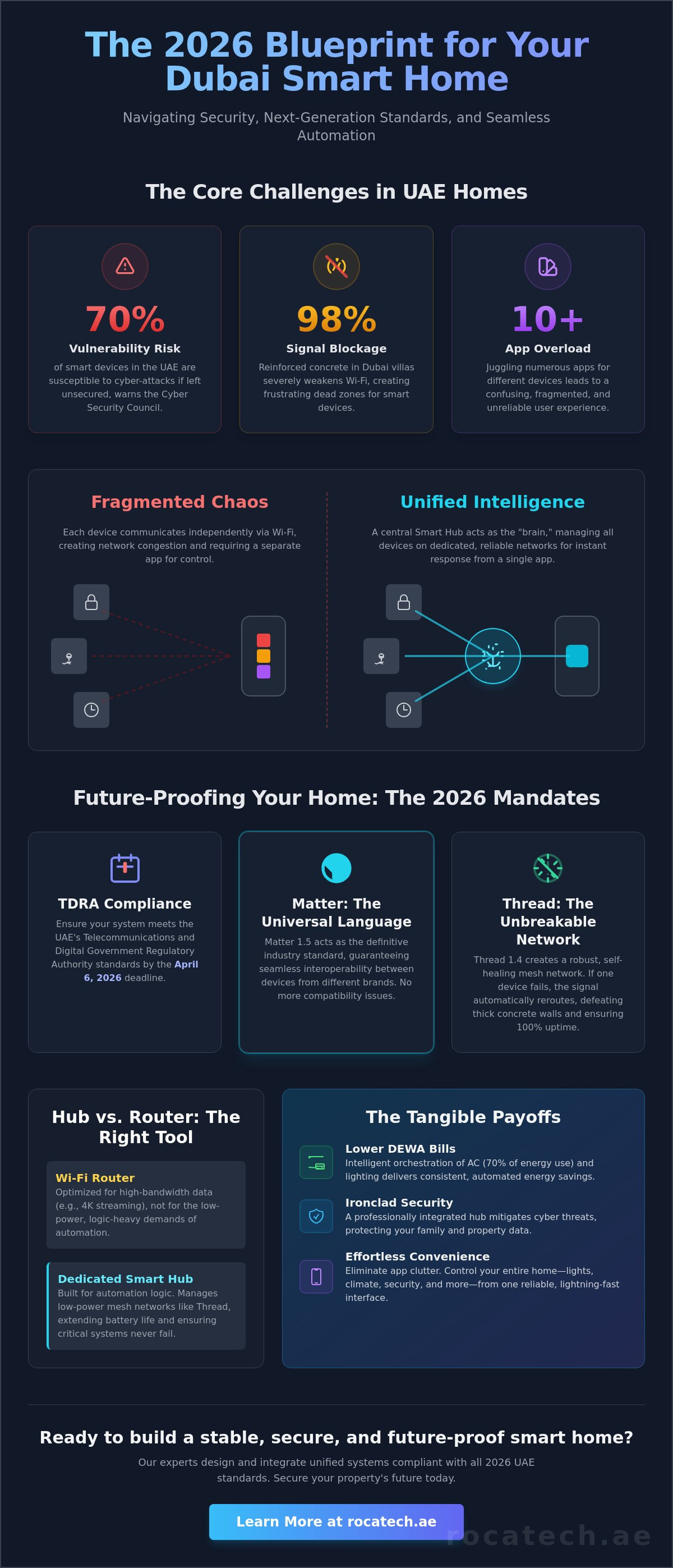
Did you know that while 96.3% of UAE internet users own smart devices, the UAE Cyber Security Council warns that 70% of these units are vulnerable to attacks if left unsecured? Selecting the best smart hub for a Dubai home in 2026 is no longer just about convenience; it's a critical decision for your property's security and operational stability. You've probably experienced the annoyance of signal dropouts caused by thick villa walls or the clutter of managing ten different apps for ten different devices. It's a common challenge in the region's unique architectural landscape where reinforced concrete often acts as a barrier to seamless automation.
This guide delivers a technical roadmap to help you integrate a hub that ensures total connectivity and regulatory compliance. We'll explain how to align your system with the April 6, 2026, TDRA enforcement deadlines and the latest Matter 1.5 standards. You'll learn how to utilize Thread 1.4 protocols to build a robust mesh network that ignores physical obstructions. We'll also demonstrate how a unified system can lower your DEWA bills by orchestrating smart thermostats and lighting control into a single, high-performance environment.
Key Takeaways
- Transition from fragmented app management to a centralized system that acts as the reliable brain for all your home automation.
- Ensure your property remains compliant with 2026 TDRA technical standards and the latest Matter 1.5 interoperability protocols.
- Discover the criteria for selecting the best smart hub for dubai home 2026 based on signal penetration through reinforced concrete.
- Learn strategic placement and mesh networking techniques to eliminate wireless dead zones in large villa layouts.
- Optimize your home’s operational efficiency to achieve consistent energy savings and lower DEWA bills through automated orchestration.
Beyond the Gadgets: Why Your Dubai Home Needs a Centralised Smart Hub
Most homeowners begin their journey by purchasing individual devices: a smart plug here, a video doorbell there. While these gadgets offer immediate utility, they often operate in isolation. A centralised smart hub serves as the "brain" of your property, moving your residence from a collection of Wi-Fi accessories to a unified, intelligent environment. Identifying the best smart hub for dubai home 2026 requires understanding that a system is only as strong as its central processor. This gateway manages the complex logic required for "Precision Automation," ensuring that your home reacts to environmental changes without manual intervention.
In high-density areas like Dubai Marina or Downtown Dubai, network congestion is a significant technical hurdle. Every Wi-Fi device you add competes for bandwidth on your router, leading to lag and dropped connections. A dedicated smart hub alleviates this pressure by moving device communication to specialised frequencies. This transition from simple Wi-Fi gadgets to unified gateway systems is essential for long-term value. It transforms your home from a series of disjointed tools into a stable, integrated asset that increases property appeal and operational reliability.
The Problem of Protocol Fragmentation
Modern smart devices speak different digital languages. Your smart curtain motor might use Zigbee, while your water leak sensor relies on Z-Wave, and your smart door lock uses Bluetooth. These protocols cannot communicate with each other directly. This fragmentation leads to "app fatigue," where residents must toggle between multiple interfaces to perform simple tasks. A smart hub acts as the universal translator. It bridges these gaps, a concept central to the evolution of home automation, where the hub ensures every component works in harmony through a single, stable interface.
Hub vs. Router: Understanding the Difference
A common misconception is that a powerful Wi-Fi router can double as a smart home controller. While your router is designed for high-bandwidth data like 4K streaming and video calls, it isn't built for the logic-heavy demands of automation. Smart hubs utilise low-power mesh networks, such as Thread, which significantly extend the battery life of motion sensors and door locks. This dedicated gateway is essential for high-stakes functions like security and cooling. In a climate where air conditioning accounts for 70% of residential energy use, a dedicated hub ensures your smart thermostat never loses its connection due to a standard router reboot or network spike.
Navigating 2026 Standards: Matter, Thread, and TDRA Compliance in the UAE
The technical landscape for residential automation has shifted significantly. Finding the best smart hub for dubai home 2026 involves more than comparing feature lists; it requires a deep dive into the regulatory and technical frameworks of the UAE. Two primary global standards, Matter and Thread, now dictate how devices communicate. Matter 1.5 has emerged as the definitive industry language, ensuring that your smart door lock from one brand can trigger lighting control from another without compatibility errors. This interoperability is no longer a luxury but a baseline requirement for any stable installation.
Data privacy and local residency requirements have also become paramount. Smart gateways in the Middle East must now often interface with local servers to ensure low latency and adhere to regional data protection standards. Choosing a hub that supports these local requirements prevents your home data from being routed through distant international servers, which can cause delays in critical functions like security alerts or motion sensor triggers. It's a matter of operational integrity and personal security.
Why Matter and Thread Change the Selection Process
Matter 1.5 provides the standard language, but Thread 1.4 provides the robust network path. Unlike Wi-Fi, which relies on a single router, Thread creates a self-healing mesh network. If one device fails, the signal reroutes through others. This is vital for Dubai properties where heavy masonry is common. Research from the National Institute of Standards and Technology (NIST) regarding Signal Interference in Thick-Walled Properties confirms that reinforced concrete can severely degrade wireless performance. Thread 1.4 hardware is designed to overcome these physical barriers, ensuring your best smart hub for dubai home 2026 maintains a constant link to every sensor in the villa.
Regulatory Compliance and Warranty in Dubai
Compliance with the Telecommunications and Digital Government Regulatory Authority (TDRA) is non-negotiable. As of February 2, 2026, all imported smart home devices require a TDRA customs clearance permit to enter the UAE legally. Furthermore, a new enforcement date of April 6, 2026, mandates that all cellular-enabled hardware conforms to updated network safety and labeling rules. Using grey-market hubs that lack these approvals can lead to frequency interference with local telecom networks and may even result in your devices being remotely disabled.
- TDRA Type Approval: Ensures the hub operates on legal frequencies within the UAE.
- Customs Clearance: Guarantees the hardware was imported through official channels with a valid permit.
- Local Technical Support: Provides a safety net for firmware updates and hardware replacements.
Working with a registered IoT service provider ensures your system stays on the right side of these regulations. To secure your property with hardware that meets every local safety standard, you can explore the certified integration options available at rocatech.ae. This proactive approach to compliance protects your investment and ensures your home automation remains stable for years to come.
Evaluating the Best Smart Hubs for Dubai Villas and Apartments
Selecting the best smart hub for dubai home 2026 requires a rigorous evaluation framework based on three pillars: Connectivity, Ecosystem Support, and Local Reliability. In a market as technologically advanced as the UAE, a hub must do more than just connect devices; it must maintain peak performance under the high device density typical of modern luxury properties. Whether you're managing a sprawling villa in Emirates Hills or a high-rise apartment in Downtown Dubai, the choice between proprietary systems and open-source gateways will define your home's operational stability for years to come.
Local reliability is particularly critical when integrating with regional infrastructure. A high-performance hub should offer seamless coordination with smart thermostats and lighting control to help manage electricity consumption. With air conditioning accounting for approximately 70% of residential DEWA bills during the summer, a hub that provides automated orchestration based on occupancy and ambient temperature is an essential tool for fiscal efficiency. This level of system harmony ensures that your automation isn't just a novelty but a strategic asset.
Professional-Grade Gateways for Full-Home Automation
Large villas often require the simultaneous management of 100 or more devices, including smart curtain motors, motion sensors, and security cameras. Standard consumer hubs often experience latency when pushed to these limits. Professional-grade gateways solve this by offering wired Ethernet options, which provide a stable backhaul for the most critical automation tasks. These systems are designed for high-stakes environments where a failed command for a smart door lock or a security breach is not an option. They prioritize local processing, meaning your home continues to function even if your external internet connection fluctuates, providing significant emotional reassurance for property owners.
User-Friendly Hubs for Modern Apartments
For residents in JVC or Downtown apartments, the focus often shifts toward ease of use and aesthetic integration. The best smart hub for dubai home 2026 in these settings is one that blends into luxury interiors while offering robust voice assistant support. Whether you prefer Alexa, Google, or Siri, the gateway must handle the specific linguistic nuances and local service requirements of the UAE market. These hubs are typically more compact and rely on sleek hardware designs that don't intrude on the architectural vision of the space. Despite their smaller footprint, they still offer comprehensive control over video doorbells and smart plugs, ensuring that even a compact residence benefits from the full breadth of modern automation.
Strategic Hub Placement: Overcoming Signal Interference in Thick-Walled Properties
The physical architecture of a property is often the greatest adversary of a stable automation system. Even the best smart hub for dubai home 2026 will suffer from latency or total disconnection if it's positioned without considering the structural composition of the building. Dubai's villas and high-end apartments are typically constructed using high-density concrete and heavy rebar. These materials don't just weaken signals; they can effectively block them entirely. Achieving "Precision Automation" requires a strategic approach to hardware placement that accounts for these physical barriers from the outset.
Homeowners often face a choice between a centralised "IT Closet" and decentralised hub placement. While a dedicated rack in a utility room offers security and a clean aesthetic, it's frequently located in a corner of the house or even the basement. This distance, combined with multiple reinforced walls, makes it nearly impossible for a single hub to reach every smart curtain motor or motion sensor. A hybrid approach is often the most reliable solution, where the core gateway remains in the IT rack but utilizes hardwired access points to extend the mesh network into living areas.
The Physics of the Dubai Villa
Standard 2.4GHz and 5GHz frequencies struggle significantly with high-density blocks. While 2.4GHz offers better penetration, it's often crowded by neighboring networks and household appliances. Conversely, 5GHz provides higher data speeds but is stopped by the first thick wall it encounters. In many Dubai properties, mirrored glass and metal cladding further complicate connectivity by reflecting RF signals rather than allowing them to pass through. For properties exceeding 3,000 sq. ft., professional site surveys using RF heat mapping are essential. These surveys identify dead zones before installation begins, ensuring that your system's foundation is mathematically sound.
Optimising Your Hub for Maximum Range
To ensure your automation remains responsive, follow these technical placement protocols:
- Step 1: Place the hub in a central, elevated location. Mounting the gateway higher on a wall or on a top shelf reduces the number of furniture obstacles the signal must navigate.
- Step 2: Use hardwired backhaul for secondary access points. Relying solely on wireless "repeaters" can cut your bandwidth in half. Connecting extenders via Ethernet ensures the full speed of your network reaches every floor.
- Step 3: Avoid placement near large appliances or metal cabinetry. Kitchens and laundry rooms are high-interference zones. Keep your hub at least two meters away from microwaves and large refrigerators.
For a deeper look at the physical setup of these components and how they integrate into a broader property strategy, consult our smart home installation dubai guide. If you're ready to eliminate signal dropouts and build a professional-grade network, you can view our range of high-penetration gateways at rocatech.ae. Proper placement isn't just about convenience; it's the difference between a system that works occasionally and one that provides total operational stability.
Professional Hub Integration: Securing Long-Term Operational Stability with Rocatech
Hardware acquisition is merely the first step in establishing a resilient automated environment. While identifying the best smart hub for dubai home 2026 provides the necessary foundation, the true value lies in how that gateway is configured and programmed. A hub that isn't professionally tuned often becomes a source of frustration, leading to command delays and system conflicts. Rocatech’s approach to "Precision Automation" focuses on eliminating these variables, ensuring that every protocol and device interaction is mathematically optimized for the specific demands of your property.
Professional integration provides a level of security hardening that DIY setups cannot match. Given that the UAE Cyber Security Council has identified that 70% of smart devices are vulnerable if left unsecured, professional installation includes rigorous network isolation and credential management. This process creates a stable, private ecosystem that protects your family's data. Additionally, a well-tuned hub acts as a primary driver for energy efficiency. By orchestrating smart thermostats and lighting based on precise occupancy data, a professionally integrated system can significantly reduce residential DEWA energy consumption, particularly during the peak summer months.
The Rocatech Advantage: Beyond Simple Setup
Our integration service moves beyond basic connectivity to create custom automation scenes tailored to the Dubai lifestyle. This includes logic-based routines that adjust your smart lighting control based on the position of the sun or pre-cooling your living spaces before you return from work. We prioritize long-term operational health through active firmware management and remote troubleshooting capabilities. This proactive stance ensures your system remains resilient against 2026 cyber threats and protocol updates without requiring constant manual intervention from the homeowner.
Transitioning to a Fully Integrated Home
The beauty of a high-performance hub is its ability to scale alongside your needs. You might begin with basic lighting and cooling control, but a professionally configured gateway allows you to seamlessly add home security cameras or leak detection sensors at a later date. This modular growth ensures your investment remains future-proof as technology evolves. Ultimately, the greatest benefit of a Rocatech integration is the psychological reassurance it provides. Knowing that your home's "brain" is stable, secure, and compliant with all UAE regulations allows you to enjoy the benefits of modern living without the stress of technical failure.
If you're ready to move beyond basic gadgets and secure a system built for precision, contact Rocatech for a professional smart hub consultation in Dubai. Our experts are ready to design a centralized solution that delivers lasting value and peak performance for your property.
Future-Proofing Your Property with Precision Automation
Transitioning to a unified home environment requires more than just high-end gadgets; it demands a strategic foundation built on compliance and technical precision. We've explored how the Matter 1.5 and Thread 1.4 protocols solve the fragmentation of the past while mesh networking overcomes the physical barriers of high-density concrete. Selecting the best smart hub for dubai home 2026 is ultimately about ensuring your system remains responsive, secure, and fully aligned with local TDRA standards. A well-integrated hub doesn't just manage your devices; it secures your property and optimizes your energy consumption for years to come.
Achieving this level of operational stability is a complex task that requires specialized knowledge. Rocatech provides the expert guidance needed to navigate these technical requirements. Our team acts as specialists in Matter and Thread integration, utilizing only TDRA-compliant hardware to guarantee long-term reliability. We provide expert installation for thick-walled villas, ensuring that your automation signals remain strong and consistent in every room. Book Your Professional Smart Hub Integration with Rocatech to transform your residence into a high-performance, integrated asset. Your journey toward a more efficient and reliable home starts with a foundation of technical excellence.
Frequently Asked Questions
Do I really need a smart hub if my devices already have an app?
A centralized hub is essential for creating automated scenes that link different brands, such as your smart door lock triggering your smart lighting control. Relying on individual apps leads to "app fatigue" and prevents devices from communicating locally without a round-trip to the cloud. A hub ensures your home remains a single, responsive ecosystem rather than a collection of isolated gadgets that cannot talk to each other.
Will a smart hub work through the thick concrete walls of my Dubai villa?
Standard hubs might struggle with heavy masonry, but those using Thread 1.4 create a self-healing mesh network that routes signals through intermediate devices. For very large properties, we recommend a hub with a wired Ethernet backhaul. This technical approach ensures that commands for your smart curtain motors or motion sensors reach their destination even through the most dense structural barriers found in regional villas.
What is the best smart hub for a home with both Apple and Android users in 2026?
The best smart hub for dubai home 2026 is one that carries the Matter 1.5 certification. This protocol acts as a universal bridge, allowing Apple HomeKit, Google Home, and Amazon Alexa to coexist on the same network. It ensures that every family member can control the property using their preferred interface, providing a seamless experience regardless of whether they use an iPhone or an Android device.
Are smart hubs compliant with UAE TDRA regulations?
Smart hubs are only compliant if they have received official TDRA type approval and a valid customs clearance permit. As of early 2026, the UAE has strict requirements for all wireless and cellular hardware to prevent frequency interference with national networks. Choosing a hub through a registered IoT service provider ensures your hardware meets these legal standards and remains operational after the April 6, 2026 enforcement deadline.
Can a smart hub help me reduce my DEWA bill?
A professionally configured hub can significantly lower energy consumption by coordinating your smart thermostat and lighting control. By using occupancy data from motion sensors, the hub can automatically adjust cooling in empty rooms or turn off lights when they aren't needed. This precise orchestration helps manage the air conditioning load, which typically represents 70% of a residential DEWA bill during the peak summer months.
What happens to my smart home if the internet goes down in Dubai?
If your internet connection fails, a hub with local processing capabilities ensures your home remains functional. Your smart door locks, motion sensors, and pre-programmed lighting scenes will continue to operate because the logic resides within the hub rather than a remote server. You'll lose remote access via your phone, but the internal "brain" of the property remains stable and responsive until the connection is restored.
How many devices can a single smart hub handle in a large property?
A high-performance professional gateway can typically manage over 100 devices without experiencing latency. In contrast, standard consumer hubs often start to show performance degradation once you exceed 30 to 50 connected units. For large Dubai villas with extensive lighting and multiple smart curtain motors, we prioritize professional hubs that offer robust processing power and dedicated memory for complex, high-stakes automation tasks.
Is it better to buy a hub locally in Dubai or order it from abroad?
Buying locally is the only way to guarantee that your hardware is TDRA-approved and carries a valid regional warranty. Hubs ordered from abroad may operate on frequencies that interfere with UAE telecom networks, leading to potential fines or device seizure at customs. Local hardware also ensures that you have access to technical support that understands the specific architectural and environmental challenges of the Dubai market.