

Vacation Mode for Smart Home Security: The Ultimate 2026 Checklist

What if your home could convince a professional intruder it was fully occupied while you were actually boarding a flight at DXB? For many Dubai residents, the excitement of a summer getaway is often dampened by the persistent fear of break-ins or the anxiety of returning to an astronomical DEWA bill. Establishing a robust vacation mode for smart home security is no longer just about setting a simple timer on a lamp. It's about creating a synchronized, intelligent ecosystem that mimics human presence and monitors environmental risks with absolute precision.
You've likely felt that familiar pang of worry regarding an undetected water leak or an AC unit malfunctioning in an empty villa. We understand that true peace of mind stems from technical reliability and a "set and forget" routine that doesn't fail when you're miles away. This guide provides a comprehensive 2026 checklist to help you master smart automation and secure your property effectively. We'll explore how to integrate smart thermostats, water leak sensors, and automated curtain motors into a cohesive strategy that protects your home while optimizing energy consumption.
Key Takeaways
- Learn how to implement randomized automation schedules for lighting and curtain motors to create a realistic "lived-in" appearance that deters potential intruders.
- Discover the essential steps for auditing smart door locks and configuring security camera zones to ensure robust perimeter defense while you are away.
- Master the configuration of vacation mode for smart home security to balance high-level protection with efficient climate control and leak detection.
- Understand how to optimize your smart thermostat for Dubai's specific humidity challenges to prevent mold growth and reduce unnecessary energy costs.
- Follow a professional pre-departure audit checklist covering system firmware updates and battery maintenance to guarantee uninterrupted operation during your travel.
What is Smart Home Vacation Mode and Why Does It Matter?
A vacation mode for smart home security is far more than a simple toggle switch in a mobile application. It represents a sophisticated, pre-configured automation scene designed to orchestrate dozens of connected devices simultaneously. When you activate this mode, your home transitions from a passive structure into an active, responsive environment. For the thousands of residents living in Dubai, particularly during the intense summer travel season, this technology provides a vital psychological anchor. Knowing that your villa or apartment is actively managing its own safety allows you to focus on your travels rather than worrying about potential vulnerabilities.
At the center of this ecosystem sits the smart hub gateway. This device acts as the central conductor, ensuring that individual components like motion sensors and curtain motors work in perfect harmony. Unlike traditional security systems that remain static until a breach occurs, a modern smart system is dynamic. It doesn't just wait for a problem; it actively works to prevent one through coordinated responses.
The Three Pillars of Away-Mode Automation
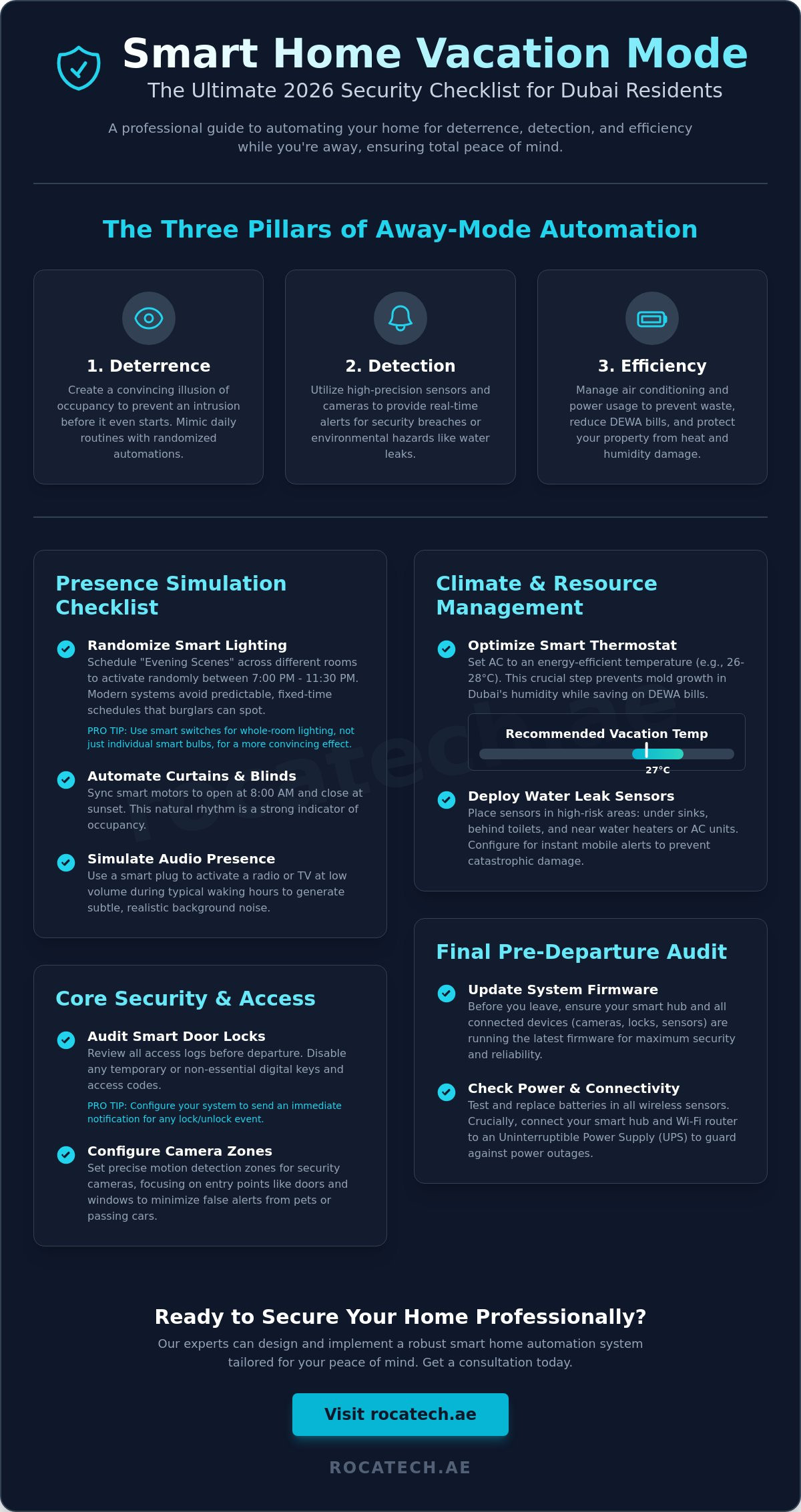
Effective vacation automation rests on three critical functional areas. First is deterrence, which focuses on creating a convincing illusion of occupancy to prevent an intrusion before it starts. Second is detection, utilizing a network of high-precision sensors and cameras to provide real-time alerts for security breaches or environmental hazards like water leaks. Finally, efficiency ensures that your home remains resource-conscious. This involves managing air conditioning and power through smart plugs to prevent waste and protect your property from the risks of extreme heat and humidity.
Why Static Timers are No Longer Enough
Relying on simple mechanical timers for lamps is an outdated strategy. Experienced burglars often monitor neighborhoods for predictable patterns, such as a light that activates at exactly 7:00 PM every evening. Modern vacation mode for smart home security solves this by using randomized scheduling. This feature varies the timing of lights and curtains by several minutes each day, creating a much more realistic "lived-in" appearance. Additionally, geofencing technology can automatically trigger these security scenes the moment your smartphone leaves a specific radius around your property, ensuring your home is never left unprotected by mistake.
The Presence Simulation Checklist: Creating the Lived-In Look
A house that appears occupied is significantly less likely to be targeted by opportunistic intruders. Presence simulation is the strategic core of a modern vacation mode for smart home security. It moves beyond simple on-off cycles to create a complex, unpredictable pattern of activity that mirrors your daily habits. By synchronizing multiple devices, you can project the image of a busy household even when you are thousands of miles away. This psychological layer of defense is your first line of protection against unauthorized entry.
Beyond visual cues, audio simulation adds a vital layer of realism. You can use a smart plug to activate a radio or a television in a central living area during typical waking hours. This generates subtle background noise that can be heard from a doorstep, suggesting someone is inside. When combined with outdoor smart lighting that highlights entry points when motion is detected, the deterrent effect is compounded. These integrated systems ensure that your home doesn't just look secure; it looks active.
Smart Lighting Strategies for Dubai Villas
Effective lighting requires more than just one or two lamps. A comprehensive smart lighting control system allows you to randomize "Evening Scenes" across different rooms between 7:00 PM and 11:30 PM. We recommend using smart switches rather than individual bulbs for whole-room simulation. Switches control the main overhead lights, which creates a much more visible and convincing glow from the exterior. Integrating porch lights with dusk-to-dawn sensors provides a stable baseline of visibility while the interior lights handle the randomized simulation of movement.
Automated Curtains and Natural Rhythm
Curtains and blinds are clear indicators of occupancy. You should set your smart curtain motors to open at 8:00 AM and close precisely at sunset. For added realism, vary the "open" percentage on different days; perhaps the master bedroom curtains only open 70% on a Tuesday. This subtle variation mimics human behavior perfectly. In the Dubai climate, there is also a critical thermal benefit. Keeping curtains closed during the peak afternoon sun reduces the load on your AC system, preventing the interior from overheating while you are away. If you are looking to enhance your home's perimeter defense, exploring a professional automation audit can identify specific vulnerabilities in your current setup.
Core Security & Access Control: The Defensive Checklist
While presence simulation creates a powerful deterrent, your defensive layer must be mathematically precise and physically impenetrable. A robust vacation mode for smart home security requires a rigorous audit of every digital and physical entry point. This ensures that even if a deterrent fails to stop an approach, your home remains an active fortress that identifies threats and alerts you instantly. Modern security is no longer about simply locking a door; it's about managing a sophisticated network of permissions and high-fidelity monitoring.
The transition from a lived-in home to a secured property involves shifting your system's logic from convenience to maximum alertness. This means arming all motion and entry sensors for immediate mobile notifications. For Dubai residents who utilize third-party services, such as garden maintenance or indoor cleaning, establishing a dedicated "Guest Mode" is essential. This allows you to maintain security protocols while granting controlled access to trusted individuals without compromising your master security codes.
Smart Locks and Temporary Credentials
Smart door locks serve as the primary gatekeepers of your property's perimeter. Before you travel, it's a professional best practice to revoke all permanent guest codes. Instead, generate unique, temporary credentials for housekeepers or pet sitters. You can set "active windows" for these codes, ensuring they only function during specific hours, such as Tuesday mornings. This prevents 24/7 access and provides a digital audit trail of exactly who entered your home and when. Always verify the physical lock status remotely via your central application to confirm the deadbolt is fully engaged after every visit.
Advanced Surveillance and Motion Logic
Modern surveillance technology has evolved beyond simple video recording. A high-performance home security camera system should utilize AI-powered human detection to differentiate between a stray animal and a genuine intruder. This precision is vital for avoiding the alert fatigue that often leads users to ignore critical notifications. You should also consider your storage strategy; while cloud storage provides off-site redundancy, local storage ensures your footage remains accessible even during a temporary internet outage. For a proactive defense, link your cameras to your smart lighting. If a camera detects a human in a restricted zone after midnight, your system can trigger an "Intruder Alert" scene, instantly illuminating all exterior lights to 100% brightness.
Climate and Resource Management for Dubai Travelers
Securing a property in the UAE requires a strategy that accounts for environmental hazards as much as physical intruders. The extreme heat and humidity characteristic of the region can cause internal damage that is often more costly than a typical security breach. A sophisticated vacation mode for smart home security must encompass climate control and resource monitoring to protect the structural integrity of your home. By integrating environmental sensors into your automation ecosystem, you can maintain a stable indoor climate while ensuring your utility consumption remains within expected parameters.
Effective resource management also involves identifying "vampire power" draws from non-essential appliances. Utilizing smart plugs allows you to cut power to entertainment systems, kitchen appliances, and home office setups remotely. This not only reduces your DEWA bill but also eliminates the minor fire risks associated with unattended electronics. Monitoring your consumption in real-time through your central hub provides a baseline of activity. Any sudden spike in water or electricity usage acts as an early warning system for anomalies like a burst pipe or a malfunctioning appliance.
The "Away" AC Strategy: Safety vs. Savings
Turning your air conditioning off entirely during a Dubai summer is a critical error. Without active circulation, indoor humidity levels can quickly exceed 60%, creating a breeding ground for mold and causing damage to delicate furniture or electronics. We recommend optimizing your smart thermostat dubai to maintain a steady temperature between 26°C and 28°C. This range is sufficient to protect your property while significantly reducing energy expenditure compared to standard settings. If your system supports it, utilize "Dry Mode" triggered by humidity sensors to extract moisture without over-cooling the space.
Preventing Water Damage While Away
Water damage is a frequent concern for residents in high-rise apartments and villas alike. AC drain line clogs are particularly common in the region, often leading to ceiling leaks or flooded laundry rooms. You should position water leak sensors in high-risk zones, including under sinks, near water heaters, and directly adjacent to AC drain pans. Configure your system to send immediate high-priority alerts to your smartphone if moisture is detected. For a truly professional setup, you can establish a protocol where these alerts are also shared with building security or a trusted local contact. To ensure your home is fully prepared for the next travel season, consider upgrading to a comprehensive environmental monitoring kit today.
Preparing for Departure: The Final Professional Audit
The final 24 hours before your departure are critical for verifying the integrity of your security ecosystem. A methodical audit ensures that every automated sequence and physical component functions exactly as intended. This final check is what transforms a collection of gadgets into a reliable, high-performance defense. Setting your vacation mode for smart home security a full day in advance allows you to observe the system in action and identify any minor logic errors or connectivity gaps before you are out of physical reach of the property.
Operational stability depends heavily on the health of your hardware. You should perform a comprehensive battery check on all wireless motion sensors, water leak sensors, and smart door locks. If any device reports a charge below 30%, replace the batteries immediately to prevent a mid-vacation failure. Simultaneously, verify that all firmware is updated to the latest version. Manufacturers frequently release patches that improve system stability and patch security vulnerabilities, which are essential for maintaining a secure environment while the home is unattended.
The 24-Hour Connectivity Test
Signal strength is the lifeblood of a smart home. You must verify the Wi-Fi signal at every peripheral camera location, as Dubai's thick concrete walls can often create dead zones that lead to intermittent recording. Ensure your smart hub gateway is connected to a stable power supply and, ideally, an uninterruptible power supply (UPS) to maintain functionality during minor power fluctuations. Finally, trigger a test alert to check that mobile notifications are active and clearly audible on all family devices. This ensures that every stakeholder is prepared to receive and act upon real-time data from the home.
When to Call the Professionals
While DIY adjustments are suitable for routine maintenance, complex integrations often require a seasoned expert's touch. If your current security setup feels fragmented or relies on aging legacy hardware, it's likely time for a system-wide upgrade. High-value villas in neighborhoods like Emirates Hills or Palm Jumeirah benefit significantly from professional calibration that ensures every sensor and camera is positioned for maximum coverage. Consulting with smart home installation dubai specialists can provide the specialized knowledge needed to build a truly resilient system. Rocatech offers localized expertise and support for Dubai residents, ensuring your automation remains technologically advanced and grounded in practical, real-world reliability. A professional pre-travel audit can be the final step in achieving absolute peace of mind for your next international journey.
Achieving Absolute Peace of Mind for Your Next Journey
Establishing a robust vacation mode for smart home security is an investment in both your property's safety and your own psychological well-being. By integrating randomized lighting schedules with intelligent environmental sensors, you move beyond basic protection to a comprehensive defense strategy. We've detailed how presence simulation deters intruders and how smart thermostats prevent climate-related damage. These systems ensure that your Dubai home remains secure and energy-efficient while you are traveling.
Strategic automation requires precision in both hardware selection and system logic. Whether you are managing a high-value villa or a modern apartment, professional calibration ensures that your security ecosystem operates without failure. Our team at Al Nasr Plaza specializes in 2026-ready automation technology tailored for the unique requirements of the Dubai market. Secure your home with a professional smart home consultation in Dubai to ensure your property is protected by the highest standards of technical excellence. Travel with confidence, knowing your home is in expert hands.
Frequently Asked Questions
Does vacation mode turn off all my lights?
No, a properly configured vacation mode utilizes randomized lighting control to simulate active occupancy. Instead of leaving the home dark, the system triggers specific lights in different rooms at varying intervals throughout the evening. This creates a realistic "lived-in" appearance that is far more effective at deterring potential intruders than a static "all-off" approach or simple mechanical timers.
How do I give a neighbor access to my smart home while I am away?
You can grant access by generating temporary digital credentials through your smart door lock application. This allows you to create a unique PIN code for a trusted neighbor that only functions during specific time windows. You can revoke these permissions instantly once they have completed their check, ensuring you never have to share master codes or physical keys with third parties.
What happens to my smart security if the power or Wi-Fi goes out in Dubai?
Most professional systems are designed with local storage and battery backups to maintain functionality during outages. While remote monitoring requires an active internet connection, your motion sensors and cameras can continue to record data locally to an SD card or internal drive. If your system includes a cellular backup module, it can still transmit critical alerts even when your primary Wi-Fi is unavailable.
Can I monitor my security cameras from another country?
Yes, you can access live video feeds and historical recordings from anywhere in the world via your smartphone. As long as you have a stable internet connection, you can check your home security camera status in real-time. This global accessibility is a fundamental advantage of implementing a comprehensive vacation mode for smart home security, providing immediate reassurance regardless of your physical location.
Is it safe to leave my AC on vacation mode in the UAE summer?
It is not only safe but essential to keep your AC active during the Dubai summer to prevent humidity damage. You should use a smart thermostat to maintain an "Away" temperature between 26°C and 28°C. This setting is sufficient to prevent mold growth and protect sensitive electronics while keeping your DEWA consumption significantly lower than standard cooling levels.
Will my smart home notify the police automatically?
Most residential smart systems are designed to notify the homeowner directly via push alerts rather than triggering an automatic police response. In Dubai, automated emergency dispatch typically requires a separate agreement with a SIRA-approved monitoring provider. You should verify your local regulations and service contracts to determine if your specific system supports professional emergency monitoring integration.
How do I prevent false alarms from my motion sensors while I am traveling?
You can minimize false alerts by utilizing AI-powered "Human Detection" and refining your motion zones. Professional-grade motion sensors can differentiate between the movement of a pet or a swaying curtain and a genuine human intruder. Adjusting the sensitivity levels in your system's application ensures that you only receive high-priority notifications, effectively reducing alert fatigue during your trip.
Do I need a smart hub to use a vacation mode?
While some individual Wi-Fi devices can operate independently, a smart hub gateway is necessary for complex, synchronized automation. The hub acts as the central brain that coordinates your lights, curtain motors, and locks into a single, reliable "Vacation Mode" scene. This centralized control ensures that all devices work in harmony and provides a more stable foundation for advanced security routines.