

The Ultimate Guide to Smoke Detectors for Dubai Homes in 2026

What if the safety device designed to protect your villa actually becomes a source of daily frustration due to humidity-triggered false alarms? In the unique climate of the United Arab Emirates, where indoor humidity levels fluctuate significantly, a standard smoke detector often fails to provide the precision required for modern living. You likely believe that home safety should be silent and invisible until the exact moment it's needed. Yet, the reality for many Dubai residents involves frequent, unnecessary disruptions during cooking or high-temperature days. Reliability shouldn't be a trade-off for convenience.
We understand that evaluating the technical specifications of different sensor technologies while ensuring compliance with 2026 Dubai Civil Defence requirements can feel overwhelming. This guide promises to simplify that process, showing you how to choose and integrate high-performance systems that offer total peace of mind without the nuisance of false triggers. You'll discover the specific advantages of multi-criteria sensors, the benefits of mobile connectivity for remote monitoring, and the exact steps to achieve a robust, smart-home ready fire safety setup that protects your family 24/7.
Key Takeaways
- Learn why the modern smoke detector has evolved into a precision safety node that ensures total property coverage through advanced interconnectivity.
- Discover how to integrate your fire safety system with smart lighting control to automatically illuminate emergency exit paths during critical events.
- Gain clarity on local compliance standards, including Dubai Civil Defence regulations and Hassantuk requirements for residential villas in the UAE.
- Understand the technical advantages of professional installation to eliminate signal interference and ensure industrial-grade reliability for your home.
- Explore the move toward 10-year sealed lithium batteries and how these robust components provide a maintenance-free solution for long-term peace of mind.
Understanding Smoke Detector Technology: More Than Just an Alarm
The modern smoke detector is a precision instrument designed for life safety rather than a simple hardware accessory. In 2026, Dubai's residential landscape demands more than basic battery-operated units; homeowners now require interconnected safety nodes that function as a unified shield. This transition represents a move away from isolated alarms toward a sophisticated ecosystem where every device communicates. If a sensor identifies a threat in a remote laundry room, every alarm in the villa sounds simultaneously. This ensures occupants have the maximum possible time to evacuate, regardless of their location within the property.
Residential safety in the UAE requires a total solution approach. This methodology integrates robust hardware with localized environmental considerations, such as high ambient temperatures and specific building materials used in regional architecture. Relying on a single, unmonitored device is no longer sufficient for high-value assets. This technical reliability provides a significant psychological benefit. It shifts the homeowner's experience from constant background anxiety to a state of genuine peace of mind. When you know the system monitors itself and communicates effectively, the stress of "what if" disappears.
Photoelectric vs. Ionization: Which is Better for Your Home?
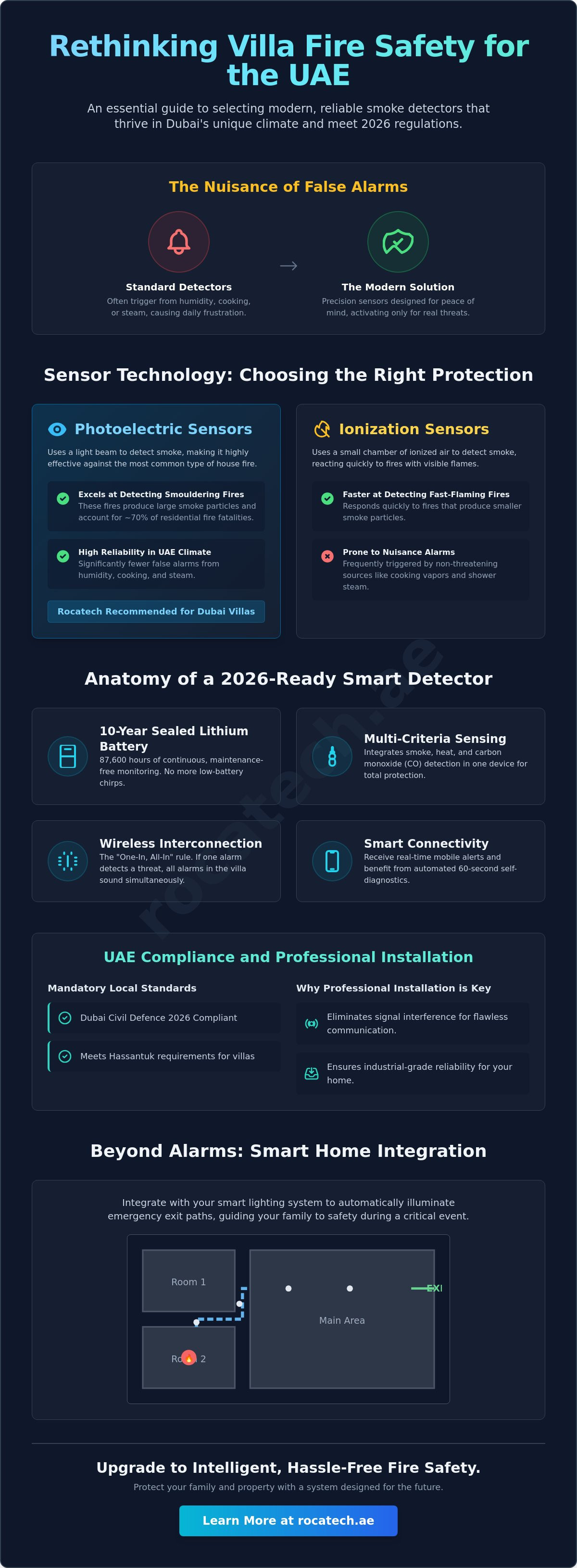
Photoelectric sensors use a light source and a light-sensing chamber to identify smoke. They're exceptionally effective at detecting smouldering fires, which produce large smoke particles and account for approximately 70% of residential fire fatalities. Conversely, ionization units use a small amount of radioactive material to ionize air, making them faster at detecting fast-flaming fires. However, ionization sensors are notoriously prone to false alarms from cooking vapours or shower steam. Rocatech recommends high-quality photoelectric or dual-sensor units for Dubai villas to ensure reliability. Understanding smoke detector technology is essential for selecting a system that minimizes nuisance alarms while maintaining high sensitivity to real threats.
The Evolution of Fire Detection in 2026
The latest generation of safety hardware has evolved into multi-functional protection hubs. Modern units now integrate heat sensors and carbon monoxide (CO) detection into a single chassis, offering a comprehensive defense against multiple atmospheric hazards. These devices feature advanced self-testing capabilities, performing internal diagnostics every 60 seconds to verify sensor health and battery integrity. Smart smoke detection is an IoT-enabled safety protocol that provides real-time alerts and diagnostic data to a user's mobile device. This level of automation removes the burden of manual testing from the homeowner, ensuring the system remains operational 24/7 without fail.
Key Features to Look for in a Smart Smoke Detector
Selecting a smoke detector for a Dubai residence requires a focus on technical endurance and system integration. Reliability is no longer just about a loud siren; it's about the power source. The industry has shifted toward 10 year sealed lithium batteries. These units provide 87,600 hours of continuous monitoring without the need for annual battery changes. This eliminates the common issue of residents disabling alarms due to low-battery chirps, ensuring the device remains operational throughout its entire lifecycle. Precision engineering in these sensors reduces false positives while maintaining high sensitivity to both smoldering and fast-flaming fires.
Interconnected Safety: The "One-In, All-In" Rule
Standalone alarms are often insufficient for the expansive, multi-storey villas found in neighborhoods like Emirates Hills or Palm Jumeirah. If a fire starts in a ground-floor kitchen, a standalone alarm might not be audible in a second-floor master suite. Interconnected systems solve this by ensuring that when one alarm detects a threat, every unit in the property activates simultaneously. This synchronized response follows NFPA smoke alarm installation standards to maximize early warning times. Wireless interconnection is now the preferred standard for retrofitting Dubai homes because it offers the stability of a mesh network without the invasive construction required for hardwired systems. This setup provides residents with vital extra seconds, which is frequently the difference between a controlled evacuation and a life-threatening situation.
Smart Notifications and Automation Triggers
Modern safety goes beyond local sounders. By integrating your smoke detector with a smart hub gateway, you receive real-time alerts on your smartphone regardless of your location. This remote monitoring is essential for Dubai residents who travel frequently. Smart systems also allow for sophisticated automation. When smoke is detected, the system can automatically unlock smart locks and illuminate exit paths by turning on all internal lights. Managing kitchen mishaps is also more efficient; smart apps include "Hush" features that allow you to silence a false alarm caused by cooking steam directly from your phone. This functionality ensures the device remains active rather than being physically removed or damaged in frustration. For homeowners seeking a comprehensive safety audit, a consultation with a specialist at rocatech.ae can identify the optimal configuration for your specific floor plan.
Integrating Fire Safety into Your Dubai Smart Home Ecosystem
A modern smoke detector shouldn't operate in isolation. In Dubai's high-rise apartments and sprawling villas, localizing a fire threat is only the first step. True protection comes from industrial-grade integration that links every component of your property's infrastructure. This ensures that your response is immediate, automated, and error-free. By moving beyond standalone units, you create a resilient safety network that acts with precision during a crisis.
Unified Control Through the Smart Hub
The smart hub serves as the central nervous system for your safety protocols. By 2026, the adoption of the Matter protocol has standardized how devices communicate, allowing a smoke detector to talk seamlessly with other hardware. Whether your system uses Zigbee or Z-Wave, a unified hub eliminates fragmented management. It centralizes battery health monitoring and sensor status into a single interface. This level of oversight is vital for Dubai residents who manage multiple properties or travel frequently. You'll receive precise data on which specific unit requires maintenance, preventing the common issue of neglected sensors or dead batteries.
Proactive Response Automation
Automation transforms a passive alarm into an active life-saving sequence. When a smoke detector identifies a threat, the system executes a pre-configured "Safety Scene." First, your smart lighting control activates, illuminating exit paths in a distinct color to guide occupants through potential haze. Simultaneously, the smart hub instructs the HVAC system to shut down immediately. This prevents the AC from circulating smoke and toxic fumes through the ventilation ducts, a critical factor in containing fire spread within modern UAE homes.
Speed is essential for verification. You can use home security cameras to get a live visual feed of the affected area on your smartphone. This allows you to confirm the emergency before the Civil Defence is dispatched, effectively reducing false alarms. While DIY kits offer basic functionality, professional integration ensures these complex handshakes between devices happen without latency. In high-stakes safety environments, a fragmented setup is a liability. A professionally calibrated system provides the robust reliability required to protect your family and assets.
- Centralized Monitoring: Track all security sensors and fire detection units from one dashboard.
- Protocol Compatibility: Future-proof your home with Zigbee, Z-Wave, and Matter support.
- HVAC Interlock: Automatically cut airflow to prevent smoke inhalation across different rooms.
- Emergency Lighting: Flash red or white lights to signal danger and clear paths to exits.
Choosing professional integration over a DIY approach ensures that every automation rule is tested for 100% reliability. Rocatech prioritizes this consultative approach, focusing on long-term value and the peace of mind that comes from a fail-safe system. We ensure your safety ecosystem meets international standards while remaining tailored to the specific architectural needs of the Dubai market.
Local Regulations and Professional Placement in the UAE
Compliance with Dubai Civil Defence (DCD) standards is a legal necessity for every homeowner. The UAE's commitment to fire safety is personified by the Hassantuk program, an intelligent system designed to connect villas directly to the emergency operations room. By January 2026, all residential villas in Dubai must adhere to the updated Fire and Life Safety Code, which mandates fully operational, interconnected alarm systems. Failing to maintain these systems can result in fines starting from AED 1,000, making technical reliability both a safety and a financial priority.
Hassantuk and Dubai Civil Defence Compliance
The Hassantuk initiative isn't just a recommendation; it's a mandatory requirement for villa owners. This system ensures that a smoke detector alert is transmitted to the authorities within seconds. While the government provides the core framework, high-quality smart detectors complement this by offering localized alerts on your mobile device. This dual-layered approach ensures you're notified whether you're in the garden or traveling abroad. The 2026 regulations emphasize that every sleeping area and hallway must have integrated coverage to eliminate blind spots in the home's safety grid.
Optimal Placement for Maximum Protection
Strategic placement is where many DIY installations fail. Precision is required to avoid "dead air" zones. These are pockets in the corners of rooms or at the very peak of a ceiling where air doesn't circulate, effectively shielding a smoke detector from the smoke it's meant to sense. Sensors should be placed at least 10 centimeters from walls and away from air conditioning vents that might blow smoke away from the device.
Different rooms require tailored solutions. Photoelectric sensors are ideal for hallways and bedrooms to catch smoldering fires, while heat detectors are necessary for kitchens to prevent false alarms from cooking vapors. Utilizing a professional smart home installation ensures that every sensor is mounted at the correct height and spacing according to DCD specifications.
Maintenance in the UAE's desert climate presents unique challenges. Fine dust can accumulate inside the sensor chamber, leading to malfunctions or frequent false triggers. Rocatech recommends a quarterly testing and cleaning schedule to ensure peak performance. Our team provides a hassle-free route to compliance, managing the technicalities of installation and calibration so you can enjoy total peace of mind.
Why Professional Installation is the Standard for Reliability
Purchasing a high-quality smoke detector is only the first step toward home safety. The device's actual performance depends entirely on its deployment. In Dubai's unique architectural landscape, DIY installation often leads to critical vulnerabilities that homeowners overlook. A misplaced sensor near a high-velocity air conditioning vent can divert smoke away from the chamber, delaying an alarm by over 120 seconds. This delay is often the difference between a contained incident and a total loss.
Professional installation eliminates technical risks like signal interference and power failures. Many modern Dubai villas utilize extensive smart home meshes that operate on similar frequencies. Our technicians ensure your smoke detector network remains isolated and prioritized. We apply industrial-grade methodology to residential settings, treating your family's safety with the same rigor we apply to high-stakes automation environments. This approach ensures that your system doesn't just look functional but is technically robust under pressure.
- Strategic placement to avoid "dead air" zones common in high-ceiling Dubai properties.
- Hardwired integration with battery backups to ensure 100% uptime during power fluctuations.
- Verification of signal strength across thick concrete and steel reinforced walls.
The Rocatech Precision Advantage
Our commitment to precision and excellence drives our hardware selection and calibration process. Dubai’s humidity levels frequently exceed 85% during the summer. This atmospheric moisture can trigger false alarms in standard optical sensors, leading to "alarm fatigue" where residents begin to ignore alerts. Rocatech engineers calibrate every sensor to distinguish between heavy humidity and actual combustion particles. We don't just sell hardware; we secure your environment through a consultative partnership that prioritizes long-term value and technical accuracy.
Ensuring Long-Term System Stability
Safety systems require consistent maintenance to remain reliable over a ten-year lifespan. Rocatech provides annual health checks and essential firmware updates for smart sensors to protect against software glitches and security vulnerabilities. We also focus on the human element by training your household on how to respond to specific smart alerts. This comprehensive support structure ensures your system remains as effective in year five as it was on day one. Don't leave your protection to chance or amateur setup. Book a safety consultation with Rocatech today to ensure your home meets the highest standards of industrial-grade residential safety.
Securing Your Dubai Residence for the Future
Integrating a modern smoke detector into your home ecosystem requires more than a basic hardware purchase. Since 2021, Rocatech has established a reputation for delivering precision-engineered safety solutions that align with the UAE's stringent Hassantuk regulations. Effective fire prevention in 2026 demands smart connectivity and professional placement to eliminate detection blind spots. By prioritizing industrial-grade reliability, you ensure your property remains compliant with local civil defense standards while providing total protection for your family. Our team focuses on seamless integration, turning complex technical requirements into a robust safety network. You don't have to navigate these technicalities alone. Our expertise ensures every component functions as a cohesive unit within your smart home architecture. Choosing a partner dedicated to technical excellence provides the peace of mind that your detection systems are always active and accurate.
Secure your home with Rocatechs professional smoke detection solutions
Investing in professional fire safety today establishes a foundation of security that will protect your property and loved ones for years to come.
Frequently Asked Questions
Is a smart smoke detector worth the extra cost in Dubai?
A smart smoke detector provides essential remote monitoring capabilities that standard units lack. While initial costs for smart units can be 150% higher than traditional models, the ability to receive real-time alerts on your smartphone while away from your home justifies the investment. These devices integrate with home automation systems to provide a comprehensive safety network. This connectivity ensures you're notified of potential hazards the moment they're detected.
How many smoke detectors do I need for a standard 3-bedroom villa?
A standard 3-bedroom villa typically requires a minimum of five units to ensure full coverage. You should install one unit in every bedroom, one in the hallway serving the sleeping areas, and one in the main living space. For multi-story villas, Civil Defense guidelines require at least one detector on every floor. This configuration ensures that an alarm is audible from any location within a typical 2,500 square foot property.
Can my smoke detector automatically turn off the AC if it detects fire?
Your smoke detector can automatically shut down the air conditioning system when integrated with a smart home hub or a dedicated HVAC relay. This functionality is crucial in Dubai homes because AC ducts can spread smoke rapidly between rooms during a fire. By cutting power to the air handling unit, the system helps contain smoke to the area of origin. This integration requires a compatible smart detector and a professional setup to ensure the relay triggers correctly.
What is the difference between a smoke alarm and a smoke detector?
A smoke alarm is a self-contained unit that includes both the smoke sensor and the audible siren in one housing. In contrast, a smoke detector is a sensor that sends a signal to a central fire alarm control panel, which then triggers external sirens. Residential villas often use standalone alarms, while larger commercial buildings or integrated smart homes utilize detectors as part of a robust, centralized safety architecture.
How often should I change the batteries in my smart smoke detector?
You should replace the batteries in your smart smoke detector every 12 to 24 months, depending on the manufacturer's specifications. Many modern smart units use lithium batteries designed for high-drain devices to maintain a constant Wi-Fi connection. If your device features a sealed 10-year battery, the entire unit must be replaced once the battery expires. Your mobile app will typically send a notification when the power level drops below 20 percent.
Will my smoke detector still work if the Wi-Fi goes down?
Your smoke detector will continue to function as a localized life-safety device even if your Wi-Fi connection fails. The internal sensors and audible siren operate independently of the internet to provide immediate on-site alerts. You'll lose remote notification features and smartphone alerts until the connection is restored. Standard 802.11b/g/n protocols ensure the device reconnects automatically once your router is back online.
What is Hassantuk and is it mandatory for my home in Dubai?
Hassantuk is a strategic UAE government initiative designed to connect residential fire alarm systems directly to the Civil Defense command center. As of 2024, UAE Cabinet Resolution No. 61 makes it mandatory for all villa owners in Dubai to subscribe to this monitoring service. The system uses a dedicated gateway to transmit fire alerts in less than 120 seconds. This ensures a rapid emergency response even if the property is unoccupied.
How do I stop my smoke detector from chirping without removing the battery?
You can stop a smoke detector from chirping by pressing the silence or hush button located on the front of the unit. This action typically mutes the alert for 8 to 10 minutes while you address the cause, such as dust or cooking vapors. If the chirping persists, use a vacuum attachment to clear any debris from the sensor chamber. Chirping often indicates a low battery or an internal fault that requires a professional inspection to resolve.