

Smart Home for Energy Conservation: A 2026 Guide for UAE Homeowners

Since buildings in the UAE account for nearly 70% of the country's total electricity consumption, your cooling system is effectively the largest line item on your monthly balance sheet. We understand the frustration of watching utility bills climb as the summer heat intensifies, especially when you realize energy is being wasted on empty rooms or unshaded windows. Implementing a smart home for energy conservation is no longer just a luxury; it's a strategic necessity for any homeowner looking to stabilize their household operational costs and improve system efficiency.
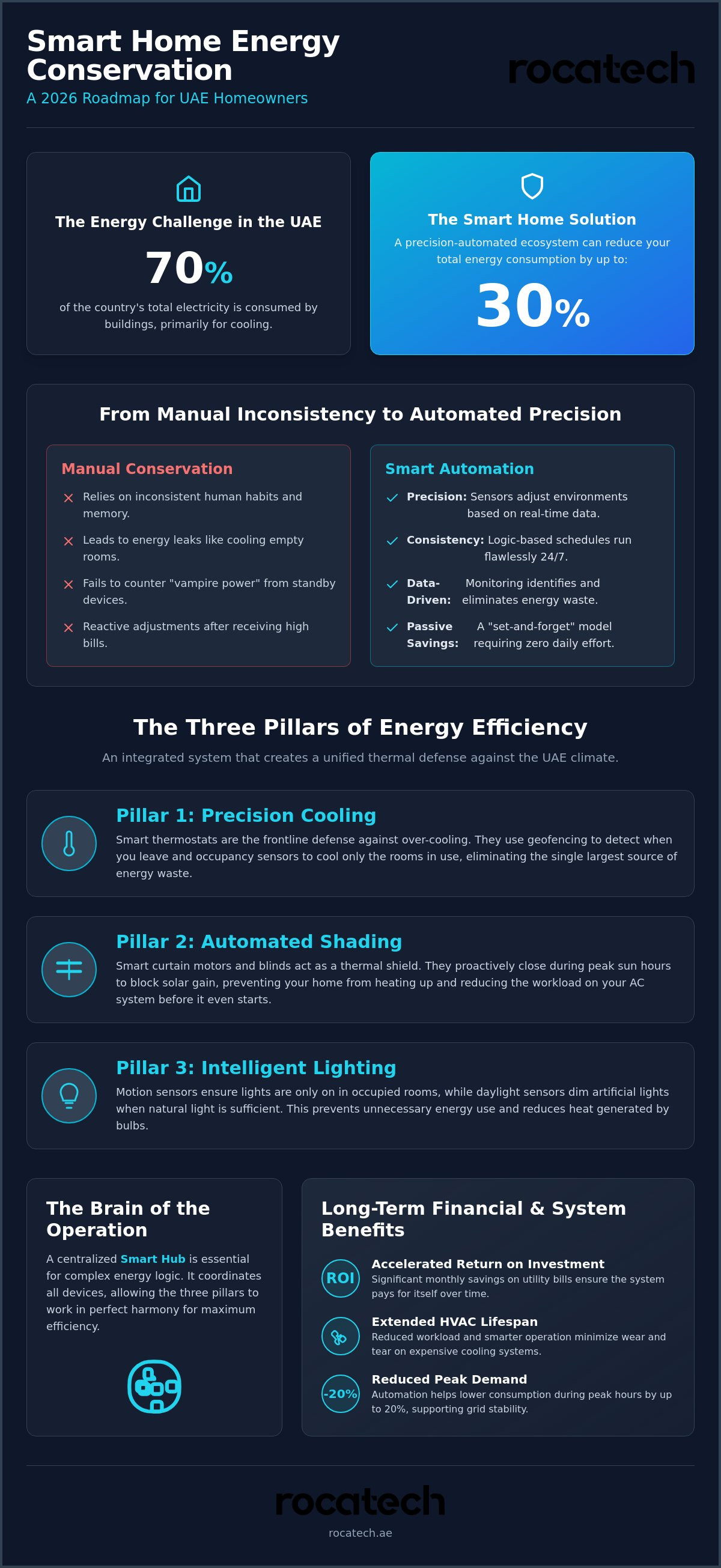
You can reduce your total energy consumption by up to 30% by transitioning from manual adjustments to a precision-automated ecosystem. This guide provides a clear roadmap for 2026, focusing on high-ROI technologies like smart thermostats and integrated curtain motors that work in harmony to maintain thermal stability. We'll examine how to navigate the latest DEWA and ADDC tariff structures while building a seamless, sustainable household that prioritizes both technical reliability and long-term value. From motion sensors to smart hubs, you'll discover how to create an integrated environment where operational failure is not an option.
Key Takeaways
- Learn how precision resource management identifies hidden energy leaks to optimize your household's operational efficiency.
- Explore the "Three Pillars" of UAE automation, including how smart thermostats and curtain motors act as a unified thermal defense against the regional climate.
- Discover the technical framework required to implement a smart home for energy conservation that delivers a measurable reduction in consumption by up to 30%.
- Understand the long-term financial benefits of automation, including accelerated ROI and the extended operational lifespan of your HVAC systems.
- Identify why a centralized smart hub is essential for complex energy logic and how a professional site assessment ensures total system harmony.
The Science of Savings: How Smart Homes Reduce Energy Consumption
Effective energy management in the Middle East requires a departure from traditional, reactive habits. We define a smart home for energy conservation as a system of precision resource management. Instead of reacting to a high utility bill at the end of the month, homeowners use real-time data to identify energy leaks as they occur. These leaks often manifest as AC units cooling unoccupied guest rooms or lighting systems remaining active during peak daylight hours. By utilizing The Science of Savings through integrated technology, you transform your home into a high-performance environment where every watt is accounted for.
Automation serves as a critical failsafe against human error. It's common to forget to adjust the thermostat before leaving for work or to overlook a balcony light. These small oversights compound into significant operational waste over a season. By delegating these tasks to a synchronized network of sensors and controllers, you gain the psychological benefit of technical reliability. You no longer need to mentally track every device in your household. The system ensures operational excellence through consistent, logic-based execution that doesn't suffer from fatigue or forgetfulness.
The 30% Efficiency Benchmark
Data from ResearchGate indicates that a properly configured smart home for energy conservation can achieve an average 30% reduction in overall consumption. This isn't just about lower bills; it includes a 20% reduction in peak demand. In the UAE, where the electrical grid faces extreme pressure during summer afternoons, reducing peak demand is essential for long-term grid stability. Demand-side management is a strategic tool that empowers residents to contribute to national sustainability goals while lowering their individual utility costs through automated load balancing.
Automation vs. Manual Conservation
Manual habits are inherently inconsistent and often fail to address the specific cooling requirements of a desert climate. Even the most disciplined homeowner cannot match the precision of sensor-based logic that adjusts climate control based on real-time occupancy and external solar gain. Smart systems also mitigate the impact of "vampire power," which is the electricity consumed by devices in standby mode. By using smart plugs and automated hubs, you can effectively sever these phantom loads when they aren't needed. This represents a fundamental shift from active, stressful management to a passive, "set-and-forget" model of household efficiency.
- Precision: Sensors detect presence and adjust environments in seconds.
- Consistency: Automation maintains strict schedules regardless of your daily routine.
- Data-Driven: Real-time monitoring reveals exactly where your money is going.
- Passive Savings: Efficiency becomes a background process that requires zero daily effort.
The Three Pillars of Energy-Efficient Automation in the UAE
Designing a smart home for energy conservation in the Middle East requires a specific focus on thermal gain. Unlike cooler climates where heating is the priority, UAE homeowners must defend their interiors against intense solar radiation and high ambient temperatures. A truly efficient system doesn't treat devices as isolated units; it coordinates them into a unified defense. By aligning your climate control, lighting, and shading, you create an ecosystem that proactively manages the heat before your AC system has to work overtime. This integrated approach is what secures a significant smart home return on investment, often reducing energy usage by 30% to 40% when executed with technical precision.
Precision Cooling with Smart Thermostats
The AC system is the primary consumer of electricity in any Dubai villa or apartment. Traditional thermostats often lead to "over-cooling" because they lack the data to make intelligent adjustments. Implementing a smart thermostat dubai allows for geofencing, which automatically raises the target temperature when the system detects that the last resident has left the property. By integrating multiple motion sensors across different zones, the system balances the load, ensuring guest rooms aren't chilled to the same level as the primary living areas. This eliminates the waste associated with cooling empty spaces while maintaining a comfortable environment for your return.
Smart Lighting and Occupancy Logic
Lighting waste is a hidden drain on household efficiency, particularly in larger villas with numerous hallways and storage areas. A robust smart lighting control system uses occupancy logic to ensure that lights are active only when a room is in use. Beyond simple motion detection, advanced systems utilize daylight harvesting. This technology uses sensors to measure the amount of natural light entering a room and adjusts the indoor brightness accordingly. If the afternoon sun is providing sufficient illumination, the system dims the artificial lights to the minimum required level, saving energy without sacrificing visibility.
Automated Curtains for Thermal Insulation
Smart curtain motors are the "passive cooling" secret for modern UAE high-rise apartments. Large floor-to-ceiling windows offer stunning views but also invite massive amounts of UV heat. By scheduling your curtains to close during peak UV hours, you significantly reduce the thermal load on your AC. This synergy between solar sensors and curtain motors prevents the "greenhouse effect" from taking hold while you're away at work. This proactive shading doesn't just save on electricity; it also protects your interior finishes and furniture from sun damage, adding another layer of long-term value to your smart home for energy conservation strategy. For those seeking to stabilize their monthly utility costs, exploring these precision automation solutions is the most effective first step toward household sustainability.
The Brain of the Operation: Smart Hubs and Energy Monitoring
A collection of standalone devices does not constitute a high-performance system. To achieve a truly effective smart home for energy conservation, you must move beyond individual controls and implement a centralized coordination layer. A central Smart Hub Gateway acts as the operational brain of your household, ensuring that every sensor and actuator communicates with technical precision. Without this central nervous system, your devices operate in silos, missing the opportunity for the sophisticated logic required to maximize efficiency in the complex UAE climate.
System stability depends heavily on the communication protocol you choose. We prioritize standards like Zigbee and the emerging Matter protocol because they offer the reliability necessary for high-stakes automation. These protocols ensure that your energy-saving routines execute without fail, even if your local Wi-Fi experiences interference. Reliability is a psychological benefit; knowing that your system will consistently shut down high-consumption appliances during peak tariff hours provides significant emotional reassurance for homeowners managing a high-value property.
While modern appliances are built for efficiency, many homes still rely on legacy hardware that drains power invisibly. Smart plugs allow you to bring these older devices into your managed ecosystem. By placing a smart plug on a secondary refrigerator or an older water heater, you can monitor its specific consumption and set strict operational schedules. This visibility turns "vampire power" into a manageable metric, ensuring that no device consumes electricity when it isn't providing a functional benefit.
Unified System Harmony
The true value of a hub lies in its ability to create cross-device synergies. A smart hub gateway allows a single motion sensor to trigger multiple energy-saving actions simultaneously. For instance, using "If-This-Then-That" (IFTTT) logic, your system can detect when a room is vacated, then immediately signal the AC to raise the temperature and the smart lighting control to deactivate the lamps. This level of system harmony eliminates the gaps where energy waste typically occurs, transforming your home into a reactive, efficiency-first environment.
Real-Time Consumption Tracking
Energy meters and hub-integrated monitoring tools provide the evidence required to validate your conservation strategy. Rather than waiting for a monthly utility bill, you can visualize energy spikes in real-time through detailed mobile dashboards. This data allows you to set "energy budgets" for specific zones or time periods. If consumption exceeds your predefined threshold, the system can send an immediate alert, allowing you to investigate the cause. By turning raw data into actionable insights, you move from passive observation to active, strategic management of your household resources.
- Protocol Stability: Zigbee and Matter ensure your logic executes without interruption.
- Legacy Integration: Smart plugs bring older appliances under your central control.
- Logic-Based Savings: IFTTT routines automate complex, multi-device responses.
- Financial Transparency: Real-time dashboards reveal the direct impact of your automation settings.
Calculating ROI: Does Smart Home Automation Pay for Itself?
The initial financial commitment required for a smart home for energy conservation is often the primary concern for UAE homeowners. However, viewing this technology as a capital expense rather than a strategic investment overlooks the long-term yield. In a high-stakes technical environment like a Dubai villa, operational inefficiency is a recurring cost that compounds over time. By implementing a precision-engineered system, you transition from reactive spending to proactive asset optimization. The financial return is realized not only through lower monthly bills but also through the preservation of your home's most expensive mechanical systems.
Direct Savings on Utility Bills
The most immediate impact is visible on your monthly DEWA or ADDC statements. With electricity tariffs in Dubai reaching 38 fils/kWh for consumption over 6,000 units, the cost of waste is high. By achieving a 20% to 30% reduction in consumption through occupancy logic and thermal shading, the payback period for your equipment is surprisingly short. Precision cooling pays for itself within 18-24 months. These savings are consistent and predictable, providing a stable financial benefit that persists for the entire lifecycle of the installation.
Long-Term Operational Value
Beyond the monthly bill, a smart home for energy conservation extends the operational lifespan of your HVAC system. AC units in the Middle East fail prematurely due to constant, high-load cycling. Smart thermostats reduce this strain by maintaining stable temperatures rather than forcing the compressor to work at maximum capacity to recover from extreme heat spikes. This reduction in mechanical wear translates to fewer emergency repairs and a longer interval between major overhauls.
There are also "invisible" savings to consider. Water leak sensors and smart plugs provide a layer of protection against catastrophic failures. A single undetected water leak in a luxury villa can cause damage exceeding the cost of an entire automation system. Similarly, monitoring for electrical surges protects sensitive electronics from damage. This technical reliability provides significant emotional reassurance, knowing that your home is actively defending itself against operational failure. To ensure your system is designed for maximum financial yield, you can schedule a technical assessment with Rocatech to identify the highest ROI opportunities for your specific property.
- Asset Protection: Reduced load on HVAC systems prevents premature mechanical failure.
- Risk Mitigation: Sensors identify leaks and surges before they cause expensive damage.
- Market Value: Smart features increase the desirability and resale price of UAE properties.
- Professional Installation: Expert configuration ensures that your automation logic actually delivers the promised savings.
Implementing Your Efficiency Strategy with Rocatech
Establishing a smart home for energy conservation requires a methodical transition from conceptual savings to operational reality. We approach every project with a professional, consultative mindset, recognizing that technical reliability is the foundation of long-term value. Our implementation strategy is a structured lifecycle designed to eliminate technical friction and ensure your automation ecosystem performs with absolute precision. We don't just provide hardware; we engineer integrated environments where operational failure is not an option.
Our process begins with a comprehensive energy audit and site assessment. This diagnostic phase allows us to identify the specific thermal challenges of your property, whether it's a high-rise apartment in Dubai Marina or a sprawling villa in Arabian Ranches. We analyze your existing HVAC configurations and lighting circuits to create a data-driven blueprint for efficiency. Following this, we move to the selection of technical-grade sensors and controllers, ensuring that every component, from motion sensors to smart hub gateways, meets international standards for durability and performance.
The third stage focuses on professional integration to achieve total system harmony. This is where individual devices are synchronized into a single, logic-based network. Finally, we provide post-installation support and logic optimization. We understand that real-world usage patterns may shift, so we refine your automation scenes to ensure they continue to deliver the highest possible ROI as the seasons change.
Why Professional Installation Matters
Many homeowners encounter the "DIY gap," where mismatched devices fail to communicate or suffer from frequent connection drops. This lack of stability compromises the energy-saving potential of the entire system. Professional installation ensures that your network is secure, private, and optimized for the specific demands of the Middle East climate. By choosing an expert-led approach, you avoid the common pitfalls of fragmented systems and gain a unified interface that is both reliable and easy to manage. You can explore our full smart home installation dubai process to see how we bridge the gap between complex technology and user-centric control.
Your Partner in Precision Automation
Rocatech is committed to delivering sophisticated automation solutions that respect the unique architectural standards of the UAE. We have extensive experience customizing energy scenes for properties developed by Emaar, Nakheel, and Damac, ensuring that our technology integrates seamlessly with local building specifications. We value stability and precision, appearing as a dependable ally for homeowners who demand excellence in their smart home for energy conservation. If you're ready to stabilize your utility costs and enhance your household's operational efficiency, contact us for a personalized energy conservation consultation today. Our seasoned experts are ready to help you build a sustainable, future-ready home.
- Methodical Audits: Every strategy starts with a technical assessment of your specific energy leaks.
- Technical-Grade Hardware: We only utilize sensors and controllers built for high-stakes environments.
- Regional Expertise: Our solutions are tailored for the unique HVAC and layout requirements of UAE villas and apartments.
- Ongoing Optimization: We ensure your system logic evolves with your lifestyle for maximum efficiency.
Securing Your Household’s Operational Future
Transitioning to a smart home for energy conservation is a strategic decision that aligns your household with the UAE’s vision for a sustainable, high-efficiency future. By integrating smart thermostats, automated curtain motors, and centralized hubs, you can achieve a measurable reduction in consumption of up to 30%. This transformation goes beyond immediate utility savings; it builds a resilient, technical environment that protects your HVAC assets and increases your property’s long-term market value. Technical reliability is no longer a luxury but a fundamental requirement for modern desert living.
Rocatech has provided Dubai-based expertise since 2021, specializing in high-heat HVAC optimization and seamless system integration. We offer comprehensive lifecycle support, from the initial energy audit to ongoing maintenance, ensuring your automation logic remains precise and effective. Our commitment to excellence ensures that your transition to a smarter home is grounded in practical, real-world applications that deliver consistent results. Take the first step toward a more efficient and stable household today. Book a Professional Energy Efficiency Consultation with Rocatech to discover how precision automation can transform your property. We look forward to helping you engineer a more sustainable and comfortable living space.
Frequently Asked Questions
How much energy can a smart home actually save in Dubai?
A properly configured smart home for energy conservation typically reduces electricity usage by 20% to 30%. Since buildings in the UAE use nearly 70% of their total power for cooling, the primary impact comes from managing HVAC systems more effectively. These savings are achieved by eliminating waste in unoccupied zones and optimizing thermal defense during peak daylight hours.
Which smart device has the fastest ROI for energy conservation?
The smart thermostat offers the fastest return on investment because it directly controls the largest energy consumer in the home. By utilizing geofencing and multi-room sensors, it prevents the over-cooling of empty spaces. Most homeowners see the technical reliability of these systems pay for themselves through utility bill reductions in less than two years.
Do smart home devices themselves consume a lot of electricity?
The power draw of sensors and hubs is extremely low. Most devices use energy-efficient communication protocols that consume only milliwatts of power during operation. The electricity used by these devices is far outweighed by the "vampire power" they eliminate through smart plugs and automated shutdowns of high-consumption appliances.
Can I integrate energy-saving smart devices into an older Dubai apartment?
Retrofitting is highly effective for older properties in areas like Bur Dubai or Deira. Many energy-saving devices, such as smart plugs and battery-powered motion sensors, don't require structural changes. These tools allow you to bring legacy appliances under a centralized management system, identifying energy leaks that are common in older building envelopes.
Is professional installation necessary for energy conservation systems?
Professional installation is recommended to ensure total system harmony and technical reliability. While individual devices are easy to purchase, integrating them so that a motion sensor correctly triggers both the AC and lighting requires expert configuration. Professional setup also ensures your network is secure and optimized for the specific electrical standards found in UAE properties.
How do smart curtains help with AC efficiency?
Smart curtain motors provide proactive thermal insulation by blocking UV heat before it enters the room. By scheduling curtains to close during the hottest parts of the day, you significantly reduce the load on your AC system. This "passive cooling" strategy prevents the greenhouse effect in rooms with large windows, maintaining a stable internal temperature without extra energy expenditure.
What happens to my energy-saving settings if the internet goes down?
Your energy-saving settings will continue to function if you have a robust smart hub gateway installed. Local automation logic doesn't require an active internet connection to execute routines between sensors and controllers. This technical reliability ensures that your cooling and lighting schedules remain active, providing significant emotional reassurance for homeowners.
Are smart thermostats compatible with all UAE AC systems?
Most modern central AC and split systems found in Emaar, Nakheel, or Damac developments are compatible with smart thermostats. However, a professional compatibility check is essential because some older chiller systems require specific interface modules. Ensuring the correct technical match is vital to prevent operational failure and maximize the efficiency of your smart home for energy conservation.