

Smart Home Ecosystem Integration in Dubai: The 2026 Strategic Guide

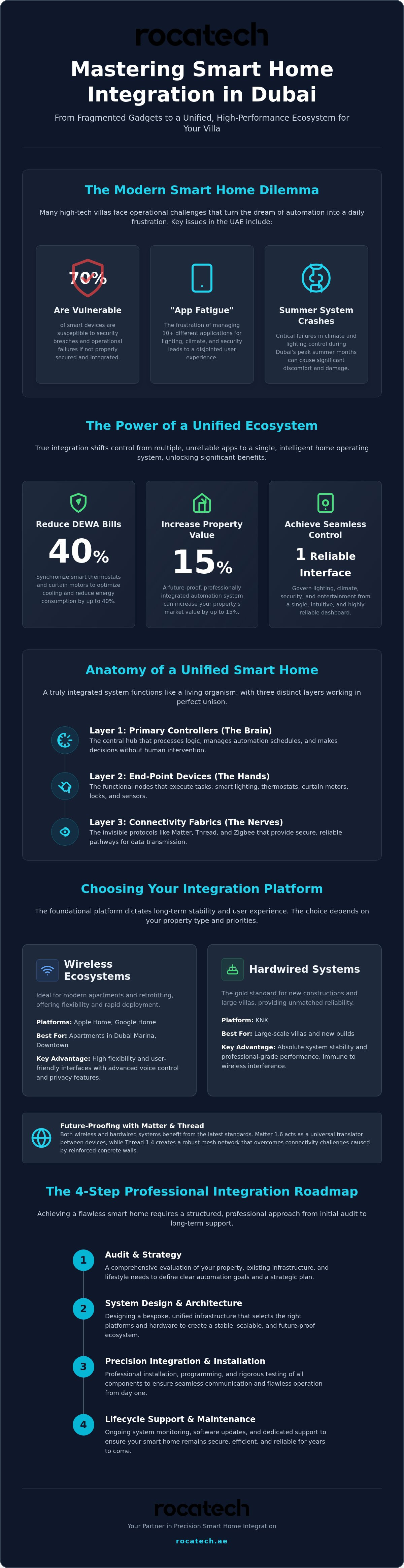
Did you know that 70% of the smart devices owned by UAE residents are vulnerable to security breaches and operational failures if they aren't properly secured? For many property owners, the dream of a high-tech villa often dissolves into the frustration of managing ten different apps and facing system crashes during the peak of summer. Achieving seamless smart home ecosystem integration dubai requires more than just buying the latest gadgets; it demands a strategic approach to technical harmony that accounts for local regulations like the 2026 TDRA customs mandates.
We understand that you want a home that works for you, not a system that requires constant troubleshooting. You deserve a single, reliable interface that governs your lighting, climate, and security with absolute precision. This guide will show you how to master the complexities of unifying your infrastructure using the latest Matter 1.6 standards and Thread 1.4 protocols. You'll learn how to optimize your intelligent climate control to reduce DEWA bills by up to 40% while ensuring your property value increases by up to 15% through future-proof automation. We'll examine the technical specifications and regulatory requirements you need to build a stable, high-performance ecosystem tailored for the Dubai landscape.
Key Takeaways
- Transition from fragmented gadget management to a unified home operating system that ensures seamless communication between disparate hardware protocols.
- Evaluate the technical reliability of hardwired KNX systems against the flexibility of wireless platforms like Apple Home and Google Home for large-scale Dubai villas.
- Master smart home ecosystem integration dubai to synchronize smart thermostats and curtain motors, effectively reducing DEWA energy consumption by up to 40%.
- Overcome connectivity challenges caused by reinforced concrete walls by implementing the latest Matter 1.6 and Thread 1.4 mesh networking standards.
- Follow a professional 4-step integration roadmap—from audit to lifecycle support—to ensure your infrastructure remains future-proof and adds significant property value.
What is Smart Home Ecosystem Integration in the Dubai Context?
True smart home ecosystem integration dubai represents a fundamental shift from owning isolated gadgets to managing a unified home operating system. In the technical environment of 2026, homeowners no longer settle for fragmented control. Instead, they require a sophisticated architecture where disparate hardware protocols communicate with absolute precision. This transition is essential in a high-stakes environment like Dubai, where operational failure during the summer months can lead to significant discomfort or infrastructure damage. Professional-grade stability ensures that your home remains a reliable sanctuary rather than a source of technical frustration.
Understanding What is Smart Home Ecosystem Integration involves looking at how different layers of technology interact. It isn't merely about remote access. It's about creating a resilient network that adheres to the latest TDRA standards and local building regulations. A centralized smart hub gateway acts as the critical anchor for this local ecosystem, translating signals between various brands and protocols to maintain a steady state of operation.
The Components of a Unified System
A high-performance ecosystem is built upon three distinct layers that must function in perfect unison:
- Primary Controllers: These serve as the brain of the integrated home, processing logic and managing automation schedules without human intervention.
- End-point Devices: These are the functional nodes, such as a Smart Lighting Control system, a Smart Thermostat, or a Smart Curtain Motor, that execute specific tasks.
- Connectivity Fabrics: These are the invisible protocols, including Matter 1.6, Thread 1.4, and Zigbee, that provide the secure pathways for data transmission across the property.
While this guide focuses on the Dubai market, the principles of robust connectivity are universal; companies like Home-A-Genius demonstrate how a focus on networking and security can create a truly stable and integrated living environment.
Ecosystem vs. Standalone Devices
Standalone devices often lead to "app fatigue," where users must navigate multiple interfaces to perform simple tasks. This fragmentation is the primary cause of system instability and user dissatisfaction. An integrated approach eliminates this friction by consolidating control into a single, intuitive interface. For instance, a Motion Sensor shouldn't just trigger a light. It should simultaneously signal the Smart Thermostat to adjust the cooling and prompt the Smart Curtain Motor to close, optimizing energy use based on real-time occupancy. Ecosystem integration is the strategic alignment of hardware and software to achieve operational harmony. By prioritizing system-wide communication over individual features, property owners can achieve a level of intelligent climate control that standalone gadgets simply cannot provide.
Evaluating Integration Platforms: Apple Home, Google, and KNX
Selecting the foundational platform is the most critical decision in any smart home ecosystem integration dubai project. This choice dictates the long-term stability, security, and user experience of your property. In alignment with the Smart Dubai Technology Roadmap, the city is moving toward a more data-driven, automated future. Consequently, property owners must choose platforms that offer both immediate functionality and long-term compatibility with regional infrastructure. Whether you prioritize the ease of a wireless setup or the absolute reliability of a hardwired system, your platform must act as a stable bridge between your lifestyle and your home's hardware.
Wireless Ecosystems for Modern Apartments
For modern residential units in areas like Dubai Marina or Downtown, wireless ecosystems offer rapid deployment and high flexibility. Apple Home remains a top choice for users prioritizing best-in-class privacy and local processing speed. By processing commands on a local hub rather than the cloud, it ensures your Smart Door Lock or Video Doorbell responds with minimal latency. Google Home provides superior AI-driven voice control and seamless search integration, making it ideal for users deeply embedded in the Google Workspace environment. As of mid-2026, any new hardware purchase must support Matter 1.6. This protocol, alongside Thread 1.4 mesh networking, ensures that devices from different manufacturers work together without the need for proprietary bridges. If you are managing multiple brands, you might consult with our integration experts to ensure total system harmony.
Wired Solutions for Ultra-Luxury Villas
In large-scale villas found in Emirates Hills or Palm Jumeirah, wireless signals often struggle to penetrate thick reinforced concrete walls. This is where enterprise-grade wired solutions like KNX and Control4 become essential. These systems offer unparalleled reliability because they don't rely on the congestion of a 2.4GHz Wi-Fi frequency. KNX is particularly effective because it integrates directly with the property infrastructure provided by developers like Emaar and Nakheel. It allows for massive scalability, enabling you to manage hundreds of nodes, from Smart Lighting Control to complex HVAC zones, through a single backbone. Because these systems involve intricate physical layers, achieving a high-performance setup requires professional smart home installation in Dubai. A professionally commissioned wired system adds significant tangible value to the property while providing the psychological reassurance that your critical security and climate systems will never suffer from a signal drop.
Optimising Integration for the UAE Climate and Regulations
In a region where summer temperatures routinely exceed 45°C, operational efficiency isn't a luxury; it's a technical necessity. Achieving true smart home ecosystem integration dubai requires a logic-based approach to thermal management that goes beyond simple scheduling. By synchronizing your environmental controls, you can achieve significant energy savings while maintaining a stable indoor climate. Research indicates that smart climate systems in Dubai properties can reduce energy bills by up to 40%, provided the hardware is unified into a high-performance ecosystem. This financial and operational benefit is a direct result of a smart thermostat in Dubai acting as the primary energy-saving node, communicating real-time data to other subsystems.
Integrated Climate Harmony refers to the automated synchronization of environmental controls to maintain a steady thermal state. This strategy prioritizes passive cooling and proactive adjustments to minimize the load on HVAC units. In 2026, AI-driven energy monitoring allows for precise appliance scheduling, ensuring that high-consumption tasks occur during off-peak hours while the ecosystem balances the cooling load across the property.
The AC-Lighting-Curtain Synergy
Solar tracking is a cornerstone of professional-grade integration. By using automated curtain motors, the system reduces thermal gain before the AC unit is forced to compensate. This proactive shading prevents the "greenhouse effect" in large glass villas. When combined with occupancy-based cooling, the system eliminates waste by automatically adjusting temperatures in unused guest rooms or lounges. Furthermore, integrating smart lighting control with natural light levels ensures that artificial lights only activate when necessary, further reducing the heat signature generated by internal hardware.
Security Integration and Local Compliance
Security integration in the UAE must adhere to strict regulatory frameworks to ensure long-term reliability and legal compliance. Unifying home security cameras with smart locks and video doorbells creates a comprehensive safety net that can be managed from a single interface. Compliance with the Security Industry Regulatory Agency (SIRA) standards is particularly critical for high-end residential and commercial properties, where integrated surveillance systems must meet specific technical benchmarks for storage and resolution. Additionally, for apartment owners in high-density areas like Business Bay, water leak sensors are a critical integration node. These sensors provide immediate alerts and can trigger an automated water shut-off, preventing catastrophic damage in multi-story buildings where a single leak can affect multiple units.
The 2026 Integration Roadmap: Matter, Thread, and AI
The roadmap for smart home ecosystem integration dubai in 2026 is defined by a strategic move toward universal interoperability and localized intelligence. The release of Matter 1.6 has effectively resolved the historical "ecosystem wars" by allowing devices from competing manufacturers to communicate through a shared language. This protocol eliminates the need for a cluttered array of proprietary bridges, simplifying the technical architecture of your home. Matter ensures that a Nest thermostat can operate natively within an Apple Home ecosystem without the need for complex workarounds or third-party bridges. This level of native compatibility provides the stable foundation required for high-stakes residential environments.
In the context of Dubai architecture, Thread 1.4 mesh networking is a critical technical solution. Most luxury villas are constructed with reinforced concrete and high-performance glass that severely hampers traditional Wi-Fi and Bluetooth signals. Thread solves this by creating a self-healing mesh where every mains-powered device acts as a router, extending the network's reach through the densest structures without losing data integrity. Reliability is further enhanced by Edge Computing. By processing data locally on your Smart Hub / Gateway, you reduce latency and mitigate the security risks associated with cloud-only platforms. This localized intelligence also enables predictive maintenance; the system can monitor the power draw of an AC compressor or a pool pump, alerting you to potential mechanical failure before the unit stops functioning during the peak of summer.
Matter-Ready Hardware in 2026
Identifying future-proof sensors and controllers is essential for long-term system harmony. When selecting new hardware, property owners must prioritize devices that carry the Matter logo and Thread 1.4 certification. This shift toward a universal standard means that proprietary hubs are becoming obsolete, allowing for a more streamlined and manageable physical layer. To build a resilient network that leverages these 2026 standards, explore our advanced integration solutions today.
AI and Generative Automation
Modern systems have evolved beyond static "if-this-then-that" schedules. Using Motion Sensors and presence detection, AI learns your daily routine to adjust lighting and cooling dynamically based on actual occupancy patterns rather than rigid timers. Natural language processing allows for complex voice commands that trigger sophisticated home scenes across multiple subsystems. Looking toward the future of human-computer interaction, high-performance neural interfaces from companies like MindRove are already being used in research environments to explore even more direct forms of environmental control. Most importantly, a privacy-first AI approach ensures that sensitive behavioral data remains stored on your local hardware, never leaving your Dubai property. This ensures that your home automation remains both intelligent and secure, providing the psychological reassurance that your data is protected by the same systems that manage your physical safety.
Rocatech: Precision Integration and Lifecycle Support
Achieving a 99.9% system uptime in a complex residential environment isn't a result of luck; it's the outcome of rigorous technical standards and professional configuration. High-performance smart home ecosystem integration dubai requires more than just high-end hardware. It demands a partner who understands the intricate interplay between network stability, local regulations, and the unique environmental stressors of the UAE. At Rocatech, we've moved beyond the transactional model of selling gadgets. We focus on consultative system harmony, ensuring that every component, from your Smart Hub / Gateway to your Motion Sensors, functions as a single, resilient entity.
The primary challenge for many property owners in Dubai is the lack of long-term support after the initial setup. While DIY solutions or basic installers might provide immediate functionality, they often fail to account for the lifecycle of the system. Rocatech Dubai acts as your dependable automation ally, providing the technical expertise necessary to maintain stability as software standards evolve. We prioritize the reliability of your infrastructure, offering the psychological reassurance that your critical climate and security systems will remain operational regardless of external conditions.
Our Consultative Integration Process
Precision begins with a methodical approach to deployment. Our 4-step integration process is designed to eliminate technical friction before it occurs:
- Property Audit: We conduct a comprehensive assessment of your existing electrical and network infrastructure, identifying potential bottlenecks in signal penetration caused by reinforced concrete.
- Bespoke Ecosystem Design: Based on the audit, we select the optimal platform—whether it's a wired KNX backbone for a villa or a Matter-over-Thread wireless setup for a modern apartment.
- Execution: Our team manages a white-glove installation, ensuring all sensors and controllers are calibrated for maximum efficiency.
- Support: We provide post-setup training for the entire family, ensuring everyone can navigate the unified interface with confidence.
Long-term Value and Support
System health is an ongoing commitment. We manage firmware updates and perform regular system health checks to prevent the "bit rot" that can lead to lag or device disconnection. This proactive maintenance ensures that your investment continues to add value to your property. As your needs change, our scalable architecture allows you to add new zones or integrated devices without compromising the stability of the existing network. Whether you're expanding your Smart Lighting Control or adding advanced Water Leak Sensors, our team ensures the transition is seamless. Book a strategic integration consultation with Rocatech today.
Mastering System Harmony for Your Dubai Property
Transitioning to a high-performance home requires a deliberate move away from isolated gadgets toward a unified operating system. You've explored how Matter 1.6 and Thread 1.4 now bridge the gap between hardware brands, while hardwired KNX remains the pillar of reliability for large-scale villas. By prioritizing smart home ecosystem integration dubai, you don't just gain convenience. You implement a strategic thermal management system that protects your property from the UAE climate and significantly reduces operational costs through intelligent synergy.
Achieving this level of precision demands more than just basic setup. It requires a long-term partnership focused on system health and regulatory compliance. Our Dubai-based technical experts are Matter and KNX certified integrators, dedicated to providing the lifecycle support and system maintenance your infrastructure deserves. We ensure your automation remains a source of stability rather than a technical burden. Take the first step toward a resilient, future-proof home today.
Schedule Your Integrated Ecosystem Consultation
Frequently Asked Questions
What is the best smart home ecosystem for a villa in Dubai?
The optimal choice depends on your property’s infrastructure and your requirement for stability. For ultra-luxury villas with thick concrete walls, a hardwired KNX system remains the professional standard for reliability. If you prefer wireless flexibility, an ecosystem centered on Matter-certified hardware provides the best interoperability. Selecting a system that aligns with your mobile habits while offering local processing ensures your home remains functional even during internet outages.
Do I need to rewire my home for ecosystem integration?
You don't need to perform structural rewiring if you opt for a wireless mesh architecture. Modern protocols like Thread 1.4 allow for high-performance smart home ecosystem integration dubai by using existing power points to create a self-healing network. However, if you're in the construction or major renovation phase, installing dedicated low-voltage cabling for a wired system provides the highest possible level of long-term operational security.
Can I mix different brands like Google, Ring, and Philips Hue in one system?
Yes, you can successfully unify disparate brands by utilizing a central Smart Hub / Gateway that supports the Matter standard. This universal language allows devices from different manufacturers to communicate natively without proprietary bridges. By selecting Matter-ready hardware, you ensure that a Ring doorbell can trigger Philips Hue lighting or Google-based voice commands without the latency typically associated with older, cloud-dependent workarounds.
How does smart home integration help reduce my DEWA bill?
Integration reduces utility costs by eliminating the operational silos between your cooling, shading, and lighting systems. Instead of running the AC at a fixed temperature, an integrated system uses motion sensors to detect occupancy and automated curtain motors to block solar heat. This logical synergy ensures your HVAC system only works when necessary, preventing energy waste in unoccupied zones and maintaining a stable thermal environment with minimal consumption.
Is a smart home hub necessary if I have a fast Wi-Fi router?
A dedicated hub is essential for a professional-grade setup because it offloads automation traffic from your primary Wi-Fi network. Routers often struggle with the high number of simultaneous connections required by a fully automated home, leading to lag or device drops. A hub provides a localized brain for your ecosystem, ensuring faster response times and better privacy by processing your data within your property rather than the cloud.
Are integrated smart home systems in Dubai secure from hacking?
Security is significantly higher in professionally integrated systems that prioritize local processing and encrypted communication fabrics. By avoiding "grey-market" devices and ensuring all hardware complies with TDRA regulations, you mitigate the vulnerabilities found in unsecured standalone gadgets. A unified ecosystem allows for centralized security management, making it easier to monitor your network health and maintain robust firewall protections across all connected nodes.
What is the difference between Zigbee, Z-Wave, and Matter?
Zigbee and Z-Wave are older mesh protocols that often require specific hubs to communicate with your phone or other brands. Matter is the new industry-wide standard that works alongside these protocols to provide a universal language for all smart devices. While Zigbee and Z-Wave are excellent for low-power sensors, Matter-over-Thread is the future-proof choice for 2026, offering superior speed and native compatibility across Apple, Google, and Amazon platforms.
How much does professional smart home integration cost in Dubai?
The investment required for integration is determined by the scale of your property and the complexity of the subsystems involved. Factors such as the choice between wired or wireless infrastructure, the number of controlled zones, and the depth of the automation logic all influence the final cost. Because each project is bespoke, we recommend a technical audit to define a scope that meets your specific requirements for performance and property value enhancement.