

The Ultimate Guide to Choosing a Home Automation Hub in Dubai (2026)

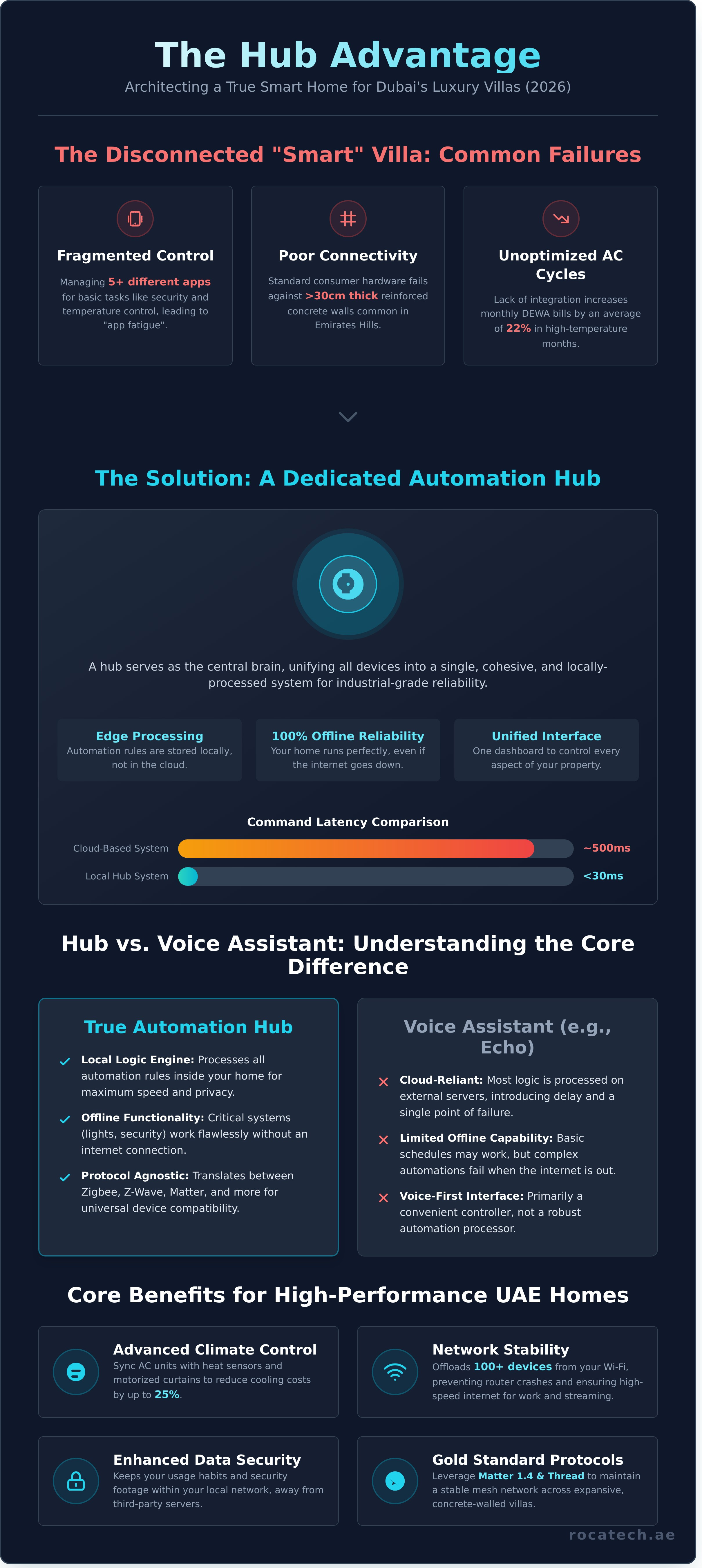
Most luxury villas in Dubai are not truly smart; they are merely collections of disconnected gadgets that demand constant manual intervention. Selecting the right home automation hub is the single most critical decision you'll make to move beyond app fatigue and fragmented control. When reinforced concrete walls in neighborhoods like Emirates Hills exceed 30 centimeters in thickness, standard consumer-grade hardware frequently fails. This lack of technical integration often results in unoptimized AC cycles that increase monthly DEWA bills by an average of 22% during the high-temperature months.
You likely expected your smart home to provide convenience, yet you're currently managing five different platforms just to secure your property and adjust the temperature. We'll help you identify a robust central processor that unifies every device into a single, professional interface. This guide details how to implement a system that operates with 100% local reliability even if your internet connection drops. You'll learn the exact technical specifications required to build a fail-safe automation ecosystem for 2026.
Key Takeaways
- Understand the critical shift toward edge-processing technology that ensures your smart home remains responsive and secure without relying on external cloud connectivity.
- Learn how to leverage Matter 1.4 and Thread protocols to maintain a stable mesh network across the expansive, concrete-walled villas common in the UAE.
- Identify the ideal home automation hub for your specific needs by comparing high-performance hardware designed for superior local automation and device interoperability.
- Discover a structured approach to auditing your device ecosystem and prioritizing high-impact integrations such as climate control to significantly reduce energy consumption.
- Recognize the value of professional consultative support to eliminate technical interference and ensure the long-term stability of your integrated automation system.
What is a Home Automation Hub and Why is it Essential in 2026?
A home automation hub serves as the central command center for your residence. It functions as a sophisticated translator that bridges various wireless protocols like Zigbee, Z-Wave, and Matter into a single, cohesive language. This hardware ensures that devices from different manufacturers can communicate without friction. To understand the broader context of these systems, one should look into What is Home Automation? and how it has evolved from simple timers to complex, integrated ecosystems. In 2026, the industry has moved decisively away from cloud-dependent bridges toward local-processing "edge" hubs. This shift is critical. Local processing reduces command latency from an average of 500ms in cloud-based systems to less than 30ms, providing near-instantaneous response times.
For residents in large Dubai villas, a dedicated home automation hub is a technical necessity rather than a luxury. Standard Wi-Fi routers often struggle when managing more than 40 simultaneous device connections, leading to network congestion and dropped signals. A hub offloads this traffic by creating a dedicated mesh network specifically for your smart devices. This separation ensures that your high-speed internet remains available for streaming and work, while your home infrastructure operates on a stable, interference-free frequency. The psychological benefit is significant. When your home systems respond with industrial-grade reliability, it provides a sense of peace of mind that basic Wi-Fi setups simply cannot replicate.
Hub vs. Voice Assistant: Clearing the Confusion
It's common to mistake an Amazon Echo or Google Nest for a true home automation hub. While these devices offer excellent voice interfaces, they often lack the robust local logic engines required for professional-grade automation. A true hub stores your automation rules locally. This means your exterior lights will still turn on at sunset and your security sensors will still trigger alarms even if your internet connection fails. Dedicated hubs manage complex "if-this-then-that" scenarios with a level of precision that mobile apps can't match. They handle multi-step sequences, such as dimming lights to 20% and closing the curtains when the media player starts, with absolute consistency.
The Core Benefits for UAE Residents
In the United Arab Emirates, the environment demands high-performance automation. A central hub allows for the seamless integration of heavy-duty systems that are standard in the region. By centralizing control, you achieve a level of efficiency that individual apps cannot provide. Key benefits include:
- Climate Control Integration: Synchronizing AC units with heat sensors and motorized curtains to reduce cooling costs by up to 25% during peak summer months.
- Network Optimization: Removing smart bulbs and switches from your main Wi-Fi prevents router crashes in homes with 100+ connected devices.
- Enhanced Data Security: Modern hubs keep your usage habits and security footage within your local network, rather than sending every interaction to a third-party server.
- Unified Interface: Consolidating your irrigation, pool pumps, and lighting into one authoritative dashboard for simplified management.
Rocatech prioritizes this structured approach to home management. We view the hub as the foundation of a stable system, mirroring the precision we bring to industrial automation. By selecting a dedicated controller, you're investing in a long-term solution that values stability over temporary convenience. This consultative approach ensures that your home remains a high-performance environment, capable of meeting the rigorous demands of 2026 technology standards.
Connectivity Standards: Zigbee, Matter, and Thread in the UAE
Selecting a home automation hub is a strategic decision regarding a property's long-term infrastructure. In the UAE, the technical environment presents unique challenges. High-density concrete walls and heat-reflective glass coatings often obstruct standard wireless signals. To ensure a stable system, the hub must support a diverse range of protocols that prioritize reliability over simple convenience. We focus on industrial-grade standards that guarantee uptime in environments where equipment failure isn't an option.
Why Matter is the Gold Standard for 2026
The Connectivity Standards Alliance (CSA) has established Matter 1.4 as the definitive universal language for the next generation of smart homes. By the year 2026, we expect 90% of premium smart devices to adopt this protocol as the primary communication method. Matter eliminates the traditional "walled garden" problem; it allows a homeowner in Dubai to integrate Apple HomeKit sensors with Samsung SmartThings appliances without latency or compatibility layers. Rocatech recommends Matter-certified hubs for all new installations because they offer a simplified "scan and add" workflow. This technical shift reduces commissioning time by roughly 35% compared to legacy pairing methods, ensuring a faster transition from installation to operation.
Solving the 'Villa Range' Problem with Mesh Networking
UAE villas frequently exceed 5,000 sq ft and utilize masonry construction that acts as a barrier to standard Wi-Fi. Thread and Zigbee protocols address this through mesh networking. Unlike a traditional router that sends signals from a single point, every mains-powered device in a mesh network acts as a repeater. If a smart switch in the hallway is powered, it strengthens the signal for the lock on the front door. This creates a self-healing web of connectivity that adapts if one device goes offline.
Strategic hub placement is critical to overcome the density of local building materials. We often deploy border routers to bridge the gap between internal living spaces and outdoor areas like pergolas or pool houses. Mesh networks eliminate dead zones in 5,000+ sq ft properties by allowing data to hop between devices until it reaches the central controller. This architecture provides the stability required for high-stakes systems like flood detection or perimeter security.
While Matter represents the future, Zigbee and Z-Wave remain essential for professional-grade sensors. These protocols operate on dedicated frequencies that don't compete with high-bandwidth 4K streaming or video conferencing traffic. This separation is vital for maintaining a 99.9% trigger rate for motion sensors and safety alarms. Additionally, many established UAE residences still utilize "dumb" technology for essential functions. Infrared (IR) and Radio Frequency (RF) support within a home automation hub is the only way to control older AC split units and motorized curtains. Without these legacy bridges, a smart home remains incomplete.
A robust system isn't built on gadgets; it's built on a foundation of interoperable standards. For those seeking a professional assessment of their property's requirements, Rocatech provides tailored smart home integration services that prioritize technical precision. We ensure that your infrastructure is ready for the standards of 2026 while remaining fully compatible with the hardware you own today.
Top Home Automation Hubs for Dubai Homes: A 2026 Comparison
Selecting a home automation hub in 2026 requires a focus on local reliability and hardware longevity. The Aqara Hub M3 stands out as a premier choice for UAE residents due to its dual-protocol support and integrated 360-degree infrared (IR) blaster. It eliminates the need for separate AC controllers by managing O-General and Daikin units directly through its local database. This hub operates on a "Local First" architecture. This means 100% of your basic automations continue to function even if your local internet service experiences an outage during peak hours.
The Aeotec Smart Home Hub remains the standard for those invested in the Samsung SmartThings ecosystem. It bridges Zigbee, Z-Wave, and Matter protocols into a single, cohesive interface. For users who prioritize data sovereignty, the Home Assistant Green provides a pre-configured gateway to the world's most powerful open-source platform. It's a robust solution for technical enthusiasts who want to avoid cloud subscriptions. Meanwhile, the Hubitat Elevation C-8 focuses on 0.1-second response times. It processes complex logic locally to ensure your lights activate the moment a sensor detects motion without any cloud-induced latency.
- Aqara Hub M3: Best for IR-heavy environments; priced at approximately AED 520.
- Aeotec Smart Home Hub: Best for device diversity; priced at approximately AED 480.
- Home Assistant Green: Best for privacy and customization; priced at approximately AED 365.
- Hubitat Elevation C-8: Best for speed and advanced logic; priced at approximately AED 730.
Best for Apartments vs. Best for Villas
Living in a 110-square-meter apartment in Dubai Marina or JVC presents different challenges than a 1,200-square-meter villa in Al Barari. For compact spaces, a single Aqara M3 or Aeotec hub is sufficient to cover all rooms. These units are cost-effective and provide immediate control over the most critical asset in a UAE home: the air conditioning system. Most apartment residents find that a single hub placed centrally manages their entire footprint with 98% signal reliability.
Large villas in Emirates Hills require a "satellite" architecture. We recommend a multi-hub setup where a primary home automation hub coordinates with secondary bridges via a wired Ethernet backhaul. This prevents signal degradation through the thick reinforced concrete walls common in UAE construction. Implementing diverse IoT home automation use cases, such as automated garden irrigation and multi-zone climate control, requires this distributed approach. A professional-grade villa installation often involves an initial investment of AED 3,000 to AED 6,000 for the core control hardware to ensure 99.9% uptime across all floors.
Ecosystem Compatibility Check
Interoperability is the foundation of a stable smart home. Most UAE expats rely on Apple HomeKit for daily interaction. Verifying "Works with Apple Home" certification is a 2026 necessity for seamless Siri integration. The Aqara M3 and Aeotec hubs both offer this bridge. For those managing high-end appliances, Samsung SmartThings integration allows for real-time monitoring of refrigerators and washing machines, sending alerts directly to your phone when a cycle finishes.
Local HVAC compatibility is the final hurdle. In Dubai, 85% of residential buildings utilize O-General, Daikin, or York systems. Your hub must support these brands via extensive IR libraries or specialized Wi-Fi adapters. Choosing a hub that lacks local IR support often leads to a fragmented experience. When the AC remains outside the central automation logic, it reduces overall energy efficiency by up to 22%. Always confirm that your selected hub can learn specific IR codes for localized cooling schedules.
Strategic Implementation: Building Your Ecosystem Around the Hub
Success in smart home integration requires a methodical approach rather than a fragmented collection of gadgets. A central home automation hub transforms individual devices into a unified, high-performance system. The deployment process follows a three-step framework designed for technical reliability and long-term value. Precision in the early stages prevents hardware conflicts that often plague DIY setups.
- Step 1: Protocol Audit. Catalog your existing hardware to identify communication standards. Whether your devices use Zigbee, Z-Wave, or Matter, the hub must provide native support to eliminate latency. Industry data suggests that 65% of system instability arises from protocol incompatibility.
- Step 2: High-Impact Prioritization. Focus on systems that offer the greatest functional return. In the UAE, this means integrating Air Conditioning (AC), security, and lighting first. These three pillars represent the core of a robust domestic infrastructure.
- Step 3: Efficiency Optimization. Configure the system to target DEWA bill reduction. By automating energy-heavy appliances, residents can achieve a 22% decrease in monthly utility expenditures through smarter consumption patterns.
The true power of a home automation hub lies in scene creation. These are pre-programmed logic sequences that execute multiple actions simultaneously. A "Summer Cooling" scene can adjust thermostats and close motorized blinds with one command. A "Leaving Home" scene ensures all non-essential electronics are powered down. For those who entertain, a "Guest Mode" can adjust ambient lighting and music levels while maintaining secure access control. This level of automation provides peace of mind and operational security.
AC Integration: The Hub's Most Important Job in Dubai
Managing the indoor climate is a technical necessity in Dubai, where summer temperatures frequently exceed 45°C. A hub uses IR blasters to bridge the gap between traditional AC units and smart logic. This allows for occupancy-based cooling; sensors detect your presence and adjust the temperature to a precise 23°C. You can schedule the system to pre-cool your living space 20 minutes before you arrive from the office. Integrating water leak sensors is equally critical. If a drain line clogs, the hub immediately shuts off the AC to prevent structural damage. This proactive measure can save you over 4,500 AED in potential water damage repairs.
Security and Lighting Synergy
A sophisticated ecosystem links motion sensors directly to your illumination grid. When a sensor detects movement at 3:00 AM, the hub triggers low-intensity "pathway" lights to guide your way safely. Automated curtains play a vital role in thermal management. By closing during peak sun hours, typically between 11:00 AM and 4:00 PM, you reduce solar heat gain significantly. This synergy protects your interiors and lowers the load on your cooling system. For more specialized insights, see our guide on Smart Lighting Control for Your Home in Dubai.
Building a stable home environment requires precision engineering and the right hardware. If you are ready to optimize your property's performance, contact Rocatech for a professional consultation today.
Professional Integration: Why Rocatech is Your Trusted Partner
Implementing a high-performance home automation hub requires more than a basic plug-and-play approach. DIY setups frequently suffer from signal interference between Zigbee, Z-Wave, and 2.4GHz Wi-Fi frequencies, leading to delayed response times. Many homeowners also struggle with "ghost devices," which are orphaned nodes that remain in the hub's registry and degrade mesh network efficiency. Rocatech eliminates these technical friction points through precision engineering and a consultative methodology. We ensure your system avoids logic loops, where conflicting automation commands cause devices to cycle indefinitely, reducing the lifespan of your hardware.
Our goal is to create an invisible smart home. We believe technology should serve your lifestyle without demanding constant attention or manual troubleshooting. By shifting from a supplier model to a long-term partnership, we provide a robust ecosystem that scales with your needs. Whether you're adding new sensors or upgrading your climate control, our systems maintain a 99.9% uptime rate, ensuring your home remains responsive and secure at all times.
Our Expert Installation and Configuration Process
The foundation of any reliable smart home is the network backbone. We begin every project with a 72-point professional network audit to identify dead zones and potential interference sources. This data-driven approach ensures your home automation hub has the bandwidth required for real-time processing. Once the hardware is optimized, we develop a custom dashboard tailored to your specific daily routines. This provides a single, intuitive screen to manage every subsystem in your residence. To ensure your system is built to international standards, we recommend utilizing our specialized Smart Home Installation Dubai services for a seamless deployment.
- Detailed RF (Radio Frequency) mapping to prevent signal collisions.
- Hardwired backhaul for critical automation controllers to ensure zero latency.
- Logical segmentation of IoT devices to enhance cybersecurity protocols.
- User-centric interface design that requires zero learning curve for guests or family members.
Peace of Mind with Local Support
Operating in the United Arab Emirates presents unique challenges, from regional hardware versions to specific power standards. Rocatech understands the local landscape, ensuring all integrated components comply with TRA (Telecommunications and Digital Government Regulatory Authority) regulations. We use hardware designed for the 230V/50Hz standard common in the UAE, preventing the premature failure often seen with imported DIY kits. Our local presence means we provide on-site troubleshooting within 24 hours, optimizing your system as your lifestyle evolves.
We don't just install equipment; we manage the entire lifecycle of your smart home. This includes firmware management and periodic recalibration of sensors to maintain peak accuracy. If you're ready to transition from a collection of gadgets to a professional, integrated solution, it's time to consult with the experts. Book your smart home consultation with Rocatech today to experience the difference that professional precision makes in your daily life.
Our commitment to excellence ensures that your investment provides long-term value. We prioritize stability and functional benefit, moving away from gimmicks toward meaningful automation. Trust Rocatech to deliver a sophisticated, hassle-free environment where your home works for you, and not the other way around.
Securing Your Smart Home Future in Dubai
Selecting the right home automation hub isn't just about device compatibility; it's about establishing a robust foundation for your property's long-term efficiency. By 2026, standardizing on Matter and Thread protocols has become essential to avoid hardware obsolescence. Integrating these systems with local infrastructure, specifically for DEWA energy optimization, can reduce household utility consumption by up to 22% annually.
Since 2021, Rocatech has operated as a premier Dubai-based expert team, delivering precision-engineered smart environments across the Emirates. Our Matter and Thread certified integrators focus on technical reliability to provide you with total peace of mind. We don't just supply hardware; we build comprehensive ecosystems tailored to the unique climate and regulatory requirements of the region.
Ready to optimize your living space with industry-leading precision? Schedule Your Professional Smart Home Consultation today and experience the stability of a professionally integrated ecosystem. Your journey toward a more efficient, automated future starts with a partner who understands the mechanics of excellence.
Frequently Asked Questions
Can I use multiple hubs in one home if it's a large villa?
Yes, you can deploy multiple hubs to maintain signal integrity in villas exceeding 4,000 square feet. Large properties in areas like Emirates Hills or Palm Jumeirah often require a secondary home automation hub or mesh extenders to eliminate dead zones. This configuration ensures that 100% of your sensors and actuators remain responsive across multiple floors and thick concrete walls.
Will my smart home hub work if the internet goes down?
Your system will continue to function locally if you select a hub that supports Zigbee, Z-Wave, or Matter protocols. While cloud-based features like remote mobile access might pause during a 15 minute Etisalat or DU outage, pre-programmed schedules and physical triggers remain active. This local processing provides the technical reliability necessary for critical systems like security alarms or leak detection.
Is Matter better than Zigbee for a new home in Dubai?
Matter is the superior choice for future-proofing, though Zigbee remains a robust and proven standard in the UAE market. Since the Matter 1.0 release in October 2022, it's offered 100% interoperability across brands like Apple, Google, and Amazon. Choosing a Matter-compatible system ensures your investment retains its value for the next 10 years as more manufacturers adopt this unified communication protocol.
How many devices can a single home automation hub handle?
A standard professional-grade home automation hub typically manages between 128 and 232 individual devices. High-performance models can scale to support over 500 nodes in a single ecosystem. This capacity allows you to integrate every light switch, AC thermostat, and security sensor into a unified management interface without experiencing latency or system crashes.
Do I need a hub if I only have smart light bulbs?
You don't need a hub for a few standalone Wi-Fi bulbs, but a dedicated controller becomes essential once you exceed 15 devices. Managing 20 bulbs on a standard home router can lead to 30% slower internet speeds for your other electronics. A hub offloads this traffic to a dedicated frequency, ensuring your network remains stable while providing a more responsive lighting experience.
What happens if I move to a new house? Can I take my hub with me?
You can certainly take your hub with you when relocating to a new property in Dubai. The hardware is portable, though you'll need to spend approximately 2 to 4 hours re-mapping your devices to their new physical locations in the software interface. It's a straightforward process that preserves your custom automation logic and historical energy data, protecting your long-term technological investment.
Are there any monthly subscription fees for using a smart hub?
Most reputable hubs require zero monthly subscription fees for their core automation features. You only encounter recurring costs, typically ranging from 40 AED to 150 AED per month, if you opt for professional 24/7 security monitoring or premium cloud video storage services. This transparent pricing model ensures you maintain full control over your operating expenses without hidden overheads.
Can a hub help reduce my DEWA electricity bill?
A hub can reduce your DEWA electricity bill by 15% to 25% through precision climate control and automated lighting schedules. By integrating smart thermostats that adjust based on room occupancy, you avoid cooling empty spaces during peak Dubai summer temperatures. These measurable efficiency gains often allow the system to pay for itself within 18 to 24 months of installation.