

Smart Home Cost in Dubai: The Definitive 2026 Budgeting Guide

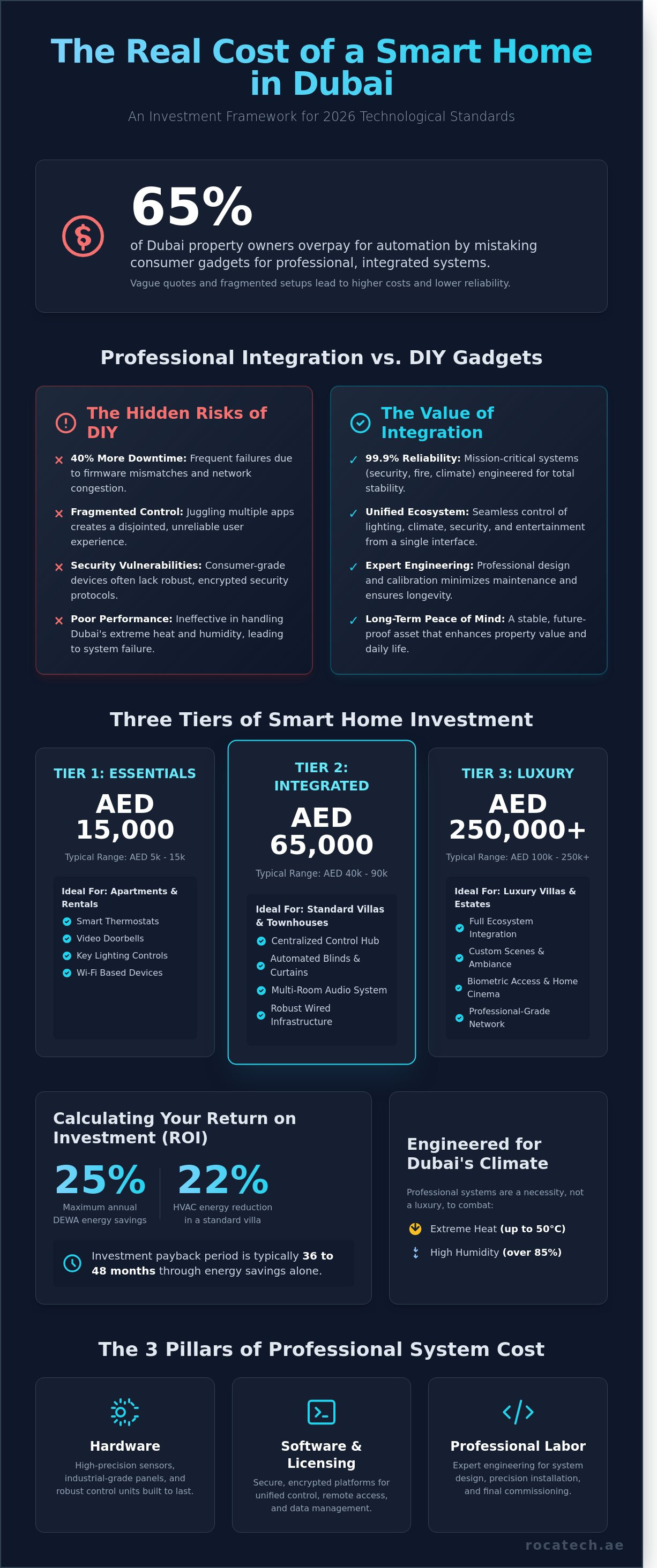
Did you know that 65% of Dubai property owners overpay for automation by failing to distinguish between consumer-grade gadgets and professional integrated systems? You've likely found that obtaining a transparent breakdown of the smart home cost dubai integrators charge is surprisingly difficult. It's a common frustration to face vague quotes when you're trying to future-proof your residence for the technological standards of 2026. We believe that precision in budgeting is just as critical as the technical excellence of the installation itself.
This guide provides a definitive investment framework, detailing everything from a basic AED 15,000 apartment upgrade to comprehensive AED 250,000 luxury villa integrations. You'll discover how to maximize your ROI through DEWA energy savings that can reach 25% annually. We'll analyze the specific hardware requirements for 2026 and compare tiered pricing structures to ensure your system remains robust and relevant. By the end of this analysis, you'll have the technical clarity needed to secure a solution that offers both immediate luxury and long-term value.
Key Takeaways
- Understand the tiered investment structures for various property types to ensure your budget aligns with the 2026 technological landscape in the Emirates.
- Access a detailed breakdown of the smart home cost dubai residents should anticipate for hardware specifically engineered to withstand local heat and dust conditions.
- Learn how precision-integrated climate control systems directly optimize DEWA consumption and enhance the long-term valuation of your real estate assets.
- Discover a consultative approach to system design that prioritizes long-term stability and minimizes maintenance costs through strategic hardware selection.
- Identify the critical shift from fragmented gadget-based setups toward robust, integrated ecosystems that offer total operational reliability and peace of mind.
Understanding the Smart Home Investment Landscape in Dubai
Dubai's residential market in 2026 has moved past the era of standalone gadgets. Modern property owners now view home automation as a core utility, similar to electricity or plumbing. This transition from "gadget-based" setups to integrated ecosystems is fundamental to calculating the total smart home cost dubai. A unified system ensures that lighting, security, and climate controls communicate through a single interface, eliminating the fragmentation that plagued earlier technology cycles.
Dubai's extreme climate makes this level of integration a functional necessity. With summer temperatures reaching 50 degrees Celsius, automated thermal management is essential for both comfort and asset protection. Smart HVAC systems can reduce energy consumption by 22% in a standard five-bedroom villa by adjusting cooling loads based on real-time occupancy and solar gain. These savings often offset the initial capital expenditure within 36 to 48 months of operation.
The investment structure for a robust system typically involves three distinct cost drivers:
- Hardware: High-precision sensors, motorized blinds, and industrial-grade control panels that form the physical backbone.
- Software and Licensing: Secure, encrypted platforms that manage data flow and remote access capabilities.
- Professional Labor: The engineering expertise required for system design, cable termination, and final commissioning.
Precision and reliability remain the hallmarks of a successful installation. When the outdoor humidity exceeds 85%, a failure in the automated ventilation system isn't just an inconvenience; it's a risk to the building's interior health. This reality drives the demand for professional-grade solutions over consumer-level alternatives.
The Evolution of Smart Home Standards in the UAE
The adoption of the Matter protocol in 2024 and 2025 has standardized device interoperability across the Emirates. This shift allows different brands to work together seamlessly, which has stabilized the smart home cost dubai by reducing the need for expensive, proprietary bridge hardware. Modern communities like Dubai Hills and Tilal Al Ghaf now feature 10Gbps fibre connectivity as a standard. This high-bandwidth infrastructure supports complex automation arrays without the latency issues common in older developments, ensuring that security feeds and sensor responses remain instantaneous.
Professional Integration vs. DIY: A Cost-Value Analysis
While DIY solutions appear cost-effective initially, they often carry hidden long-term expenses. Data from local service logs indicates that DIY systems experience 40% more downtime due to firmware mismatches and network congestion. Professional integration delivers a "hassle-free" experience through expert commissioning. A certified integrator ensures that high-stakes systems, such as biometric security and fire suppression, function with 99.9% reliability. This structured approach provides the ultimate peace of mind for homeowners, positioning smart technology as a stable, long-term asset rather than a temporary technical hobby. Investing in professional calibration ensures the system remains robust against the unique environmental challenges of the UAE.
The Three Tiers of Smart Home Cost in Dubai
Calculating the smart home cost dubai residents should expect depends heavily on the scale of the property and the depth of technical integration required. A structured investment approach allows for professional-grade reliability whether you're outfitting a compact apartment in JVC or a sprawling estate in Emirates Hills. The hardware choice and installation complexity are the primary drivers of the final invoice. Property type dictates the infrastructure; a 1,500 sq. ft. apartment requires fewer nodes and sensors than a 7,000 sq. ft. villa with extensive outdoor zones. Precision in planning ensures that technical reliability remains high while avoiding unnecessary hardware redundancy.
Tier 1: Entry-Level Solutions (AED 5,000 - AED 15,000)
Entry-level automation focuses on essential comfort and security without requiring extensive rewiring. For a budget between AED 5,000 and AED 15,000, homeowners can implement smart thermostats, video doorbells, and key lighting controls for main living areas. This tier is particularly effective for small rental units or apartments in areas like JVC where portability is a factor. Most devices at this level rely on Wi-Fi connectivity, making them easy to install but limited by the robustness of the home network. It's a pragmatic starting point for those intending to expand their system over time as their needs evolve. You're essentially building a modular foundation that can be scaled as your budget allows.
Tier 2: Comprehensive Home Automation (AED 20,000 - AED 60,000)
Mid-range integration provides a significant leap in functional synergy and system stability. With a budget of AED 20,000 to AED 60,000, the focus shifts toward a professional hub setup that manages multi-zone AC control, smart curtains, and full-perimeter security. This is the standard for 3-4 bedroom villas in communities like Arabian Ranches or Dubai Hills. The integration of tailored scene programming allows for automated routines, such as "Away Mode," which adjusts cooling and lighting simultaneously to maximize energy efficiency. The growth of these sophisticated systems is supported by the regional tech boom, evidenced by a record-breaking $3.94 billion in funding within the Middle Eastern technology sector. This investment ensures that local service providers can offer high-performance IoT protocols that maintain connectivity across larger floor plans without latency issues.
Tier 3: Premium Bespoke Systems (AED 100,000+)
Luxury estates require a level of precision where technology is felt rather than seen. Premium systems starting from AED 100,000 utilize high-end brands to create a seamless environment. This tier includes invisible speakers embedded within walls, motorized outdoor solutions, and advanced bioclimatic controls that respond to real-time weather data. Custom-coded scenarios are designed to match the specific lifestyle of the resident, ensuring that every interaction with the home is intuitive and hassle-free. The emphasis here is on aesthetic integration; hardware is hidden within the architecture to preserve the interior design. Achieving this level of sophistication requires a consultative partnership with technical experts who understand the nuances of industrial-grade residential integration and long-term system stability.
When evaluating the smart home cost dubai market offers, remember that property size directly impacts the hardware count. A 4-bedroom villa will naturally require 45% more sensors and switches than a 2-bedroom apartment to achieve the same level of coverage. Professional installation typically accounts for 20% to 30% of the total project cost, ensuring that the system remains stable and secure against potential network failures. This investment provides long-term value by potentially reducing energy consumption by 22% through optimized climate control and automated lighting schedules.
Component-Level Pricing: A Granular Breakdown
Precision budgeting for a high-performance ecosystem requires a detailed understanding of individual hardware requirements. In the United Arab Emirates, hardware selection isn't merely a matter of aesthetic preference; it's a technical decision influenced by ambient temperatures that frequently exceed 48°C during summer months. This specific environmental factor dictates a shift toward industrial-grade components that offer superior thermal management and dust ingress protection. When calculating the smart home cost dubai, homeowners must prioritize equipment that can withstand the fine particulate dust prevalent in the region, as standard consumer-grade sensors often fail under these conditions.
Climate and Lighting Control Costs
Climate control is the most critical automation category in Dubai, directly impacting both comfort and operational efficiency. High-quality smart thermostats range from AED 800 to AED 2,500 per unit, a price that typically includes professional calibration for district cooling or central AC systems. These devices manage AC loads that account for approximately 70% of a local villa's energy consumption. Automated curtain tracks, priced between AED 1,200 and AED 3,500 per track, provide a necessary thermal barrier by reacting to solar intensity. Smart lighting switches generally cost AED 250 to AED 600 per gang, depending on the communication protocol and finish quality.
Security and Access Control Expenses
Security hardware must maintain absolute reliability to ensure peace of mind. High-security smart locks, featuring biometrics and encrypted digital keys, command prices between AED 1,500 and AED 4,500. For surveillance, indoor and outdoor cameras range from AED 600 to AED 2,500 per unit. It's vital to select outdoor models with high IP ratings to prevent damage from humidity and sand. Specialized sensors for water leaks and motion are priced at AED 150 to AED 400 each. These small components are essential for automated flood prevention and energy-saving occupancy logic.
The Cost of the "Brain": Hubs and Gateways
The central gateway serves as the technical anchor of your integrated system. Standard gateways cost between AED 300 and AED 1,000, while advanced local servers designed for privacy-focused automation start at AED 2,500. Investing in a robust local hub ensures that your automation logic remains functional during internet outages. This local processing capability is a hallmark of professional-grade installations that prioritize system uptime. By avoiding a total reliance on cloud servers, you ensure that your home remains intelligent even when the external connection is compromised.
Professional configuration and labor fees are a significant part of the smart home cost dubai, usually representing 15% to 25% of the total hardware investment. This fee covers the complex task of logic programming, network optimization, and cross-platform integration. Software models also vary; cloud-based services often require monthly subscriptions ranging from AED 30 to AED 150. Conversely, local-first systems involve a higher upfront cost but eliminate recurring monthly overheads. Choosing a one-time purchase model often provides better long-term value and data security for high-end residential projects.
Rocatech emphasizes a consultative approach to these costs. We focus on the entire lifecycle of the system, ensuring that every component chosen contributes to a seamless, hassle-free experience. By selecting hardware based on technical specifications rather than brand hype, you achieve a stable environment that delivers consistent performance year after year. This methodical selection process transforms a collection of gadgets into a unified, reliable asset for your property.
Calculating ROI: Energy Efficiency and Property Value
Evaluating the initial smart home cost dubai requires a shift in perspective from a simple purchase to a long-term capital investment. While the upfront expenditure covers hardware and professional integration, the financial recovery begins immediately through operational optimization. A robust automation system functions as a digital asset that actively reduces overheads while preserving the structural integrity of your property's electrical and mechanical systems. Precision control over home environments ensures that energy is never wasted, transforming your residence into a high-performance ecosystem that aligns with the UAE's vision for sustainable urban living.
DEWA Savings: The Real Numbers
Cooling accounts for approximately 70% of a typical Dubai household's annual energy consumption. By implementing intelligent climate control, homeowners consistently achieve a 15% to 25% reduction in their monthly DEWA bills. These systems utilize advanced algorithms to adjust temperatures based on external ambient heat and internal occupancy patterns. A high-precision smart thermostat installation in a standard 3-bedroom villa typically achieves a full return on investment within 14 to 18 months through cumulative energy savings. Integrating motion and infrared sensors ensures that lighting and AC units in unoccupied guest rooms or storage areas remain inactive; this eliminates the 10% to 12% energy waste caused by human error or forgetfulness.
Impact on Property Resale and Rental Yield
The Dubai real estate market shows a clear "Smart Home Premium" for properties in Tier-1 developments. Data from recent transactions in Emaar and Nakheel communities indicates that "Smart Ready" villas command a 5% to 8% higher resale price compared to traditional units. This value increase stems from the buyer's desire for move-in-ready technology and the perceived lower maintenance burden. For landlords, automation is a powerful tool for attracting high-quality tenants who prioritize security and modern convenience. Properties equipped with comprehensive automation often see rental yields increase by 3% to 5% annually; they also experience shorter vacancy periods as they stand out in a competitive luxury market.
Future-proofing is another critical factor in the ROI equation. As the Dubai 2040 Urban Master Plan emphasizes sustainability, building regulations are expected to become more stringent regarding energy efficiency. Investing in a professional system today ensures your asset remains compliant with upcoming green building standards. Reliability is a core component of this value; industrial-grade components often have a functional lifespan of 10 to 15 years, far outlasting consumer-grade alternatives. This longevity reduces the frequency of replacement cycles and stabilizes long-term maintenance costs. You can consult with our automation experts to design a system that maximizes your property's market value.
Government initiatives like the Dubai Smart City project have created an environment where digital integration is the standard rather than the exception. The infrastructure of the UAE is rapidly evolving to support interconnected homes that communicate with smart grids and municipal services. By aligning your home with these technological advancements, you ensure that your property remains a relevant and liquid asset. The peace of mind provided by 24/7 remote monitoring and automated leak detection also prevents catastrophic repair costs, adding a layer of financial protection that traditional homes simply cannot offer.
Designing Your Custom Smart Home Strategy with Rocatech
Achieving a balance between luxury and budget requires a methodical engineering approach. At Rocatech, we view every residential project through a lens of technical precision. We don't offer generic bundles that lead to future technical debt. Our consultative method ensures that the initial smart home cost dubai homeowners face is an accurate reflection of long-term value. We prioritize system stability and architectural integration, treating your villa or apartment with the same rigor we apply to industrial automation environments.
Strategic hardware selection serves as our primary tool for cost optimization. By selecting interoperable components that adhere to global standards like KNX or Zigbee 3.0, we eliminate the need for expensive proprietary bridges. This approach typically reduces the total cost of ownership by 18% over a five-year period compared to closed-ecosystem alternatives. For expansive properties in neighborhoods like Emirates Hills or Al Barari, we advocate for a phased rollout. This strategy allows you to prioritize high-impact systems like HVAC control and lighting first. You can then expand into multi-room audio or advanced security as your requirements evolve, spreading the investment without compromising the core infrastructure.
Reliability isn't just a technical metric; it's a psychological benefit. We build robust systems that function without constant user intervention. Our goal is to provide a "set and forget" experience where the technology disappears into the home's fabric. This stability ensures that the smart home cost dubai remains predictable, avoiding the frequent call-out fees and maintenance costs associated with poorly integrated DIY solutions. We target a 99.9% system uptime through redundant networking and high-grade components.
Our Professional Installation Process
Our workflow begins with a comprehensive site survey to map signal strength and physical wiring requirements. We provide a line-item bill of quantities, ensuring transparent pricing with zero hidden "integration surprises" during the final stages. Following hardware deployment, our engineers conduct a 48-hour stress test before the final software handover. This process includes a detailed walkthrough of your custom interface. We also provide ongoing optimization services to ensure your automation logic adapts to your changing lifestyle habits.
Tailored Solutions for Dubai Living
The UAE climate presents unique challenges, specifically regarding sustained heat and humidity. Our hardware selections are rated for 50°C environments, ensuring that outdoor sensors, gate motors, and camera housings don't degrade during peak summer months. We specialize in adapting technology to Dubai's specific architectural styles, from modern glass-fronted penthouses to traditional concrete villas that require advanced mesh networking to penetrate thick walls. Contact us for a personalised smart home consultation to receive a bespoke technical proposal and a precise cost breakdown for your property.
Securing Your Technical Advantage for 2026
Navigating the smart home cost dubai landscape requires a strategic balance between immediate expenditure and long-term asset appreciation. Whether you invest AED 20,000 for a targeted apartment upgrade or AED 250,000 for a bespoke villa ecosystem, the focus remains on precision. Modern systems now deliver a documented 25% reduction in annual cooling expenses through automated HVAC optimization. This data-driven approach ensures your property maintains its competitive edge in the evolving UAE real estate market.
Founded in 2021, Rocatech provides the local expertise necessary for high-stakes technical integration. We don't just install devices; we engineer robust ecosystems that prioritize energy efficiency and operational stability. Our team specializes in seamless transitions from basic automation to industrial-grade smart environments that offer total peace of mind. Every solution is tailored to meet specific regulatory standards and individual lifestyle requirements with absolute accuracy.
Ready to optimize your living space? Book a Professional Smart Home Consultation to define your roadmap toward a sophisticated, energy-efficient home. Your journey toward a smarter, more valuable property starts with a single strategic decision.
Frequently Asked Questions
Is a smart home system worth the cost in Dubai?
A smart home system provides a measurable return on investment by increasing property resale value by 5% to 10% in the Dubai real estate market. These systems optimize energy usage and enhance security, offering long-term savings that offset the initial smart home cost dubai. Beyond financial gains, the integration of automated lighting and climate control improves daily operational efficiency and provides homeowners with significant peace of mind.
How much does it cost to automate a 2-bedroom apartment in Dubai?
Automating a standard 2-bedroom apartment in Dubai typically requires an investment between AED 15,000 and AED 45,000. This range covers essential components like smart lighting, climate control, and basic security sensors. A mid-tier installation at AED 30,000 often includes centralized hub integration and voice control capabilities. Costs vary based on the specific hardware brands selected and the complexity of the technical integration required for the unit.
Do I need to rewire my house to install smart home technology?
You don't need to rewire your entire property if you opt for wireless communication protocols like Zigbee or Z-Wave. Approximately 85% of modern smart home retrofits in the UAE utilize wireless technology to avoid invasive construction work. Hardwiring is generally reserved for new builds or extensive renovations where maximum signal stability is required. We recommend a site survey to determine if your existing electrical infrastructure supports your desired automation goals.
Can smart home systems help reduce my DEWA bill?
Smart home systems can reduce your monthly DEWA bill by 20% to 30% through precise climate and lighting management. Smart thermostats prevent AC units from cooling empty rooms, which is critical given that cooling accounts for 70% of household energy consumption in Dubai. Automated schedules ensure lights and appliances remain active only when necessary. This level of optimization leads to a smaller carbon footprint and direct financial savings every month.
What is the most expensive part of a smart home installation?
The central processing hub and high-end audio-visual (AV) integration represent the most significant portion of the budget. A professional-grade controller can cost between AED 5,000 and AED 12,000 alone. This component acts as the brain of the entire ecosystem, ensuring all devices communicate without latency. High-fidelity multi-room audio systems also drive up the smart home cost dubai due to the specialized hardware and calibration required for optimal performance.
Are there monthly subscription fees for smart home systems in the UAE?
Most professional smart home systems in Dubai operate without mandatory monthly fees once the hardware is installed. You'll only encounter recurring costs if you subscribe to cloud-based video storage for security cameras or professional monitoring services. These subscriptions typically range from AED 40 to AED 150 per month. Opting for local storage solutions like a Network Video Recorder (NVR) eliminates these ongoing expenses while maintaining data privacy.
How long does a professional smart home installation take?
A professional installation for a standard apartment or villa usually takes between 3 and 10 business days. This timeline includes the physical mounting of hardware, network configuration, and personalized programming of automation scenes. Larger villas with complex integrations might require up to 21 days to ensure every system is fully tested. Our structured approach minimizes downtime, ensuring your home remains functional throughout the entire deployment process.
Can I add more devices to my system later to spread the cost?
You can expand your system incrementally by choosing a modular architecture that supports future device integration. Starting with a robust foundation, such as smart lighting and AC control, allows you to add security or entertainment modules later. This phased approach helps manage your initial capital outlay while ensuring long-term system compatibility. Approximately 60% of our clients choose to scale their systems over a 12 to 24 month period as their needs evolve.