

How to Control Home Lighting from Your Phone: The 2026 Guide for Dubai Residents

Why does a technology designed for convenience often feel like a full-time management job? You likely want to control home lighting from phone devices without the constant frustration of bulbs going offline or a dozen different apps cluttering your screen. It's common for Dubai residents to feel overwhelmed by technical hurdles, particularly when facing legacy wiring issues or the limitations of standard WiFi. Reliability shouldn't be a luxury in a high-stakes home environment.
This guide provides a definitive roadmap to achieving a unified and stable lighting ecosystem. We'll help you master the art of mobile control through a focus on technical precision and long-term system harmony. You'll learn how to leverage the latest 2026 standards, including Matter 1.5 and Zigbee 4.0, to ensure your home remains responsive and secure. We explore the essential hardware for UAE properties, strategies for reducing DEWA energy costs, and the professional integration methods that turn a collection of gadgets into a sophisticated, single-app experience.
Key Takeaways
- Understand why specialized mesh networks like Zigbee and Z-Wave outperform standard WiFi for maintaining a stable connection in large Dubai properties.
- Compare the functional benefits of smart bulbs versus smart switches to determine which hardware best aligns with your property ownership status and lighting goals.
- Learn how to seamlessly control home lighting from phone apps by integrating different hardware types into a single, unified interface.
- Discover how to configure automated scenes and schedules that reduce DEWA consumption while enhancing your home's security through presence simulation.
- Identify the critical differences between a DIY setup and a professionally integrated system to ensure your smart home infrastructure remains reliable and safe.
What Does It Mean to Control Home Lighting from Your Phone?
To truly understand the evolution of What Does It Mean to Control Home Lighting from Your Phone?, we must look beyond the simple act of toggling a switch. It's the ability to manage brightness, color temperature, and complex schedules through a dedicated smartphone application. This digital interface connects to your home's electrical infrastructure via a local or cloud-based network, transforming static fixtures into dynamic assets. For many residents, the ability to control home lighting from phone devices serves as the essential foundation for comprehensive smart lighting control.
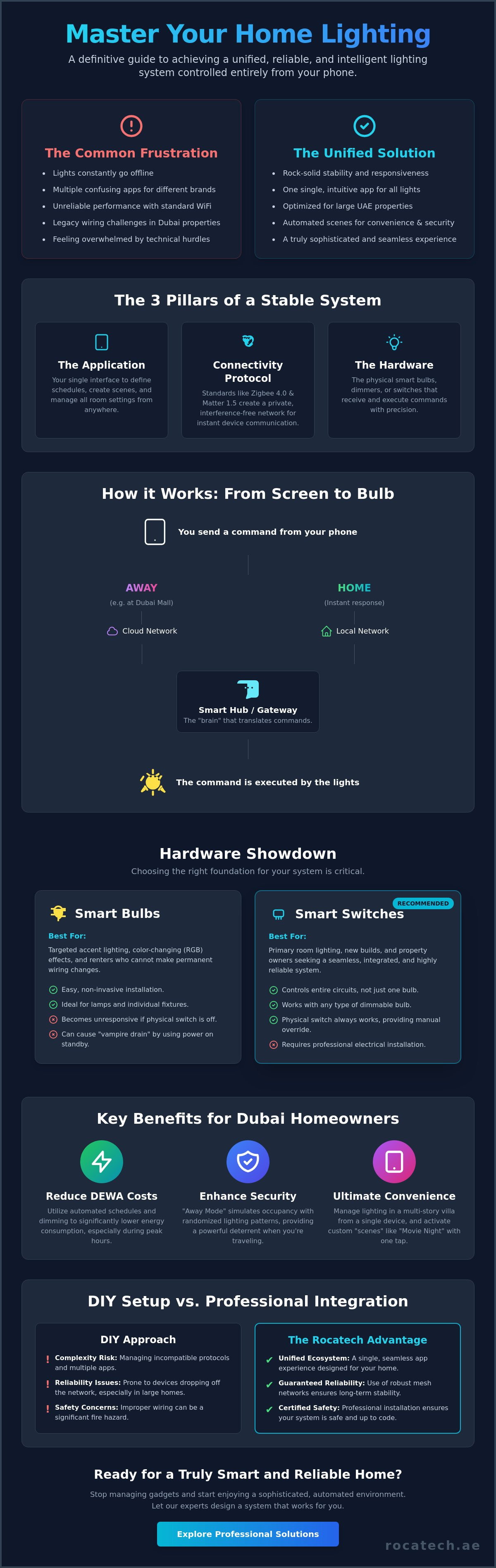
Modern systems rely on three technical pillars to ensure operational stability:
- The Application: The user interface where you define schedules, triggers, and individual room settings.
- The Connectivity Protocol: The communication standard, such as Matter 1.5 or Zigbee 4.0, that allows devices to talk to each other without interference.
- The Hardware: The physical smart bulbs, dimmers, or switches that receive and execute the digital commands.
We've moved past basic binary functions. Today's environments utilize intricate "scenes" that adjust multiple light sources simultaneously to suit specific activities, such as evening relaxation or focused work. This shift represents a move toward holistic energy management where lighting is no longer just a utility but a managed resource.
How the Signal Travels: From Screen to Bulb
When you adjust a slider on your screen, the command follows a specific path. If you're away at Dubai Mall, the request travels through the cloud, allowing for remote oversight of your villa. When you're home, the system prioritizes local network control to achieve near-instantaneous response times without relying on an external internet connection. A centralized smart hub gateway acts as the brain of this operation. It translates your phone's instructions into the specific language of your bulbs or switches, ensuring that signals aren't lost or delayed. This architecture is vital for maintaining system harmony across large properties.
Key Benefits for Dubai Homeowners
The primary advantage is precision in energy management. By utilizing dimming functions and automated schedules, you can significantly reduce DEWA consumption, particularly during peak hours. Security is another critical factor. "Away Mode" allows residents in Jumeirah or Downtown to simulate occupancy through randomized lighting patterns, deterring potential intruders while you travel. Finally, the convenience of managing multi-story lighting from a single bedside device eliminates the need to manually check every room before sleep. It's about more than just a gadget; it's about creating a reliable, high-performance environment. When you control home lighting from phone apps, you gain a level of operational oversight that manual switches simply cannot provide.
Hardware Options: Smart Bulbs vs. Smart Switches
Selecting the right hardware is the most critical decision in your automation journey. While the ability to control home lighting from phone apps is a universal goal, the physical components you choose dictate the system's long-term reliability. In Dubai, where property types range from high-rise apartments in Marina to sprawling villas in Emirates Hills, the hardware must match both the electrical infrastructure and the lifestyle of the occupants. We generally categorize these options into two primary paths: smart bulbs and smart switches.
Choosing Smart Bulbs for Targeted Lighting
Smart bulbs offer a non-invasive entry point into home automation. They're particularly effective for renters, who make up over 80% of the Dubai population, because they require no permanent changes to the property. These devices excel in accent lighting scenarios, such as bedside lamps or RGB feature walls where color-changing capabilities are a priority. However, they rely on a constant power supply from the wall. If a physical switch is manually turned off, you lose the ability to control home lighting from phone interfaces entirely. Smart bulbs in standby mode utilize a continuous low-voltage draw, often termed vampire drain, to keep their internal communication modules active. This ensures they remain responsive to your next digital command.
The Case for Smart Light Switches in UAE Villas
Smart switches represent the professional standard for integrated lighting control technologies. Instead of replacing the bulb, you replace the control mechanism at the wall. This architecture is far superior for managing large chandeliers or built-in downlights common in UAE villas. The primary advantage is that physical control remains active for guests or domestic staff without disabling the app's connectivity. Even if the wall button is pressed, the internal radio stays online.
It's important to consider that most smart switches in Dubai require a neutral wire to maintain their WiFi or Zigbee 4.0 connection. Many older buildings lack this at the switch location, which may necessitate professional installation to pull a new wire. All components must also carry ESMA certification to ensure they meet local safety and energy efficiency standards. For those seeking a permanent, high-performance solution, consulting a specialist in Smart Lighting Control ensures that your hardware choice aligns with your home's specific wiring and MEP requirements.
A hybrid approach often provides the most flexibility. You can install smart switches for the main ambient lighting in living areas while using smart bulbs for decorative lamps or nursery mood lighting. This strategy ensures that your core infrastructure remains robust while allowing for creative, localized lighting effects where they matter most.
Connectivity Protocols: Ensuring Reliability in Large Properties
Establishing a stable connection is the backbone of any automation system. In Dubai, structural builds often utilize heavy concrete and steel, which present significant obstacles for wireless signals. To reliably control home lighting from phone devices, you must select a protocol that can penetrate these barriers without failure. As of June 2026, the industry has moved toward Matter 1.5 as the primary standard for cross-brand compatibility. This protocol allows devices from different manufacturers to work in harmony, reducing the technical friction often found in older, fragmented systems.
Selecting the right protocol is a strategic choice that affects the entire lifecycle of your home's technology. While many consumers start with basic WiFi, professional environments require more specialized mesh architectures to maintain system harmony across large villas or multi-story properties. These systems are designed to handle high-stakes operational requirements where a signal failure is not an option.
Why WiFi Isn't Always the Best Choice
Standard WiFi is often the default choice due to its accessibility. However, it's rarely the best solution for a comprehensive lighting system. Most residential routers have a finite capacity for concurrent connections. Adding dozens of smart bulbs can quickly congest the network, leading to dropped signals and high latency. You don't want a five-second delay between tapping your screen and the lights activating. Security is another factor. Unsecured IoT devices on a primary WiFi network can create vulnerabilities, making it difficult to maintain a secure digital environment for your family.
Mesh Networks: Zigbee and Z-Wave Explained
Mesh networks like Zigbee 4.0 and Z-Wave offer a more robust alternative for a permanent smart home installation in Dubai. Unlike WiFi, where every device must talk directly to the router, mesh devices act as signal repeaters. The signal hops from one switch to the next, creating a self-healing web that grows stronger as you add more devices. This architecture is particularly effective for penetrating the thick walls found in Emirates Hills or Palm Jumeirah villas. These protocols operate on lower power, which reduces the electrical load and increases the durability of the components. To manage these networks effectively, a dedicated Smart Hub / Gateway is required to act as the primary coordinator, ensuring that your ability to control home lighting from phone apps remains instantaneous and reliable.
Setting Up Scenes and Automations for Daily Life
The true value of a sophisticated smart system lies in its ability to operate autonomously. While you can manually control home lighting from phone devices at any time, the highest level of efficiency is achieved through the implementation of "Scenes." A scene is a pre-configured set of commands that adjusts multiple fixtures simultaneously. Instead of managing each bulb individually, you trigger a global state for your environment. This creates a predictable and harmonious living space that adapts to your routine without manual intervention.
Integration with other subsystems enhances this effect. For example, syncing your lighting with a Smart Thermostat and Smart Curtain Motor allows your home to respond to external environmental factors. When the UAE sun is at its peak, your curtains can close automatically while lights dim to a cool, energy-efficient level. This holistic approach reduces the operational load on your HVAC system, which research indicates accounts for approximately 60% of residential electricity consumption in the UAE. By coordinating these systems, you ensure a stable and cost-effective operational environment.
Essential Scenes for Every Modern Apartment
Reliability is the cornerstone of a well-designed scene. A "Welcome Home" scene can be programmed to illuminate the hallway and kitchen at 6:00 PM, ensuring you never enter a dark property. For entertainment, a "Movie Night" scene dims the living room to 10% and closes the smart curtains with a single tap. At the end of the day, a "Goodnight" command executes an "All Off" function across the entire property. This ensures no lights are left active in unoccupied rooms, supporting both home security and DEWA cost management through reduced waste.
Advanced Automations Using Sensors
Automations take your system a step further by removing the need for manual phone interaction entirely. By incorporating a Motion Sensor, you can enable path-finding lights for nighttime safety in bathrooms or hallways, which deactivate automatically after a set period of inactivity. Geofencing technology uses your phone's GPS to detect when your car enters the driveway, activating exterior and entryway lights before you even reach the door.
Solar-syncing is particularly relevant in the Dubai market. This automation allows your indoor lighting to adjust its color temperature and brightness based on the intensity of the natural sunlight outside. This maintain a steady, comfortable atmosphere throughout the day and helps regulate your circadian rhythm. For those traveling abroad, simulated occupancy patterns randomize lighting to mimic a lived-in environment, providing significant emotional reassurance for villa owners. To achieve this level of technical precision, it's often beneficial to partner with a specialist who understands system harmony. You can explore a professional Smart Lighting Control solution to ensure your automations are executed with absolute reliability and long-term value.
The Rocatech Advantage: Professional Integration vs. DIY
Attempting to implement a comprehensive smart home system independently often results in a collection of disconnected gadgets rather than a unified ecosystem. While DIY kits offer a low barrier to entry, they frequently fail in the complex structural environments of Dubai villas. Thick concrete walls and extensive square footage create significant signal interference that standard consumer-grade hardware cannot overcome. When you choose to control home lighting from phone devices through a professionally integrated system, you're investing in a robust infrastructure designed for long-term operational stability.
Rocatech prioritizes technical precision and system harmony over simple hardware installation. Our approach moves away from fragmented apps and unreliable WiFi connections toward a centralized, high-performance architecture. We understand that in high-stakes home environments, operational failure is not an option. By focusing on the entire lifecycle of your system, we ensure that every component, from the Smart Hub / Gateway to individual dimmers, functions as a single, dependable unit. Our local expertise in Oud Metha and the wider Dubai area allows us to provide responsive, on-the-ground support tailored to the specific needs of regional residents.
Beyond Hardware: The Lifecycle of Your Smart System
Professional integration begins with a comprehensive network audit to identify and eliminate potential dead zones within your property. This ensures that your signal remains strong whether you're in a basement cinema room or an outdoor garden pavilion. We go beyond standard settings by creating customized app interfaces that reflect your family's unique routines and preferences. This level of personalization simplifies the user experience, allowing every member of the household to manage the environment with ease. Rocatech maintains a steadfast commitment to executive-level technical support, ensuring that your mission-critical home systems remain operational at all times.
Partnering for Success in Home Automation
Our consultative process involves selecting hardware brands that are specifically tested for the intense UAE climate and local electrical standards. We ensure that your control home lighting from phone setup integrates seamlessly with existing property standards found in Emaar, Nakheel, or Damac developments. This alignment with master developer specifications prevents conflicts with built-in MEP systems and preserves the value of your real estate investment. By moving beyond immediate transactions toward a supportive partnership, we provide the emotional reassurance that your home technology is managed by seasoned experts. To transition from a collection of bulbs to a sophisticated automated environment, book a personalized lighting consultation with Rocatech today.
Securing Your Smart Home Infrastructure
Transitioning to a sophisticated lighting ecosystem is a strategic investment in your home's long-term efficiency and security. By selecting the correct connectivity protocols and hardware, you're ensuring that your ability to control home lighting from phone devices remains a reliable utility rather than a technical burden. We've discussed how mesh networks like Zigbee 4.0 overcome structural challenges and why professional switches maintain physical and digital harmony within your property.
Since 2021, Rocatech has specialized in high-stakes technical environments across Dubai, offering comprehensive lifecycle support from the initial consultation to final installation. Our expertise ensures your system remains responsive and secure, providing the emotional reassurance that comes with operational excellence. Don't settle for fragmented DIY setups that struggle with signal interference or complex wiring requirements in large villas. Precision in automation is the key to a truly effortless living experience.
Design your bespoke smart lighting system with Rocatech and transform your villa or apartment into a model of modern automation. It's time to enjoy the precision and comfort of a home that works exactly as you intended.
Frequently Asked Questions
Can I still use my wall switches if I control my lights from my phone?
You can maintain physical control by installing smart light switches rather than relying solely on smart bulbs. While smart bulbs require the physical wall switch to remain in the "on" position to receive digital commands, smart switches replace the internal mechanism entirely. This allows you to toggle the lights manually at the wall while still retaining the ability to control home lighting from phone apps at any time without conflict.
Do I need a special hub to control my lights remotely in Dubai?
A dedicated Smart Hub / Gateway is essential for professional-grade systems using Zigbee 4.0 or Matter 1.5 protocols. While some entry-level WiFi bulbs connect directly to your router, they often congest your home network and reduce overall reliability. A hub acts as a centralized coordinator, managing local traffic and ensuring your commands are executed instantly even when you are away from your property.
What happens to my smart lighting if the internet goes down?
Local control remains functional if your system utilizes a hub-based architecture. Commands sent while you are at home will still reach your fixtures through the local network even without an active internet connection. However, remote access from outside the home and cloud-dependent automations will be temporarily disabled until your service is restored by your provider. Physical wall switches will continue to operate as normal.
Will smart lighting significantly reduce my DEWA bill?
Smart systems contribute to energy savings by ensuring lights are only active when necessary. Features like automated scheduling and motion sensors prevent electricity waste in unoccupied rooms. By utilizing dimming functions to lower output by 20 percent or more, you can directly reduce your lighting-related electricity consumption. This supports broader sustainability goals and helps manage monthly DEWA costs more effectively through precise resource management.
Can I control my lights from my phone if I am away from home?
You can manage your entire lighting system from any location with a stable internet connection. The mobile app communicates with your home gateway via the cloud, allowing you to check the status of individual rooms or trigger scenes from your office. This feature is particularly useful for activating security modes or ensuring all fixtures are extinguished after you have already left the property for the day.
Is smart lighting compatible with older wiring in UAE apartments?
Compatibility depends on the specific hardware chosen for your property. Many smart switches require a neutral wire to power their internal communication modules, which may be absent in some older Dubai buildings. In these scenarios, smart bulbs or battery-powered sensors offer a non-invasive alternative that requires no electrical modifications. A professional technical audit can determine the most stable path for your specific electrical configuration.
How many smart bulbs can I connect to one app?
The capacity of your system is primarily limited by your chosen connectivity protocol. WiFi-based setups often experience performance issues after 20 devices due to router congestion. In contrast, professional mesh networks using a Smart Hub / Gateway can typically support over 100 individual devices without any loss in response time. This scalability is vital for large villas where you need to control home lighting from phone devices across multiple floors.
Are smart light switches better than smart bulbs for a villa?
Smart switches are generally the superior choice for permanent villa installations. They allow you to manage entire circuits of built-in downlights or heavy chandeliers from a single point of control. This approach is more cost-effective for large rooms with multiple fixtures and ensures that guests or domestic staff can still use physical buttons without disabling the system's smart functionality or connectivity.