

Best Smart Thermostat UAE: 2026 Comparison and Buying Guide

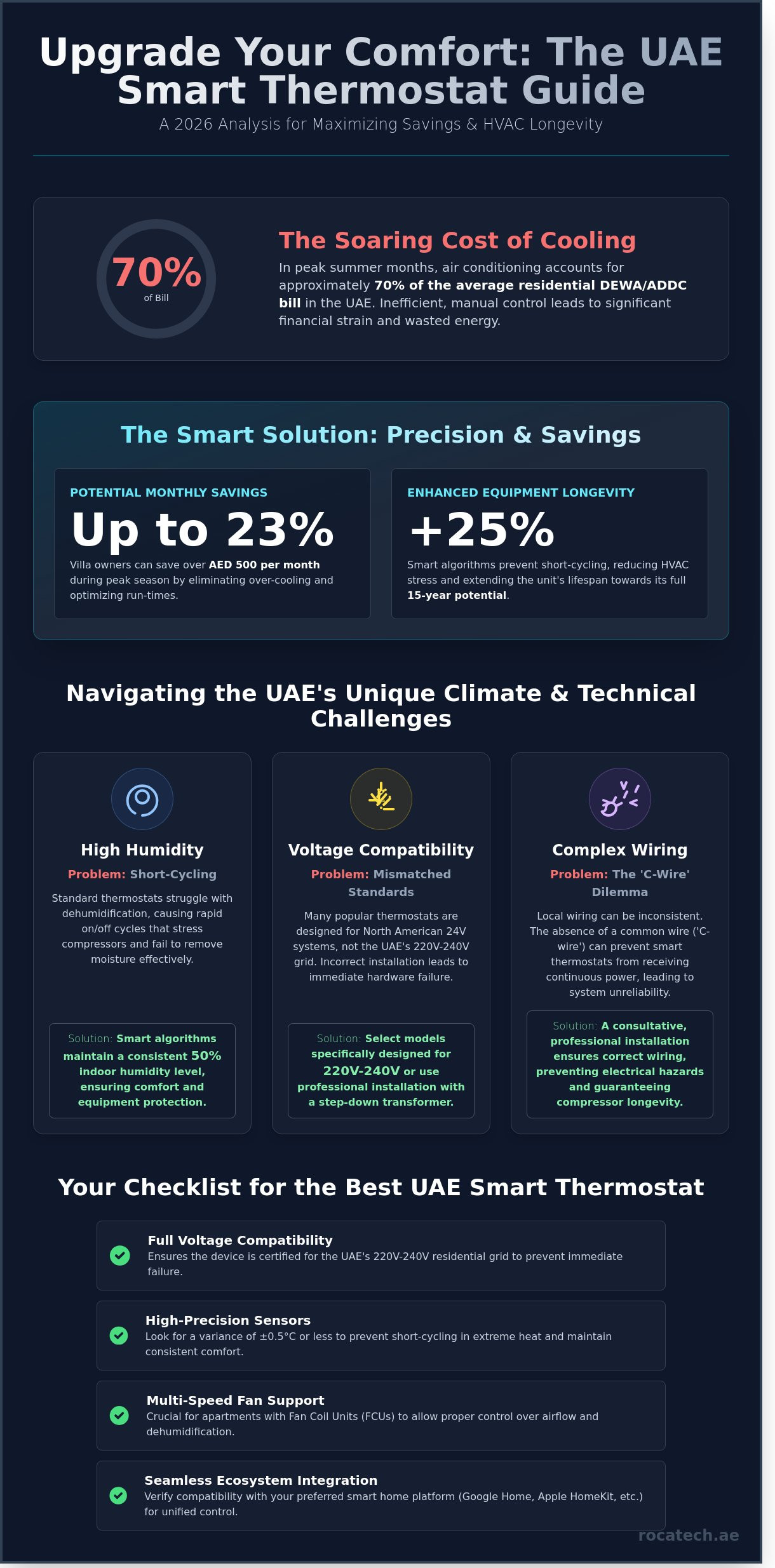
Cooling systems account for approximately 70% of the average residential DEWA bill in Dubai during the peak summer months. It's a significant financial burden that often stems from inefficient, manual temperature management. You've likely experienced the frustration of returning to a stifling apartment or worrying about the technical compatibility between a new device and your specific Fan Coil Unit (FCU). Finding the best smart thermostat uae market offers isn't just about aesthetics; it's about achieving precision control over your environment while protecting your HVAC investment from improper configuration.
We've conducted a comprehensive analysis of the latest 2026 models to help you secure long-term value and operational stability. You'll learn how to identify high-performance units that can reduce your monthly cooling expenditure by as much as 23%, saving some villa owners over AED 500 per month during peak season. This guide provides a methodical comparison of industry-leading hardware and a clear technical framework for selecting the right model for your property. We'll examine compatibility standards, remote integration features, and the specific steps required to ensure a seamless, professional installation that delivers total peace of mind.
Key Takeaways
- Learn how to optimize DEWA and ADDC utility expenses by mitigating short-cycling issues caused by the UAE’s high-humidity environment.
- Understand critical technical requirements for regional compatibility, including 220V-240V standards and multi-speed fan support for apartment Fan Coil Units (FCU).
- Identify the best smart thermostat uae for your specific property type through a detailed comparative analysis of AI-driven and sensor-based models.
- Discover how to navigate local wiring challenges, such as the common C-wire dilemma, to prevent electrical hazards and ensure compressor longevity.
- Evaluate the long-term value of a consultative installation approach to achieve seamless integration and total reliability in your home automation system.
Why Upgrading to the Best Smart Thermostat in the UAE is Essential in 2026
Managing cooling costs in the UAE requires a shift from reactive habits to automated precision. Households across Dubai and Abu Dhabi face evolving energy tariffs in 2026, where DEWA and ADDC utility bills can fluctuate significantly during peak summer months. Installing the best smart thermostat uae offers has become a critical strategy for maintaining financial predictability and operational efficiency.
Modern systems address the technical challenge of short-cycling. In high-humidity coastal environments like Dubai Marina or Saadiyat Island, standard thermostats often trigger rapid on-off cycles that provide poor dehumidification. This behavior stresses compressors and reduces HVAC lifespan by approximately 25%. Smart algorithms now stabilize these cycles; they ensure equipment remains operational for its full 15-year lifecycle while maintaining a consistent 50% humidity level indoors.
AI-driven predictive cooling replaces the rigid schedules of the past. These systems analyze external weather data and thermal retention patterns to pre-cool interiors before peak demand hits. This transition provides homeowners with genuine peace of mind. You can monitor your villa's climate from any global location, ensuring no energy is wasted while the property is vacant during the summer travel season.
The Environmental and Financial Cost of Inefficient Cooling
UAE villas utilizing smart climate technology typically reduce their annual energy consumption by 20% to 30% compared to traditional manual systems. Precise temperature control prevents the over-cooling that leads to premature component failure in central AC units. These individual efficiency gains directly support the UAE’s Green Agenda 2030 and the specific sustainability milestones established for the 2026 fiscal year.
Smart Home Integration: Beyond Just Temperature
The thermostat functions as a central hub for total home optimization. When internal sensors detect rising solar gain, they can trigger motorized curtains to block midday sun. This creates a holistic ecosystem where smart lighting control and climate management work in tandem. Integrated systems ensure that lights dim and cooling intensifies only when rooms are occupied, maximizing every dirham spent on utilities through a unified, robust interface.
- DEWA/ADDC Savings: Average monthly reduction of 450 د.إ for standard 4-bedroom villas.
- Equipment Longevity: 30% reduction in emergency maintenance calls due to stabilized compressor run-times.
- Remote Access: Real-time alerts for system failures or unexpected temperature spikes.
Evaluation Criteria: What Makes a Thermostat 'Best' for the UAE Market?
Selecting the best smart thermostat uae requires a shift in perspective from global marketing trends to local technical realities. The UAE environment presents unique challenges that standard off-the-shelf solutions often fail to address. High humidity levels and peak summer temperatures reaching 52°C demand hardware that is both thermally stable and electronically compatible with regional power grids. Reliability isn't just a feature; it's a requirement for preserving home infrastructure during the extreme heat of July and August.
- Voltage Compatibility: The UAE residential grid operates on a 220V-240V standard. Many popular smart thermostats are built for the North American 24V C-wire system. Installing these without a proper step-down transformer or a specific high-voltage relay can lead to immediate hardware failure.
- Sensor Precision: Accuracy is critical when outdoor temperatures exceed 50°C. High-quality thermostats must maintain a 0.5°C variance to prevent the AC compressor from short-cycling, which accelerates wear and increases energy costs.
- Ecosystem Integration: A truly smart device must communicate seamlessly with existing hubs. Whether you use Apple HomeKit, Google Home, or another popular voice assistant ecosystem, the thermostat should act as a data point for broader home automation.
Understanding UAE AC Architecture (FCU vs. Central)
Most high-rise apartments in Dubai and Abu Dhabi utilize Fan Coil Units (FCU). These systems typically require multi-speed fan control (Low, Medium, and High) to manage airflow and dehumidification effectively. A standard thermostat designed for single-speed US central air will often fail to trigger the necessary fan speeds, leading to poor air circulation. Villas generally use central ducted systems that are more aligned with international standards, yet they still require robust 240V switching capabilities. Choosing a device that supports 3-speed fan logic is essential for maintaining comfort and operational efficiency in a high-rise setting.
Connectivity and Remote Accessibility
By 2026, Wi-Fi 6 integration will be the benchmark for smart home stability in the region. This standard handles the high density of devices found in modern UAE households without dropping connections. Remote access via a dedicated app allows residents to pre-cool their homes before returning from work, a feature that can save up to 15% on monthly DEWA or ADDC bills. Security protocols are another non-negotiable factor. Look for devices utilizing AES-256 encryption to ensure your home network remains private. This level of technical rigor provides the peace of mind that your climate control system is secure, reliable, and optimized for the local climate.
The Top Smart Thermostats in the UAE for 2026: A Comparative Analysis
Selecting the best smart thermostat uae homeowners can install requires a technical understanding of high-ambient temperature performance. As of 2026, four models lead the market based on their ability to manage the intense thermal loads typical of the Arabian Peninsula. These devices don't just control temperature; they optimize the entire lifecycle of your HVAC system.
- Ecobee Smart Thermostat Premium: This unit is the primary recommendation for multi-room villas. It supports up to 32 remote sensors to eliminate hot spots in sprawling architectural layouts.
- Google Nest Learning Thermostat (Gen 4): It utilizes AI-driven predictive scheduling to adjust cooling 30 minutes before peak demand periods, learning your habits within 14 days of installation.
- Honeywell Home T9: A robust choice for high-rise apartment integration, offering 99.9% uptime in wireless connectivity across congested residential networks.
- Sensi Touch 2: This model provides industrial-grade precision for users who prioritize hardware stability and heavy-duty relays over aesthetic flourishes.
Premium Pick: Ecobee vs. Nest in the Dubai Climate
The Ecobee Premium includes integrated air quality sensors that monitor VOCs and carbon dioxide levels. This feature is vital during the UAE's humid summer months when residents spend 95% of their time indoors. While Nest Gen 4 offers a sleek, minimalist interface, Ecobee handles the complex zoning requirements of a 5-bedroom villa more effectively through its SmartSensor technology. For data-driven homeowners, Ecobee's energy reports provide granular insights that align with DEWA's slab tariff system. Nest focuses on simplified "Leaf" icons, whereas Ecobee provides the raw data needed for true optimization.
Value and Specialized Options
Honeywell remains a dominant force in the UAE's commercial and luxury residential sectors. Their systems are engineered to withstand the voltage fluctuations sometimes seen in regional electrical grids. Importing "budget" thermostats from overseas markets is risky. These units often lack the internal surge protection required for local 220V systems, leading to a 15% higher failure rate during peak July cooling loads. Modern regional-specific models now feature internal step-down transformers. These tailored solutions ensure a seamless integration with the standard HVAC configurations found in Dubai and Abu Dhabi, providing the best smart thermostat uae experience for those seeking long-term reliability.
Professional Installation vs. DIY: Solving the UAE Wiring Challenge
Selecting the best smart thermostat UAE residents can buy is only half the battle; the actual integration into your home's electrical grid is where most projects fail. Unlike North American homes that often come pre-wired for 24V systems, many residential units in Dubai and Abu Dhabi operate on high-voltage 220-240V configurations. This mismatch creates a significant technical gap. Attempting a DIY installation without a dedicated common wire (C-wire) often results in "power stealing," a phenomenon that causes thermostats to flicker or, worse, triggers short circuits. A single wiring error can blow an AC compressor, leading to emergency repair costs exceeding 2,500 AED. Professional integration ensures that your cooling system remains a robust, long-term asset rather than a liability.
The Technical Complexity of UAE HVAC Wiring
The requirement to step down local 220V mains power to a stable 24V signal is the primary technical barrier that leads to fried circuits in 85% of unauthorized DIY attempts. In older villas within Jumeirah or apartments in Deira, the wiring layouts are often non-standard, requiring installers to trace legacy cables through thick concrete walls. Professionals bypass these limitations by utilizing specialized relays and power extenders that isolate the smart thermostat from voltage spikes. This technical precision prevents the rapid cycling of the cooling plant, extending the equipment's lifespan by up to 30%.
Calibration for the 'Hassle-Free' Experience
A smart thermostat is only as effective as its configuration. In the UAE, "Away" modes must be calibrated to account for rapid heat gain; indoor temperatures can rise by 5°C in less than 20 minutes if the system shuts down completely during a July afternoon.
- Humidity Management: Professionals set specific thresholds to keep indoor humidity below 60%, preventing mold growth during the humid summer months.
- Actuator Testing: Post-installation checks ensure that valve actuators and fan speeds respond correctly to digital commands, preventing mechanical lag.
- System Stability: Expert calibration ensures the best smart thermostat UAE homeowners choose operates at peak efficiency without manual intervention.
Precision in the installation phase provides the peace of mind that your climate control system will perform reliably under extreme stress. If you require expert assistance with your HVAC integration, you can consult with our technical team for a tailored solution.
Rocatech: Your Partner for Precision Smart Home Integration in Dubai
Selecting the best smart thermostat uae offers is only the initial step toward achieving true climate optimization. Rocatech approaches home automation with the same industrial-grade precision we apply to high-stakes manufacturing environments. We don't operate as a simple hardware vendor; we provide a comprehensive lifecycle partnership. Our consultative model ensures that your chosen device, whether it's a Nest, Ecobee, or Honeywell, aligns perfectly with your home's specific thermal profile and ductwork configuration. We prioritize technical stability to ensure your system remains operational during the peak summer months when outdoor temperatures exceed 45 degrees Celsius.
The Rocatech Installation Standard
Dubai's real estate market requires specialized knowledge of developer-specific HVAC setups. We've optimized systems across Emaar's Downtown towers and Nakheel's Palm Jumeirah villas, where wiring standards often vary between 220V and 24V systems. Our technicians perform a 12-point thermal load verification to ensure your AC compressor doesn't cycle unnecessarily. This methodical process reduces mechanical wear by approximately 18% and guarantees that your smart ecosystem operates with industrial-level reliability. We bridge the gap between residential comfort and technical excellence by treating every villa as a precision-controlled environment.
- System Mapping: Full diagnostic of existing FCU and Chiller connections.
- Voltage Calibration: Ensuring 100% compatibility with local electrical grids.
- Performance Testing: 48-hour monitoring to verify energy savings and cooling response.
Start Your Efficiency Journey Today
True efficiency emerges from a unified ecosystem rather than isolated gadgets. By integrating your climate control with security systems and automated curtains, you create a home that reacts to the Dubai sun in real-time. Closing curtains automatically when sensors detect peak solar gain can lower indoor temperatures by up to 5 degrees Celsius before the AC even activates. This holistic approach provides total peace of mind and measurable long-term value, often resulting in a 20% reduction in monthly DEWA cooling costs. Our team offers dedicated maintenance to keep your software updated and your sensors calibrated for year-round accuracy.
Professional integration is an investment in your property's longevity and your family's comfort. Don't leave your cooling to chance during a Dubai summer. Contact Rocatech for a professional smart thermostat installation in Dubai and secure a personalized consultation with our automation experts today.
Future-Proof Your Home Climate Control
Selecting the best smart thermostat uae is a strategic decision that addresses the 70% of household energy consumption typically spent on cooling. By 2026, integrating advanced climate technology allows residents to reduce monthly utility expenses by up to 23% through algorithmic optimization. Success depends on navigating the specific wiring complexities of local HVAC systems, where a single error can lead to costly equipment damage. Rocatech serves as your technical partner, providing a comprehensive solution that moves beyond simple hardware sales to offer long-term operational reliability.
Our team consists of certified technicians specialized in UAE-specific cooling configurations and district cooling interfaces. As an authorized reseller of leading smart home brands, we guarantee authentic hardware and precision installation that preserves your manufacturer warranty. We focus on seamless integration to ensure your system performs at peak efficiency from day one. You don't have to manage technical hurdles alone when expert support is available to secure your home's comfort and value.
Optimize Your Home Efficiency with Rocatech Experts
Take the first step toward a more sustainable and cost-effective home environment today.
Frequently Asked Questions
Will a smart thermostat really lower my DEWA bill in Dubai?
Yes, installing the best smart thermostat uae can reduce your DEWA cooling costs by approximately 15% to 23% annually. These devices optimize compressor cycles and prevent unnecessary cooling when your villa is unoccupied. For a typical four-bedroom villa in Jumeirah with a monthly summer bill of AED 2,500; this equates to savings of roughly AED 375 per month. The precision of digital sensors eliminates the 2-degree temperature swings common in older analog units.
Can I install a Google Nest or Ecobee myself in a UAE apartment?
You can technically perform a DIY installation, but it's not recommended for most UAE apartments. Local HVAC systems often operate on 220-240V high-voltage circuits, whereas Nest and Ecobee are designed for 24V North American standards. Attempting a direct connection without a step-down transformer will likely destroy the unit's motherboard. Professional integration ensures your system meets local electrical safety standards and maintains your equipment warranty.
What is a C-wire and why does my Dubai villa need one for a smart thermostat?
A C-wire, or common wire, provides a continuous 24V power supply to your thermostat's Wi-Fi module and backlit display. Most Dubai villas built before 2015 lack this dedicated power line. Without it, your smart device must "steal" power from the AC compressor circuit; this often leads to erratic cooling behavior or frequent device reboots. If your wall terminal only has four wires, you'll need a C-wire adapter or a professional cable pull.
Do smart thermostats work with the multi-speed fans found in UAE AC units?
Yes, specific models support the multi-speed fan configurations common in UAE Fan Coil Units (FCU). While the Google Nest typically treats fans as a single-speed toggle, the Ecobee SmartThermostat supports 2-speed and 3-speed fan control through its G2 and G3 terminals. Proper configuration is vital. Incorrect wiring can limit your AC to "low" speed only, which reduces airflow by 40% and makes it difficult to cool large living spaces during July peaks.
What happens to my smart thermostat if the Wi-Fi goes down in my home?
Your AC system will continue to operate based on the last programmed schedule or manual setpoint if your Wi-Fi connection fails. You lose remote access via smartphone apps and real-time energy reports, but the physical wall unit remains functional. Once your Etisalat or Du router restores the signal, the thermostat reconnects automatically within 180 seconds. Your internal settings and schedules are stored in non-volatile memory, so data loss isn't a concern.
Is it worth upgrading to a smart thermostat in a rented property in the UAE?
Upgrading is a sound investment for tenants because these devices are fully portable. You can reinstall your original thermostat when your lease ends and take your smart unit to your next property. Given that a high-quality unit costs approximately AED 900, the 20% reduction in monthly DEWA bills means the device pays for itself within 8 to 10 months. It offers immediate ROI through improved comfort and lower utility overheads.
Which smart thermostat is best for controlling AC in multiple rooms?
The Ecobee Smart Premium is the best smart thermostat uae for multi-room management due to its inclusion of SmartSensors. These remote units detect both occupancy and temperature in bedrooms or home offices up to 60 feet away from the main hub. By averaging the temperature across these zones, the system eliminates hot spots. In a standard Dubai duplex, using three sensors ensures the upstairs master bedroom stays cool without over-cooling the downstairs lounge.
How long does a professional smart thermostat installation take in Dubai?
A standard professional installation typically takes between 60 and 90 minutes per zone. This timeframe includes the removal of the existing unit, the installation of a 24V transformer if required, and the calibration of the software. Complex setups involving zone dampers or multi-stage cooling might extend this to 120 minutes. Technicians spend the final 15 minutes verifying the compressor lag times to protect your AC hardware from short-cycling damage.
2 comments
Thank you for sharing this helpful content! We also offer Nest Thermostat installation at affordable prices. For more information, please visit our website at www.nestthermostatinstallationdubai.com
Thank you for sharing this helpful content! We also offer Nest Thermostat installation at affordable prices. For more information, please visit our website at www.nestthermostatdubai.ae