

Zigbee vs. Z-Wave Dubai: Choosing the Best Smart Home Protocol in 2026

Why does a premium smart lighting system lag in a Downtown high-rise while a similar setup in a sprawling Jumeirah villa remains flawless? The answer often lies not in the brand of the hardware, but in the invisible battle of zigbee vs z-wave dubai protocols. You've likely felt the frustration of signal drops in large properties or the interference caused by crowded Wi-Fi networks in dense urban blocks. It's a common challenge in our region's unique architectural landscape, where reinforced concrete and high-frequency congestion can turn a sophisticated smart home into a source of constant maintenance.
We understand that you prioritize stability and long-term value over temporary trends. This guide promises to provide the technical clarity you need to build a high-performance system that lowers energy bills through precision climate control and remains future-proof against the evolving standards of 2026. We will examine the specific TDRA-approved frequencies for the UAE, compare signal penetration through thick masonry, and explain how a professional hybrid approach creates the "set-it-and-forget-it" reliability you require for a truly intelligent home.
Key Takeaways
- Learn how a dedicated smart hub gateway creates a stable communication environment for your sensors and controllers without relying on overtaxed Wi-Fi networks.
- Compare the technical architecture of zigbee vs z-wave dubai to determine which frequency band offers the best performance for your property’s specific device density.
- Identify how Z-Wave’s lower frequency provides a significant advantage in signal reliability when operating through the thick masonry and concrete barriers found in local architecture.
- Determine the ideal protocol for specific applications, prioritizing Zigbee for diverse smart lighting control and Z-Wave for high-stakes security hardware like motion sensors and smart door locks.
- Understand why a professional hybrid integration is the most effective way to build a future-proof system that avoids technical obsolescence and operational failure.
What are Smart Home Protocols and Why Do They Matter in Dubai?
Smart home protocols are specialized wireless languages that allow your sensors, switches, and controllers to communicate with one another without cluttering your internet connection. Unlike Wi-Fi, which is designed for high-bandwidth tasks like 8K streaming, protocols such as Zigbee and Z-Wave are optimized for small, frequent bursts of data with minimal power consumption. In the technical landscape of zigbee vs z-wave dubai, selecting the right standard is about more than just brand preference. It's about ensuring your home automation remains responsive and resilient in a city where high-density living and large architectural footprints are the norm.
The central coordinator for these signals is the smart hub gateway, which acts as a dedicated translator. This device bridges the gap between different protocol languages and your home network, allowing you to control diverse hardware through a single interface. Relying solely on Wi-Fi for a comprehensive setup is often a mistake. While a standard router handles a few smartphones well, it quickly becomes overwhelmed when tasked with managing 50 or more smart devices in a large villa. This congestion leads to dropped signals and lag, undermining the operational reliability required for consistent climate and lighting control.
The Concept of Mesh Networking
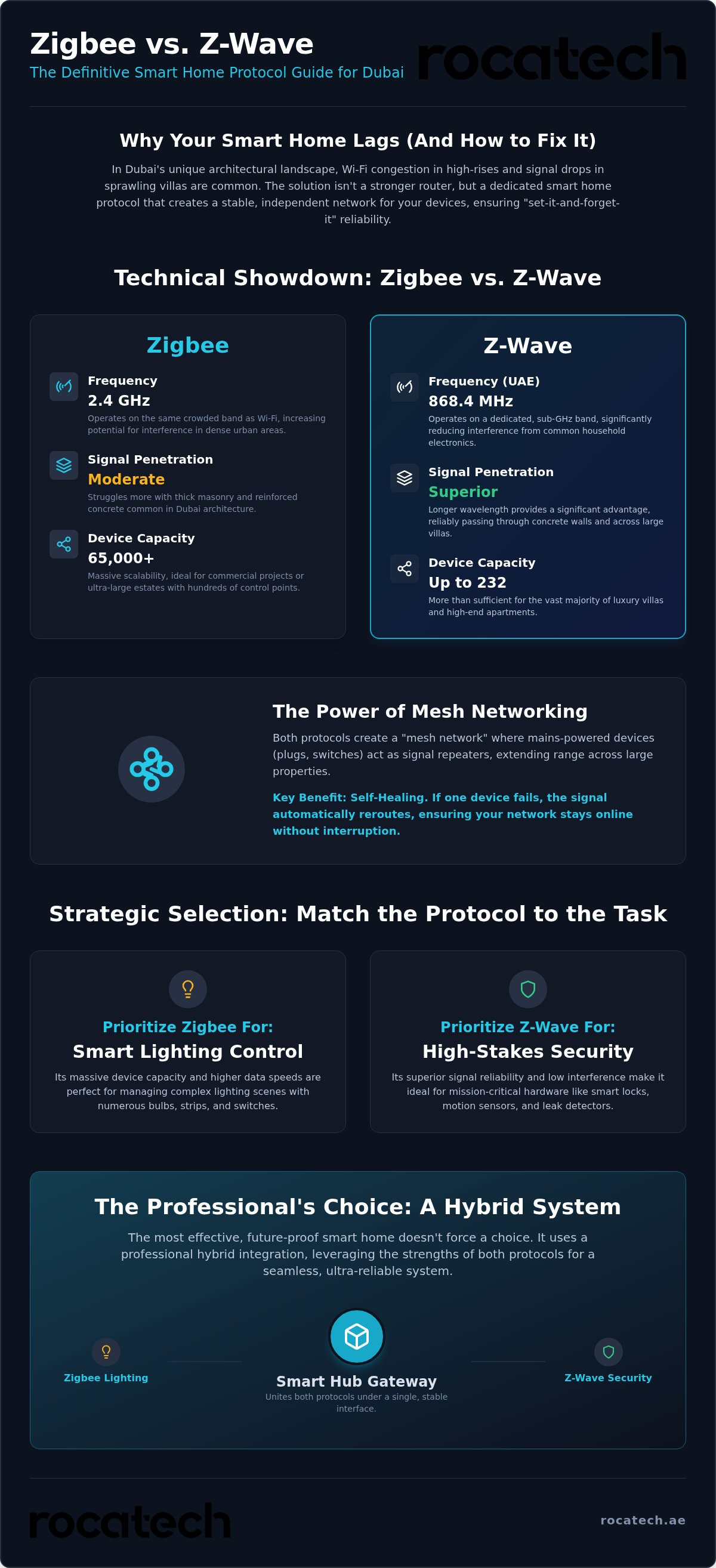
A defining feature of both Zigbee and Z-Wave is their mesh networking architecture. In a mesh system, every mains-powered device, such as a smart plug or a wall switch, acts as a signal repeater. This effectively extends the range of your network across multi-story properties in areas like Jumeirah or Emirates Hills. These networks are inherently self-healing; if one device is removed or fails, the signal automatically finds an alternative path through the remaining nodes. When weighing zigbee vs z-wave dubai for a new installation, the stability of this mesh becomes a primary factor in system longevity. This redundancy is essential for maintaining connectivity across the expansive floor plans typical of premium Dubai residences.
Operational Reliability in High-Stakes Environments
Mission-critical systems such as water leak sensors or security cameras require a level of stability that standard Wi-Fi cannot guarantee. When your internet connection fluctuates, a protocol-based system continues to function locally, ensuring your home remains protected and your automation routines continue to execute. This provides significant emotional reassurance for homeowners who value precision and excellence. Protocol latency refers to the time delay between a command being sent and the hardware executing the action, and keeping this value low is vital for a seamless user experience. By offloading these tasks from the Wi-Fi network, you ensure higher system uptime and better long-term energy efficiency, directly supporting regional goals for sustainable resource management and lower DEWA bills.
Zigbee vs. Z-Wave: A Technical Comparison of Wireless Standards
Understanding the technical divergence between these two standards is essential for maintaining a high-performance smart home. While both protocols facilitate device communication, they operate on fundamentally different wireless frequencies. In the context of zigbee vs z-wave dubai, this choice impacts everything from signal reliability to device capacity. Zigbee utilizes the globally harmonized 2.4 GHz band, which is the same frequency used by standard Wi-Fi and Bluetooth. Z-Wave, conversely, operates on the 868.4 MHz frequency in the UAE. This sub-GHz band is significantly less crowded, reducing the risk of signal collisions in high-traffic environments.
Device capacity and scalability also vary between the two. Zigbee is designed for massive scalability, theoretically supporting over 65,000 nodes on a single mesh network. This makes it a robust choice for commercial applications or ultra-large estates requiring hundreds of points of control. Z-Wave supports up to 232 devices in a standard mesh. While this is lower, it's more than sufficient for the vast majority of luxury villas and apartments. Both protocols are engineered for ultra-low power consumption. This efficiency allows battery-operated hardware, such as water leak sensors or motion sensors, to operate for several years without intervention. If you're unsure which standard aligns with your property’s layout, a professional consultation can clarify your specific technical requirements.
Security and Encryption Standards
Security remains a cornerstone of professional automation. In 2026, both protocols utilize AES-128 encryption, which is the same standard employed by financial institutions to protect sensitive data. Z-Wave takes this further with its mandatory S2 Security framework. This provides a multi-layered defense against hacking during the device pairing process. Zigbee 3.0 employs a centralized "trust center" approach, which manages security keys and ensures that only authorized hardware can join the network. These rigorous standards provide the emotional reassurance that your home’s operational floor is protected against external interference.
The 2026 Outlook: Matter and Thread Integration
The smart home landscape in the UAE is currently being reshaped by the Matter protocol. Matter acts as a unifying software layer that allows Zigbee and Z-Wave devices to communicate more fluidly within a single ecosystem. Zigbee is evolving toward Thread, an IP-based version of the protocol that offers faster response times and better native integration with mobile devices. However, Z-Wave remains highly relevant due to the introduction of Z-Wave Long Range, which extends the network's reach without needing repeaters. This makes Z-Wave an indispensable choice for external security cameras and gate controls where distance and signal penetration are critical. Choosing between zigbee vs z-wave dubai now requires a strategic look at how these standards will integrate with the Matter-enabled hubs of the future.
Performance in Dubai Homes: Overcoming Concrete Walls and Interference
The architectural landscape of the UAE presents a unique set of challenges for wireless communication. In the debate of zigbee vs z-wave dubai, the physical composition of your home is often the deciding factor. Most villas and high-rise apartments in Dubai utilize reinforced concrete and thick masonry, materials that act as significant barriers to radio frequencies. While a signal might travel freely in an open-plan office, it faces substantial attenuation when passing through the structural heart of a property in Emirates Hills or Palm Jumeirah. Understanding how these protocols interact with these materials is the first step toward a reliable system.
Z-Wave holds a distinct advantage in signal penetration due to its lower frequency. Operating at 868.4 MHz in the UAE, Z-Wave signals can be 12 to 18dB stronger through brick walls compared to Zigbee's 2.4 GHz signal at similar distances. This makes Z-Wave an exceptionally stable choice for large, multi-room villas where the hub may be several walls away from the end device. Zigbee's higher frequency provides faster data transfer, but it struggles more with solid obstructions. To maintain high performance, Zigbee networks require a denser mesh of repeaters to ensure the signal can "hop" around corners and through partitions without losing integrity.
Signal Propagation in Masonry Construction
For older Dubai builds with particularly dense walls, Z-Wave's sub-GHz frequency penetrates structural elements more effectively, reducing the need for excessive hardware. When using Zigbee in these environments, we recommend the strategic placement of mains-powered repeaters, such as smart plugs or in-wall switches, to bypass signal dead zones. The Fresnel zone represents the three-dimensional elliptical space surrounding the visual line-of-sight between two communicating devices; any encroachment by solid masonry into this zone can significantly attenuate the signal strength. Maintaining a clear path, even in a mesh network, is vital for low-latency performance.
Interference Management in High-Rise Living
In dense urban areas like Dubai Marina or Downtown, the 2.4 GHz spectrum is incredibly crowded. Every Wi-Fi router, Bluetooth speaker, and microwave contributes to a "noisy" environment that can drown out Zigbee signals. Z-Wave operates in a much quieter band, making it virtually immune to Wi-Fi interference. However, Zigbee can still be highly effective if managed correctly. By tuning Zigbee to specific channels that don't overlap with standard Wi-Fi frequencies, we can achieve high reliability even in spectrum-heavy environments. This level of precision is why smart home installation Dubai requires professional RF planning to ensure your automation remains responsive during peak usage hours.
Finally, consider the environmental impact of the UAE's high temperatures. While internal hardware is usually climate-controlled, devices located near windows or in outdoor areas must be rated for thermal stability. High-quality Zigbee and Z-Wave components are designed to maintain operational excellence even when ambient temperatures rise, ensuring your smart curtains or security sensors don't fail during the peak of summer. This dedication to hardware durability is what separates a DIY experiment from a professional-grade automation system.
Strategic Selection: Matching Protocols to Your Automation Needs
Designing a robust smart home requires a strategic allocation of hardware based on the specific strengths of each protocol. In the ongoing technical evaluation of zigbee vs z-wave dubai, we find that the most effective systems are rarely monolithic. Instead, they utilize a hybrid architecture where each standard handles the tasks it's best suited for. This approach ensures that your home’s operational floor remains both responsive and secure, providing the long-term value and stability that sophisticated property owners expect.
Zigbee has established itself as the premier choice for smart lighting control. Its massive ecosystem and high device capacity allow for the seamless integration of dozens of bulbs and switches across a single floor plan. For security-sensitive applications like smart door locks and motion sensors, Z-Wave remains the superior option. Its strict certification process and dedicated frequency band ensure that critical access points remain accessible even in the most crowded wireless environments.
Use Case: The Ultimate Smart Lighting Setup
Zigbee’s architecture is ideal for managing the complex requirements of modern lighting design. By leveraging this protocol, you can integrate color-changing bulbs and dimmable switches that respond instantly to your commands. Because Zigbee functions locally, these "scenes" execute without the latency often associated with cloud-based systems. This provides a level of precision that is essential for creating the perfect ambience in your living spaces. Many global lighting brands utilize Zigbee, ensuring that your system remains compatible with a wide range of hardware through a central gateway.
Use Case: High-Security Perimeter Monitoring
When it involves the safety of your villa, reliability is not optional. Z-Wave's sub-GHz frequency is perfect for door and window sensors because it offers exceptional battery life and superior range through structural walls. Unlike Zigbee, which shares the 2.4 GHz band with your home Wi-Fi, Z-Wave operates in a quiet spectrum. This prevents your high-definition security cameras or streaming services from interfering with your security sensors. For Dubai villa owners, this separation of traffic provides the emotional reassurance that their perimeter monitoring is always active and accurate.
Effective climate management is another area where protocol selection impacts your daily comfort and operational costs. Integrating a smart thermostat Dubai system requires a protocol that can maintain a stable connection with HVAC controllers and remote temperature sensors. While Zigbee offers affordability for large-scale sensor deployments, Z-Wave’s specialized reliability is often preferred for the primary thermostat unit. Balancing the cost-benefit ratio of zigbee vs z-wave dubai involves weighing these hardware advantages against your specific property goals. If you're ready to optimize your home's performance, contact our integration experts to design a custom protocol map for your property.
The Rocatech Advantage: Expert Integration of Hybrid Systems
While the technical debate of zigbee vs z-wave dubai often focuses on which protocol is superior, the most resilient smart homes don't rely on a single standard. Rocatech advocates for a "best-of-breed" hybrid approach. This strategy allows us to deploy Zigbee for its expansive lighting ecosystem while utilizing Z-Wave for mission-critical security hardware. By moving away from a monolithic system, we ensure that every device in your home operates on the frequency best suited for its specific function, resulting in a more stable and responsive environment.
Professional integration is the key to managing this technical complexity. A DIY setup often leads to fragmented control and signal drops, especially in the reinforced concrete structures common in Dubai. Our team focuses on the entire lifecycle of your system, ensuring that your smart lighting, thermostats, and security cameras work in harmony. This unified approach provides significant emotional reassurance, as it eliminates the technical friction that often plagues less sophisticated installations.
Consultative Partnership vs. Retail Transaction
Our process begins with a comprehensive analysis of your property’s wireless topography. We don't just supply hardware; we map your specific floor plan to identify potential interference and eliminate dead zones before installation begins. This consultative method allows us to create custom automation logic that bridges different protocols seamlessly. Choosing Rocatech Dubai means you gain a long-term technology ally dedicated to maintaining your system’s operational excellence and long-term value.
Next Steps for Your Dubai Smart Home
Building a high-performance smart home is a methodical process that rewards precision. We recommend beginning with a professional site survey to assess your home’s architectural barriers and local RF congestion. From there, we often suggest a phased implementation. You might start with a robust smart lighting control system and gradually expand into precision climate management and perimeter security. This steady, logical progression ensures that each layer of your automation is fully optimized before the next is added.
The technical nuances of zigbee vs z-wave dubai shouldn't be a source of confusion for homeowners. Our experts handle the underlying complexity, providing you with a single, user-friendly interface to manage your entire property. We offer ongoing support and optimization to keep your system aligned with evolving international standards and regional requirements. Contact Rocatech today to schedule your initial consultation and begin the journey toward a precision-engineered smart home.
Building a Future-Proof Foundation for Your Smart Home
Choosing between zigbee vs z-wave dubai isn't about finding a single winner; it's about architecting a system that respects your property’s physical and technical realities. We have explored how Z-Wave’s sub-GHz frequency masters signal penetration through reinforced concrete, while Zigbee’s massive ecosystem provides unparalleled smart lighting control. By 2026, the most reliable homes will be those that leverage hybrid integration to ensure every sensor and controller operates at peak efficiency.
As an authorized dealer for leading global automation brands, Rocatech brings a dedicated Dubai-based expert installation team to every project. We specialize in DEWA-efficient smart cooling and precision automation that provides long-term value and emotional reassurance. Our consultative approach transforms technical complexity into a seamless, stable experience tailored to your lifestyle. We ensure your system remains responsive even in the most crowded wireless environments.
Ready to eliminate signal drops and optimize your home's performance? Book a Professional Smart Home Consultation in Dubai today. Let’s build a system that works for you, every time.
Frequently Asked Questions
Is Zigbee better than Z-Wave for large villas in Dubai?
Z-Wave is generally superior for signal penetration in large villas because its 868.4 MHz frequency passes through thick masonry more effectively than Zigbee's 2.4 GHz signal. While Zigbee supports more devices, it often requires a dense network of repeaters to maintain stability across multiple floors. In the context of zigbee vs z-wave dubai, Z-Wave’s sub-GHz advantage reduces the likelihood of signal dead zones in expansive residential properties.
Do Zigbee and Z-Wave work with my existing Wi-Fi router?
These protocols don't connect directly to your Wi-Fi router; instead, they require a dedicated smart hub gateway. This gateway acts as the central coordinator, translating protocol signals into a format your home network understands. While Zigbee shares the 2.4 GHz band with Wi-Fi, it operates on a separate mesh network, which helps prevent your router from becoming overwhelmed by dozens of individual smart devices.
Can I mix Zigbee and Z-Wave devices in the same smart home system?
You can certainly mix both protocols within a single system by utilizing a multi-protocol hub. This hybrid approach is often the most effective strategy for a zigbee vs z-wave dubai installation. It allows you to select the best hardware for each specific task, such as using Zigbee for smart lighting control and Z-Wave for mission-critical security sensors and smart door locks.
Which protocol is more secure for smart door locks in the UAE?
Both standards offer high-level security, but Z-Wave's S2 framework is widely considered the benchmark for smart door locks and motion sensors. This mandatory security layer provides a more standardized defense against hacking during the device pairing process. While Zigbee 3.0 is also highly secure, Z-Wave’s strict certification ensures a consistent level of protection across all authorized hardware in the UAE market.
Does Dubai's weather or heat affect Zigbee or Z-Wave signals?
High temperatures don't directly degrade the radio frequency signals of these protocols, but the heat can impact the physical longevity of outdoor hardware. It's essential to select devices rated for the UAE’s environmental conditions. Professional-grade sensors and cameras are designed to maintain operational excellence even when exposed to high ambient heat, ensuring your mesh network remains stable throughout the summer months.
Do I need a professional to install these protocols, or can I do it myself?
While basic setups can be DIY projects, professional installation is recommended for complex properties to ensure long-term operational reliability. Experts perform RF mapping to eliminate dead zones and tune Zigbee channels to avoid interference from local Wi-Fi networks. This precision setup is vital for achieving a "set-it-and-forget-it" system that provides genuine psychological benefit and avoids the frustration of frequent technical failures.
What happens to my Zigbee/Z-Wave devices if my internet goes down?
Your devices will continue to function locally even if your internet connection is interrupted. Because Zigbee and Z-Wave don't rely on the cloud for basic communication, your smart lighting control and automated schedules will execute as planned. You might lose remote app access temporarily, but your home’s core automation and security logic remain intact, providing a significant advantage over Wi-Fi-only systems.
Is Matter going to replace Zigbee and Z-Wave in 2026?
Matter is a unifying software layer designed to improve interoperability, not a replacement for these established hardware protocols. In 2026, many hubs use Matter to allow Zigbee and Z-Wave devices to communicate more effectively with one another. While Zigbee is evolving toward the Thread standard for better IP-based integration, Z-Wave remains a critical choice for long-range, interference-free communication in high-stakes security environments.