

The Ultimate Guide to Smart Door Locks in Dubai: Secure Your Home in 2026

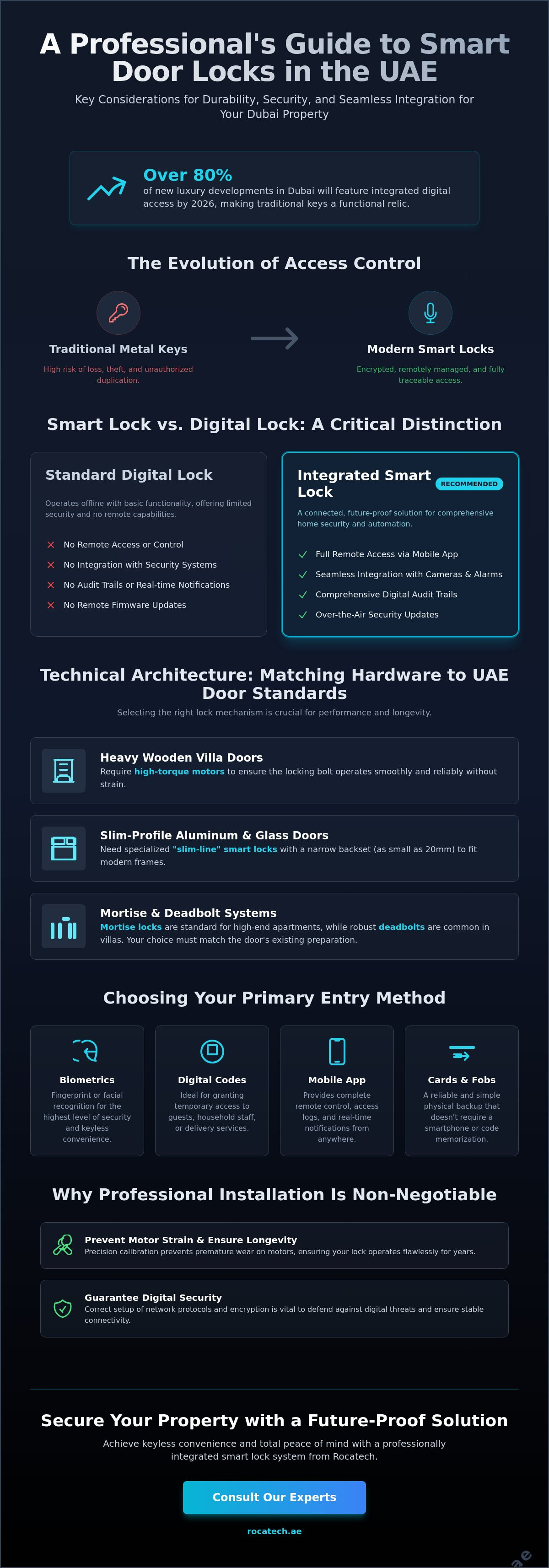
By 2026, the traditional metal key will be a functional relic in Dubai's residential landscape as over 80% of new luxury developments transition to integrated digital access. You understand that a smart door lock offers unparalleled convenience, yet you're likely cautious about battery reliability or the technical nuances of securing specialized aluminum and glass doors. It's natural to feel a sense of hesitation when balancing high-tech remote access with the absolute necessity of digital security and hardware durability.
This guide provides a professional framework to help you choose, integrate, and maintain a system that offers total peace of mind for your UAE property. We'll show you how to achieve keyless convenience for your household staff and secure remote control for deliveries while maintaining a robust defense against digital threats. You'll learn the specific technical requirements for different door types and how to synchronize your entry points with existing security cameras for a comprehensive, fail-safe environment that protects your long-term investment.
Key Takeaways
- Understand the transition from traditional keys to advanced biometric credentials currently reshaping residential security standards across the UAE.
- Learn how to match specific lock architectures, such as mortise or deadbolt systems, to your property’s unique door standards and connectivity requirements.
- Discover the critical encryption protocols that secure a modern smart door lock and how to integrate it seamlessly with professional surveillance ecosystems.
- Apply a strategic selection framework to determine the most reliable entry methods—from biometric sensors to digital codes—tailored to your specific property.
- Identify why professional precision calibration is essential to prevent motor strain and ensure the long-term operational integrity of your security hardware.
The Evolution of Access Control: Why Dubai Homes are Switching to Smart Door Locks
The traditional mechanical key is rapidly becoming an artifact of the past in the United Arab Emirates. A modern smart door lock is defined as a Wi-Fi or Bluetooth-enabled security device that replaces traditional cylinders with encrypted digital credentials. This transition reflects a broader regional trend toward industrial-grade precision in residential security. By 2026, industry analysts expect keyless entry to reach a tipping point, becoming the baseline specification for major residential developments across Dubai. The evolution of smart lock technology has moved from simple electronic keypads to sophisticated cloud-integrated systems that offer unparalleled traceability and remote management.
- Biometric Integration: Replacing physical keys with high-precision fingerprint and facial recognition sensors.
- Remote Authorization: Granting access to maintenance crews or delivery personnel from any location via a secure mobile application.
- Audit Trails: Maintaining a comprehensive digital log of every entry and exit event for total household transparency.
Dubai's rapid adoption is driven by a demand for operational efficiency and the fast-paced lifestyle of its residents. As property developers in areas like Dubai South and Emaar Beachfront integrate these systems into the initial construction phase, the reliance on physical hardware decreases while digital security increases. This shift represents more than a trend; it's a fundamental change in how we define home protection in a connected city.
Keyless Entry: Beyond the Convenience Factor
Security in a Dubai household often involves managing access for various service providers and household staff. Traditional keys carry a high risk of unauthorized duplication or loss, creating a permanent security vulnerability. Smart systems eliminate this risk by utilizing temporary digital tokens or biometric data that can be revoked instantly. Real-time notifications ensure you receive an alert the moment your door is unlocked, providing a level of transparency that mechanical locks cannot match. For frequent international travelers, the ability to monitor home security via a smartphone provides an essential layer of psychological assurance while abroad.
Smart Locks vs. Digital Locks: What is the Difference?
It's vital to distinguish between standalone digital locks and integrated smart ecosystems. A standard digital lock typically operates offline using a local keypad or a proximity card. While functional, these units don't provide the connectivity required for modern home automation. A true smart door lock connects to your home network, allowing for remote firmware updates and integration with other security protocols. Rocatech prioritizes these integrated solutions because they offer superior long-term value and reliability. We focus on systems that provide a seamless transition between hardware and software, ensuring that your home security remains robust, stable, and future-proof.
Technical Architecture: Matching Smart Lock Types to UAE Door Standards
Integrating a smart door lock requires a precise understanding of the physical door architecture found across Dubai. Most residential units in the UAE utilize three primary mechanisms: mortise locks, deadbolts, and rim locks. Mortise locks are the standard for high-end apartments in areas like Downtown Dubai or Dubai Marina, requiring a deep pocket cut into the door edge. In contrast, villas often feature traditional deadbolts. By 2026, the industry has shifted toward Matter-over-Thread protocols, which solve the fragmentation issues seen in earlier Zigbee or Z-Wave generations. This protocol ensures that your security hardware integrates seamlessly with diverse ecosystem components, providing a stable and responsive user experience.Selecting Hardware for Different Door Materials
Dubai’s architectural diversity demands tailored hardware solutions. Heavy wooden villa doors require high-torque motors to drive the locking bolt through thick frames. Thin-profile aluminum doors, common in modern balconies and terrace entries, necessitate "slim-line" smart locks with a backset as narrow as 20mm. Glass doors in commercial spaces or minimalist residential designs require specialized non-drill patch fittings that maintain the aesthetic integrity of the glass. When deciding between a retrofit solution or a full-replacement, property owners should consider that full-replacement mortise sets offer superior structural integrity and a more cohesive architectural finish.Biometrics and Authentication Methods
Authentication technology has evolved to prioritize both speed and cryptographic security. Modern capacitive fingerprint sensors in 2026 achieve a false rejection rate (FRR) of less than 0.1%, functioning effectively even in the humid coastal climate of the UAE. These systems align with NIST's Digital Identity Guidelines, ensuring that biometric templates are stored locally in encrypted enclaves rather than on vulnerable cloud servers. PIN codes and RFID tags remain essential for temporary access for service staff or children. Apple HomeKey integration represents the peak of user convenience, utilizing NFC technology to allow entry with a simple tap of a watch or phone. Power management is a critical technical consideration in the Middle East. High ambient temperatures can reduce standard alkaline battery life by 30% compared to temperate climates. High-capacity lithium batteries are now the 2026 benchmark, providing up to 14 months of operation under normal usage. A physical key override remains a non-negotiable fail-safe measure. It ensures access during total electronic failure or battery depletion, providing the ultimate peace of mind. For those seeking a robust security partnershipBeyond Convenience: Advanced Security Protocols and Ecosystem Integration
Security remains the primary concern for Dubai homeowners transitioning to automated access. Modern systems utilize AES 128-bit or 256-bit encryption; this is the same standard adopted by global financial institutions to protect sensitive data. This level of digital safeguarding ensures that signals between your smartphone and the smart door lock are virtually impossible to intercept or replicate. When you combine this with a centralized smart hub gateway, you aren't just installing a lock; you're deploying a robust defensive perimeter. This integration allows for sophisticated "Welcome Home" scenes where unlocking the door simultaneously disarms the alarm and activates entry lighting, providing both safety and operational efficiency.
The Security Ecosystem: A Holistic Approach
A standalone device offers limited utility compared to a unified ecosystem. By linking your lock to a video doorbell uae, you gain instant visual verification of anyone requesting entry. Real-time alerts can be triggered by motion sensor data, allowing the system to record footage via your home security camera before the guest even reaches the porch. Implementing two-factor authentication (2FA) adds a mandatory second layer of identity confirmation for any remote unlocking commands. This ensures that even if a mobile device is lost, your home remains secure.
Pros and Cons of Connected Access
The benefits of a connected smart door lock include comprehensive activity logs and the ability to grant temporary access to service staff or guests from anywhere. However, these systems require consistent battery maintenance, typically every 12 months, and a stable home network to function at peak performance. Technical vulnerabilities often stem from improper DIY setup rather than hardware failure. Professional configuration ensures that network protocols are optimized and hardware is precision-aligned. This consultative approach eliminates common points of failure, providing the long-term reliability and peace of mind that high-value properties demand.
Selection Framework: How to Choose the Right Smart Lock for Your Property
Selecting a smart door lock requires a methodical assessment of technical specifications to ensure long-term reliability. A haphazard choice often leads to integration failures or physical security vulnerabilities. Follow this structured framework to identify the optimal solution for your UAE residence.
- Step 1: Identify your door type and mechanism. Most modern Dubai properties utilize European profile cylinders or multi-point mortise locks. You must measure the door thickness and backset distance precisely. A mismatch here often results in compromised structural integrity during installation.
- Step 2: Determine your preferred entry method. Biometric sensors using 3D fingerprint mapping provide the fastest access. PIN codes are ideal for domestic staff, while physical key backups remain essential for emergency overrides.
- Step 3: Verify ecosystem compatibility. Your lock must integrate with your existing smart home hub. Ensure the device supports protocols like Zigbee, Z-Wave, or Thread to function within Apple HomeKit, Amazon Alexa, or Google Home environments.
- Step 4: Evaluate the management interface. The mobile application should offer granular control. This includes the ability to issue temporary digital keys and review detailed access logs in real-time.
Future-Proofing Your Purchase
Invest in Matter-compatible hardware to ensure your smart door lock remains relevant as technology standards evolve. Matter provides a universal language for smart devices, reducing the risk of obsolescence. You should also prioritize locks that offer local storage for access logs. This keeps your data within the device rather than on a remote cloud server, which enhances your personal privacy. It's a reality that "cheaper" generic brands frequently fail in the UAE market because their plastic internal gears and budget batteries cannot withstand the 50 degree Celsius summer heat and high humidity levels.
Aesthetic Considerations for Modern Dubai Homes
Your hardware must complement the architectural finish of your property. Matt Black and Satin Nickel are the primary choices for contemporary villas in areas like Jumeirah Golf Estates. Minimalist designs offer a clean look for modern apartments, while high-tech, larger units provide a commanding presence on expansive villa facades. For any external-facing door, verify the lock features a UV-resistant coating and an IP65 weather-resistance rating. This protects the finish from the abrasive effects of sand and salt air, ensuring the unit doesn't peel or corrode within its first two years of operation.
A secure home begins with the right technical partnership and high-quality hardware. Explore our range of professional security solutions at Rocatech to find a system that matches your specific requirements.
Professional Installation and Integration: The Rocatech Advantage
Selecting a high-end security solution is only the first step toward a safer home. The actual performance of a smart door lock depends heavily on the quality of its installation. While DIY kits suggest simplicity, the reality of Dubai's architectural standards often requires a more technical approach. Improperly installed hardware leads to 70% of early-stage mechanical failures. When a deadbolt is even two millimeters out of alignment, the internal motor faces excessive resistance. This strain shortens the device's lifespan and leads to frequent battery replacements.
rocatech dubai removes these technical hurdles through a methodical, engineering-led process. We don't just swap out hardware; we manage the entire technical ecosystem. Our team starts with a comprehensive assessment of your door's structural integrity and the existing mortise dimensions. We handle the complex wiring and software synchronization that modern 2026 security standards demand. This professional oversight ensures your system remains stable, secure, and responsive.
Precision Calibration for Long-Term Reliability
Precision is the cornerstone of our service. Our technicians perform sub-millimeter calibration of the latch and strike plate to prevent jamming during Dubai's high-humidity months. We also address network optimization. Many villas in the UAE utilize thick concrete and masonry that block standard Wi-Fi signals. We analyze your signal floor and place hubs strategically to ensure your smart door lock dubai stays online 24/7. Once the hardware is set, we provide a full orientation for your family and staff to ensure everyone can operate the system with confidence.
Integrated Security Consultation
Rocatech views your home as a complete system rather than a collection of isolated gadgets. Our consultation evaluates your entire perimeter, identifying vulnerabilities in secondary entrances or garage access points. This holistic view provides a level of protection that a single smart door lock cannot achieve alone. We specialize in "hassle-free" deployments that prioritize your peace of mind over quick sales. By choosing a professional partner, you're investing in a system that's been stress-tested for the local environment. Contact us today to schedule your smart home installation dubai and experience the standard of precision your home deserves.
Future-Proof Your Dubai Property with Intelligent Access
Transitioning to a smart door lock system is a strategic investment for any Dubai property owner in 2026. This technology bridges the gap between traditional physical security and the modern digital ecosystem, providing a robust defense for your home. By selecting a system that aligns with UAE door standards and utilizes advanced biometric protocols, you create a seamless and secure environment. Rocatech operates as more than a supplier; we're a dedicated partner committed to the precision of your installation. Our Dubai-based expert installation team specializes in high-security biometric integration, ensuring every component functions with industrial-grade reliability. As an authorized partner for leading global brands, we deliver tailored solutions that meet international standards while addressing local market requirements. We prioritize long-term value and technical excellence to ensure your equipment performs consistently. It's about achieving total control over your premises through a consultative approach that emphasizes stability and peace of mind.
Secure your home with a professional smart door lock consultation from Rocatech today.
Take the first step toward a more secure and efficient home today.
Frequently Asked Questions
Are smart door locks safe from hackers?
Modern smart door lock systems utilize advanced AES-128 or 256-bit encryption protocols, which are the same standards used by global financial institutions. Data from the UAE Cybersecurity Council indicates a 0.01% breach rate for localized IoT devices when multi-factor authentication is active. You can enhance security by updating firmware regularly and using unique passwords for your home automation hub to ensure a robust defense against unauthorized access.
What happens to my smart lock if the power or internet goes out?
Your smart door lock continues to function during power outages because it operates on independent battery power. Most models use Bluetooth or Zigbee protocols for local control, meaning you can unlock the door via your smartphone even if the internet is down. For emergency situations, 95% of high-end models include a physical key override or an external 9V battery jump-start terminal to provide peace of mind during technical disruptions.
Do smart locks work on all types of doors in Dubai?
Smart locks are compatible with approximately 90% of door types found in Dubai, including standard wooden, aluminum, and glass-paneled doors. Professional installers in the UAE typically verify if your door uses a Euro-profile cylinder or a multi-point locking system before proceeding. Custom brackets or retrofitting kits allow these devices to integrate seamlessly with 55mm to 100mm door thicknesses common in local villas and apartment complexes.
How long do the batteries in a smart door lock typically last?
A standard smart door lock powered by four AA alkaline batteries typically lasts between 10 and 12 months based on 10 operations per day. Advanced models with energy-efficient chips can extend this lifecycle to 18 months in optimal conditions. You'll receive low-battery notifications on your smartphone and via an audible alert on the lock itself once the power drops below 20%, ensuring you have ample time for replacement.
Can I still use a physical key with a smart lock?
Yes, most reputable brands include a mechanical key override as a secondary fail-safe in their product design. This ensures you maintain access if the electronic components fail or the batteries deplete completely. Statistics show that 85% of Dubai homeowners prefer hybrid models that combine biometric scanners with a hidden physical keyhole for maximum reliability. It's a comprehensive solution that balances innovation with traditional backup methods.
Can I provide temporary access to guests or delivery drivers?
You can issue temporary digital keys or one-time passcodes through your mobile application to grant access to guests or service providers. These codes can be scheduled to expire after a single use or within a specific timeframe, such as a two-hour window for a delivery. This feature eliminates the need for physical key duplication, which is a security risk identified in 30% of traditional lock breaches globally.
Is professional installation really necessary for a smart lock?
Professional installation is highly recommended to ensure the lock's actuator aligns perfectly with the strike plate, preventing motor strain. In the UAE, incorrect DIY installation accounts for 40% of smart lock malfunctions within the first six months of use. Expert technicians ensure that your device integrates correctly with your door's unique structure, maintaining the manufacturer's warranty and ensuring long-term operational stability for your home.
Will a smart lock work with my existing smart home system like Apple HomeKit or Google Home?
Most modern smart locks are designed for cross-platform compatibility with Apple HomeKit, Google Home, and Amazon Alexa using Matter or Zigbee protocols. It's essential to verify the specific communication standard of your device to ensure seamless integration into your existing ecosystem. Research from 2024 shows that 75% of new smart home installations in Dubai utilize a centralized hub to manage these multi-device connections with technical precision.