

The Definitive Guide to Wifi Cameras in Dubai: Secure Your Home in 2026

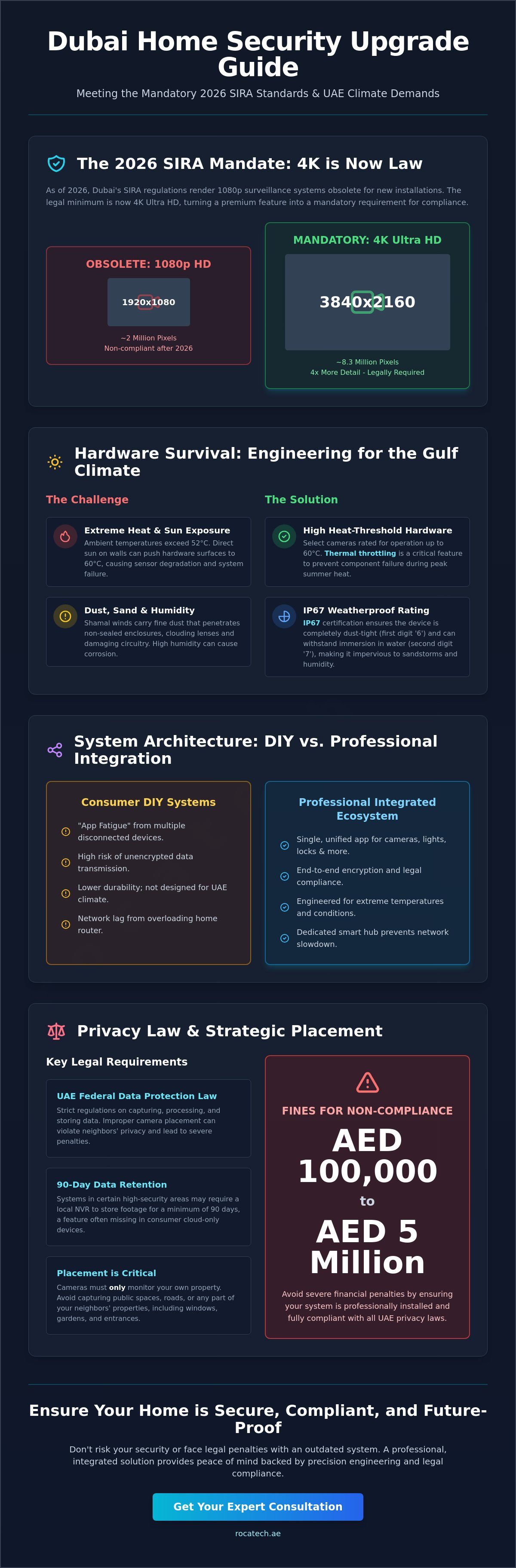
If your home security system still relies on 1080p resolution, it's technically obsolete under Dubai's latest safety standards. As of 2026, SIRA regulations mandate a minimum of 4K Ultra HD for surveillance, turning what was once a premium feature into a legal necessity. You likely want a system that delivers absolute reliability, without juggling multiple disconnected apps or worrying if your hardware will fail during a 52°C August afternoon. Choosing the right wifi camera in the UAE involves more than just picking a brand; it requires a strategic approach to hardware durability and legal compliance.
This guide provides the technical clarity you need to select a robust system that integrates with your smart lighting and thermostats while remaining fully compliant with the UAE Federal Data Protection Law. We'll examine the specific IP67 hardware required to withstand the Gulf climate, the exact placement strategies to avoid fines ranging from AED 100,000 to AED 5 million, and the technical steps to achieve a unified smart home ecosystem. From understanding 90 day data retention to professional integration, we ensure your peace of mind is backed by precision engineering and stable, 24/7 surveillance.
Key Takeaways
- Understand the 2026 SIRA requirements for 4K Ultra HD resolution and how these standards dictate your residential hardware choices.
- Identify the critical IP67 ratings and heat-threshold specifications required to ensure your wifi camera remains operational in the extreme Dubai summer.
- Learn how to mitigate app fatigue by consolidating surveillance with smart lighting and door locks into a single, cohesive ecosystem.
- Discover strategic placement protocols that maximize coverage while maintaining strict adherence to the UAE Federal Data Protection Law.
- Evaluate the long-term reliability of professional-grade hardware versus the security risks associated with unencrypted budget retail devices.
Understanding Wifi Cameras for Dubai Smart Homes in 2026
A wifi camera is a wireless surveillance device that transmits high-definition video and audio data over a local network, allowing for real-time monitoring and encrypted storage via mobile devices. By 2026, the industry has transitioned from passive recording to AI-driven proactive security. Modern systems utilize edge computing to distinguish between a delivery person and a potential intruder, significantly reducing false alarms. This evolution is critical for Dubai residents who demand immediate, accurate notifications rather than a backlog of irrelevant footage. These systems now act as intelligent sensors that can trigger other smart home actions, such as locking a door or activating exterior lights when unauthorized movement is detected.
Wireless systems are the preferred choice for retrofitting Dubai villas and apartments because they eliminate the need for invasive structural changes. Many high-rise developments in areas like Dubai Marina or Downtown restrict structural modifications, making a wifi camera the only viable high-end solution. Wifi 7 security cameras represent the latest technological standard, utilizing wider 320 MHz channels and 4K QAM to virtually eliminate latency and ensure 4K video remains fluid even in high-density smart homes. This technology ensures that your security feed doesn't stutter when other family members are streaming 8K content or gaming on the same network.
How Modern Wireless Surveillance Works
Central to a reliable setup is the smart hub gateway, which acts as a dedicated traffic controller for your security data. This device offloads camera traffic from your primary home router, preventing the lag often associated with budget consumer setups. Understanding how wireless security cameras work involves choosing between local NVR storage, which supports the 90-day data retention required for high-security areas, or secure cloud storage for off-site redundancy. The integration of 5G and Wifi 7 ensures that 4K streaming remains stable across all connected devices, even during peak usage hours.
Wifi vs. PoE: Which is Right for Your Dubai Property?
While wifi offers unmatched installation flexibility, Power over Ethernet (PoE) provides superior stability for permanent fixtures. We recommend a hybrid approach for large Dubai villas. Use a wireless system for internal monitoring where aesthetics and easy relocation are priorities. For external perimeters, PoE remains a strong choice for consistent power. However, the 2026 market has seen a rise in high-performance battery-powered cameras with integrated solar panels. These units are specifically rated for temperatures up to 60°C, making them an excellent wire-free solution for monitoring garden gates or balconies without the need for existing power outlets.
Essential Features for UAE Environmental Conditions
Dubai's climate presents a unique set of engineering challenges that standard consumer electronics aren't designed to handle. When selecting a wifi camera for outdoor use, heat resistance is the most critical technical specification. Average summer temperatures frequently exceed 45°C, but localized heat on a south-facing villa wall can easily reach 60°C. Hardware that isn't rated for these extremes will suffer from sensor degradation or constant reboots. Thermal throttling is a critical protective mechanism that reduces a camera's processor speed to prevent internal component failure when ambient temperatures exceed 50°C. Without this feature, your surveillance system may fail exactly when you need it most during the peak of summer.
Dust and sand protection are equally vital for maintaining operational uptime. During Dubai's shamal winds, fine particulate matter can penetrate poorly sealed housings, clouding the lens or damaging internal circuitry. A wifi camera must feature high-quality starlight sensors for night vision to remain effective in poorly lit villa alleyways. While traditional infrared provides a clear monochrome image, modern color night vision allows for better identification of clothing colors and vehicle details in low-light conditions. These technical nuances ensure that your footage remains actionable rather than just a blurry record of events.
Weatherproofing and Durability Standards
Adhering to the UAE technical specifications for CCTV is the first step in ensuring long-term reliability. An IP67 rating is non-negotiable for outdoor units; it guarantees the device is completely dust-tight and can withstand heavy rain or pressure washing. Additionally, look for UV-resistant housing. Prolonged exposure to intense Arabian Gulf sunlight can turn standard plastics brittle within 18 months. We recommend a monthly maintenance routine using a microfiber cloth and specialized lens cleaner to remove the fine film of desert dust that accumulates on the glass, ensuring 4K clarity remains consistent.
AI-Powered Detection and Intelligent Alerts
Sophisticated AI algorithms have transformed how home security systems in Dubai manage data. Modern cameras can accurately distinguish between a human, a pet, or a swaying palm tree, which reduces false notifications by up to 90%. Facial recognition technology allows the system to identify known family members or staff, only alerting you when an unrecognized individual enters the property. You can also integrate these cameras with smart lighting to trigger "deterrence scenes." For instance, if an intruder is detected at 2:00 AM, your exterior floodlights can flash while your smart curtains close automatically. If you're unsure which hardware matches your specific villa layout, you can consult with our technical team for a tailored assessment.
Standalone DIY Cameras vs. Professional Integrated Systems
Managing a collection of disparate security gadgets often leads to "app fatigue," where a homeowner must navigate multiple interfaces to verify a single event. This fragmentation is more than a convenience issue; it's a security vulnerability. If an alert triggers on your front porch, switching between three different applications to check the side gate and backyard significantly delays your response time. A professional wifi camera installation avoids this by unifying all hardware into a single, cohesive dashboard. This centralized approach ensures that your surveillance works in tandem with your smart lighting control and door locks, creating a responsive environment rather than a series of isolated recordings.
Data integrity remains a primary differentiator between retail-grade devices and professional systems. Many budget-friendly options suffer from weak encryption protocols, which exposes users to the cybersecurity risks of smart cameras documented by industry experts. Professional-grade hardware prioritizes end-to-end encryption and secure boot processes, ensuring your private footage remains inaccessible to unauthorized parties. Beyond digital security, professional setup addresses physical signal optimization. Dubai villas are often constructed with thick reinforced concrete and insulated glass, which can degrade wireless signals. An expert installer optimizes the network topology to ensure high-bandwidth 4K streams remain stable across the entire property without dead zones.
The Hidden Costs of DIY Wifi Cameras
While a standalone wifi camera might seem cost-effective initially, the long-term financial commitment is often understated. Many retail brands lock essential features behind monthly subscription paywalls, which can exceed the original hardware cost over a three to five-year period. Additionally, unoptimized DIY cameras can consume excessive bandwidth, slowing down your home internet for other users. Professional systems offer a more predictable value proposition by utilizing efficient H.265+ compression and providing local storage options that eliminate recurring fees. Perhaps most importantly, professional systems come with dedicated local support, providing a reliable point of contact if a component requires troubleshooting while you're traveling.
The Power of a Unified Ecosystem
A unified security ecosystem transforms passive monitoring into active protection. Instead of just recording an event, an integrated system can trigger automated responses. For instance, if a camera detects movement in the garden after midnight, the system can automatically engage smart curtain motors to ensure privacy and activate exterior floodlights to deter the intruder. This level of automation is only possible through a professional smart hub that bridges different communication protocols. By consolidating your surveillance with motion sensors and water leak detectors, you gain a holistic view of your home's health. This architectural stability provides the ultimate peace of mind, knowing that your data is backed up both locally and on secure, encrypted cloud servers.
Strategic Placement and UAE Privacy Regulations
Correct placement of a wifi camera is a balance between technical optimization and legal compliance. Dubai villas often feature thick reinforced concrete walls that act as Faraday cages, significantly attenuating wireless signals. To maintain a stable 4K stream, you must position cameras within an unobstructed line of sight to your smart hub or use high-gain mesh nodes. Strategic positioning also involves maximizing the field of view (FoV) at entry points like main gates and balcony sliders. In UAE law, a 'reasonable expectation of privacy' dictates that homeowners must ensure their surveillance field of view doesn't capture the private living areas, entrances, or windows of adjacent properties.
Compliance with the UAE Federal Data Protection Law is non-negotiable. While you've the right to secure your property, capturing footage of public streets or a neighbor's swimming pool can lead to severe legal complications. Fines for violating privacy through unauthorized surveillance range from AED 100,000 to over AED 5 million. It's your responsibility to ensure that digital masking features are used to black out any areas beyond your property boundary. This technical step ensures that your security system remains a tool for protection rather than a legal liability.
Optimal Placement for Maximum Security
We recommend mounting external units at a height of 2.7 to 3 meters. This height is sufficient to prevent tampering while maintaining an angle sharp enough for clear facial recognition. For larger villas, you should overlap the fields of view of multiple integrated units to eliminate blind spots. Internal placement requires a different strategy; cameras intended for baby monitoring or domestic staff safety should be positioned in common areas. Avoid placing cameras in private quarters like bedrooms or bathrooms, as this violates both social norms and legal privacy standards in the Emirates.
Staying Compliant with UAE Surveillance Laws
The prohibition of filming public spaces is strictly enforced by Dubai authorities. If your wifi camera must face a street to cover your driveway, you must technically mask the public areas in the software. Additionally, you're required to display clear signage at entry points notifying visitors that video recording is in progress. Perhaps the most critical regulation involves the sharing of footage. Sharing security clips on social media platforms without the explicit consent of everyone in the video is a criminal offense under Federal Decree-Law No. 34 of 2021. To ensure your installation meets all current legal and technical benchmarks, book a professional site survey with our specialists.
Rocatech: Your Partner for Secure, Integrated Surveillance
Choosing a wifi camera is only the first step in a broader residential security strategy. At Rocatech, we move away from the transactional nature of retail sales toward a consultative partnership that prioritizes long-term stability. We're the leading choice for smart home installation in Dubai because we view security as a comprehensive landscape rather than a collection of isolated devices. Our methodology ensures your surveillance system isn't a standalone silo but a core component of your home’s operational intelligence. This includes seamless synchronization with your smart thermostats and lighting systems to create a unified, responsive environment.
Our "Hassle-Free" promise is built on technical precision and professional accountability. We handle every aspect of the deployment, from initial hardware configuration to long-term technical support. This approach eliminates the common frustrations of DIY setups, such as intermittent connectivity or firmware incompatibilities. By integrating your wifi camera into a robust network architecture, we provide a level of reliability that matches industrial standards. We ensure your home remains protected 24/7 without the need for constant user intervention, providing the ultimate peace of mind for property owners.
Tailored Security Consulting for Dubai Residents
We begin every project with a rigorous on-site assessment to identify the specific vulnerabilities of your property. Our engineers perform professional signal testing to overcome the interference caused by Dubai's reinforced concrete structures, ensuring 100% camera uptime across your entire villa or apartment. This tailored hardware selection process respects your aesthetic preferences while meeting the 2026 SIRA requirements for 4K resolution. We design systems that are both high-performing and discreet, maintaining the visual integrity of your high-end living space while maximizing coverage.
The Rocatech Integration Advantage
The true value of a Rocatech system lies in its architectural stability. We specialize in the expert setup of Network Video Recorders (NVRs) that support the 90-day local recording retention required for high-security environments. This local storage strategy effectively eliminates recurring monthly cloud fees while keeping your data under your direct control. This integration consolidates your security, lighting, and climate controls into a single, high-performance network that's easy to manage and technically superior. Book a consultation with Rocatech Dubai to secure your property with a professional-grade surveillance ecosystem today.
Future-Proofing Your Residential Security
Securing a Dubai property in 2026 requires a technical shift from basic monitoring to high-precision, integrated surveillance. You've learned that 4K resolution is now the mandatory SIRA standard and that IP67-rated hardware is essential for surviving 60°C surface temperatures. Integrating a high-performance wifi camera shouldn't be a source of app fatigue; it should be a seamless extension of your home’s intelligence. By prioritizing local NVR storage and end-to-end encryption, you protect both your physical property and your digital privacy from evolving cybersecurity risks.
Rocatech offers the technical expertise to transform these requirements into a stable, hassle-free reality. Our Dubai-based expert installation team specializes in deploying heat-resistant outdoor hardware that maintains 100% uptime. We ensure full integration with Google Home, Alexa, and professional smart hubs to create a unified ecosystem that works for you. Secure your Dubai home with a professional camera consultation from Rocatech and experience the confidence of a professionally engineered security landscape. Your peace of mind is our standard for excellence.
Frequently Asked Questions
Is it legal to install a wifi camera outside my villa in Dubai?
Yes, it is legal to install surveillance hardware provided the field of view remains strictly within your property boundaries. Under the UAE Federal Data Protection Law of 2021, you must avoid capturing footage of public streets, common areas, or neighboring villas. Violating these privacy boundaries can result in significant legal penalties, so utilizing digital masking features is a critical technical requirement for every installation.
Do wifi cameras work during a power outage or internet failure?
Standard models typically stop transmitting during a power cut unless they feature an internal battery backup. If the internet fails, cameras with local storage options like a microSD card or a connected NVR will continue to record footage locally. Professional installations often include an Uninterruptible Power Supply (UPS) to ensure your wifi camera system maintains 100% uptime regardless of external utility stability.
Can the extreme Dubai summer heat damage my outdoor wifi cameras?
Extreme temperatures can cause permanent sensor degradation in hardware not specifically rated for the Middle East. You must select units with an IP67 rating and a certified operating threshold of at least 60°C. High-quality outdoor cameras utilize thermal throttling to manage internal heat during 50°C+ summer days, ensuring the internal circuitry remains functional and the lens clarity is preserved over a multi-year lifecycle.
What is the difference between cloud storage and an NVR for my security footage?
Cloud storage uploads encrypted data to remote servers, which usually involves a recurring monthly subscription fee. A Network Video Recorder (NVR) is a physical device located on your property that provides local storage without ongoing costs. NVR systems are the preferred choice for Dubai residents who need to meet 90-day data retention standards while maintaining total control over their private surveillance data.
How many wifi cameras can my home network handle before it slows down?
A standard residential router often experiences latency issues after connecting more than five 4K cameras. Each 4K stream requires approximately 8 to 10 Mbps of bandwidth. To prevent your home internet from slowing down, we recommend using a dedicated smart hub gateway to manage camera traffic independently from your primary browsing and streaming devices.
Can Rocatech integrate my existing cameras into a new smart home system?
We can integrate existing hardware provided the devices are ONVIF-compliant or support standard RTSP protocols. Our technical team conducts a compatibility audit to ensure your current cameras can trigger actions within a broader ecosystem, such as activating smart lighting. This consultative approach allows you to upgrade your home’s intelligence without necessarily replacing every piece of functional legacy hardware.
Do I need a smart hub to use wifi cameras in my apartment?
A smart hub isn't strictly required for a single standalone unit, but it's essential for a reliable multi-camera setup. In dense Dubai apartment buildings, a dedicated hub provides a stable, interference-free connection that bypasses the congestion of dozens of neighboring wifi networks. This architectural choice ensures your security feed remains fluid and responsive even during peak evening hours.
What is the best resolution for home security cameras in 2026?
4K Ultra HD is the recommended standard for residential security in 2026. This resolution provides the necessary pixel density to identify facial features or vehicle plates at a distance of 10 meters. Because SIRA regulations now mandate 4K for many commercial sectors, choosing this resolution for your home ensures your system remains technologically relevant and provides actionable evidence if an incident occurs.