

Smart Home Energy Savings Dubai: The 2026 Strategy for Lower DEWA Bills

What if your villa could predict a peak DEWA tariff hike and adjust its cooling cycle before you even felt the humidity? For many residents, the arrival of a summer utility bill is a source of genuine anxiety, particularly when cooling costs for a large property scale into the highest slab rates of 0.380 AED per kilowatt-hour. You've likely experienced the frustration of discovering AC units running at full capacity in empty guest wings or curtains left open to the midday sun, driving up expenses through simple manual oversight.
Achieving meaningful smart home energy savings dubai homeowners can trust is no longer about sacrifice; it's about technical precision. We'll show you how to leverage advanced home automation to reduce your utility costs by up to 30% without compromising on luxury or comfort. This 2026 strategy explores how to navigate the latest Matter 1.6 connectivity standards and ensure your devices are TDRA-approved for long-term reliability. You'll learn how professional integration transforms a collection of individual sensors into a unified, energy-efficient ecosystem that protects both your operational costs and your lifestyle.
Key Takeaways
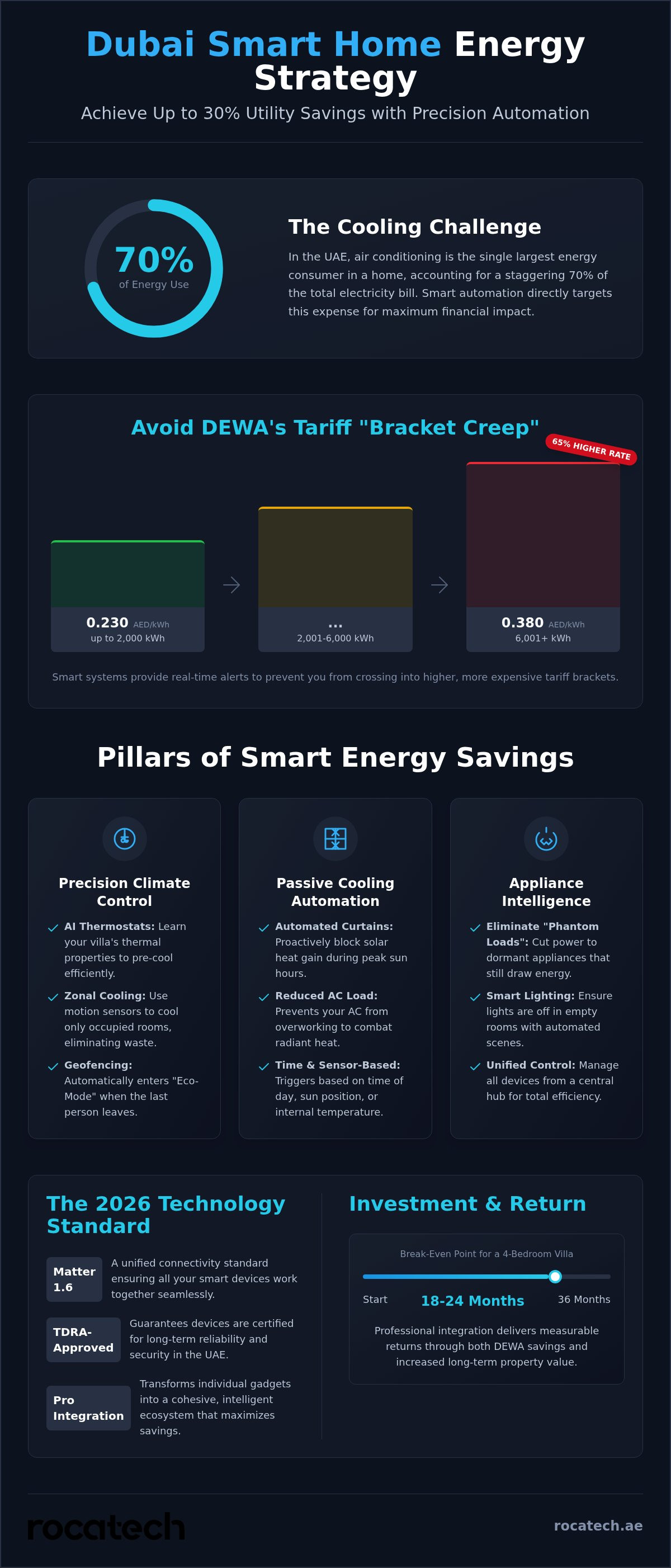
- Understand how cooling accounts for 70% of UAE household energy consumption and why targeting DEWA slab thresholds is the most effective financial strategy.
- Discover how AI-driven thermostats and zonal cooling systems eliminate waste in unoccupied rooms while maintaining high-luxury comfort levels.
- Learn to implement smart home energy savings dubai strategies by using automated curtain motors to block solar heat gain before it triggers your AC.
- Identify the role of the Matter 1.6 standard and smart hub gateways in creating a unified system that eliminates "phantom loads" from dormant appliances.
- Gain insights into why professional integration ensures sensors and actuators communicate effectively to maximize long-term system reliability and ROI.
The Financial Architecture of Dubai Energy: Why Smart Homes Are an Asset
In Dubai, energy efficiency is a technical challenge that requires a strategic response. A smart home in 2026 isn't defined by voice-controlled lights; it's defined by its ability to manage the "70% factor." In the UAE, cooling accounts for the vast majority of residential power consumption. Manual adjustments fail in large villas because human oversight can't track thermodynamic shifts across multiple floors. Integrated home automation systems act as a digital concierge, ensuring every kilowatt-hour is utilized with maximum precision to achieve smart home energy savings dubai residents need.
The DEWA Tariff Structure and "Bracket Creep"
DEWA utilizes a slab tariff system where electricity costs increase as consumption rises. For residential users in 2026, the first 2,000 kWh per month costs 0.230 AED/kWh. However, once you cross into the 6,001+ kWh bracket, the rate jumps to 0.380 AED/kWh. This "bracket creep" can inflate a monthly bill by hundreds of dirhams if a single AC unit is left running in an empty guest wing. Smart hubs provide real-time alerts before you hit the next tariff slab. By analyzing historical data, these systems predict end-of-month costs and suggest immediate adjustments to keep your villa within a lower cost bracket. It's about proactive management rather than reacting to a bill after the fact.
ROI: When Does Home Automation Pay for Itself?
Investing in high-efficiency hardware is a capital expenditure that delivers measurable returns. For a typical 4-bedroom villa, the break-even point for a professionally integrated system often occurs within 18 to 24 months. While DIY hardware-only setups might seem cheaper, they often lack the system harmony required to manage complex HVAC loads across multiple zones. Professional integration ensures that thermostats, motion sensors, and curtain motors work together. Beyond immediate DEWA savings, these systems contribute to long-term property value appreciation. Homes with high-efficiency ratings are increasingly sought after by executive buyers who prioritize operational excellence and sustainability. It's a strategic upgrade that pays dividends in both monthly liquidity and future resale value.
Precision Climate Control: Smart Thermostats and Zonal Cooling
Standard programmable thermostats often fall short when facing the extreme thermal loads found in the UAE. To achieve genuine smart home energy savings dubai residents must transition to AI-driven adaptive cooling systems that learn a property's thermal inertia. These systems don't just follow a clock; they analyze how long it takes to cool a room based on external temperatures and humidity levels. Recent innovations in home energy management have introduced predictive algorithms that prevent the AC from over-working when moisture levels spike, which is a frequent challenge for coastal villas. Geofencing technology further optimizes this by ensuring your home enters an automated "Eco-Mode" the moment the last resident leaves the premises.
The Power of Multi-Zone AC Management
Cooling an entire floor to maintain comfort in a single occupied study is the primary source of energy waste in large residences. By integrating motion sensors with smart HVAC controllers, you can direct airflow specifically to the rooms being used. This strategy relies on the concept of Zonal Cooling Efficiency. Zonal Cooling Efficiency is the ratio of occupied space to active cooling load. When your system recognizes that guest rooms or formal dining areas are empty, it can throttle back those specific zones without affecting the climate in the master suite or kitchen. This granular control prevents the compressor from running at 100% capacity when 20% would suffice.
Selecting the Right Smart Thermostat for Dubai HVAC
Compatibility is the most critical factor when upgrading your HVAC interface. While global brands like Nest and Ecobee offer sophisticated features, they require expert verification to ensure they interface correctly with local fan coil units (FCU) or split systems. A common technical requirement in UAE residential units is the presence of a "C-wire" to provide constant power to the unit's Wi-Fi and display components. Professional installation is vital to prevent system short-cycling, which can lead to premature hardware failure and higher maintenance costs. For a deeper look at specific hardware, explore this smart thermostat Dubai guide. If you aren't sure whether your current wiring supports these advanced features, consulting with a technical partner can ensure your system harmony remains intact while maximizing your ROI.
Passive Cooling Automation: Smart Curtains and Solar Heat Gain
Windows represent the most significant thermal vulnerability in any Dubai residence. While high-performance glazing helps, the greenhouse effect remains a primary driver of AC load as intense sunlight penetrates glass and traps heat within your living spaces. Relying on manual curtain operation often results in "reactive cooling," where the AC must work at maximum capacity to counteract heat that has already entered the room. Implementing smart home energy savings dubai strategies requires a proactive approach. Smart curtain motors function as a technical thermal barrier, obstructing solar radiation before it can spike internal temperatures. This aligns with the goals of the DEWA Smart Living Initiative, which encourages residents to utilize automated tools for more precise energy management.
Sun-Tracking Automation Logic
Effective automation goes beyond simple time-based scheduling. In a multi-story villa, West-facing windows require a completely different logic than those facing North. West-facing glazing absorbs the brutal afternoon sun, meaning curtains in these zones should close based on UV intensity or specific temperature triggers rather than a fixed clock. By integrating temperature sensors near the glass, the system can trigger closure the moment the solar load exceeds a specific threshold. We often recommend a "Summer Guard" scene for our clients. This single-tap configuration ensures that all primary thermal gaps are sealed during peak heat hours, regardless of whether you are home or at the office. It's a methodical way to maintain system harmony across large properties.
Aesthetic and Functional Harmony
Dubai's luxury interiors often utilize heavy, high-quality blackout fabrics that require robust hardware. Standard retail motors frequently struggle with the weight of these textiles, leading to mechanical strain and operational failure. Professional installation ensures that the selected smart curtain motors possess the necessary torque for silent, reliable operation. These systems also offer "Touch-to-Move" features, allowing for manual override without damaging the internal gears. When integrated into a central hub, your window treatments can communicate with your smart lighting control. If the curtains close to block heat, the system can subtly increase internal LED brightness to maintain a comfortable environment. This level of technical coordination ensures that your energy-saving measures never compromise the sophisticated atmosphere of your home.
Lighting and Appliance Intelligence: Eliminating "Phantom Loads"
Eliminating phantom loads is a critical step in optimizing residential utility costs. While HVAC remains the primary consumer, the cumulative effect of dormant electronics, inefficient water heaters, and redundant lighting can account for up to 15% of a villa's energy waste. A comprehensive smart home energy savings dubai strategy involves de-energizing these non-essential systems when they aren't required. We often implement a "Kill Switch" concept, where a single button or automated scene de-energizes designated smart plugs and non-critical circuits. This ensures that devices like coffee machines, media centers, and secondary appliances don't draw power while the home is empty or during overnight hours.
Outdoor and garden lighting also present opportunities for improvement. Rather than relying on simple timers that require manual seasonal adjustment, astronomical timers integrated into a smart hub automatically sync with Dubai's shifting sunset and sunrise times. For perimeter security and pathway lighting, motion sensors ensure high-intensity LEDs only activate when presence is detected, maintaining safety without constant power draw.
Occupancy Sensors vs. Motion Sensors
Occupancy sensors represent a technical evolution over standard motion-based triggers. While motion sensors detect large physical movements, occupancy sensors use more sensitive infrared or ultrasonic technology to detect presence even when a resident is stationary. This is particularly effective for home offices or kitchens where you might be working at a desk or preparing food for extended periods. By utilizing these advanced sensors, you reduce "false offs" while guaranteeing that lights never remain active in empty hallways or storage areas. For a detailed breakdown of hardware options, explore our guide to smart lighting control.
Automating the Water Heater: The Hidden Energy Drain
Water heaters are often the most overlooked energy drain in a Dubai household. Keeping several large tanks at 60°C 24/7 is an expensive redundancy, especially during the hotter months when ambient water temperatures are already high. Smart plug scheduling allows you to synchronize heating cycles with your actual usage patterns, such as early morning or evening peaks. This prevents the heater from cycling on and off throughout the day to maintain a temperature that isn't needed. For villas with multiple independent heaters, this coordinated control can significantly lower your total kWh consumption and help keep your account in a lower DEWA tariff slab. If you're ready to identify the specific drains in your property, a professional system audit can pinpoint exactly where your current hardware is underperforming.
The 2026 Connectivity Standard: Matter, Thread, and System Integration
Many homeowners mistake a collection of Wi-Fi gadgets for a cohesive efficiency strategy. However, achieving sustainable smart home energy savings dubai requires more than just installing individual devices. Without a unified communication layer, your AC won't know the curtains are closed, and your water heater won't account for your occupancy status. This fragmentation leads to "app fatigue," where residents manage ten different interfaces without seeing a significant reduction in their DEWA bill. True efficiency stems from system harmony, where every component shares data through a central intelligence layer to eliminate redundant power draw.
Matter 1.3 and Energy Management
The 2026 Matter standard has revolutionized how we track and manage power consumption. Unlike earlier versions, Matter 1.3 and subsequent specifications allow compatible devices to report their exact wattage usage in real-time to a central dashboard. This granular data enables the system to identify exactly which appliance is driving your account into a higher DEWA slab. When paired with Thread, a low-power mesh networking protocol, sensors respond with sub-second latency. This ensures that lights and AC units deactivate the moment a room is vacated, preventing even a few minutes of wasted energy. To understand how these protocols interact within your property, check our smart hub gateway guide for 2026.
Rocatech: Precision Installation for Maximum Savings
Rocatech approaches home automation as a technical partnership rather than a retail transaction. Our consultation process begins by identifying specific energy leaks within your floor plan, such as thermal gaps in high-ceiling foyers or inefficient lighting circuits in garden areas. We design ecosystems where the smart thermostat, curtain motors, and lighting control function as a single, reflexive unit. This professional integration ensures that your sensors actually talk to each other to maximize savings. We also provide ongoing support to optimize your system for changing seasonal needs, ensuring your villa remains an asset of operational excellence. By focusing on long-term reliability and international standards, we provide the technical stability and smart home energy savings dubai residents expect from high-end automation.
Securing Your Villa's Operational Future
The shift toward a high-efficiency household is a strategic investment in both environmental sustainability and monthly liquidity. By moving beyond basic automation and embracing the 2026 Matter standards, you can effectively navigate the complexities of DEWA slab tariffs. We've explored how precision HVAC management and automated thermal barriers work in tandem to eliminate waste without sacrificing the luxury lifestyle you expect. Achieving genuine smart home energy savings dubai residents can rely on requires a technical partner who understands the unique thermodynamic challenges of the UAE climate.
Fragmented devices often lead to data silos and operational failure. Professional integration ensures that every sensor and actuator contributes to a unified, energy-efficient ecosystem. Rocatech offers the specialized expertise needed to audit your current infrastructure and implement a high-performance solution tailored to your floor plan. Our Dubai-based technical experts provide precision integration for villa HVAC systems and remain available with reliable support to ensure your system harmony persists through every season.
Take the first step toward optimizing your utility costs and enhancing your property value. Book a Professional Smart Home Energy Audit with Rocatech Dubai today to secure your home's technical excellence. It's time to transform your residence into a model of modern efficiency.
Frequently Asked Questions
How much can I realistically save on my DEWA bill with a smart home?
Well-planned automation systems in Dubai can reduce cooling and power costs by 15% to 25% over time. Some residents achieve even higher results, as AI-powered predictive maintenance algorithms demonstrate measurable energy savings of up to 37%. These results are achieved by precisely managing HVAC loads to prevent your account from crossing into the highest DEWA slab tariffs. The financial impact is most significant for large villas where manual oversight is difficult.
Will a smart thermostat work with my existing AC system in Dubai?
Most smart thermostats are compatible with Dubai's common fan coil units and split systems, provided they have been verified for local HVAC standards. It is critical to ensure your device has TDRA type approval before installation in the UAE. Professional integration is necessary to confirm the presence of a C-wire for constant power. This technical precision prevents system short-cycling and ensures your smart home energy savings dubai strategy remains reliable.
Is professional smart home installation worth the cost for energy savings?
Professional installation is a strategic investment that ensures long-term system harmony. While DIY setups often lead to fragmented data and "app fatigue," a professionally integrated ecosystem allows all devices to communicate through a single hub. This coordination is essential for maximizing ROI, as it ensures motion sensors and thermostats work together to eliminate waste. Expert installers also identify specific thermal leaks in your floor plan that generic retail solutions might overlook.
Can I control my home energy use while I am traveling outside the UAE?
You can monitor and manage your entire energy profile from anywhere in the world using a secure smart hub gateway. This is particularly valuable for Dubai residents who travel frequently during the peak summer months. You can remotely adjust cooling setpoints, deactivate water heaters, and receive real-time alerts if consumption spikes unexpectedly. This global access provides significant emotional reassurance and prevents unnecessary utility costs while your property is unoccupied for extended periods.
What is the best smart home hub for energy monitoring in 2026?
In 2026, the most effective hubs are those that support the Matter 1.6 standard and Thread networking protocol. These devices provide the low-latency response and granular energy reporting required for professional-grade monitoring. A robust gateway centralizes your smart home energy savings dubai strategy by localizing device communication. This reduces reliance on external cloud servers, which enhances both the speed of your automation and the security of your sensitive household consumption data.
Do automated curtains really help with cooling costs in a villa?
Automated curtains function as a proactive thermal barrier against intense solar radiation. By closing shades based on UV intensity or temperature triggers, you prevent the greenhouse effect from spiking your internal climate. This significantly reduces the load on your AC units, which otherwise must work at maximum capacity to counteract heat that has already entered the room. In large villas with extensive glazing, this passive cooling strategy is a primary driver of operational efficiency.
How long does it take to see a return on investment for smart home tech?
The break-even point for a professionally integrated system typically occurs within 18 to 24 months for a standard 4-bedroom villa. This ROI is driven by immediate utility savings and the prevention of high-tariff slab charges. Beyond monthly liquidity, smart features can increase a home's value by up to 10%. Statistics show that 78% of home buyers are willing to pay more for properties with integrated, energy-efficient technical infrastructure and reliable automation.
Can smart home devices help reduce my carbon footprint in Dubai?
Smart home technology directly supports the UAE's sustainability goals by optimizing electricity and water consumption. By eliminating phantom loads and precision-tuning HVAC cycles, you significantly reduce your household's total carbon emissions. Automated systems ensure that energy is only consumed when and where it is actually needed. This methodical approach to resource management aligns your lifestyle with international environmental standards while contributing to the broader Smart Dubai vision for a digital and sustainable city.