

Integrated Security and Lighting System: The 2026 Guide to Smart Protection

Most security systems in Dubai are merely expensive witnesses to a crime that has already happened. You likely feel the frustration of juggling a dozen different apps just to check your cameras or dim the porch lights, only to realize your smart home still requires manual intervention during a crisis. By deploying a truly integrated security and lighting system, you can transform your property from a passive observer into a proactive shield that deters intruders before they ever reach your door. This approach moves beyond simple recording. It uses automated sequences to create a visible, defensive presence the moment a sensor is triggered.
We understand that technical reliability is the foundation of your peace of mind. In this 2026 guide, you'll discover how to unify your motion sensors, smart lighting control, and home security cameras into a single, harmonious ecosystem. We'll show you how to achieve comprehensive protection that aligns with the safety standards of Dubai's Law No. (2) of 2026 while significantly reducing your energy consumption. From streamlining your controls into one interface to leveraging AI-driven automation, you're about to learn how to build a home that's as intelligent as it is secure.
Key Takeaways
- Understand how a central hub unifies disparate hardware into a single integrated security and lighting system for seamless operational harmony.
- Discover how to implement automated logic sequences to ensure lighting scenes respond instantly to motion sensor triggers.
- Learn to apply Environmental Design principles that transform smart lighting into a proactive, non-violent deterrent against unauthorized access.
- Identify the technical requirements for heat-resistant hardware and secondary integrations like AC and curtain control tailored for the Dubai climate.
- Explore the value of a professional security audit to replace unreliable patchwork setups with a stable, expertly installed ecosystem.
Beyond Standalone Devices: The Necessity of an Integrated Security and Lighting System
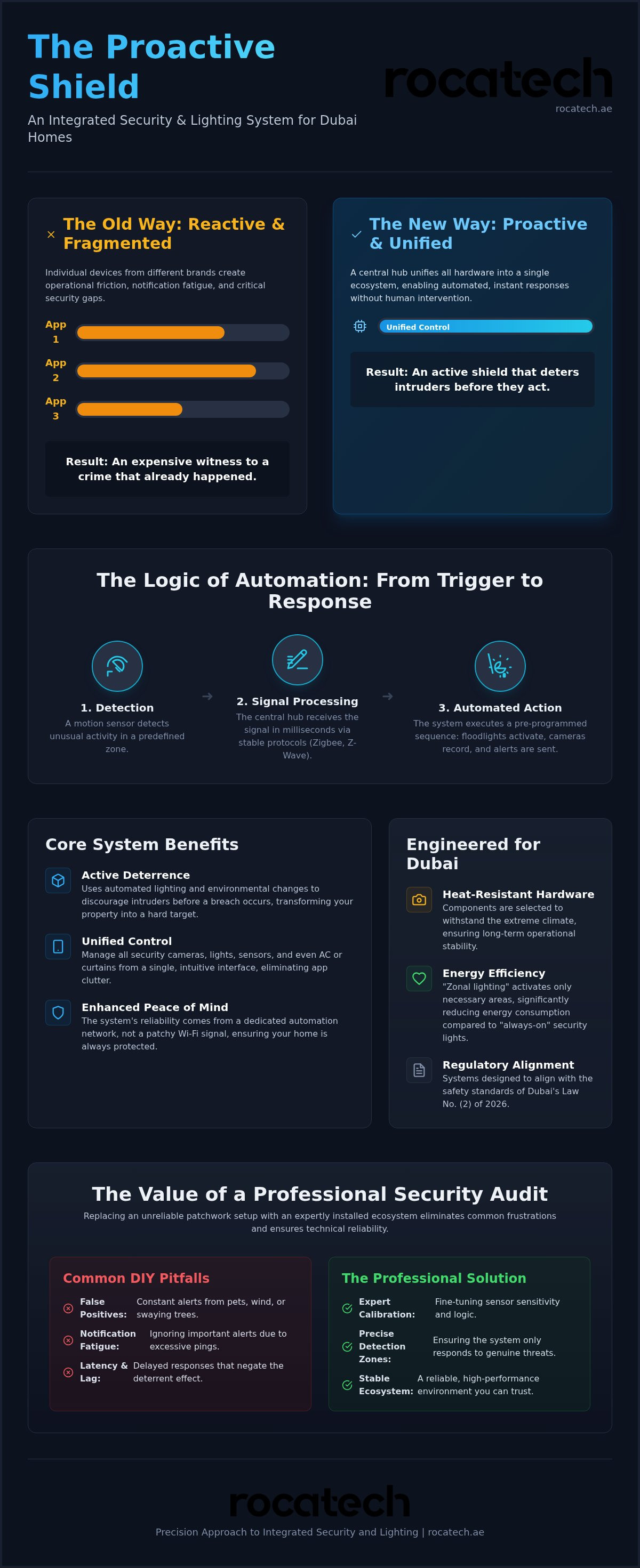
An integrated security and lighting system represents a fundamental shift from individual gadgets to a unified operational ecosystem. In many Dubai residences, security is treated as a series of isolated purchases: a camera here, a floodlight there, and perhaps a smart lock on the main door. This "Patchwork Problem" creates significant operational friction. When these devices don't communicate through a central brain, you're forced to manage multiple apps. This leads to notification fatigue and, eventually, critical security gaps. A true integrated system ensures every component works in harmony. It's managed by a single interface that responds to threats in real time without human intervention.
The Reactive vs. Proactive Security Paradigm
Traditional security setups are inherently reactive. They focus on gathering evidence after an incident has occurred, such as recording footage of an intruder. While useful for investigations, this does little to protect your property in the moment. An integrated system flips this logic. By linking motion sensors directly to smart lighting control, your home can execute immediate environmental changes. If a sensor detects movement in a restricted area at 2 AM, the system doesn't just record. It floods the area with light and flashes external fixtures to signal that the property is occupied. Active Deterrence is the practice of using automated environmental responses to discourage criminal intent before a breach occurs.
Centralized Control: The Role of the Smart Hub
The intelligence of these systems relies entirely on the gateway. This device acts as the primary brain for all connected hardware. It translates signals between different components, ensuring that your home security camera can trigger your smart plugs or lighting scenes instantly. For a robust setup, you should refer to a comprehensive smart hub gateway guide to understand how different communication standards interact. Modern systems utilize protocols like Zigbee, Z-Wave, and the newer Matter standard to ensure low-latency communication. This technical stability provides a psychological benefit. It's the reassurance that your home's defense isn't dependent on a patchy Wi-Fi signal or a manual app command, but on a dedicated, industrial-grade automation network.
How Integrated Systems Function: The Logic Behind the Automation
Technical reliability in a smart home depends on the logic layer that connects individual devices. An integrated security and lighting system operates on the "If This, Then That" (IFTTT) principle, which serves as the foundation for operational harmony. When a specific event occurs, such as a sensor detecting movement, the system executes a pre-programmed response across multiple hardware categories. This automation removes the need for manual intervention, ensuring your property reacts instantly to potential threats. For this to be effective, the system requires low-latency communication. If there is a delay between detection and the lights activating, the deterrent effect is lost.
Professional configuration is essential to refine this logic and prevent the frustration of false positives. A system that triggers every time a pet moves or a palm tree sways in the wind quickly becomes a nuisance rather than a utility. Expert installers calibrate sensitivity levels and define specific detection zones to ensure the system only responds to genuine security events. This precision instills confidence in the technology, allowing you to trust the automation without constant monitoring. If you want to ensure your home's logic is sound, consulting with Rocatech experts can help you design a stable, high-performance environment.
Sensor-to-Light Trigger Mechanisms
The communication between a Passive Infrared (PIR) motion sensor and a smart light switch happens in milliseconds. This near-instantaneous response is critical for active deterrence. Modern systems utilize "zonal lighting," where only the fixtures in the immediate vicinity of the detected motion are activated. This creates a spotlight effect that alerts intruders they have been spotted while maintaining energy efficiency. High-definition home security cameras act as visual verifiers in this process, allowing the system to distinguish between a delivery driver and an unauthorized visitor before escalating the response.
Custom Security Scenes and Schedules
Integrated systems allow for the creation of complex security scenes that go beyond simple on-off triggers. "Away Mode" is a sophisticated occupancy simulation that varies lighting patterns throughout the evening, making a vacant villa look lived-in. In the event of a confirmed breach, an "Emergency Scene" can be triggered. This immediately sets all internal and external lights to maximum brightness or initiates a flashing sequence to disorient the intruder and alert neighbors. These high-stakes operations are managed through a single authoritative interface, providing a streamlined experience that reduces user fatigue and ensures technical stability when it matters most.
Active Deterrence: Using Smart Lighting as a Primary Security Layer
Sudden illumination serves as a powerful psychological barrier. An integrated security and lighting system leverages this by forcing an intruder out of the shadows and into the open. This follows the principles of Crime Prevention Through Environmental Design (CPTED), which emphasizes natural surveillance. When a property is well-lit upon detection, it signals to the intruder that the home is actively monitored. Beyond deterrence, lighting significantly enhances the technical performance of your surveillance hardware. Even advanced 4K cameras struggle with grain and noise in total darkness. By providing a clear, high-contrast environment, your system ensures that facial recognition remains accurate, meeting the rigorous standards of Dubai’s Law No. (2) of 2026.
Energy efficiency is another critical advantage of this automated approach. Traditional security often relies on high-wattage floodlights left on throughout the night, contributing to high utility bills. Since lighting accounts for roughly 15% of a typical home's energy consumption, switching to motion-activated LED systems is a strategic financial move. Smart LEDs use up to 90% less energy than traditional bulbs. They provide robust protection without the waste of 24/7 operation, allowing you to maintain a secure perimeter while optimizing operational costs.
Perimeter Protection and Entrance Lighting
Dubai villas often feature expansive garden areas and gated entrances that are difficult to monitor manually. Implementing smart lighting control allows you to secure these dark corners effectively. You can program your system to illuminate the driveway the moment your smart door lock is engaged or when a vehicle approaches the gate. This creates a safe, welcoming path for residents while simultaneously alerting any unauthorized individuals that their presence has been noted. It's a seamless blend of convenience and technical defense.
Interior Lighting Response to Security Breaches
The utility of an integrated security and lighting system extends deep into the home's interior. In the event of a detected breach or a fire alarm, the system can guide occupants to safety by illuminating exit paths and unlocking smart doors automatically. Many homeowners find value in a "Panic Button" feature, typically located by the bedside. A single press can instantly flood the entire house and exterior with full-spectrum light. This "waking up" effect is disorienting for intruders and provides immediate psychological reassurance to the family, confirming that the home's defensive systems are fully operational.
Designing Your Integrated Ecosystem for Dubai Properties
Designing an integrated security and lighting system in the UAE requires a deep understanding of local environmental stressors. The extreme summer temperatures, often exceeding 50°C, demand outdoor hardware with high Ingress Protection (IP) ratings to prevent internal component failure. While standard devices might suffice in temperate climates, Dubai properties require industrial-grade sensors and fixtures that resist both heat and fine desert dust. Beyond hardware durability, a successful ecosystem integrates security with other essential utilities like smart thermostats and automated curtains. This creates a holistic environment where your home's defenses and climate controls operate in a single, efficient cycle.
Choosing the right architecture for your integration depends on your property's current state. For new villa builds in areas like Emirates Hills or Palm Jumeirah, a wired system offers the highest level of technical reliability and low-latency performance. Retrofitting an existing property often favors a wireless approach to avoid structural modifications. Consider this brief checklist for your deployment:
- Wired Integration: Best for new constructions; provides maximum stability and handles high data loads from multiple 4K cameras.
- Wireless Integration: Ideal for apartments and retrofits; uses Zigbee or Matter protocols for flexible device placement without drilling.
- Hybrid Models: Combines wired backbones for cameras with wireless sensors for peripheral areas.
Professional installation is essential to ensure these systems remain stable under the specific electrical loads of UAE residences. If you are ready to secure your property with a custom-engineered solution, contact Rocatech for a professional consultation today.
Villa vs. Apartment: Tailoring the Integration
The layout of your property dictates the focus of your security layers. For expansive villas, the priority is perimeter protection, which involves gate integration and synchronized garden lighting. Conversely, apartment units in JVC or Dubai Marina benefit most from internal motion sensors and high-performance smart door locks. Rocatech specializes in customizing these setups for specific Nakheel and Emaar property layouts, ensuring that every blind spot is covered without compromising the aesthetic of a luxury residence.
Optimizing Energy Efficiency and DEWA Costs
Integrated systems provide a significant return on investment by reducing monthly DEWA expenses. By linking your security modes to your smart lighting control and HVAC system, you can automate energy-saving sequences. For example, when the system is set to "Away," it doesn't just activate the cameras; it can also signal the smart thermostat to adjust the AC to an eco-friendly temperature and ensure all unnecessary lights are extinguished. This level of automation ensures that your property remains protected while operating at peak financial efficiency. Integrated systems provide ROI through both proactive protection and measurable utility savings.
Rocatech’s Precision Approach to Integrated Security and Lighting
Deploying a sophisticated integrated security and lighting system requires more than just connecting hardware; it demands a strategic understanding of technical harmony. Rocatech positions itself as the premier partner for smart home installation in Dubai, moving beyond simple device setup toward comprehensive ecosystem engineering. We eliminate the "patchwork" problem by ensuring every sensor, light, and camera communicates through a stable, unified brain. Our approach is rooted in the belief that security should be invisible yet infallible, providing a seamless experience that protects your property without requiring constant troubleshooting.
The Rocatech Installation Lifecycle
Our methodology follows a logical, three-step progression to ensure your system meets the specific demands of your lifestyle and property layout. We don't believe in one-size-fits-all solutions.
- Step 1: On-site Consultation: We conduct a thorough audit of your Dubai property to identify security blind spots and areas where lighting can be optimized for both safety and energy efficiency.
- Step 2: Custom Logic Design: Our engineers develop the "If This, Then That" logic layer, tailoring automation sequences to your specific security needs and aesthetic preferences.
- Step 3: Technical Deployment: We handle the professional installation of hardware and the precise synchronization of software, ensuring low-latency communication across all devices.
This methodical process guarantees that your integrated security and lighting system is calibrated for maximum performance from day one. We prioritize precision in every connection, ensuring that your home's defenses are both proactive and reliable.
Why Reliability Matters in Dubai’s High-Stakes Environments
In high-value residential and commercial environments, operational failure is not an option. Rocatech builds systems with a focus on durability and fail-safe performance. We recognize that internet stability can fluctuate, so we prioritize local processing. This ensures your security logic and lighting triggers continue to function offline, maintaining your property's protection even during network interruptions. This dedication to technical resilience provides significant psychological reassurance, allowing you to trust your home’s automation implicitly.
Our commitment to your success extends beyond the initial installation. We provide comprehensive post-deployment support and personalized training for every client. We ensure you are fully confident in managing your single-interface control system before we consider the project complete. If you are ready to transition from reactive gadgets to a proactive, unified shield, schedule your professional smart home consultation with Rocatech today. We are your seasoned ally in creating a safer, more intelligent Dubai home.
Securing Your Dubai Property with Proactive Intelligence
Transitioning to a unified ecosystem is the most effective way to protect your home while optimizing energy consumption. By moving beyond reactive cameras and embracing an integrated security and lighting system, you transform your property into an active deterrent that responds to threats in real time. We've explored how centralized logic layers and Environmental Design principles provide both technical reliability and psychological reassurance. Whether you're managing a luxury villa or a modern apartment, the synergy between motion sensors, smart lighting control, and high-definition surveillance ensures comprehensive protection.
Rocatech has provided specialized expertise in Dubai since 2021, offering deep experience with Emaar and Nakheel property layouts. We provide complete lifecycle support, from the initial security audit to professional installation and personalized training. Technical failure isn't an option when your family's safety is at stake. It's time to eliminate the patchwork of apps and invest in a stable, harmonious environment that manages itself.
Contact Rocatech for a Professional Integrated Security Consultation and take the first step toward a smarter, more secure future for your home. We look forward to building a lasting partnership based on precision and your peace of mind.
Frequently Asked Questions
What is an integrated security and lighting system?
An integrated security and lighting system is a unified ecosystem where security hardware and lighting controls communicate through a central gateway to perform automated actions. Unlike standalone devices, this system uses logic-based triggers to create a proactive defense. For instance, a motion sensor can instantly activate specific lighting scenes to deter intruders. This integration ensures all components work in harmony rather than functioning as isolated, reactive gadgets.
Can I integrate my existing security cameras with smart lights?
Integration is possible if your existing hardware supports common communication protocols like Zigbee, Z-Wave, or Matter. Most modern home security cameras can be linked to smart lighting control via a compatible gateway or a professional automation platform. This allows your cameras to act as triggers for your lights. Any detected movement results in immediate illumination, which improves footage quality and provides a powerful deterrent against unauthorized access.
Do I need a smart hub for an integrated security system?
A smart hub or gateway is essential for creating a stable and low-latency integrated security and lighting system. It acts as the central brain that translates signals between different devices, such as motion sensors and smart plugs. Using a dedicated hub ensures that your automations continue to function even if your external internet connection fluctuates. This provides the technical reliability required for high-stakes security environments in Dubai.
How does integrated lighting deter burglars better than standard lights?
Integrated lighting provides active deterrence by responding dynamically to a perceived threat rather than remaining static. Standard security lights are often ignored if they stay on 24/7 or follow a simple timer. An integrated system uses motion sensors to trigger sudden, bright illumination exactly when an intruder is detected. This unexpected change in the environment signals that the property is actively monitored, which creates a significant psychological deterrent.
Will an integrated system work if my internet goes down in Dubai?
A professionally installed system with a local smart hub will maintain its core security functions during an internet outage. While you might lose remote smartphone access and cloud notifications, the local logic triggers between your sensors and lights will continue to operate. This technical resilience is a hallmark of industrial-grade automation. It ensures your property remains protected regardless of external network stability or service provider fluctuations in the UAE.
How much does professional smart home integration cost in the UAE?
The total investment for professional integration varies based on the scale of your property and the complexity of the hardware required. Factors such as the number of zones, the choice between wired or wireless protocols, and the inclusion of advanced sensors influence the final cost. While fixed pricing is not provided without a technical audit, these systems offer long-term ROI through reduced energy consumption and enhanced property protection.
Can I control my security and lighting system from my smartphone?
You can manage your entire system through a single authoritative interface on your smartphone. This eliminates the need to toggle between multiple apps for different devices. From your mobile device, you can view live camera feeds, adjust smart lighting control schedules, and receive instant alerts. This streamlined control reduces user fatigue and ensures you have complete visibility of your property from anywhere in the world.
Is it possible to integrate smart curtains with my security system?
Integrating a smart curtain motor with your security ecosystem adds an extra layer of privacy and protection. You can program your curtains to close automatically when your security system is armed or when specific lighting scenes are activated. This prevents outsiders from viewing your home's interior at night. During a security event, the system can be configured to open curtains, exposing the intruder and making their presence visible to neighbors.