

How to Upgrade a Traditional Home to a Smart Home: The 2026 Dubai Guide

Did you know that a properly integrated smart climate control system can reduce your energy bills by up to 40%? For many residents in Dubai, the decision to upgrade a traditional home to a smart home often stems from a desire to manage rising DEWA costs or to eliminate the anxiety of leaving a property unattended during international travel. It's natural to feel confused by the shifting technical landscape, especially with the 2026 TDRA regulations and the rapid move toward Matter 1.5 interoperability standards. This guide provides a professional roadmap to ensuring your residence becomes a high-performance environment that prioritizes technical reliability and regional efficiency.
We will examine the essential components of a unified mesh network, including smart thermostats, lighting controls, and secure entry systems. You'll discover how to achieve system harmony and long-term value without the need for a disruptive structural renovation. Our focus remains on creating a stable, future-proof ecosystem that provides both operational excellence and genuine peace of mind for the modern UAE homeowner.
Key Takeaways
- Transition from manual controls to an autonomous, data-driven environment by integrating intelligent controllers into your existing residence.
- Prioritize climate and lighting controls as the primary pillars for managing the UAE's extreme heat and reducing monthly utility expenses.
- Learn how to successfully upgrade a traditional home to a smart home by selecting dedicated communication protocols that offer superior stability over standard Wi-Fi.
- Follow a strategic, phased roadmap that begins with high-impact energy savers before expanding into integrated security and automated access solutions.
- Understand the necessity of professional integration to ensure system harmony and prevent the technical failures common in complex regional installations.
What Does it Mean to Upgrade a Traditional Home to a Smart Home?
To upgrade a traditional home to a smart home is a strategic technical transition. It involves retrofitting intelligent controllers into the established electrical and mechanical infrastructure of a residence. This process replaces legacy manual switches with data-driven interfaces capable of autonomous decision-making. By 2026, this shift has become a regional necessity, driven by the UAE's Smart Dubai initiative and the April 6, 2026, TDRA enforcement of new network safety rules. These regulations ensure that every cellular-enabled device in your residence meets strict security standards.
The psychological impact of this transition is profound. Homeowners gain absolute system visibility through a centralized smart hub. Whether you are in the office or traveling abroad, the ability to monitor water leak sensors or verify door locks provides a level of reassurance that traditional homes cannot match. It moves the home from a passive structure to an active, responsive environment. This evolution prioritizes technical reliability and precision, ensuring that your home's operational floor runs with global competence.
The Core Benefits for Dubai Homeowners
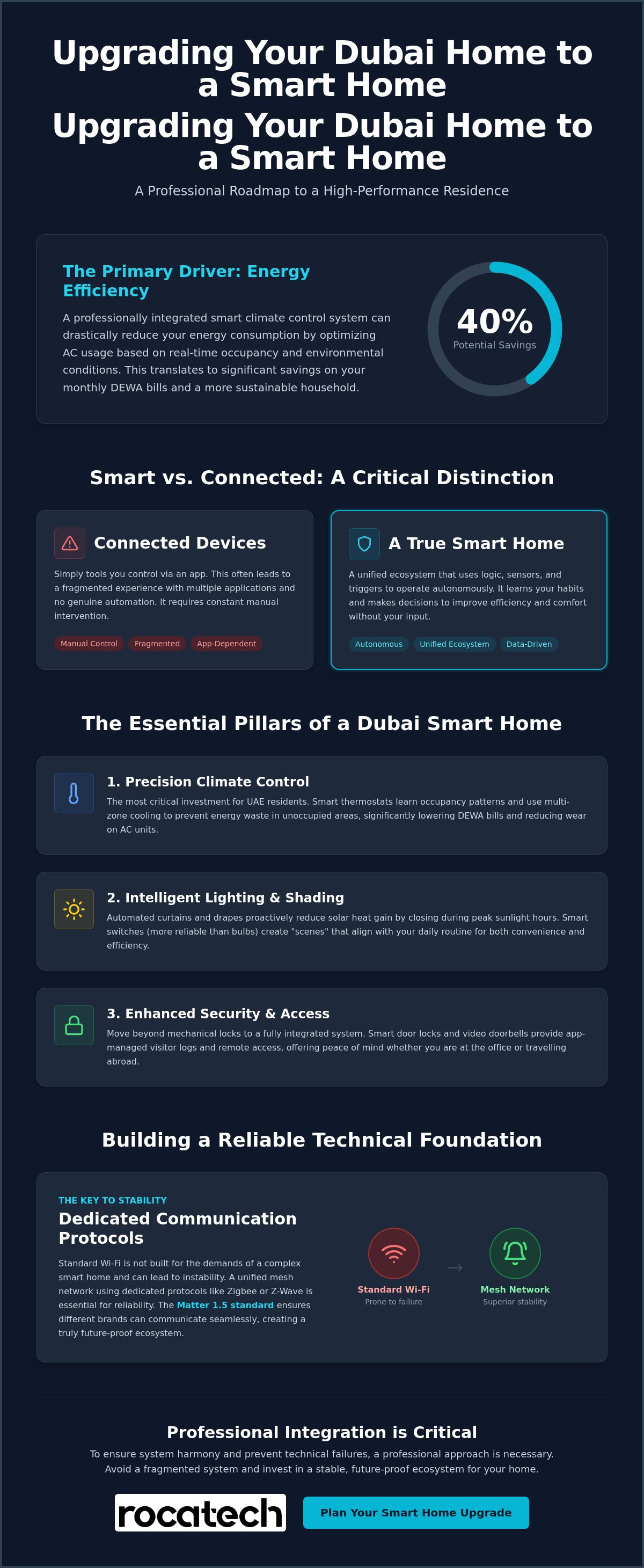
Precision climate management is the primary driver for local upgrades. Smart thermostats can reduce energy bills by up to 40% by optimizing AC usage based on real-time occupancy. Beyond efficiency, security is significantly enhanced through integrated systems. Moving beyond basic mechanical locks, a modern upgrade includes smart door locks and video doorbells that provide app-managed visitor logs. Lifestyle simplification follows naturally; tasks like adjusting heavy drapes are handled by a smart curtain motor, allowing the home to adjust to the sun's position automatically.
Smart vs. Connected: Understanding the Difference
A connected device is simply a tool you control via an app, which often leads to a fragmented experience. A truly smart ecosystem uses logic and triggers to operate without manual intervention. For example, a motion sensor that activates a smart lighting control sequence only when a room is occupied represents a higher level of technical maturity. Integrated automation is the harmony of hardware and software. By utilizing the Matter 1.5 standard, different brands can finally communicate within a single, unified mesh network, providing the stability required for high-stakes home environments.
The Essential Pillars of a Dubai Smart Home Upgrade
To effectively upgrade a traditional home to a smart home in the UAE, you must focus on the systems that endure the highest operational strain. In Dubai, this begins with climate management and extends to asset protection. These pillars form the technical foundation of a reliable residence. They ensure that novelty never takes precedence over functional durability. By prioritizing these core areas, you create a home that's both efficient and secure.
Climate control remains the most critical investment for any regional residence. With summer temperatures frequently exceeding 45°C, manual AC management is often inefficient and expensive. Transitioning to automated systems allows for a more granular approach to home management. This move from passive infrastructure to an active, data-driven environment is what defines a successful modern upgrade.
Precision Cooling with Smart Thermostats
A smart thermostat dubai does more than just adjust temperature settings. It manages the total AC load by learning occupancy patterns and responding to external thermal conditions. For large villas, multi-zone cooling is essential. It prevents the system from wasting energy in unoccupied wings of the property. This intelligent scheduling reduces operational wear on compressor units. It also helps lower DEWA bills by up to 40%, according to verified energy efficiency data. Using motion sensors to detect presence further refines this process, ensuring cooling is only active when necessary.
Intelligent Lighting and Shading
Transitioning from standard switches to precision smart lighting control is the next logical step. In traditional residences, replacing the wall switch is often more reliable than using smart bulbs. This approach maintains the physical interface while adding sophisticated automation. Integrating a smart curtain motor is equally vital for thermal management. By automating drapes to close during peak sunlight hours, you proactively reduce heat gain. You can create "scenes" that align with your daily routine, such as a "Welcome Home" mode that adjusts both lighting and shading as you arrive.
Upgrading traditional doors with a smart door lock and video doorbell provides secure, keyless entry. It allows you to manage visitor logs and grant access from your smartphone, even when you aren't home. This level of control is a significant upgrade over mechanical keys. Finally, asset protection through water leak sensors provides psychological reassurance. These devices offer 24/7 monitoring, alerting you to potential hazards before they escalate into costly structural repairs. If you're ready to secure your property, exploring a comprehensive automation suite can provide the stability your home requires.
Building the Technical Foundation: Hubs and Protocols
When you decide to upgrade a traditional home to a smart home, the most critical decision isn't which individual gadget to buy, but which protocol will carry the data. Many DIY setups rely solely on Wi-Fi, which often leads to network congestion and latency as more devices are added. In a professional environment, dedicated protocols like Zigbee, Z-Wave, or the latest Thread 1.4 are preferred for their low-power mesh capabilities. These systems allow devices to communicate with each other, effectively extending the range and reliability of the network without taxing your primary internet router.
UAE villas present a unique technical challenge due to thick concrete walls and rebar construction. These materials are notorious for blocking high-frequency signals. Using a mesh-based protocol ensures that a command sent to a smart curtain motor in a distant wing reaches its destination by hopping through intermediate nodes, such as a smart plug or a wall switch. This architectural approach guarantees that "system offline" errors are eliminated, providing the operational stability required for high-stakes home management.
Choosing Your Central Gateway
Selecting the right smart hub gateway is about establishing the operational brain of your residence. While voice assistants like Alexa or Google Home are excellent for the user interface, a professional gateway handles the complex logic and local processing. Local control is faster and more secure because it doesn't rely on an external cloud server to execute simple commands. By 2026, ensuring your hub supports Matter 1.5 is essential for future-proofing, as this standard allows devices from disparate manufacturers to work in perfect harmony within a single ecosystem.
Security and Privacy in the Smart Ecosystem
Security is both a psychological benefit and a technical necessity. The UAE Cyber Security Council has highlighted that 70% of smart devices in the region are vulnerable to cyberattacks if not properly secured. When installing a home security camera, it's vital to prioritize encrypted, locally stored data. This ensures your surveillance feeds remain private and accessible only to you, even if the internet connection is interrupted. Professional configuration remains the best defense against vulnerabilities, ensuring your installation aligns with the TDRA’s 2026 network safety and labeling regulations.
The 2026 Roadmap: A Phased Approach to Upgrading
A common misconception is that you must replace every legacy system simultaneously to achieve a modern residence. In reality, the most successful projects to upgrade a traditional home to a smart home follow a logical, phased progression. This methodical approach ensures technical stability and allows you to prioritize investments based on immediate operational needs. By breaking the transition into manageable segments, you maintain control over the integration process while avoiding the complexity of a total structural overhaul.
- Phase 1: High-Impact Energy Savers. Focus on smart thermostats and smart plugs to gain immediate control over utility consumption.
- Phase 2: Security and Access. Deploy smart door locks and video doorbells to establish a secure perimeter and visitor log.
- Phase 3: Environmental Comfort. Integrate smart lighting control and smart curtain motors to manage thermal gain and ambiance.
- Phase 4: Advanced Safety. Install water leak and motion sensors to provide 24/7 monitoring and asset protection.
- Phase 5: Full Integration. Consolidate all systems into a unified dashboard for complex scene automation and predictive logic.
Starting Small for Immediate ROI
The smart thermostat is the most effective first investment for any Dubai resident. Given that cooling accounts for a significant portion of regional DEWA bills, optimizing AC cycles offers the fastest return on investment. You can complement this by using smart plugs to identify and eliminate 'vampire' energy drain from appliances that remain in standby mode. Industry data suggests that the combined efficiency gains from a Phase 1 implementation can pay for the hardware investment in as little as 12 months. This phase establishes the operational floor, providing immediate financial relief and technical confidence.
Scaling to a Whole-Home System
Once your energy and security foundations are stable, the focus shifts toward system harmony. This is the point where you transition from managing individual apps to utilizing a unified dashboard. Adding motion sensors allows your home to respond to your presence, triggering lighting and climate actions without manual input. It's vital to ensure that every new device remains compatible with your initial smart home installation dubai. This foresight prevents the 'system offline' frustrations caused by fragmented hardware and ensures your ecosystem remains future-proof as new standards like Matter 1.5 emerge.
If you're ready to begin your transition with precision and expert guidance, you can explore our professional automation solutions to start your Phase 1 upgrade today.
Why Professional Integration is Critical for Dubai Homes
While the market is flooded with DIY gadgets, the decision to upgrade a traditional home to a smart home in a high-stakes environment like Dubai requires a more rigorous approach. Traditional UAE residences often feature complex electrical standards and structural elements, such as thick reinforced concrete walls, that frequently interfere with standard wireless signals. A professional integrator ensures that hardware is not just installed, but harmonized with the building's specific architecture. This precision prevents the common "system offline" frustrations that plague amateur setups and ensures that your mesh network remains robust across every room.
Stability is the ultimate luxury in a modern home. When a system is professionally configured, it operates with a level of technical reliability that provides genuine psychological reassurance for homeowners. Beyond daily convenience, a professionally integrated smart home significantly enhances property resale appeal. Potential buyers in Dubai's luxury market look for unified, future-proof ecosystems that comply with the April 2026 TDRA regulations rather than a fragmented collection of incompatible devices. Professional setup ensures that every smart door lock and water leak sensor contributes to a stable, data-driven environment.
The Rocatech Approach to Precision Automation
Rocatech Dubai bridges the gap between hardware and lifestyle by focusing on long-term value over immediate transactions. We believe a personalized consultation is essential before any hardware is purchased. This consultative partnership ensures that every smart thermostat or motion sensor serves a specific functional benefit tailored to your routine. Our involvement doesn't end at installation; we provide ongoing support and system optimization to ensure your home environment remains secure, efficient, and aligned with international standards.
From Traditional to Smart: The Final Transition
The journey to upgrade a traditional home to a smart home is a strategic move toward energy efficiency, enhanced security, and total peace of mind. By following a phased roadmap and prioritizing professional integration, you transform your residence into a high-performance asset that manages itself. This transition replaces manual effort with autonomous logic, allowing you to focus on your lifestyle while your home handles climate, lighting, and security. The next step in your transition is a comprehensive site survey and technical assessment to identify your property's unique requirements.
Contact Rocatech for a professional smart home consultation in Dubai to begin your journey with a seasoned ally and ensure your home's technical foundation is built for the future.
Future-Proofing Your Dubai Residence
Transitioning to an automated environment is a strategic investment in your property's long-term value and operational efficiency. By following a phased roadmap, you can effectively upgrade a traditional home to a smart home while maintaining technical stability and managing costs. The primary objective is to move beyond fragmented gadgets toward a unified ecosystem that prioritizes climate efficiency and robust security.
Since 2021, Rocatech has provided Dubai residents with specialized expertise in precision automation. We are specialists in DEWA-optimizing climate control and the comprehensive integration of lighting, security, and shading systems. Our consultative approach ensures that your system harmony is grounded in practical, real-world application and international standards. This dedication to excellence provides the psychological reassurance that your home's infrastructure is reliable and secure.
Don't let the complexity of 2026 regulations or technical protocols delay your transition. Schedule your professional smart home consultation with Rocatech today to establish a high-performance environment tailored to your lifestyle. Your journey toward a sophisticated, automated residence starts with an expert technical assessment.
Frequently Asked Questions
Can I upgrade my traditional home to a smart home without rewiring?
Yes, you can upgrade a traditional home to a smart home without invasive rewiring by utilizing modern wireless protocols like Zigbee or Thread 1.4. These systems are designed to replace existing wall switches and thermostats using the current electrical backbox. This approach preserves your property's structural integrity while adding advanced automation capabilities through a unified mesh network.
How much can I save on my DEWA bill by switching to a smart home?
Smart climate control systems can reduce energy bills by up to 40% by optimizing AC usage based on real-time occupancy and external temperatures. When combined with automated smart curtain motors and lighting controls, the system proactively reduces the thermal load on your property. These efficiencies ensure your residence's operational costs remain manageable even during the peak summer months.
Do smart home devices work with the traditional AC systems found in Dubai?
Most smart thermostats are fully compatible with the Fan Coil Units (FCU) and split systems common in Dubai villas and apartments. Professional integration ensures the controller communicates correctly with the specific wiring of your AC unit. This precise management allows for granular temperature control and reduces mechanical wear on your cooling infrastructure.
Is a smart home upgrade worth it if I am renting my villa or apartment?
Upgrading is a practical choice for renters because many smart devices are retrofittable and completely portable. Smart plugs, thermostats, and battery-powered sensors allow you to improve energy efficiency and security without making permanent structural changes. You can simply reinstall the original legacy fixtures and move your smart hardware to your next property when your lease ends, and for those relocating within the region, Choose and Move offers professional moving services to ensure a smooth transition.
What is the best smart home hub for a large home in the UAE?
For large UAE villas, a Matter-compatible smart hub gateway that supports mesh networking is the superior choice. Mesh protocols allow signals to hop between devices, effectively overcoming the interference caused by thick reinforced concrete walls. This architecture provides the technical reliability needed to maintain a stable connection across expansive, multi-story floor plans.
How long does a professional smart home installation usually take?
A professional upgrade a traditional home to a smart home typically takes between one and three days depending on the project's scale. A standard apartment setup can often be completed in a single day. Larger villas requiring multi-zone AC integration and full lighting automation follow a more methodical schedule to ensure every component achieves perfect system harmony.
Are smart home systems reliable during Dubai's extreme summer heat?
High-quality smart home hardware is specifically engineered to operate reliably in high-stakes environments, including Dubai’s extreme heat. Smart thermostats and sensors are designed to manage thermal loads proactively, ensuring your AC doesn't overwork. This reliability provides emotional reassurance that your home remains protected and efficient even when outdoor temperatures exceed 45°C.
Can I control my Dubai smart home while I am traveling abroad?
You can monitor and control your entire ecosystem from anywhere in the world through secure, encrypted remote access. Whether you're checking a home security camera or adjusting the AC before your flight lands, the system provides 24/7 visibility. This global competence ensures you maintain authority over your residence's operational floor regardless of your physical location. For those traveling to Morocco, you can visit DriveCars.ai for a no-deposit car rental service that matches your preference for modern, hassle-free solutions.