

How to Reduce Your Electricity Bill with a Smart Home in Dubai: The 2026 Energy Saving Guide

What if the highest cost on your monthly DEWA statement isn't the price of cooling your home, but the price of cooling empty space? In Dubai's high-stakes climate, inefficient energy management is an operational failure that many homeowners accept as inevitable. You can actually reduce electricity bill with smart home dubai solutions that transition your property from a passive consumer to a precision-managed environment. Unpredictable surges in utility costs create unnecessary financial instability, especially when energy is wasted by lighting left on or AC units running in unoccupied rooms.
We promise to show you how to slash your DEWA costs by up to 30% using precision automation and smart cooling strategies tailored specifically for the 2026 Dubai energy landscape. This guide provides a clear roadmap for achieving predictable monthly utility costs and automated comfort without the need for constant manual monitoring. We will examine the specific ROI of hardware like smart thermostats and curtain motors; we also detail how professional integration ensures these systems work in harmony to protect your long-term investment and provide significant emotional reassurance.
Key Takeaways
- Analyze the DEWA slab tariff structure to understand how precision cooling prevents your household from entering higher-cost consumption brackets.
- Discover how to reduce electricity bill with smart home dubai solutions by synchronizing smart thermostats, lighting controls, and curtain motors.
- Evaluate the operational difference between monitoring consumption and implementing hardware-level automation through a dedicated smart hub gateway.
- Learn to configure strategic automation scenes that eliminate energy waste in unoccupied spaces without sacrificing residential comfort.
- Understand why professional installation is necessary to navigate Dubai's specific HVAC technical requirements and ensure long-term system stability.
The DEWA Challenge: Why Electricity Bills Spike in Dubai
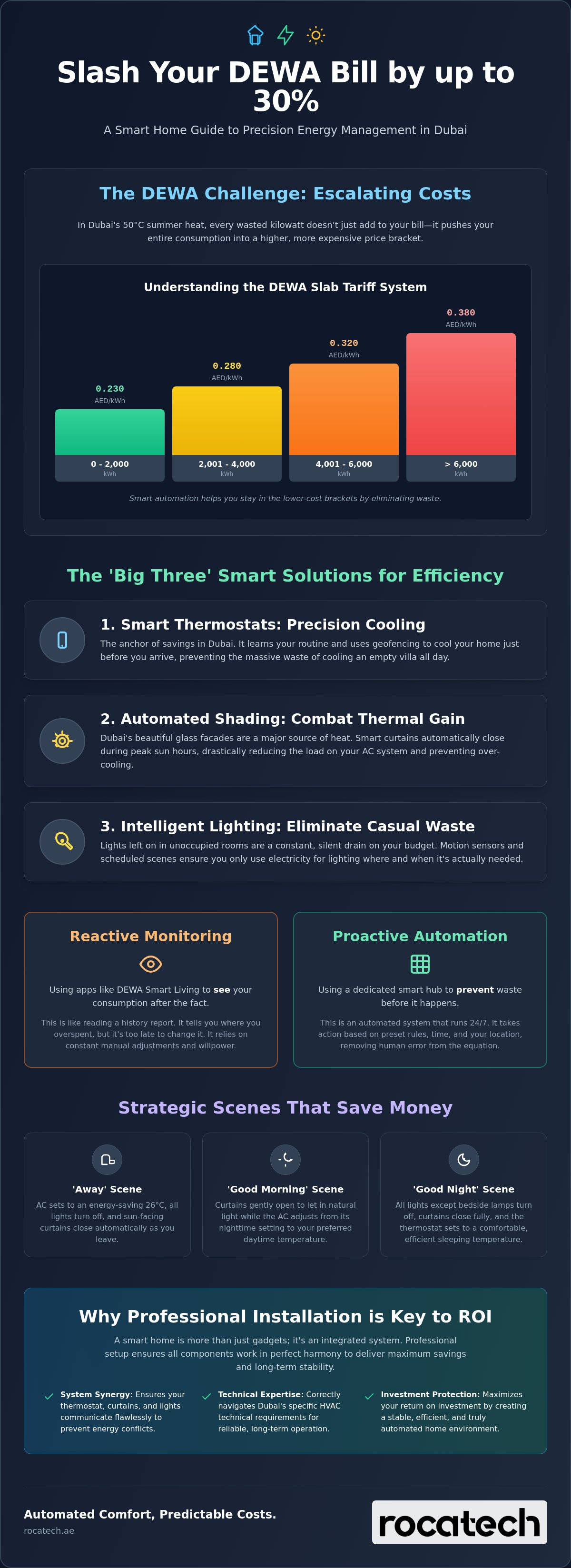
Dubai's climate demands constant, high-performance climate control. During the peak summer months, external temperatures frequently hit 50°C, forcing HVAC systems to operate at maximum capacity for extended periods. This environmental reality makes energy management a high-stakes operational priority for every resident. DEWA utilizes a slab tariff system where the cost per unit increases as your consumption grows. For residential accounts, rates begin at 0.230 AED/kWh for the first 2,000 units but escalate to 0.380 AED/kWh once you exceed 6,000 units. Every kilowatt wasted in an empty room doesn't just represent a minor cost; it's a catalyst that pushes your entire bill into a significantly higher price bracket.
Identifying invisible waste is the first step toward reclaiming your budget. Lights left on by staff and AC units cooling unoccupied guest rooms are the primary drivers of these financial spikes. Adopting a strategy to reduce electricity bill with smart home dubai technology is no longer a luxury; it's a necessary financial safeguard. A comprehensive home automation system provides the tracking and system integration needed to stabilize these costs by intercepting waste before it reflects on your monthly statement. By shifting from reactive manual adjustments to proactive automation, you ensure your home operates at peak efficiency regardless of external conditions.
Understanding the Impact of Thermal Gain
Dubai's architecture often features expansive glass facades and large windows. While these design choices are aesthetically pleasing, they allow significant solar heat to penetrate the interior. Thermal gain in Dubai's glass-heavy architecture refers to the accumulation of heat within a building caused by direct solar radiation and high ambient external temperatures. When curtains stay open during peak daylight hours, your AC must work twice as hard to maintain a comfortable set point. This over-cooling is a reactive and expensive habit that leads to premature equipment wear and inflated utility costs. Precision shading and automated cooling are the only reliable ways to combat this constant heat infiltration.
The Limitations of Manual Energy Management
The biggest driver of excessive DEWA costs isn't usually the equipment itself; it's human error. Forgetting to raise the AC temperature before leaving for work or leaving balcony doors slightly ajar creates massive energy leaks that your system must work to overcome. Traditional thermostats encourage a set and forget fallacy that fails to account for the shifting intensity of the Arabian sun throughout the day. Relying on manual adjustments is an unstable strategy for long-term savings. Choosing a professional smart home installation Dubai service provides a permanent, automated solution that removes the variable of human forgetfulness from your financial equation, ensuring that your home's energy profile remains optimized 24/7.
The 'Big Three' Smart Solutions for Energy Efficiency
Achieving a sustainable reduction in utility costs requires more than installing high-efficiency appliances. It involves creating a technical ecosystem where devices communicate to eliminate waste. A holistic system outperforms standalone gadgets because it addresses the house as a single operational unit. To effectively reduce electricity bill with smart home dubai setups, homeowners must prioritize the 'Big Three' pillars of automation: climate control, lighting, and shading. These systems work in synergy to ensure you only consume energy in the spaces you actually occupy. By aligning your home with official UAE government energy efficiency standards, you move beyond basic conservation into professional-grade energy management.
Smart Thermostats: The Anchor of Dubai Savings
In the UAE, the HVAC system is the primary driver of electricity consumption. A smart thermostat Dubai residents use can learn household patterns to optimize cooling cycles without manual intervention. Geofencing technology represents a significant advancement in this area. It allows your home to detect when you are 10 minutes away, adjusting the temperature from an energy-saving 'away' mode to your preferred comfort level just before you arrive. This prevents the costly practice of cooling an empty villa all day. Integration with your existing HVAC ensures consistent, low-energy maintenance of indoor temperatures rather than the high-draw surges associated with traditional manual thermostats.
Smart Lighting Control and Motion Sensors
Lighting waste is often 'invisible' but contributes heavily to the higher tiers of the DEWA slab tariff. Implementing smart lighting control allows for automated dimming schedules that reduce power draw during evening hours when full brightness is unnecessary. Motion sensors play a critical role here by preventing 'zombie lighting' in hallways, kitchens, and outdoor areas. When a room is empty, the system automatically terminates the power supply to the lights. This precision ensures that energy is never wasted on unoccupied square footage, providing a reliable ROI through immediate consumption reduction.
Smart Curtain Motors: The Secret to Passive Cooling
While often overlooked, automated shading is the most effective way to reduce the thermal load on your air conditioning. Smart curtain motors allow you to schedule your blinds to block the afternoon sun automatically, preventing the 'greenhouse effect' that forces AC units into overdrive. By maintaining lower ambient temperatures through passive means, you significantly reduce the operational strain on your cooling hardware. You can program curtains to open only when the sun moves to the opposite side of the building. Achieving this level of system harmony often requires a consultative approach to hardware selection. Consulting with a technical expert can ensure your devices work together rather than in isolation to reduce electricity bill with smart home dubai configurations.
DEWA Smart Living vs. Hardware-Level Automation
Understanding the distinction between consumption monitoring and active intervention is vital for any homeowner looking to reduce electricity bill with smart home dubai systems. The DEWA Smart Living program provides excellent visibility through its dashboard and consumption assessment tool. However, awareness alone doesn't lower a tariff slab; action does. While the DEWA app shows you how much you spent yesterday, hardware-level automation prevents overspending today. Real-time sensor data allows your home to react instantly to environmental changes, such as a sudden rise in temperature or a door left open. This is far more effective than reviewing a utility report 24 hours after the waste has occurred.
You can establish "If-This-Then-That" routines for energy emergencies to ensure your home remains in the lowest possible tariff bracket. For example, if the external temperature exceeds a specific threshold, the system can automatically lower the curtains and adjust the AC set point to maintain efficiency. This proactive approach ensures system harmony and operational stability. By automating these responses, you remove the need for constant manual monitoring and create a home that defends your budget by default.
Active Management with Smart Hubs
The smart hub gateway serves as the central intelligence of this ecosystem. It coordinates your AC and curtain motors to work as a unified unit. Local processing within the hub is superior to cloud-based systems because it operates without latency. This speed is critical for energy savings; if a motion sensor detects a room is empty, the hub terminates lighting and cooling immediately rather than waiting for a remote server to respond. This reduces your reliance on manual app checks and ensures your energy-saving scenes run reliably even if your internet connection fluctuates.
Smart Plugs: Taming 'Vampire' Power Draw
Vampire power draw is a significant contributor to baseline energy waste in Dubai households. Many appliances, such as home theaters, coffee machines, and gaming consoles, consume electricity even when they are technically turned off. Using smart plugs allows you to cut this power completely during late-night hours. Beyond simple scheduling, these devices monitor the health of specific appliances. If a smart plug detects a sudden spike in power draw from a refrigerator or wine cooler, it may indicate a failing, energy-hungry motor. Identifying these issues early allows for maintenance that prevents a significant surge in your next DEWA statement.
Strategic Scheduling: Scenes That Save Money
Strategic scheduling is the operational brain of a high-performance household. By grouping devices into 'Scenes,' you can execute complex energy-saving protocols with a single command or automated trigger. This approach is essential to reduce electricity bill with smart home dubai configurations, as it ensures all hardware components work in unison rather than fighting for individual set points. A well-designed 'Away' scene, for instance, terminates all non-essential lighting, closes smart curtains to block solar gain, and adjusts the AC to a maintenance temperature the moment you depart for work. This transition happens instantly, removing the risk of human forgetfulness and providing the emotional reassurance that your home's operating at peak efficiency in your absence.
The 'Sleep' scene offers similar financial benefits by gradually increasing the bedroom temperature during the early morning hours when ambient temperatures are lower. This aligns with natural body cooling cycles and avoids the heavy energy draw required to maintain a frigid environment against the rising sun. For residents traveling during the hotter months, a 'Summer Vacation' mode provides critical protection. It maintains a safe humidity level to prevent mold growth while keeping consumption at a minimum. This ensures you don't return to an inflated DEWA bill or a damaged interior, providing a stable environment for your property's long-term value.
The 'Peak Hours' Strategy
Shifting the heaviest energy loads to cooler periods is a proven method for maintaining system longevity and reducing overall demand. Pre-cooling your property before the mid-day heat peak allows the structure to absorb and retain cool air, significantly reducing the mechanical strain on your AC units during the most expensive hours of the day. Pre-cooling high-thermal-mass villas during early morning hours creates a thermal reservoir that maintains comfort while allowing the AC to cycle less frequently during peak solar radiation periods. This tactical use of your home's architecture, paired with automation, creates a predictable energy profile even in August.
Occupancy-Based Cooling for Large Villas
Large villas often suffer from significant energy waste in formal majlis areas or guest wings that remain empty for weeks at a time. Cooling these spaces 24/7 is an unnecessary expense that pushes many households into the highest DEWA slab tariffs. Integrating motion sensors with a multi-zone smart thermostat allows the system to maintain these areas at a higher baseline temperature, only activating full cooling when occupancy is detected. This granular control is a primary way to reduce electricity bill with smart home dubai systems in expansive residences. It ensures you aren't paying to cool square footage that isn't being utilized. To implement these strategic scenes for your property, schedule a consultation with our technical automation experts.
Why Professional Installation is Key to Energy ROI
Hardware acquisition is merely the foundational step in a comprehensive energy strategy. The true return on investment (ROI) is realized during the configuration phase. Poorly integrated devices often lead to operational conflicts, such as an air conditioner increasing its output because a smart curtain failed to close during a peak thermal gain period. These configuration errors can actually increase consumption rather than reduce it. To effectively reduce electricity bill with smart home dubai investments, the system must be calibrated to the specific electrical environment of the UAE. Precision in setup ensures that every sensor and actuator works toward the same financial objective.
Dubai's residential infrastructure presents unique technical challenges, particularly regarding HVAC wiring. Many properties utilize 220V systems, while certain smart thermostats are designed for 24V standards common in other regions. Attempting a DIY installation without understanding these specifications can lead to system failure or significant hardware damage. Rocatech Dubai prioritizes technical precision and lifecycle value, ensuring that every component is compatible with your home's specific voltage and wiring architecture. This methodical approach extends to regular firmware updates, which are essential for maintaining both the security and the efficiency of your automation ecosystem over the long term.
Custom Consultations for Maximum Savings
Every residence in Dubai has a distinct energy profile based on its orientation and construction materials. We conduct unique energy audits before installation to identify 'hot zones' where solar radiation is most intense. Mapping these zones allows for the precise placement of motion sensors and thermostats to maximize their impact on your DEWA statement. We also provide personalized automation training for family members and household staff. This ensures that everyone understands how to interact with the system, preventing manual overrides that could compromise your energy-saving goals or disrupt system harmony.
The Psychological Benefit: Peace of Mind
Technical reliability provides a significant psychological benefit that goes beyond financial savings. Knowing that your home is operating at peak efficiency creates a sense of stability and control. This reduces 'bill anxiety' as automated reports and alerts keep you informed of your consumption in real-time, preventing the shock of an unexpected summer surge. Our commitment to a long-term partnership means we support your energy goals over the entire lifecycle of your system. Choosing a professional partner allows you to reduce electricity bill with smart home dubai technology while enjoying the emotional reassurance of a perfectly synchronized, stable home environment.
Securing Your Financial Future Through Precision Automation
Transitioning to a smart home is a strategic investment in operational stability. By synchronizing your climate control, automated shading, and lighting, you eliminate the invisible energy waste that leads to high DEWA slab tariffs. While monitoring apps provide visibility, true savings come from hardware that acts autonomously to protect your budget. This guide has detailed how strategic scenes and professional configuration create a home that manages itself, ensuring you only pay for the energy you actually need.
Implementing these integrated strategies is the most reliable way to reduce electricity bill with smart home dubai systems. Rocatech offers expert integration for Dubai HVAC systems and precision-focused automation lifecycle support. Our technical expertise is already trusted by residents across Emaar and JVC developments to maintain system harmony and long-term value.
Book a Professional Energy Saving Consultation with Rocatech Dubai to stabilize your monthly utility costs today. You deserve a home that provides both comfort and financial peace of mind.
Frequently Asked Questions
How much can I realistically save on my DEWA bill with a smart home?
You can realistically slash your utility costs by up to 30% through precision automation and smart cooling strategies. This reduction is achieved by preventing your household consumption from escalating into the higher tiers of the DEWA slab tariff system. By maintaining usage in the lower brackets, you avoid the premium rates charged for high-volume consumption during the intense summer months.
Will a smart thermostat work with my existing AC unit in Dubai?
Most smart thermostats are compatible with Dubai's HVAC systems, but technical requirements differ between 24V and 220V standards. Professional configuration is essential to ensure your new hardware communicates correctly with your specific AC unit without causing electrical damage. A correctly integrated thermostat is the most effective way to reduce electricity bill with smart home dubai setups.
Is smart home installation expensive for a standard apartment?
Smart home installation is a strategic investment focused on long-term operational improvement rather than a simple one-time expense. For a standard apartment, the ROI is often realized quickly because the system targets the most inefficient habits, such as cooling empty rooms or leaving lights on. The cost of the hardware is balanced by the immediate and predictable reduction in monthly utility outlays.
Do I need a smart hub to save energy, or is the DEWA app enough?
The DEWA app is an excellent tool for monitoring consumption, but it cannot take physical action to stop waste. A smart hub is necessary to coordinate your devices and execute automated scenes, such as closing curtains when the sun hits a specific room. The hub acts as the central intelligence that transforms monitoring data into actual energy-saving actions.
Can automated curtains really lower my cooling costs?
Automated curtains are a critical component of passive cooling in the UAE. By blocking direct solar radiation during the hottest parts of the day, they significantly reduce the thermal load on your air conditioning system. This allows your AC to maintain a comfortable environment while operating at a lower, more efficient power level, preventing the mechanical strain of over-cooling.
What is the best smart device to start with for energy savings?
The smart thermostat is the most impactful device to start with because the HVAC system is the primary driver of energy consumption in Dubai. Following this, adding smart lighting controls and motion sensors provides a comprehensive foundation for energy management. These devices offer the most immediate and measurable impact on your overall household efficiency.
Do smart home devices consume a lot of electricity themselves?
Smart home devices use a negligible amount of electricity, typically measuring only a few watts for standby operation. The energy they consume is a tiny fraction of the power they save by automating larger, energy-hungry appliances like AC units and water heaters. Every component is designed for high-efficiency operation within a modern technical ecosystem.
How long does it take to see a return on investment (ROI)?
Most homeowners see a clear return on investment within the first year of operation, particularly during the peak summer seasons. The exact timeline depends on your previous consumption habits and the scale of your automation system. Beyond the financial ROI, these systems provide significant emotional reassurance by ensuring your home is always operating at peak efficiency.