

Commercial Smart Lighting Dubai: The 2026 Business Guide to Intelligent Efficiency
Your office lighting system is costing you more than electricity. For facility managers and business owners operating across Dubai's commercial districts, the real price of outdated lighting shows up in inflated DEWA bills, inconsistent illumination across large open-plan floors, and a maintenance cycle that never seems to end. Commercial smart lighting Dubai has quietly shifted from a premium aesthetic choice into a core operational requirement, and the businesses recognising this earliest are pulling measurably ahead.
You already know that rising energy costs are squeezing operational margins. That frustration is entirely valid, and it's shared across industries from retail and hospitality to corporate offices and logistics hubs throughout the emirate.
This guide is built to give you a clear, practical picture of how intelligent lighting control systems work in real commercial environments, what they actually deliver in terms of energy reduction and workspace quality, and how centralised control through smart hubs and gateways transforms a fragmented lighting setup into a seamless, automated environment. By the end, you'll have a solid framework for evaluating what an upgrade genuinely looks like for your specific facility.
Key Takeaways
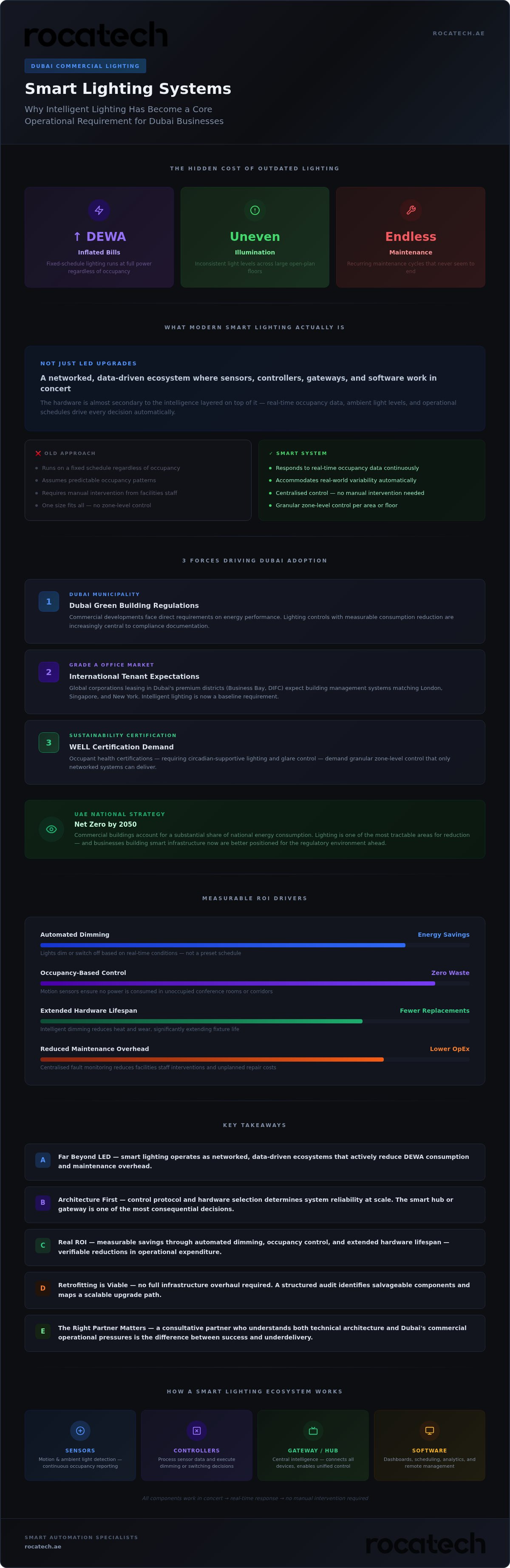
- Commercial smart lighting Dubai has evolved far beyond LED upgrades — modern systems operate as networked, data-driven ecosystems that actively reduce DEWA consumption and maintenance overhead.
- The control protocol and hardware architecture you choose directly determines system reliability at scale, making the selection of a robust smart hub or gateway one of the most consequential decisions in any commercial installation.
- Intelligent lighting delivers measurable ROI through automated dimming, occupancy-based control, and extended hardware lifespan — not just energy savings on paper, but verifiable reductions in operational expenditure.
- Retrofitting an existing facility does not require a full infrastructure overhaul; a structured audit can identify which components are salvageable and how to build a scalable system around them.
- A consultative partner who understands both the technical architecture and the operational pressures of Dubai's commercial environment is the critical difference between a system that performs and one that underdelivers.
The Evolution of Commercial Smart Lighting in Dubai's 2026 Business Landscape
Smart lighting is no longer a synonym for LED retrofits. That distinction matters enormously for facility managers who are evaluating where to direct capital expenditure in 2026. A modern commercial smart lighting system is a networked ecosystem: sensors, controllers, gateways, and software working in concert to respond to real-time occupancy data, ambient light levels, and operational schedules. The hardware is almost secondary to the intelligence layered on top of it.
Dubai's commercial sector has been moving in this direction for several years, but 2026 represents a genuine inflection point. A combination of regulatory pressure, tenant expectations, and maturing technology has compressed the timeline for adoption from "strategic consideration" to "operational necessity."
From Basic LED to IoT-Enabled Systems
An IoT-enabled luminaire is not simply a light source; it's a data collection point. Motion sensors embedded within or alongside fixtures continuously report occupancy patterns across a floor. That data feeds back through a central smart hub or gateway, which adjusts output in real time rather than running on a fixed schedule regardless of whether anyone is present. For multi-floor towers in Business Bay or DIFC, this centralized management architecture is the difference between a lighting system that reacts to the building and one that simply runs on a timer.
The practical shift is significant. Scheduled lighting assumes predictable occupancy. Real-world commercial environments don't behave that way. Conference rooms sit empty during scheduled peak hours; open-plan floors have pockets of activity that shift throughout the day. Responsive systems accommodate this variability automatically, without manual intervention from facilities staff.
Dubai-Specific Market Drivers
Three forces are accelerating commercial smart lighting Dubai adoption at a pace that outstrips most other regional markets:
- Dubai Green Building Regulations: The Dubai Municipality's green building standards place direct requirements on commercial developments regarding energy performance. Lighting controls that demonstrate measurable consumption reduction are increasingly central to compliance documentation.
- Grade A tenant expectations: International corporations leasing space in Dubai's premium office districts expect building management systems that align with what they operate in London, Singapore, or New York. Intelligent lighting control is part of that baseline expectation.
- WELL certification demand: Building certifications that prioritize occupant health, including circadian-supportive lighting and glare control, are gaining traction among developers and corporate tenants alike. These certifications require the kind of granular, zone-level control that only networked lighting systems can deliver.
The UAE's Net Zero by 2050 strategic initiative adds a longer-term dimension to this picture. Commercial buildings account for a substantial share of national energy consumption, and lighting represents one of the most tractable areas for reduction. Businesses that build intelligent infrastructure now are better positioned for the regulatory environment that's already taking shape, not just the one that currently exists.
For facility managers evaluating commercial smart lighting options across Dubai's commercial districts, the question in 2026 is no longer whether to upgrade. It's how to structure that upgrade so the system scales cleanly with the building's operational demands over the next decade.
Technical Architecture: Protocols and Hardware for Commercial Spaces
The performance gap between a smart lighting system that delivers and one that frustrates almost always traces back to architectural decisions made before a single fixture is installed. Protocol selection, hardware grade, and sensor placement aren't implementation details — they're the structural decisions that determine whether a system scales cleanly across a 20,000 square foot floor or becomes a maintenance liability within eighteen months.
Choosing the Right Protocol: DALI, Zigbee, or KNX?
Each major control protocol serves a distinct operational profile. Understanding the differences is essential for any serious evaluation of commercial smart lighting Dubai solutions.
- DALI (Digital Addressable Lighting Interface): The preferred protocol for large-scale precision control. DALI assigns an individual address to each luminaire, enabling independent dimming, grouping, and fault reporting at the fixture level. For multi-floor commercial towers, this granularity is operationally significant — facilities teams can identify a failing driver in a specific zone without physically inspecting the floor. DALI's wired architecture also delivers the signal reliability that wireless systems can struggle to maintain in dense, RF-congested environments like Business Bay or DIFC.
- Zigbee and Z-Wave: Mesh-based wireless protocols that excel in retrofit scenarios where running new control cabling isn't feasible. Zigbee's low power consumption and self-healing mesh topology make it a practical choice for flexible, phased rollouts. The trade-off is interference sensitivity in environments with high wireless device density, which requires careful channel planning during design.
- KNX: The gold standard for integrated building automation across the UAE's premium commercial sector. KNX operates as a unified backbone that connects lighting, HVAC, blinds, and access control into a single addressable network. For facilities pursuing LEED or WELL certification, KNX's interoperability with third-party building management systems is a decisive advantage. It's a higher upfront investment, but one that eliminates the integration friction that plagues multi-vendor environments over time.
The right choice depends on your building's existing infrastructure, the scope of integration required, and your operational horizon. A reliable smart hub gateway sits at the centre of all three architectures, translating protocol-specific signals into a unified management interface and ensuring that zone-level commands execute with the consistency that commercial operations demand.
The Role of Sensors in Commercial Efficiency
Sensors are where intelligent intent becomes measurable outcome. Three sensor types carry the most operational weight in commercial environments:
- Lux sensors for daylight harvesting: Dubai's solar intensity is an asset when the system is designed to use it. Lux sensors continuously measure ambient light levels at the workplane and instruct dimmers to reduce artificial output proportionally. In perimeter zones with significant glazing, this alone can substantially reduce daytime consumption without any change to occupant experience.
- PIR vs. ultrasonic occupancy detection: Passive infrared sensors are effective for open spaces with clear sightlines and active movement. For meeting rooms and enclosed offices where occupants may sit still for extended periods, ultrasonic sensors detect micro-movements that PIR misses, preventing the disruptive lights-off events that frustrate building users and generate helpdesk calls. Vacancy sensing — where occupants manually activate lights but the system handles switch-off — is generally preferred for private offices, while full occupancy sensing suits corridors and common areas.
- Integration with security infrastructure: Motion data from lighting sensors can be shared with home security camera systems and facility access platforms, creating a unified picture of building activity. This cross-system visibility is particularly valuable for after-hours monitoring, where lighting state changes serve as an additional layer of anomaly detection.
If you're evaluating how these architectural components map to your specific facility, speaking with a consultative integrator who understands both the protocol landscape and Dubai's commercial environment is the most efficient starting point — explore Rocatech's smart lighting control solutions to understand what a structured assessment looks like in practice.
Strategic Benefits: ROI and Operational Value for Dubai Businesses
The business case for intelligent lighting control isn't built on energy savings alone. That framing undersells what these systems actually deliver and, more importantly, it's the framing that competitors use when they don't have anything more substantive to offer. For facility managers operating commercial properties in Dubai, the real value compounds across four distinct dimensions: energy expenditure, hardware lifecycle, workforce performance, and operational intelligence.
Energy Savings and DEWA Optimization
Dubai's commercial electricity tariffs mean that lighting energy waste carries a direct, quantifiable cost. Automated dimming through daylight harvesting and occupancy-based control addresses this at the zone level, reducing output precisely where and when it isn't needed rather than applying blanket schedules across entire floors. The compounding effect is particularly significant in large open-plan environments where perimeter zones receive substantial natural light throughout the day but continue drawing full artificial output regardless.
One of the most overlooked contributors to inflated DEWA bills is what facilities professionals call "vampire consumption": lighting running at full draw in empty zones after business hours. A networked system with occupancy sensing eliminates this automatically. There's no reliance on staff to remember switch-off procedures, and the system logs every instance, giving facilities teams verifiable data rather than estimates when reviewing consumption reports.
For businesses pursuing LEED or Estidama certification, this logged performance data is operationally valuable beyond the energy saving itself. Both certification frameworks require documented evidence of lighting control performance, and a properly configured commercial smart lighting Dubai system generates that audit trail continuously without additional administrative overhead.
Human-Centric Lighting and Workforce Performance
Human-centric lighting adjusts colour temperature and intensity across the working day to align with occupants' natural circadian rhythms. Cooler, higher-intensity light during morning hours supports alertness; warmer tones in the afternoon reduce eye strain during sustained screen work. The practical outcome is a workspace that actively supports cognitive performance rather than simply illuminating it. For corporate tenants in Dubai's Grade A office districts, this is increasingly a baseline expectation rather than a premium feature.
Enhancing the Commercial Brand Image
Lighting communicates before a word is spoken. In retail showrooms, dynamic scene control allows operators to shift accent lighting to highlight specific product displays, create atmosphere for promotional events, or adjust the environment for different customer segments across the trading day. Dubai's luxury hospitality sector uses the same principle at a larger scale: programmable lighting scenes in lobbies, restaurants, and event spaces that shift from daytime operational settings to evening ambience without manual intervention.
For corporate offices, an intelligently controlled environment signals operational sophistication to visiting clients and prospective talent. It's a tangible expression of how a business manages its infrastructure, and in competitive commercial districts, that perception carries weight.
Beyond brand perception, the data that networked lighting systems generate has a practical operational application. Occupancy patterns captured at the zone level reveal which areas of a floor are consistently underutilised, informing decisions about desk allocation, meeting room provision, and lease footprint. That's a category of insight that most businesses currently pay consultants to estimate.
Retrofitting and Installation: A Roadmap for Dubai Facility Managers
Most commercial facilities in Dubai don't need a complete lighting overhaul. That's the first thing a competent integrator will tell you, and it's a meaningful distinction. The more precise question is: which components of your existing infrastructure are worth retaining, and how do you build a scalable intelligent system around them without dismantling what already works? Getting that answer right before a single product is ordered is what separates a clean retrofit from an expensive rework.
Step-by-Step Retrofitting Guide
Phase 1: Site survey and energy audit. A detailed audit maps every fixture type, control zone, wiring topology, and current consumption point across the facility. For older commercial buildings in areas like Deira or Bur Dubai, this phase often surfaces legacy fluorescent or metal halide installations that are drawing significantly more power than their output justifies. The audit also identifies which existing drivers and wiring runs are compatible with modern control protocols, directly informing the scope and cost of what follows.
Phase 2: Controller and gateway architecture selection. With audit data in hand, the appropriate control architecture becomes a technical decision rather than a sales conversation. A centrally managed smart hub gateway sits at the core of this architecture, providing the unified management layer that connects zones, sensors, and schedules into a single operational interface. The protocol choice, whether DALI for wired precision or Zigbee for wireless flexibility in retrofit scenarios, flows directly from the building's physical constraints identified in Phase 1.
Phase 3: Smart switch and sensor deployment. Implementation follows a zone-by-zone sequence that keeps operational disruption to a minimum. Motion sensors and lux sensors are positioned based on ceiling height, furniture layout, and natural light penetration. Smart switches replace legacy panels without requiring structural electrical work, maintaining the existing wiring infrastructure while adding full digital control capability.
Overcoming Common Dubai Installation Challenges
Dubai's commercial building stock presents three recurring challenges that generic installation guides don't address:
- Thick concrete construction in older districts: Buildings in Deira, Bur Dubai, and parts of Al Quoz frequently have dense concrete cores that attenuate wireless signals. The practical solution is a combination of mesh network topology and strategically placed signal repeaters, ensuring consistent coverage without resorting to full recabling.
- HVAC integration: A commercial smart lighting Dubai system that operates in isolation from climate control misses a significant efficiency opportunity. Occupancy data from lighting sensors can feed directly into HVAC zone management, reducing cooling load in unoccupied areas automatically. This integration requires a gateway architecture that supports cross-system communication, which is why protocol selection in Phase 2 carries long-term consequences.
- High-temperature hardware reliability: Ambient temperatures in Dubai's plant rooms and ceiling voids regularly exceed what equipment rated for temperate climates can sustain. Hardware specified for the region needs to be rated for sustained high-temperature operation, not just peak conditions.
Professional commissioning after installation isn't optional. It's where the system is calibrated to the building's actual occupancy patterns, sensor thresholds are tuned, and staff are trained to operate and override controls confidently. A system that's technically sound but poorly commissioned will underperform from day one, and the resulting frustration tends to get attributed to the technology rather than the setup.
The smart home installation Dubai process shares the same foundational principles at the commercial scale: structured phases, verified integration, and commissioning that accounts for how the space actually operates. If you're ready to move from audit to implementation, speak with Rocatech's installation team about what a structured assessment looks like for your facility.
Rocatech: Your Partner for Precision Smart Lighting in the UAE
Most providers in this space lead with a product catalogue. Rocatech leads with a problem statement. That distinction shapes everything that follows, from the initial site assessment through to commissioning and ongoing support. For facility managers who've experienced the frustration of a technically sound installation that never quite performs as promised, that difference in approach is the one that matters most.
Founded in 2021 with a deliberate focus on Dubai's specific automation environment, Rocatech has built its practice around the understanding that commercial smart lighting Dubai projects succeed or fail at the design stage, not the installation stage. The consultative process begins by mapping your operational reality: occupancy patterns, existing infrastructure constraints, integration requirements with HVAC and security systems, and the compliance documentation your building management team needs to maintain. Hardware recommendations follow from that analysis, not the other way around.
The service model covers the complete project lifecycle. Initial design, protocol and gateway architecture selection, professional installation, sensor calibration, and system commissioning are treated as a continuous process rather than discrete handoffs between separate teams. That continuity matters in high-stakes commercial environments where a poorly commissioned system creates operational disruption that reflects directly on the facilities function.
Tailored Solutions for Every Commercial Sector
Different commercial environments place different demands on a lighting control system, and Rocatech's approach reflects that directly:
- Corporate offices and co-working spaces: Occupancy-based zone control, human-centric lighting schedules, and integration with smart hub and gateway architecture for centralised floor management. The system adapts to how the space is actually used, not how it was planned to be used.
- Retail outlets and showrooms: Scene-based lighting control that allows operators to shift accent configurations across the trading day without manual intervention. In Dubai's competitive retail environment, the ability to programme distinct lighting atmospheres for different product displays or promotional periods is a practical operational tool, not a luxury feature.
- Hospitality and restaurant environments: Integrated systems that transition seamlessly between service periods, from bright operational settings during preparation to precisely calibrated ambience during service. Rocatech's motion sensor and smart lighting control solutions work in concert to maintain the right environment without requiring constant manual adjustment from front-of-house staff.
Start Your Transformation Today
An initial Rocatech consultation is a structured technical conversation, not a sales presentation. You'll leave with a clear picture of which components of your existing infrastructure are worth retaining, what a phased upgrade looks like in terms of scope and sequencing, and how the proposed architecture maps to your specific operational and compliance requirements.
That combination of local market knowledge and global technical standards is what positions Rocatech as the dependable ally for facility managers navigating commercial smart lighting decisions in 2026. International certification frameworks, Dubai Municipality requirements, and the practical realities of the emirate's commercial building stock are all part of the same conversation.
If your current lighting infrastructure is costing more than it should and delivering less than it could, the right starting point is a precise assessment of what's actually there. Explore how Rocatech approaches precision automation for Dubai's commercial sector and take the first step toward a workspace that performs as intelligently as the business running inside it.
The Intelligent Lighting Decision That Shapes Your Next Decade
Commercial smart lighting Dubai isn't a future consideration anymore. The regulatory environment, tenant expectations, and energy economics of 2026 have made it a present operational priority. The businesses that act on structured assessments now are building infrastructure that compounds in value, through lower DEWA consumption, reduced maintenance cycles, and workspace environments that actively support the people working inside them.
Three things determine whether an upgrade delivers on its promise: the right protocol architecture for your building's physical constraints, a gateway that unifies control across every zone, and a partner whose expertise covers the full lifecycle from audit through commissioning. Getting all three right is what separates a system that performs from one that frustrates.
Rocatech's Dubai-based team brings precisely that combination: deep integration expertise across smart ecosystems, hardware specified for operational durability in the region's conditions, and a consultative approach that starts with your building's reality rather than a product list.
Book a professional commercial lighting consultation with Rocatech and take the first step toward a facility that runs as intelligently as the business inside it.
Frequently Asked Questions About Commercial Smart Lighting in Dubai
How much can a smart lighting system save on a commercial DEWA bill?
Savings vary by building type, existing infrastructure, and how aggressively the system is configured, but the primary drivers are occupancy-based control and daylight harvesting in perimeter zones. Facilities with legacy fluorescent or metal halide installations running on fixed schedules typically see the most significant reductions, since those systems draw full power regardless of whether anyone is present. The logged consumption data a networked system generates lets you verify actual savings rather than relying on estimates.
It's worth speaking with an integrator who can model your specific facility against your current DEWA tariff tier, since commercial tariff structures are tiered and the financial impact of reducing peak-hour draw differs from reducing off-peak consumption. Rocatech's consultative assessment is designed to give you that facility-specific picture before any commitment is made.
Can I install smart lighting in an existing office without major rewiring?
Yes, in most cases. Wireless protocols like Zigbee use a self-healing mesh topology that works with your existing wiring infrastructure, making them well-suited to retrofit scenarios where running new control cabling isn't feasible. Smart switches replace legacy panels without structural electrical work, and sensors are positioned based on ceiling height and layout rather than requiring new conduit runs.
The honest caveat is that older buildings in areas like Deira or Bur Dubai sometimes have dense concrete construction that attenuates wireless signals, which requires careful channel planning and strategic repeater placement during design. A proper site survey identifies these constraints before installation begins, not during it.
What is the difference between a smart bulb and a commercial smart switch system?
A smart bulb replaces a single lamp and gives you control over that individual point of light, typically via an app or voice command. A commercial smart switch system operates at the circuit or zone level, integrating with sensors, gateways, and building management infrastructure to automate control across an entire floor or facility. The two operate at fundamentally different scales of complexity and reliability.
For any commercial environment, smart bulbs introduce a fragility that doesn't suit operational demands: if a bulb is replaced by maintenance staff with a standard lamp, that zone loses its intelligence entirely. A properly architected commercial smart lighting Dubai system maintains its control logic at the switch and gateway level, independent of the specific luminaire installed in each fitting.
Do smart lighting systems work with existing building management systems (BMS)?
They can, but compatibility depends on the protocols involved on both sides. KNX-based lighting architectures are specifically designed for BMS integration and are widely used in Dubai's Grade A commercial sector for exactly this reason. DALI systems can also interface with most modern BMS platforms through appropriate gateway hardware. The key is ensuring the lighting control architecture is selected with integration in mind from the design stage, not retrofitted as an afterthought.
Where lighting and BMS share occupancy data, the operational benefit extends beyond lighting itself. HVAC zones can respond to the same occupancy signals, reducing cooling load in unoccupied areas automatically. That cross-system efficiency is one of the more compelling arguments for choosing a gateway architecture that supports open protocol communication.
How long does it take to install smart lighting in a typical Dubai office?
For a mid-sized commercial floor of roughly 1,000 to 2,000 square metres, a structured installation typically runs across several days to a week, depending on the complexity of the zone configuration and the degree of BMS integration required. The installation phase itself is generally the shorter part; site survey, design, and post-installation commissioning collectively take more time and carry more consequence for the system's long-term performance.
Phased rollouts across multi-floor towers are common and practical. Starting with one or two floors allows the system to be calibrated against real occupancy patterns before the architecture is replicated across remaining floors, which reduces the risk of configuration errors compounding at scale.
What happens to the smart lighting if the office internet goes down?
A well-designed commercial smart lighting system doesn't rely on continuous internet connectivity for basic operation. Local processing through the smart hub or gateway maintains zone control, scheduling, and occupancy response independently of the internet connection. Cloud connectivity is used for remote management, software updates, and data reporting, not for the moment-to-moment control logic that keeps lights functioning correctly.
This distinction matters operationally. A system that requires live cloud access to function creates a single point of failure that's unacceptable in commercial environments. Specifying hardware with robust local processing capability is part of the architectural review that Rocatech conducts during the initial assessment phase.
Is smart lighting worth it for a small retail shop in Dubai?
It depends on the shop's trading hours, lease terms, and how actively the owner manages the space. For retail environments with long operating hours, the combination of occupancy sensing in stockrooms and back-of-house areas with scene-based accent control on the shop floor delivers both running cost reduction and a more controlled customer environment. The payback timeline is longer for smaller footprints, but the operational simplicity of automated control has value beyond the energy calculation.
The more relevant question for small retail operators is whether the system can scale if the business grows or relocates. A properly specified commercial smart lighting Dubai solution built on standard protocols can be expanded or reconfigured without starting from scratch, which makes the initial investment more defensible over a multi-year horizon.
Are there specific UAE regulations for commercial smart lighting safety?
Commercial lighting installations in Dubai are subject to Dubai Municipality building regulations and the UAE's electrical safety standards, which govern wiring, fixture ratings, and installation practices. Any commercial lighting system must be installed in compliance with these standards, and hardware specified for the region should carry appropriate safety certifications. Dubai's Green Building Regulations also place requirements on lighting control performance for new commercial developments and major fit-outs.
Regulatory requirements evolve, and the specific documentation needed for compliance depends on your building's classification and the scope of the works being carried out. Verifying current requirements with your municipality-registered electrical contractor and the relevant authority before specification is the responsible approach. A consultative integrator familiar with Dubai's commercial environment can help you understand which certifications and documentation your project will need.