

What is a Thermostat? The Ultimate Guide to Precision Cooling Control in Dubai

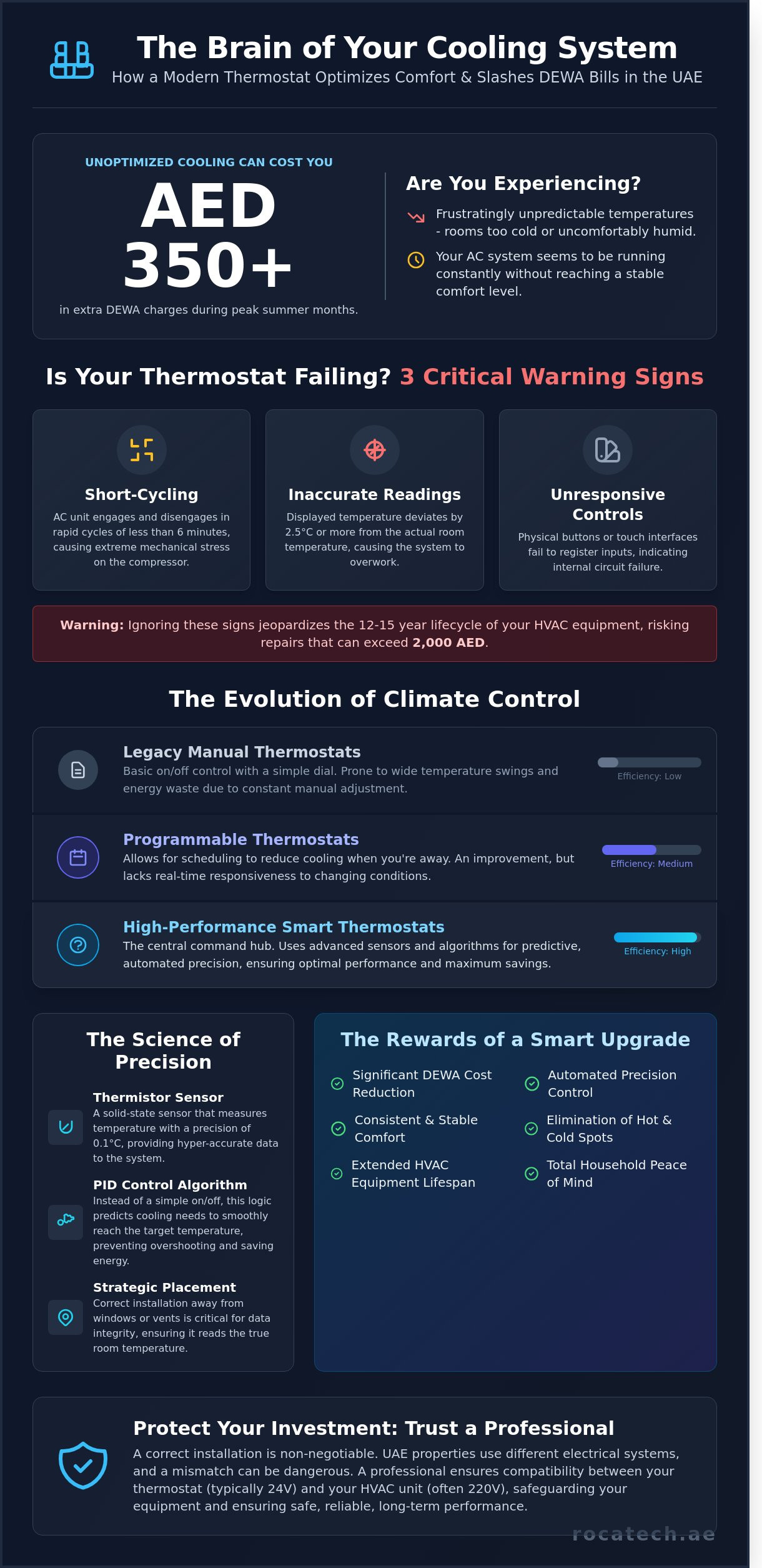
Did you know that an unoptimized cooling interface can inflate your DEWA bill by more than AED 350 during the peak summer months? This inefficiency often stems from a lack of technical precision in how we manage our indoor environments. You've likely experienced the frustration of unpredictable AC performance where rooms are either too cold or uncomfortably humid. It's a common challenge across the UAE, yet the solution lies in one critical component. Understanding the role of a high-performance thermostat is essential because it acts as the central intelligence of your cooling infrastructure, ensuring every watt of electricity is utilized effectively.
We recognize that you value stability and long-term performance over temporary fixes. This guide provides a comprehensive look at how modern control systems deliver consistent comfort while protecting your HVAC hardware from premature wear. You'll learn exactly how to transition from manual guesswork to automated precision, resulting in lower energy costs and total peace of mind for your household. We will explore the technical differences between smart and traditional controls to help you make an informed, value-driven investment for your property's future.
Key Takeaways
- Understand how a high-precision thermostat functions as the central command for your HVAC system, ensuring stable climate control during extreme Dubai summers.
- Learn the technical mechanics behind thermistor-based regulation and how modern setpoint logic ensures your cooling system responds accurately to thermal shifts.
- Compare the operational advantages of programmable and smart technologies over legacy manual units to optimize your property’s cooling schedule and performance.
- Discover strategic temperature settings designed to significantly reduce monthly DEWA utility costs while maintaining a robust and comfortable indoor environment.
- Identify the critical technical differences between 24V and 220V systems to ensure a safe, professional installation that protects your long-term HVAC investment.
Understanding the Thermostat: The Brain of Your UAE Cooling System
A thermostat functions as a sophisticated closed-loop control device rather than a simple manual toggle. In the high-demand environment of Dubai, where external temperatures often peak at 48°C during July and August, this device serves as the central command for your entire HVAC infrastructure. It's the primary regulator that maintains equilibrium between external heat gain and internal cooling capacity. Unlike a basic on/off switch, it utilizes constant feedback to adjust system behavior in real-time. This automated precision ensures your cooling system operates only when necessary, providing a level of reliability that translates directly into peace of mind for property managers and homeowners alike.
How a Thermostat Communicates with Your AC
The communication process relies on a robust relay system that transmits low-voltage signals to the AC compressor and fan. A critical feature within this logic is the temperature differential, often referred to as the "swing." This setting prevents the system from running 24/7 by allowing a controlled variance, typically 0.5°C to 1.0°C, before triggering a cooling cycle. For large Dubai villas exceeding 4,500 square feet, sensor accuracy is paramount. High-precision sensors eliminate cold spots and ensure the thermostat captures an authentic reading of the thermal load, preventing unnecessary energy expenditure.
Common Signs Your Current Thermostat is Failing
Performance degradation in your cooling control system often leads to increased operational costs and reduced equipment longevity. Identifying these symptoms early is essential for maintaining a stable indoor climate. Watch for these specific indicators of technical failure:
- Short-cycling: The cooling unit engages and disengages in rapid successions of less than 6 minutes. This behavior places extreme mechanical stress on the compressor.
- Inaccurate readings: The displayed temperature deviates by 2.5°C or more from the actual room environment. This causes the system to overwork and increases DEWA bills.
- Unresponsive controls: Physical buttons or touch interfaces fail to register inputs or the display fades. These signs indicate internal circuit failure.
Ignoring these warnings doesn't just affect your comfort; it jeopardizes the 12 to 15-year lifecycle of your HVAC equipment. Addressing a faulty controller early can prevent unexpected repair costs that often exceed 2,000 AED in the local market.
The Science of Temperature Regulation: How Modern Units Work
At the core of a high-performance thermostat is the thermistor. This solid-state component acts as a thermal resistor, changing its electrical resistance in direct response to ambient heat levels. When the air temperature in a Dubai residence or office shifts, the thermistor's resistance changes, allowing the onboard processor to translate this into a digital reading with a precision of 0.1 degrees Celsius.
Modern units don't just react; they calculate. The device uses the setpoint, the desired temperature you've programmed, to determine the exact cooling demand. High-end models integrate Proportional-Integral-Derivative (PID) control. This mathematical algorithm predicts how long it takes to cool a specific volume of air. Instead of a simple "on or off" switch that causes temperature swings, PID control adjusts the cooling cycle to reach the target smoothly. This prevents the system from overshooting the setpoint, a common issue in large villas that leads to unnecessary compressor wear and higher DEWA bills.
Placement is a critical factor for data integrity. A unit installed near a window or in the direct path of a kitchen vent will receive "false" data, triggering the AC even when the rest of the property is cool. Ensuring unobstructed airflow around the device is essential for maintaining the robust performance required in the UAE's 45 degree Celsius summer peaks.
The Role of Sensors in Modern Climate Control
Precision sensing has moved beyond the main hallway. Remote sensors now communicate with the central hub to eliminate "hot zones" in multi-story properties. These sensors prioritize the rooms currently in use, ensuring a balanced climate throughout the structure. In Dubai, humidity sensing is just as vital as heat detection. By utilizing "dry mode" to maintain indoor humidity between 45% and 55%, the system can achieve a high level of comfort at a higher temperature setpoint. Occupancy sensors further refine this by reducing cooling output in empty rooms, often cutting energy waste by 20% in commercial spaces.
The Impact of Calibration on System Efficiency
Calibration is the process of aligning the sensor's output with a known temperature standard. Over time, sensors can drift due to dust accumulation or component aging. A drift of just 1.5 degrees Celsius can increase cooling costs by 8% to 12% as the system works harder than necessary. Regular calibration ensures the precision of the system's marking and logic, providing the same level of traceability found in industrial automation. Thermal lag is the time delay between a change in air temperature and the sensor's physical response, which can impact how quickly your home feels comfortable after a heat spike. For those seeking long-term reliability and seamless integration of their climate hardware, professional calibration is the foundation of a hassle-free environment.
Comparing Thermostat Technologies: Manual vs. Programmable vs. Smart
Cooling management in the UAE has transitioned from reactive manual adjustments to proactive, data-driven automation. In a climate where summer temperatures frequently exceed 45°C, the specific thermostat technology you employ determines your facility's energy efficiency and equipment lifespan. This shift represents a move toward precision cooling that aligns with modern industrial and residential standards.
Manual and Programmable Options
Manual dials are becoming obsolete across Dubai's real estate landscape. These legacy devices rely entirely on physical input, which introduces a significant human error factor. Data indicates that manual overrides and forgotten settings contribute to a 15% increase in cooling waste. Users often leave the AC at a low setpoint while away, causing the system to cycle unnecessarily during peak heat hours.
Programmable units offer a structured alternative by allowing users to define schedules for work and sleep cycles. While more efficient than manual dials, they remain limited by their lack of connectivity. They're best suited for specific environments:
- Short-term rentals: Simple interfaces provide basic control without requiring complex app setups for guests.
- Budget-conscious retrofits: They offer a 10% energy saving over manual units at a lower entry cost.
- Staff accommodations: Fixed schedules ensure basic comfort while preventing extreme temperature settings that strain the compressor.
The Smart Thermostat Revolution
Smart devices represent the current pinnacle of IoT-enabled automation. These systems utilize Wi-Fi connectivity to offer remote management via mobile applications. This allows you to adjust your home's climate from the office or while traveling, ensuring the system only runs when necessary. It's a comprehensive solution for those seeking total control over their environment.
Machine learning is the core differentiator. A smart thermostat learns your specific Dubai lifestyle over a 14-day period. It identifies when the house is empty and automatically transitions to an eco-mode. Rocatech's integration solutions ensure these devices work in harmony with broader home automation systems. This creates a robust, stable environment where precision cooling is the standard. By adopting these proactive systems, residents can achieve a documented reduction in DEWA bills of 20% to 25% annually, providing long-term value and peace of mind.
Maximizing Efficiency: Reducing DEWA Costs in a Desert Climate
Precision is the foundation of energy conservation. In Dubai's extreme climate, where summer temperatures frequently exceed 45°C, cooling accounts for approximately 70% of a household's DEWA bill. A standard thermostat often lacks the sensitivity to manage these loads effectively, leading to frequent compressor cycling and energy waste. By switching to a high-precision digital interface, you ensure the system maintains a steady environment without overshooting the target temperature or causing unnecessary wear on the HVAC unit.
The UAE Energy Strategy 2050 aims to increase clean energy contributions and improve energy efficiency by 40%. Smart cooling is a critical component of this national mandate. Setting your AC to 24°C, as recommended by DEWA, provides an optimal balance between comfort and cost. Every degree lower significantly increases the workload on your system, driving up monthly expenditures and your carbon footprint simultaneously.
Strategies for Lowering Your Cooling Bill
- The 1-degree rule: Raising your temperature setting by just 1°C can result in a 5% reduction in cooling costs. For a typical villa with a monthly bill of AED 2,000, this simple adjustment saves AED 100 every month.
- Away Mode: Use smart scheduling to raise the temperature to 27°C during your workday, particularly during DEWA peak hours from 12 PM to 6 PM. Modern systems pre-cool your home 30 minutes before you arrive, ensuring comfort without wasting electricity while the house is empty.
- Multi-zone control: Large multi-story homes in areas like Emirates Hills benefit from independent zone management. You don't need to cool the guest wing or the first floor to 22°C when everyone is in the living room.
Humidity Control and Indoor Air Quality
Moisture management is as vital as temperature control in the UAE. High humidity makes 24°C feel like 28°C because it prevents natural cooling through evaporation. A smart thermostat monitors relative humidity levels, keeping them below 60% to prevent mold growth in closed apartments, especially during the humid months between July and September. Integrated systems also track filter health, sending alerts to your smartphone when air purification levels drop, ensuring the air you breathe remains clean and free of desert dust.
Implementing a Total Solution: Professional Installation in Dubai
Attempting a DIY installation of a smart thermostat in the UAE often results in costly HVAC repairs that far exceed the initial savings. Dubai properties frequently utilize 220V high-voltage systems for fan coil units; however, many popular smart devices are designed for 24V low-voltage standards common in North America. Connecting these incompatible systems without a specialized relay or professional transformer can lead to immediate circuit failure or long-term compressor damage. Rocatech moves beyond simple hardware sales by acting as a consultative partner. We focus on industrial-grade precision to ensure your cooling infrastructure remains stable even when outdoor temperatures exceed 50 degrees Celsius.
Our approach prioritizes long-term value over quick transactions. We've seen that 15% of self-installed units in local villas fail within the first year due to improper wiring or poor signal strength in thick concrete walls. By choosing a professional integration, you protect your equipment warranty and ensure the device operates within the manufacturer's specified electrical parameters. This technical accuracy is what separates a gimmick from a reliable home utility.
The Importance of Professional Integration
Our engineers specialize in integrating advanced controls with major HVAC brands like Daikin and Carrier. We don't just mount a device; we configure the software to match your specific lifestyle patterns and the unique thermal profile of your Dubai residence. This professional setup eliminates the technical friction often associated with smart tech. You gain peace of mind knowing the system is optimized for maximum efficiency from the moment it's powered on. Expert configuration ensures that your thermostat communicates perfectly with your building's chiller system or package unit.
Next Steps for Your Home Automation Journey
A single smart device is just the beginning of a robust home ecosystem. We recommend starting with a comprehensive home energy audit to identify thermal leaks before upgrading your hardware. Combining your climate control with smart curtains can improve heat rejection by up to 25% during peak summer months. This holistic approach transforms your living space into a high-performance environment. You can book a personalized consultation with Rocatech today to start your transition toward a more efficient, automated home that delivers measurable savings in AED every month.
Optimize Your Dubai Cooling Strategy
Achieving precise environmental control in the UAE requires more than just a functional AC unit. It demands a high-performance thermostat that serves as the intelligent core of your cooling infrastructure. Industry data shows that upgrading to advanced regulation systems can reduce DEWA cooling costs by up to 25% annually. These modern units provide the granular data and automation necessary to maintain a stable indoor climate even when outdoor temperatures exceed 45 degrees Celsius. Rocatech bridges the gap between complex HVAC technology and seamless user operation through comprehensive industrial integration. We're specialists in Dubai HVAC systems, offering 100% professional installation for total peace of mind. As an authorized partner for leading smart home brands, we ensure your climate control system delivers long-term value and operational stability. It's time to transition from basic cooling to a tailored, high-efficiency solution that protects your investment and your comfort.
Secure your home's comfort with Rocatech's expert thermostat solutions
Take the first step toward a more efficient and reliable home environment today.
Frequently Asked Questions
Can any thermostat work with my AC unit in Dubai?
Not every device is compatible with the specific HVAC configurations found in the United Arab Emirates. Many Dubai properties utilize 220-240V fan coil units or district cooling interfaces, whereas several international models are designed for 24V systems. You must verify your system's voltage and wiring type to ensure the thermostat integrates safely without risking a short circuit in your control board.
How much can I actually save on my DEWA bill with a smart thermostat?
You can expect to reduce your cooling costs by 12% to 15% annually through precise scheduling and occupancy sensing. For a standard three-bedroom villa with a peak summer DEWA bill of AED 2,800, this represents a monthly saving of approximately AED 420. These savings stem from the device’s ability to eliminate cooling waste during the hours you're at work or away from the home.
Is it difficult to switch from an old manual thermostat to a smart one?
The transition is a technical process that typically requires 40 minutes to complete for a standard installation. Most modern kits provide labeled backplates and push-terminals that simplify the wiring phase. If your home uses a complex multi-stage cooling system, hiring a professional ensures the commissioning process meets local electrical standards and provides long-term operational reliability.
Does a smart thermostat require a constant Wi-Fi connection to work?
A smart thermostat will continue to regulate your home's temperature based on its last programmed schedule even if your internet connection fails. It doesn't need a live signal to trigger the AC compressor or fan. You'll only lose the ability to make remote adjustments via your smartphone or receive real-time energy reports until the Wi-Fi signal is restored.
What is the best temperature to set my thermostat at in Dubai during summer?
The Dubai Electricity and Water Authority recommends a set point of 24°C for the ideal balance of comfort and energy optimization. Research shows that every degree you increase the temperature above this point can lower your AC's power consumption by up to 6%. Maintaining 24°C ensures a robust cooling performance while preventing your system from running continuously during 48°C outdoor peaks.
Why is my thermostat reading a different temperature than my thermometer?
Discrepancies usually occur because of the unit's placement near heat-generating appliances or direct sunlight. A variance of 1.5 to 3 degrees is common if the sensor is located on an uninsulated external wall. You can fix this by calibrating the device settings or using external room sensors to provide a more accurate average of the living space's climate.
Can I control my Dubai home's temperature while I am travelling abroad?
You can manage your home's climate from any global location as long as your mobile device has an active data connection. This is a vital feature for residents who travel during the summer break. It allows you to set the AC to a "vacation mode" of 28°C to prevent humidity buildup and mold growth while ensuring you don't return to an overheated apartment.
What is a C-wire and do I need one for a smart thermostat installation?
A C-wire, or common wire, delivers a continuous flow of 24V power to keep your device's LED screen and Wi-Fi radio powered 24/7. Approximately 85% of modern smart controllers require this dedicated power line to function correctly. If your current wall jack lacks this wire, you'll need to install a power-add-a-wire kit or choose a model specifically designed for power-stealing applications.