

The Ultimate Guide to Motion Sensors for Dubai Smart Homes in 2026

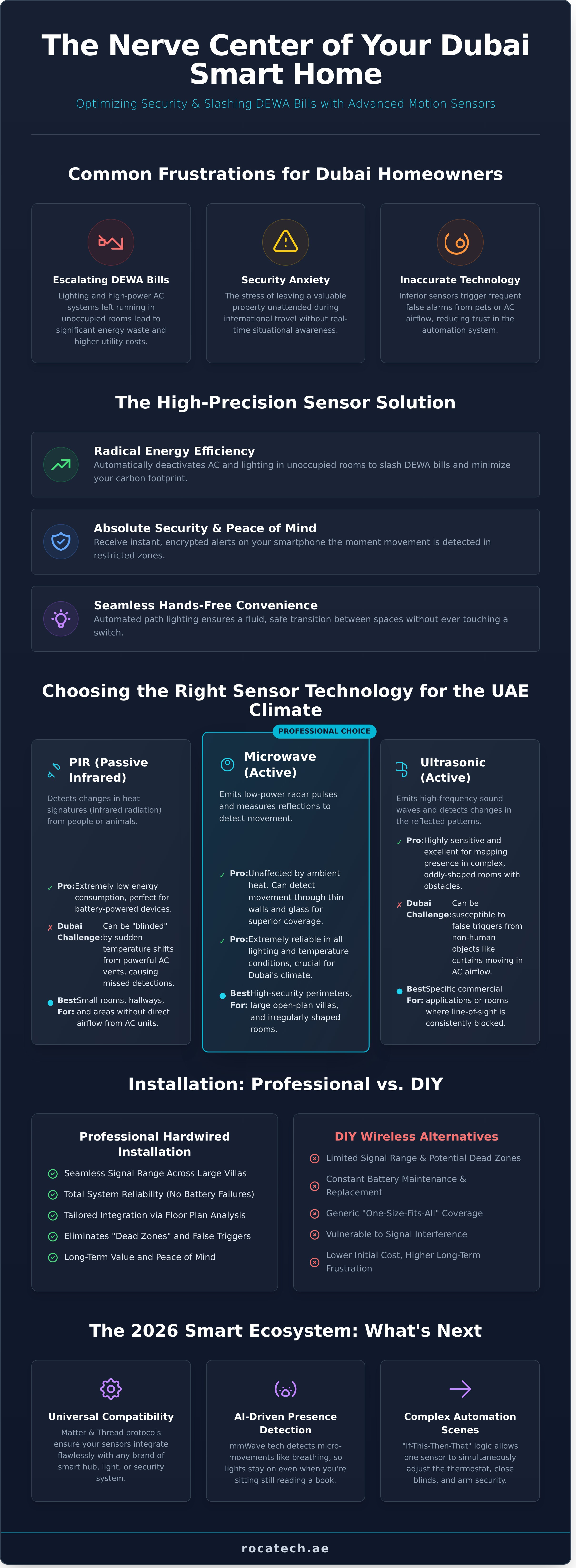
Managing a modern residence in Dubai requires a delicate balance between luxury and operational efficiency. Many homeowners face the frustration of escalating DEWA bills caused by lighting and air conditioning systems left running in unoccupied rooms, coupled with the anxiety of leaving their property unattended during international travel. Integrating a high-precision motion sensor network is no longer just a convenience; it is a strategic necessity for energy optimization and robust security. By eliminating the inaccuracies of inferior technology that trigger frequent false alarms, you can achieve a truly seamless, hands-free living environment tailored to the unique climate of the UAE.
This comprehensive guide provides a professional roadmap for navigating the smart home landscape in 2026. You will discover how to select industrial-grade sensors that offer total reliability, identify optimal placement strategies for maximum coverage, and integrate these components into a unified ecosystem. Our objective is to help you slash energy costs in AED and secure your home with absolute confidence. Whether you are seeking to automate your indoor lighting or fortify your perimeter, this guide ensures your transition to a smarter home is grounded in technical excellence and long-term value.
Key Takeaways
- Understand why the motion sensor acts as the essential nervous system of a Dubai smart home, enabling automated lighting and cooling responses.
- Distinguish between PIR, Microwave, and Ultrasonic technologies to ensure your system remains robust against false triggers from pets or AC airflow.
- Discover strategic placement techniques to eliminate "dead zones" and maximize DEWA savings through precision-targeted climate and lighting control.
- Evaluate the technical advantages of professional hardwired installations over DIY alternatives for maintaining seamless signal range across large villas.
- Learn how a consultative approach to floor plan analysis provides a tailored integration that ensures long-term reliability and total peace of mind.
What is a Motion Sensor and Why is it Essential for Dubai Homes?
At its core, a motion sensor is a precision electronic device designed to detect physical movement within a specific radius and trigger a pre-defined automated response. In the context of a sophisticated Dubai residence, these devices act as the "nervous system" of the smart home. They provide the critical data points required for a central hub to execute commands-whether that involves illuminating a hallway or activating high-definition surveillance systems. By providing real-time environmental feedback, these sensors transform a static living space into a responsive, intelligent environment.
The UAE market presents a unique intersection of requirements where high-end security meets the urgent need for energy conservation. With external temperatures frequently exceeding 40°C, the integration of a robust motion sensor system is no longer a luxury but a functional necessity for optimizing HVAC performance. We have observed a significant industry transition from simple Passive Infrared (PIR) switches to intelligent occupancy detection systems. These advanced solutions offer the precision required to distinguish between a person remaining stationary in a room and a truly unoccupied space, ensuring total operational efficiency.
The Core Benefits of Motion Detection
- Enhanced Security: Instant, encrypted alerts are delivered to your smartphone the moment movement is detected in restricted zones, providing immediate situational awareness and peace of mind.
- Energy Efficiency: By automatically deactivating air conditioning and lighting in unoccupied rooms, homeowners can significantly reduce their carbon footprint and lower monthly utility costs in AED.
- Hands-Free Convenience: Navigate your home during late hours without the need for manual switches. Sensors ensure a fluid, safe transition between spaces through automated path lighting.
Motion Sensors in the 2026 Smart Ecosystem
As we move toward 2026, the smart ecosystem is prioritizing universal compatibility through the adoption of Matter and Thread protocols. This ensures that your motion sensor integrates flawlessly with a diverse range of smart hubs and third-party hardware. Modern integration allows for complex "If-This-Then-That" (IFTTT) scenarios, where a sensor can simultaneously adjust the thermostat, close motorized blinds, and arm the security perimeter.
Furthermore, the industry is shifting from basic movement triggers toward AI-driven presence detection. Unlike traditional sensors that may fail if a person is sitting still, AI-enhanced units utilize millimeter-wave (mmWave) technology to detect micro-movements such as breathing. This level of technical precision ensures that your home automation remains reliable and responsive, regardless of the occupant's activity level.
Understanding Motion Sensor Technologies: PIR vs. Microwave vs. Ultrasonic
Selecting the appropriate motion sensor technology is a critical decision that directly impacts the long-term reliability and efficiency of an automated environment. In the United Arab Emirates, where high-performance AC systems create constant airflow and external temperatures fluctuate significantly, an incorrect choice often leads to frequent false triggers or system fatigue. Precision in detection ensures that your automation remains a seamless asset rather than a source of technical frustration.
PIR (Passive Infrared) Sensors
PIR sensors detect movement by monitoring changes in infrared radiation-essentially heat signatures-within their field of view. These units are highly efficient and are the preferred choice for battery-powered applications due to their low energy consumption. They are best suited for small rooms and hallways; however, they can be "blinded" by sudden temperature shifts from AC vents, a common architectural challenge in Dubai interiors where climate control is constant.
Microwave and Ultrasonic Sensors
Unlike passive systems, Microwave and Ultrasonic technologies are active. Microwave sensors emit radar pulses that can detect movement through glass and thin walls, while Ultrasonic sensors utilize high-frequency sound waves to map presence in irregularly shaped rooms. These technologies are frequently specified for high-security villa perimeters in Dubai because they remain effective regardless of ambient heat levels. As noted in recent research on Understanding Motion Sensor Technologies, active sensing provides the high-fidelity detection required for complex architectural layouts where line-of-sight is obstructed.
Dual-Technology Sensors
For mission-critical security and industrial-grade integration, Dual-Technology sensors are the professional choice. By combining PIR and Microwave technologies, these sensors require both a heat signature change and physical movement to trigger an alert, virtually eliminating false alarms from pets or environmental shifts. Dual-Technology sensors represent the gold standard for high-stakes reliability in sophisticated automation systems.
- Durability: Sensors for outdoor placement must feature IP-rated housing to withstand 50°C+ temperatures and fine desert dust.
- Cost-to-Performance: While a standard PIR motion sensor may start at AED 75, industrial-grade Dual-Tech units range from AED 400 to AED 900.
- Optimization: Investing in higher-tier sensors reduces long-term maintenance costs and provides the peace of mind that comes with a robust, hassle-free system.
Strategic Placement: Maximizing Security and DEWA Savings
Precision in placement is the difference between a high-performing automated environment and a frustrating one. A common pitfall in home automation is the "Dead Zone"-a blind spot created when a motion sensor is obstructed by architectural features or furniture. For a robust security installation, UAE homeowners should implement a "Ring of Protection." This strategy involves a layered approach, starting with weather-resistant sensors at the villa gate and progressing through entry points to the master bedroom, ensuring comprehensive coverage without gaps.
To maintain the visual integrity of high-end interiors, Rocatech recommends discreet mounting options. Recessed ceiling sensors or corner-mounted units finished to match specific RAL paint colors allow the technology to remain invisible while maintaining peak performance. Understanding the technical nuances of how motion sensors work-specifically the reliance on line-of-sight infrared signatures-is vital for avoiding these placement errors.
The AC-Motion Link: Slashing Energy Bills
In the United Arab Emirates, air conditioning accounts for the vast majority of DEWA consumption. Integrating a motion sensor with your smart thermostat offers a significant ROI. By configuring "Away" modes that trigger when a room remains unoccupied for 30 minutes, homeowners can achieve zonal cooling-only cooling the spaces currently in use. In a standard five-bedroom villa, this level of optimization can save hundreds of AED during the peak Dubai summer, allowing the hardware to pay for itself within a single season.
Placement Rules for Common Rooms
To ensure long-term reliability and minimize false triggers, specific environmental factors must be considered for each room:
- Bathrooms: High humidity can degrade standard electronics. We specify humidity-resistant sensors with appropriate IP ratings to ensure consistent performance during steam-heavy showers.
- Kitchens: To prevent false alarms, sensors must be positioned away from heat-producing appliances like ovens or air fryers, which can mimic human heat signatures.
- Hallways: For late-night safety, ceiling-mounted sensors with 360-degree lenses are preferred. This ensures that movement is detected the moment a door opens, providing a seamless transition of light.
By treating sensor placement as a technical discipline rather than an afterthought, you ensure a system that is both efficient and unobtrusive, providing the peace of mind that defines a truly smart home.
Professional Installation vs. DIY: Making the Right Choice
Choosing between a DIY setup and a professionally integrated system is a decision that impacts the long-term reliability of your smart home. While the initial appeal of budget-friendly hardware might suggest a bargain, the total cost of ownership often tells a different story. A standalone motion sensor purchased for 50 د.إ might seem economical, but when factoring in frequent battery replacements, signal dropouts, and the lack of technical support, the value proposition diminishes. In contrast, professional-grade hardware is designed for industrial-level durability and seamless integration into the home's infrastructure.
The hidden complexity of wireless protocols like ZigBee and Z-Wave becomes apparent in large UAE villas. Thick masonry and reinforced concrete walls can significantly degrade signal range, leading to "dead zones" where sensors fail to trigger. Professional installers overcome this by designing robust mesh networks and utilizing hardwired sensors where possible, eliminating the maintenance cycle of battery swaps and ensuring the system remains responsive year-round.
Furthermore, a standalone sensor is only roughly 10% as effective as one integrated into a holistic ecosystem. When a motion sensor is professionally networked, it doesn't just turn on a light; it communicates with the HVAC system to optimize cooling and alerts the security perimeter of unauthorized movement, providing a comprehensive "peace of mind" solution.
When to Go DIY
DIY solutions are best suited for small apartments with one or two rooms where signal interference is minimal. They are also the ideal choice for renters who cannot make permanent electrical modifications to the property. If your requirement is limited to a basic use case-such as a single light trigger for a walk-in closet or a pantry-a simple plug-and-play sensor provides a practical and cost-effective entry point into automation. For a curated selection of such devices, you can check out TipTop360.
The Case for Professional Integration
For multi-story villas in neighborhoods like Emirates Hills or Palm Jumeirah, professional integration is a necessity for system stability. Expert technicians ensure that your sensors work in harmony with security cameras and smart door locks, creating a unified defense and convenience layer. Advanced calibration is also performed to prevent false triggers caused by pets or robot vacuums, which are common nuances in high-end households. Professional calibration ensures 99.9% uptime for security systems.
At Rocatech, we focus on delivering tailored automation that moves beyond simple gadgets toward a sophisticated, industrial-grade experience that prioritizes precision and long-term value.
Rocatech’s Integrated Motion Solutions: Peace of Mind as a Service
At Rocatech, we view home automation as a technical discipline rather than a retail transaction. Our consultative approach prioritizes the long-term stability of your system, beginning with a detailed analysis of your floor plan before any hardware is specified. By understanding the architectural nuances of your property, we ensure that every motion sensor is positioned for optimal detection and seamless integration with existing smart lighting and HVAC systems.
Operating within the unique UAE environment requires specialized local expertise. Our solutions are rigorously tested to withstand the regional climate-where heat and humidity can interfere with sensitive electronics-and adhere strictly to UAE electrical standards. This methodical focus on precision ensures that your automation ecosystem remains robust, whether you are managing a private villa in Dubai or a high-traffic commercial space.
The Rocatech Professional Setup
Our implementation process is designed to eliminate the variables that lead to system failure. We conduct a comprehensive initial audit that evaluates energy consumption patterns and security vulnerabilities. By utilizing industrial-grade hardware, we provide a level of reliability that consumer-grade products cannot match. Our engineers focus on:
- System Audit: Identifying areas where automation can significantly reduce utility overheads in AED.
- Precision Hardware: Deploying robust sensors designed for high-stakes environments to ensure zero false triggers.
- Scene Optimization: Programming tailored automation sequences, such as "Away Modes" that secure the perimeter while optimizing AC usage.
Starting Your Automation Journey
The transition to a fully automated home often begins with a targeted motion sensor audit. This initial step frequently serves as the catalyst for a total home transformation, revealing the immense potential for energy efficiency and enhanced security. Beyond the technical specifications, the primary value we offer is the psychological benefit of a "hassle-free" environment.
A professionally managed system provides the ultimate peace of mind, allowing you to focus on your priorities while Rocatech manages the technical complexities of your smart infrastructure. To explore how our tailored solutions can enhance your property’s value and efficiency, Book a Professional Consultation with Rocatech today. Our commitment to ongoing support ensures your system remains optimized for peak performance throughout its entire lifecycle.
Securing Efficiency and Peace of Mind for Your Dubai Villa
As we navigate the technological advancements of 2026, the integration of a high-performance motion sensor system has evolved from a luxury to a fundamental component of the modern Dubai residence. By understanding the technical nuances between PIR and microwave technologies, villa owners can optimize their environments for both uncompromising security and significant DEWA utility savings. Strategic placement and professional calibration remain the primary drivers of long-term system reliability and operational excellence.
At Rocatech, we transition you from simple automation to a sophisticated, total-solution ecosystem. Our commitment to excellence is supported by robust industrial-grade hardware and expert installation performed by certified UAE technicians. We provide more than just equipment; we deliver tailored, custom energy-saving reports designed specifically for the unique demands of the local market, ensuring your investment yields measurable value and total peace of mind.
Take the first step toward a more efficient and secure future by partnering with experts who prioritize your home’s stability and precision. Book your free smart home consultation in Dubai today and experience the confidence that comes with world-class industrial integration. We look forward to helping you optimize your living space for the years ahead.
Frequently Asked Questions
Which motion sensor is best for outdoor use in the Dubai heat?
For the extreme UAE climate, we recommend sensors with an IP65 or higher ingress protection rating and a high-temperature tolerance of at least 60°C. Industrial-grade models from brands like Steinel or Philips Hue are engineered with UV-resistant housings that prevent material degradation. These robust units ensure reliable performance despite the intense summer heat and high humidity levels common in Dubai.
Can motion sensors distinguish between humans and pets?
Yes, advanced sensors utilize "pet immunity" technology to differentiate between human movement and domestic animals. These devices typically use dual-technology PIR sensors that ignore heat signatures from objects weighing less than 25kg. By fine-tuning the sensitivity levels and optimizing the installation height, homeowners can ensure their pets roam freely without triggering false alarms or unnecessary lighting sequences.
Do motion sensors work in total darkness?
A motion sensor utilizing Passive Infrared (PIR) technology functions perfectly in total darkness because it does not rely on visible light. Instead, it detects fluctuations in infrared radiation-essentially heat signatures-within its field of view. This makes it an exceptionally reliable tool for both night-time security monitoring and automated path lighting in windowless areas of your home.
How much can I actually save on my DEWA bill with motion sensors?
Integrating sensors into your lighting and HVAC systems can reduce energy consumption by approximately 20% to 30%. For a typical villa, this can lead to monthly savings ranging from AED 75 to AED 200 on your DEWA bill. Over time, the reduction in wasted electricity from unoccupied rooms ensures the system pays for itself while contributing to the UAE's broader sustainability initiatives.
Is it better to have battery-powered or hardwired motion sensors?
Hardwired sensors are the superior choice for long-term reliability and "hassle-free" operation, as they eliminate the need for battery replacements and offer a more stable connection. However, battery-powered units provide a flexible, non-invasive solution for retrofitting existing villas where running new cables is not feasible. For high-stakes security, hardwired integration is always the professional recommendation for maximum uptime.
Will a motion sensor trigger my security alarm if I'm at home?
A correctly configured motion sensor will not trigger your alarm if the system is set to "Stay" or "Home" mode. In these configurations, the central hub is programmed to bypass internal sensors while keeping perimeter door and window contacts active. This allows you to move throughout your residence freely while maintaining a robust security posture against external threats.
How many motion sensors do I need for a standard 3-bedroom villa?
For comprehensive coverage in a standard 3-bedroom villa, we recommend installing between eight and ten sensors. This includes placement in the main entrance, living room, kitchen, and hallways, plus individual sensors for each bedroom and the staircase. This density ensures that your automation system can accurately track occupancy and optimize energy usage across both floors of the property.
Can motion sensors be integrated with Apple HomeKit or Google Home in the UAE?
Yes, most premium smart sensors sold in the UAE are compatible with Apple HomeKit, Google Home, and Amazon Alexa. When purchasing, ensure the devices support universal protocols like Zigbee, Z-Wave, or Matter. This ensures seamless integration with your preferred ecosystem, allowing you to create automated "scenes" that link your sensors with other smart devices for a truly unified home experience.